A fan that hums or starts slowly can have a run-capacitor fault, but the sound alone cannot identify the failed part. A binding wheel, a supply problem, a motor winding fault, or a control issue may produce a similar complaint. The useful first decision is whether the exact motor is a capacitor-run design and which evidence a qualified technician needs before replacing anything.
This guide explains the decision process and the label information to collect. Electrical isolation, stored-energy control, testing, wiring, and replacement belong to a qualified person following the equipment instructions and site rules. The video walks through the same distinction.
Start with the motor, not the symptom
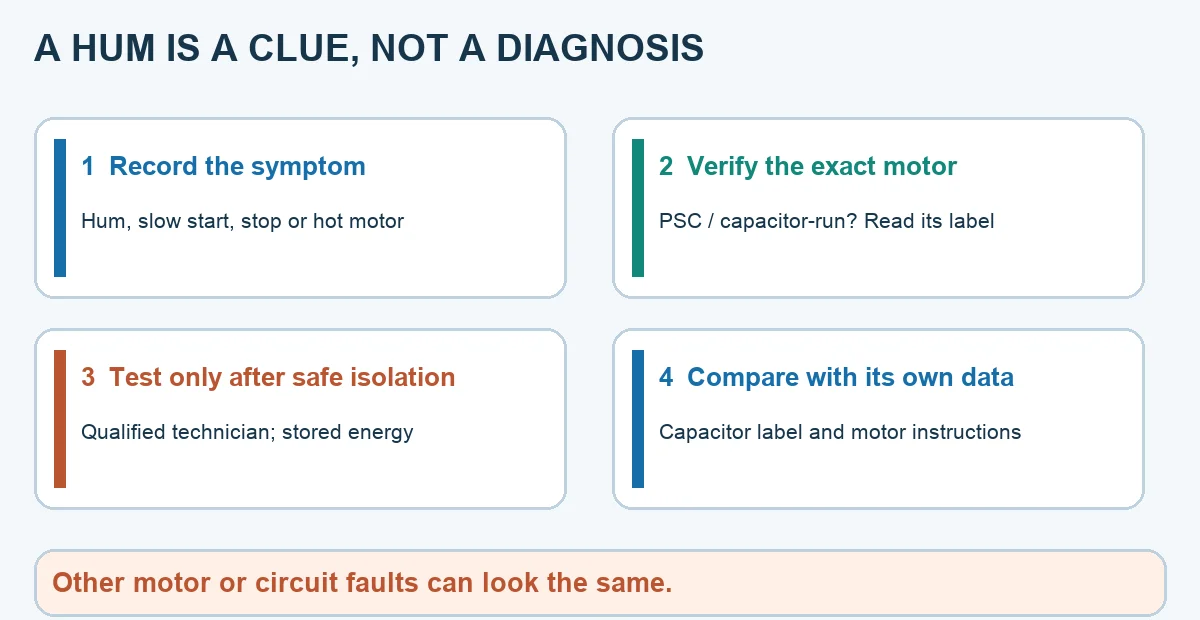
A permanent-split-capacitor motor uses a run capacitor with its auxiliary winding during operation. Other fan motors use different electrical designs. A replacement decision therefore starts with the motor label, the equipment wiring diagram, and the manufacturer’s service information. An old capacitor can be useful identity evidence, but an earlier repair may have installed the wrong component. A humming fan is a reason to investigate, not proof that the capacitor is weak. For the wider symptom pattern, see our guide to an AC fan that keeps stopping.
Record what happens without opening an energized compartment: Does the wheel turn freely when the equipment is safely out of service? Is the complaint a slow start, a stop during operation, a control fault, or an unusual mechanical noise? Give that history and a clear photo of the motor label to the service technician. Avoid trying to start a fan by pushing its wheel through a grille; the motion can be hazardous and the result is not a definitive electrical test.
Control electrical and stored energy before a test
Switching a thermostat off does not establish that an electrical compartment is safe. The applicable isolation and lockout procedure, verification of de-energization, and control of stored energy must be completed by a person trained for the equipment. A capacitor can retain charge after supply power is removed. The correct discharge and verification method depends on the equipment and component; this article does not prescribe a resistor value or a hands-on procedure.
If the equipment documentation or the motor identity is missing, stop the test and obtain it. In the United States, OSHA’s electrical work-practices rule describes de-energizing, lockout or tagging, and verification before work on exposed parts. Local rules and the actual equipment instructions govern the job. A screwdriver across capacitor terminals is not an acceptable substitute for a documented safe method.
Interpret a capacitance reading against the actual label
Once the technician has made the circuit safe and isolated the component as the service method requires, a meter reading can be compared with the capacitor’s marked microfarad value and tolerance. The tolerance printed on the component or specified for the motor is the decision boundary. A generic “five percent” or “six percent” rule can be wrong for a different part. A single cold reading also does not, by itself, explain every intermittent fault under operating conditions.
Visible swelling, leakage, damaged connections, or heat marks should be documented and assessed with the rest of the assembly. They do not establish a root cause by themselves. The technician should consider the supply, wiring, motor, wheel, control, and operating conditions before assigning the fault to a capacitor. If the label is unreadable, the manufacturer or exact equipment record is needed before choosing a replacement.
Match the replacement specification as a set
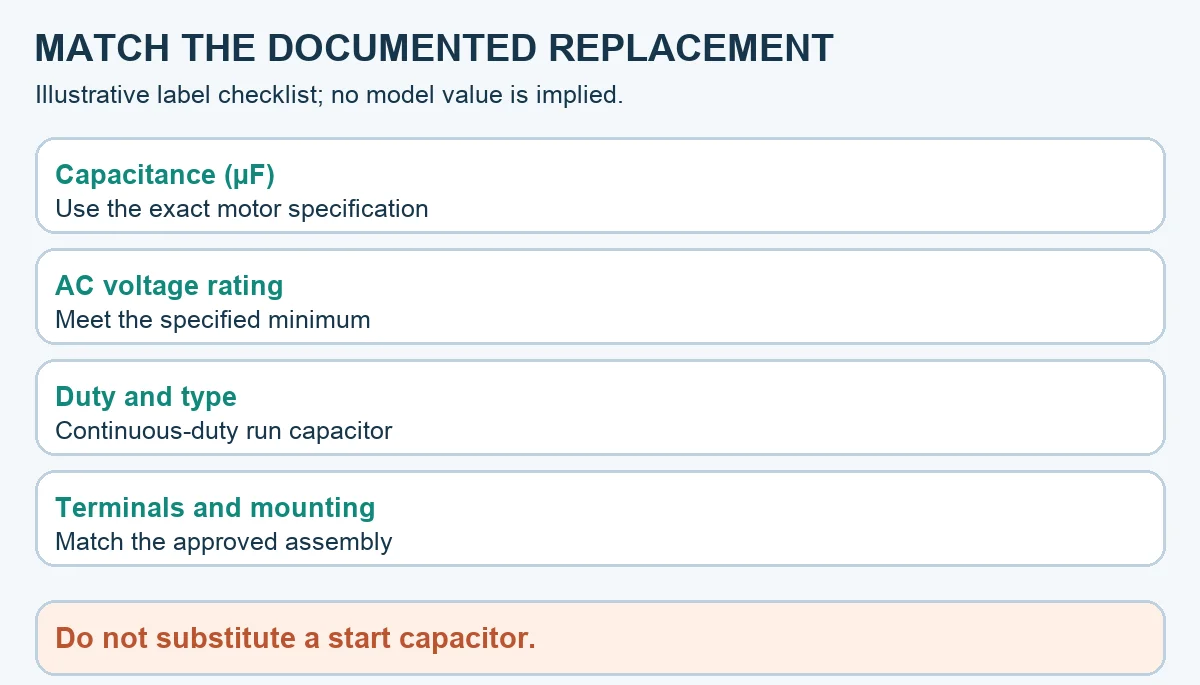
The microfarad value, AC voltage rating, continuous-duty run type, temperature and duty classification, terminals, mounting, and approved wiring arrangement all matter. The specified AC voltage rating is a minimum, but a larger number is not a license to ignore physical fit, terminal layout, or the manufacturer’s approved part. A start capacitor has a different duty and must not be substituted for a run capacitor.
For a dual-run unit, each marked section has its own function and value. The technician must use the exact equipment diagram rather than general terminal-position guesses. The old part’s photograph, the motor plate, and the service part number make the replacement traceable; they do not prove that an earlier installation was correct.
Where Longwell product evidence fits
Longwell’s controlled capacitor-motor catalog identifies several AC motor families and drawings. That establishes that capacitor-motor designs exist in the range; it does not supply a universal service capacitor or prove that a pictured motor fits an unnamed fan. A model or revision-specific drawing is useful for identifying an assembly, while the final capacitor value and service procedure still require the corresponding motor and equipment documentation. The Longwell AC capacitor motor family is a place to begin a new selection, not an exact-fit recommendation. Compare the complete electrical and mechanical requirements first.
A technician can make the discussion efficient by providing the exact motor model and suffix, equipment model, supply voltage and frequency, capacitor label, terminal photo taken only after the equipment is made safe, and the observed symptom. For a replacement motor, also provide airflow, pressure, mounting, and control requirements. This keeps a component fault separate from a broader fan-selection decision.
Common questions
Should every humming fan get a new capacitor?
No. The symptom calls for investigation. Confirm the motor design and complete the appropriate safe tests before identifying a failed component.
Can a higher voltage-rated capacitor replace the old one?
A rating at or above the documented minimum is one condition, but the complete approved specification, duty and physical connections must also match. Use the exact service data.
Should a capacitor be changed whenever the motor is changed?
Follow the replacement motor and equipment instructions. An existing capacitor may be unsuitable or out of tolerance, but a universal automatic-replacement rule ignores the new motor’s specification.
In short, treat a symptom as the start of diagnosis and the motor documentation as the source of replacement values. That protects the technician and avoids fitting a plausible but unverified part.
Choose the right ac motor
Longwell manufactures 22 ac motors in-house. Send airflow, static pressure and voltage — an engineer replies with a matching model, performance curve and price within one working day.