Key Takeaways:
- DIDW fan is a fan type that has two inlets and a double-width impeller.
- DIDW working principle: air enters at both ends of the shaft, and the impeller is roughly twice as wide as a single-inlet wheel of the same diameter.
- Pressure is set by impeller diameter and speed. At equal diameter and speed a DIDW and a SISW reach the same pressure; the DIDW gets there at lower rpm, and that is where its lower noise comes from.
- The trade is cost, footprint and service: one motor and one mounting position instead of two, but a higher unit price, a wider casing and a longer bearing span to align.
- Blade shape matters more than inlet count.
Centrifugal fans are commonly used in residential, commercial, and industrial ventilation. DIDW centrifugal fans can be divided into different types. Based on inlet count, they can be classified into single inlet and double inlet fans. They can also be divided into backward curved and forward curved centrifugal fans based on blade design. DIDW centrifugal fans are often mentioned in industrial ventilation and exhaust and in this guide, we’ll explain what DIDW centrifugal fans are, how they differ from SISW fans, and what buyers should check before selecting.
What is a DIDW Centrifugal Fan?
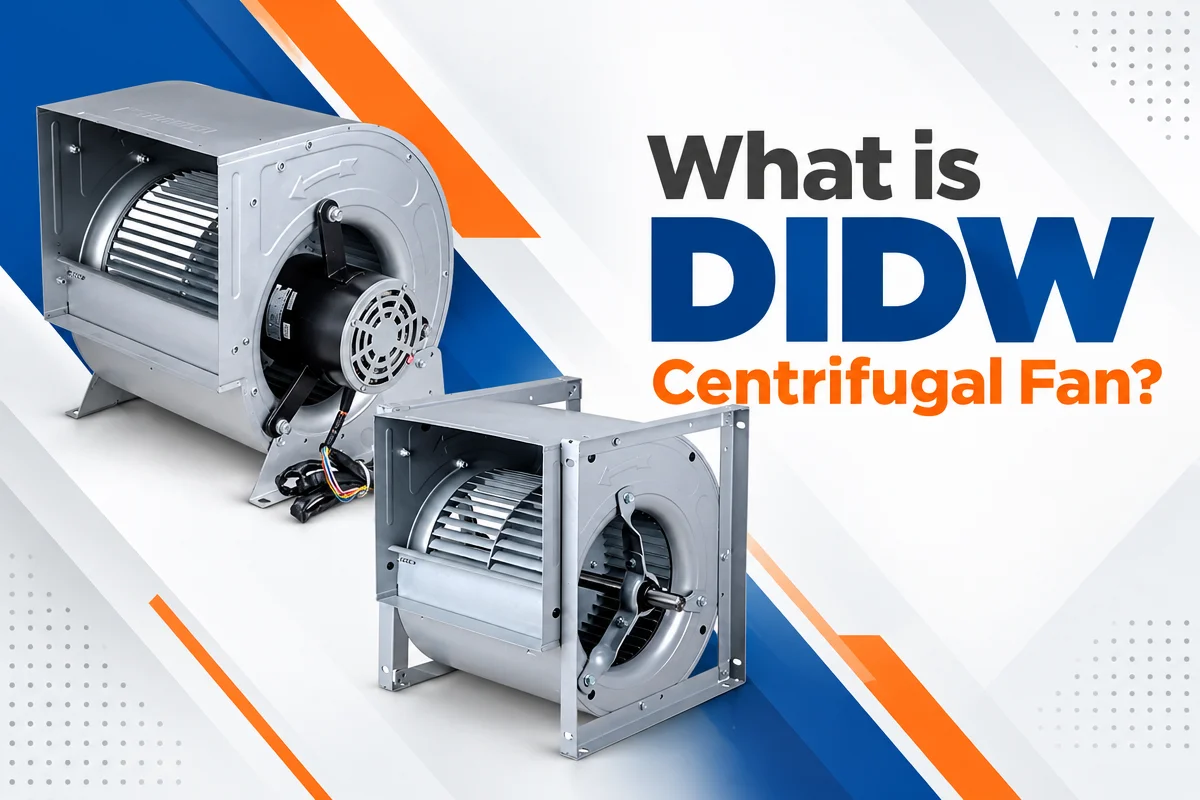
The full name of DIDW fan is Double Inlet Double Width, which is a fan type that has two inlets and a double-width impeller. The name describes the geometry exactly: air enters through two inlet cones, one at each end of the shaft, and the impeller between them is roughly twice as wide as the single-inlet wheel of the same diameter. A typical DIDW centrifugal fan usually include components like impeller, fan housing, motor and drive system, inlet openings, and mounting frame and supporting structure. Each component has its own function. For example, the impeller draws air from both sides and throws it radially outward, the motor and drive system provides the mechanical power. Motor and drive system can be divided into direct AC, direct EC, and belt drive, offering different efficiency levels, static pressure, and airflow capabilities.
What is the Working Principle of DIDW Centrifugal Fan?
The DIDW centrifugal fan works by converting mechanical energy into airflow and pressure. Because the DIDW fan has double air inlet design, the air enters axially from both ends. Each inlet opening turns the incoming air through 90°and feeds it into the impeller. The rotating blades catch the air and accelerate it radially outward. The amount of energy transferred depends on the impeller diameter, blade geometry, rotational speed, and operating conditions.
The air then leaves the tip at high velocity. At the impeller outlet the air has high kinetic energy and relatively little static pressure. The volute converts velocity into pressure. The expanding spiral casing slows the air down as it travels to the outlet, trading velocity pressure for static pressure.
Double Inlet Centrifugal Fan vs. Single Inlet Centrifugal Fan
The main difference between single inlet and double inlet centrifugal fan is the direction and number of air entry points. This difference also makes their performance different.
- Airflow. A double inlet fan has increased airflow capacity and is often suited for higher airflow applications compared to single-inlet fan. To match that airflow with single-inlet fans you need two units, two motors, two sets of electricals and two mounting positions.
- Pressure. Practically identical at equal diameter and speed. Neither design is inherently a higher-pressure machine. Pressure is a diameter-and-speed decision in both cases.
- Shaft loading. A DIDW fan draws air into the impeller from both sides to create a more balanced inlet arrangement. In a SISW fan the whole load sits on one side and the bearing carries it as continuous thrust. That is why DIDW frames tend to run cooler bearings for the same duty, and why bearing life is often the reason an OEM chooses the wider fan even when two single-inlet units would fit. However, the actual shaft loads depends on the fan’s aerodynamic design, fan design, and fan installation.
- Service and cost. A DIDW fan has more parts and a longer bearing span. But it is also the more expensive unit.
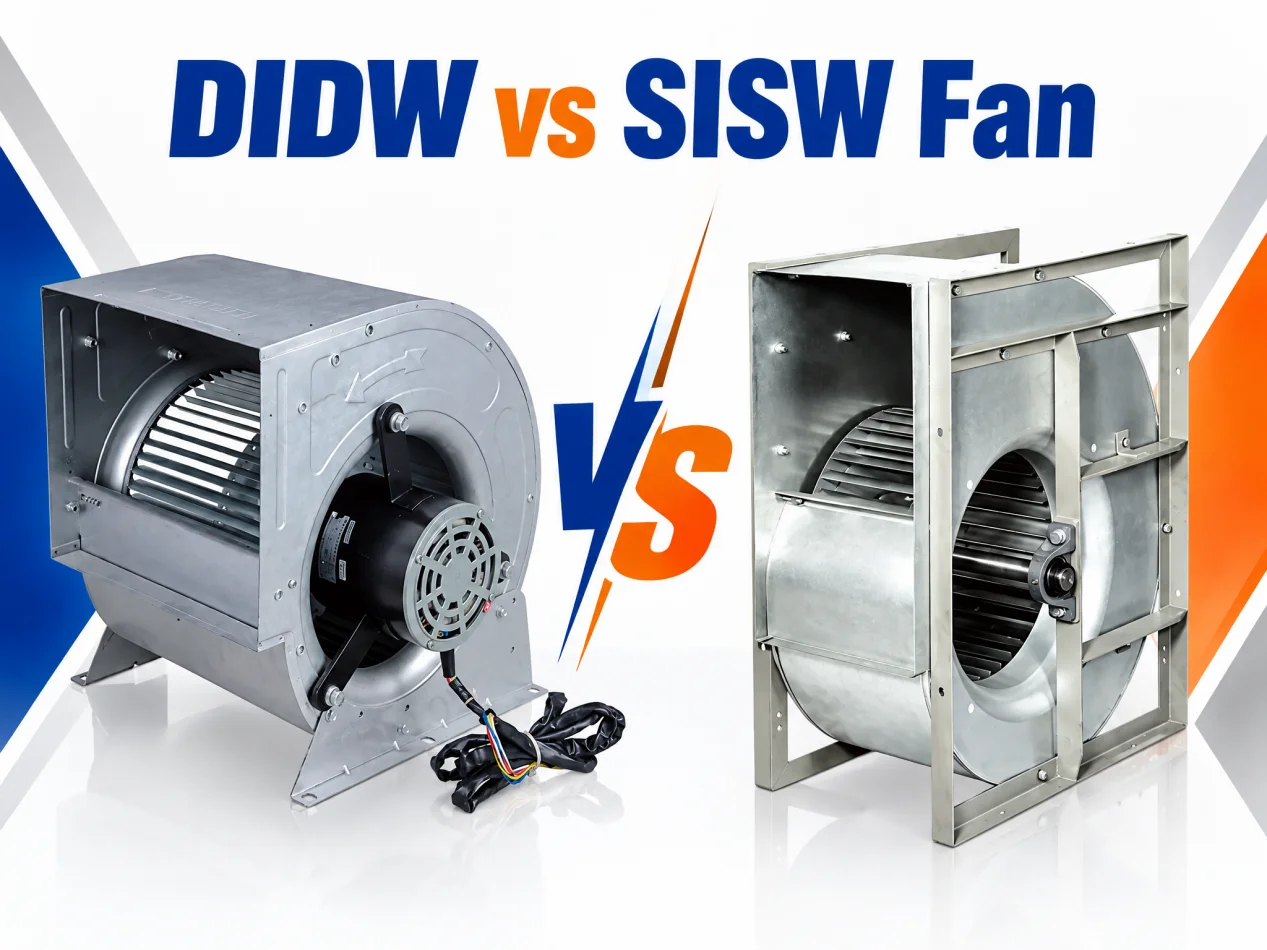
DIDW vs. SISW Fan Comparison Chart
|
Comparison |
DIDW (Double Inlet Double Width) |
SISW (Single Inlet Single Width) |
|---|---|---|
|
Inlets |
2, one at each end of the shaft |
1 |
|
Impeller width (b/D) |
~0.6–1.0 |
~0.3–0.5 |
|
Airflow at equal diameter |
Higher |
Lower |
|
Pressure |
Not inherently higher: same at equal diameter and speed, reached at lower rpm for a given duty |
Same at equal diameter and speed, but needs higher rpm for the same duty |
|
Axial thrust on bearings |
Minimal (cancelled between the two inlets) |
Higher (Carried fully on one side) |
|
Speed for a given duty |
Lower, because more inlet area is available |
Higher |
|
Noise at a given duty |
Usually lower (lower tip speed) |
Higher |
|
Casing radiating area |
Roughly double |
Baseline |
|
Width / footprint |
Wide; narrower than two SISW units, one motor |
Narrow |
|
Installation requirement |
Clear approach on both sides |
One clear side only |
|
Bearing span / alignment sensitivity |
Longer span, more sensitive |
Shorter, more forgiving |
|
Maintenance |
Two bearing positions, more parts |
Simpler |
|
Unit cost |
Higher |
Lower |
|
Cost per m³/h delivered |
Usually lower at high flow, higher at low flow |
Competitive at low flow |
|
Typical applications |
AHU sections, FCUs, CRAH/CRAC, heat recovery and HRV, ovens, LAF beds, range hoods, dust extraction |
Wall-mounted units, shallow casings, single-point exhaust, compact OEM equipment |
DIDW Centrifugal Fan VS SISW Centrifugal Fan: Which One Suit You
The choice between DIDW and SISW centrifugal fan depends on your specific application. If you need to move a large volume of air at high pressure, a DIDW centrifugal fan may be a better option. But if you need to install the centrifugal fan in a limited space, a SISW centrifugal fan could be a better choice because of its compact size. If your cost is a main consideration, SISW centrifugal fan is the better choice. DIDW centrifugal fans are often used in AHU sections, fan coil units, CRAH and CRAC units, heat recovery and HRV ventilation, process cooling and heating, LAF beds and medical diagnostic equipment, range hoods, and dust extraction, while SISW centrifugal fans can be more suitable for compact commercial and industrial ventilation.
Blade Shape Matters More Than Inlet Count
A DIDW fan is not the only factor to choose centrifugal fan. Blade shape matters more than inlet count. Centrifugal fans are divided into the following types based on blade types:
- Forward-curved Centrifugal Fan: Features multiple shallow blades facing the direction of rotation. This geometry can deliver substantial airflow at relatively low speeds, making it an ideal choice for compact HVAC equipment.
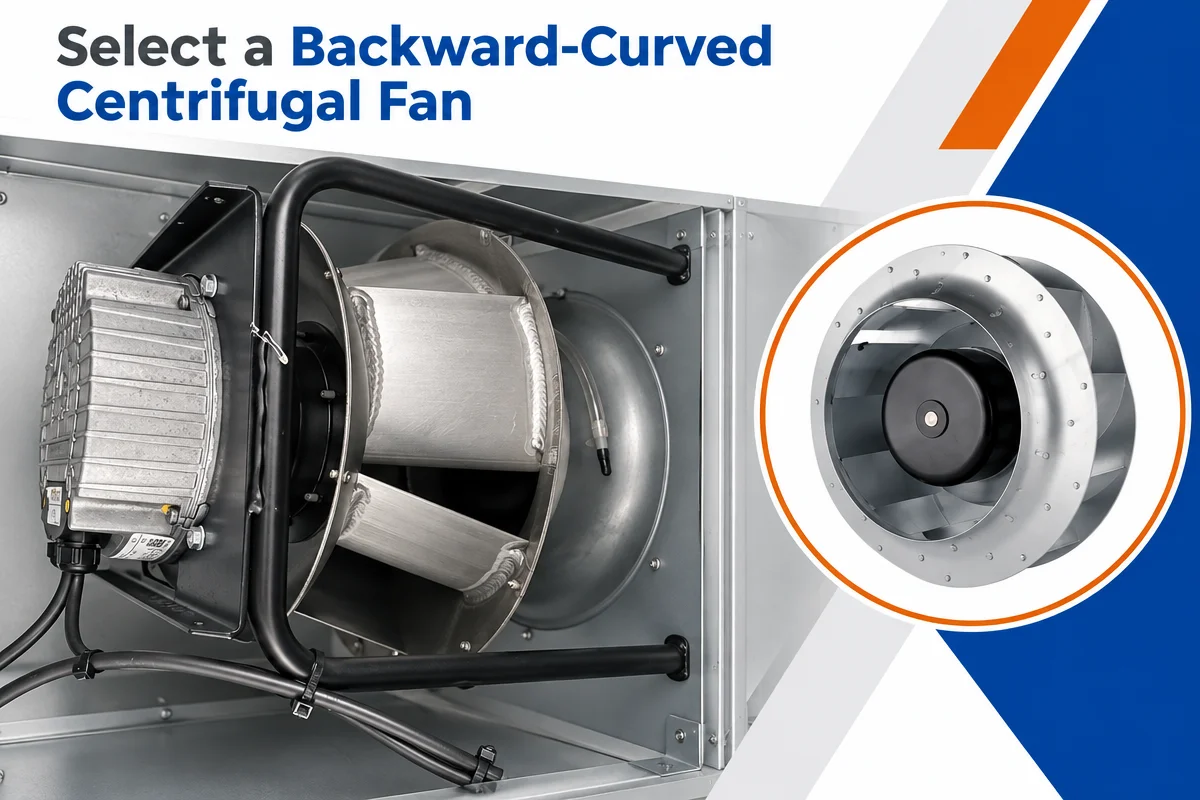
- Backward-curved Centrifugal Fan: Features fewer, deeper blades curving away from rotation. A key advantage of many backward-inclined designs is their non-overloading power characteristic over the specified operating range.
- Airfoil Centrifugal Fan: Uses airfoil-section backward-curved blades. This fan type provides the highest-efficiency geometry available, at a price premium. It is often used in large AHU and continuous-duty installations.
What Buyers Should Check Before Selecting a DIDW Fan?
- Fix the duty point on total pressure. Define the required airflow and the system resistance at the operating point. If the selected fan cannot meet the environment’s operating pressure, the fan equipment cannot work well.
- Confirm whether your application require a backward-curved or forward-curved design. This choice can affect your fan’s efficiency, and potential noise performance.
- Run the low-resistance case for forward-curved wheels. Compute shaft power at the resistance the system would have with clean filters and open dampers.
4. Decide the drive honestly. Direct EC for stepless control, tach feedback and part-load efficiency. Direct AC for fixed-speed, cost-driven units. Belt drive where the duty point needs pulley trimming, the airstream is hot, or the motor must sit outside the casing.
5. Check the box, not just the curve. Clear approach on both inlets, service access to both bearing positions, weight and lifting points, and whether the outlet can be ducted in the direction the drawing actually shows.
6. Ask for the documents behind the numbers. Balance grade, bearing L10 life at a stated ambient, and a measured P-Q curve rather than a catalogue sketch.
7. Check certifications against your model number. Check if your supplier can provide the certification in your targeted market.
LONGWELL DIDW Fan
LONGWELL has been building centrifugal fans in Ningbo since 1990 and exports to more than 30 countries. The DIDW range spans from compact EC blowers for fan coil units up to belt-driven backward-inclined frames for dust extraction.
The DD series — direct drive, where fan coil and VAV work lives. Developed from the AT-series platform specifically for air-conditioning duty, the DD series covers 800 to 5,000 m³/h across nine frame sizes, DD7-7I to DD12-12I. It is aimed at changeover air conditioners, tube-type units, VAV systems and heating, and it ships with a single-phase 220 V / 50 Hz three-speed motor as standard — speed trimmed through a silicon-controlled voltage regulator or a frequency converter, depending on how much control the job needs.
The DDM series — the same architecture on an EC platform. For AHU, large RTU and commercial AC duty, the DDM series lifts the envelope to 3,000–15,000 m³/h at up to 800 Pa, with impellers from 7″ to 15″ — DDM 9-9, 10-10 and 15-15 as the typical frames. Control is 0–10 V, PWM or Modbus, which puts it in fan-array and variable-volume territory rather than fixed-speed. It is also a dimensional drop-in for the Nicotra DDM B, which matters if the job is qualifying a second source for an existing AHU line rather than designing a new one.
Frequently Asked Questions (FAQs) about DIDW Centrifugal Fans
What does DIDW stand for in fans?
DIDW means Double Inlet Double Width. DIDW fans are widely used in HVAC systems, industrial ventilation, air handling units (AHUs), clean rooms, data centers, chemical plants, and power generation cooling.
Is a double-inlet fan always better than a single-inlet fan?
Double-inlet fan can be better than single-inlet fan in most cases, but single-inlet fan is more often used in application that require moderate airflow.
What is the difference between a DIDW fan and a SISW fan?
The main difference between DIDW and SISW fan is the number of inlets. A DIDW fan draws air from both sides and the SISW fan draws from one side.
Are DIDW fans more efficient than single-inlet fans?
Generally, yes. Because a DIDW fan distributes the airflow load across two inlets, it achieves higher volumetric efficiency and reduces axial thrust on the shaft bearings.
Choose the right centrifugal fan
Longwell manufactures 1,135 centrifugal fans in-house. Send airflow, static pressure and voltage — an engineer replies with a matching model, performance curve and price within one working day.