
Fan Selection for Greenhouse Circulation and Ventilation
A greenhouse needs air movement around the crop and a controlled path for exchanging indoor and outdoor air. These are different fan tasks. Start with the growing layout, seasonal climate targets and ventilation equipment, then select fans for the actual mounting arrangement and resistance.
Separate crop-area circulation from greenhouse air exchange
This page helps growers, greenhouse builders and equipment integrators define two airflow duties before choosing a product. Circulation redistributes air inside the growing space. Exhaust and intake arrangements exchange that air with outdoors. Screens, pads, shutters and crop obstructions change the selection.
How Greenhouse Fans Build a Horizontal Air Loop
See how greenhouse circulation fans maintain paired horizontal airflow lanes around the crop, renew air near leaves, and avoid quiet corners. A separate view explains the intake and exhaust route needed for outdoor-air exchange.
Follow the air through the process
Build a coherent horizontal loop
Fans move air down one side of the greenhouse and back along the other side.
Renew air around leaves
Moving greenhouse air replaces the local leaf-adjacent air layer, supporting heat, moisture and carbon-dioxide exchange.
Check spacing around the crop
Poor placement can create early returns and leave corners poorly reached. Crop growth and hanging baskets alter the obstruction pattern.
Coordinate outdoor-air exchange
Exhaust and intake openings create the route that takes heat and moisture outside. Coordinate ventilation with indoor circulation controls.
Airflow function
- Add momentum to the common circulation loop.
- Overcome drag from crops and greenhouse structures.
- Support canopy coverage when guards and mounting are included in the assembly.
What can change the result
- Air returns early and leaves a quiet corner.
- Crop growth or hanging baskets interrupt the intended path.
- Running circulation fans is mistaken for verified outdoor-air exchange.
Start with the complete air path
Share your layout and the information you already have. Unknown values can be identified before a configuration is selected.
Match the fan to this air path
LONGWELL EC axial motor-and-impeller families can be evaluated within an engineered circulation assembly. Share the greenhouse layout and operating conditions so the fan, guard and mounting can be matched together.
Where it sits
Inside an engineered horizontal-airflow circulation assembly placed along the greenhouse air loop. Intake and exhaust ventilation remain a separate outdoor-air exchange function.
Why consider this configuration
The axial motor-and-impeller family is a candidate component for moving air along a low-resistance circulation lane. The complete guard, housing, mounting and controls must work with crop height, obstructions and exposure conditions. This component discussion does not replace the circulation and exhaust assembly options already listed below.
Check the result in your equipment
Discuss your greenhouse airflow
Send greenhouse dimensions, mature crop layout, hanging obstructions, desired circulation pattern, mounting positions and moisture exposure. Ask for a complete assembly review and the canopy measurements needed to confirm the result.
A layout, installation photos or your existing model is enough to start the discussion.
Engineering references
Plan circulation around the crop canopy
Discuss the horizontal airflow pattern with the growing-system designer. Fan positions, direction and mounting height must work around benches, mature plants and closed screens. Check the distribution at representative locations after installation; a catalog airflow figure cannot establish canopy velocity or coverage across the greenhouse.
- Bay dimensions, crop height and bench layout
- Suspension points, direction and safe access
- Canopy velocity objective and measurement positions
Select exhaust fans with their intake path
Define where outdoor air enters and indoor air leaves before choosing exhaust capacity. Include the resistance of insect screens, shutters, cooling pads and other restrictions, allowing for the condition expected during operation. Coordinate the fan stages with vents so that the proposed airflow path remains available.
- Intake opening and screen or pad specification
- Installed resistance and seasonal ventilation duties
- Vent position, exhaust location and control sequence
Specify moisture exposure and climate controls
Describe fogging, irrigation spray, condensation and cleaning practices, together with the available electrical supply. Confirm the materials, enclosure requirements and control interface for the chosen fan. Plan access for cleaning guards and screens, and agree how the climate controller should respond if a fan stops.
- Moisture, cleaning agents and ambient conditions
- Supply, speed command and fault indication
- Cleaning access and controller response to a fault
Match the fan family to the equipment.
Compare the proposed model at the required airflow and pressure, then check the installation and control interface.
Circulation fan assemblies
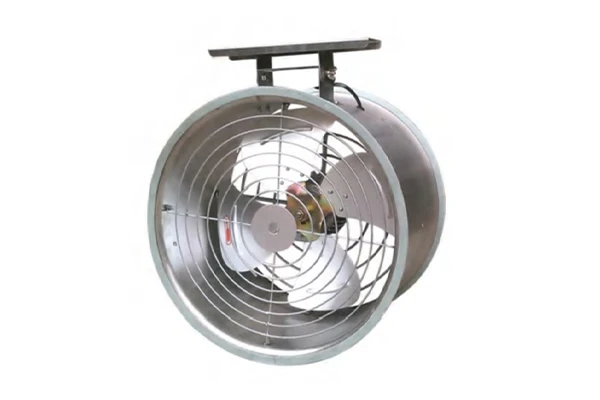
Review circulation formats with suspension brackets and guards for internal air movement. Confirm the mounting, airflow direction and distribution requirements for the growing layout.
Explore this fan family →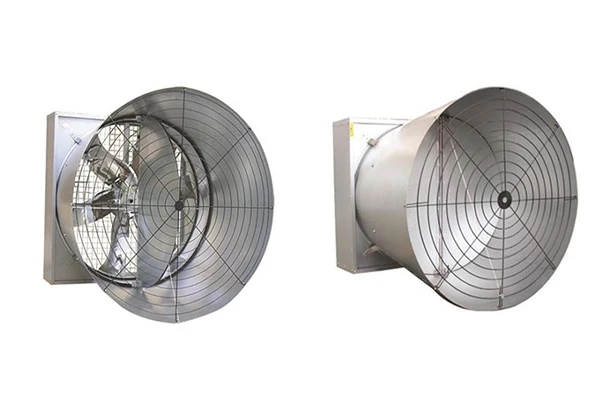
Agricultural exhaust fan assemblies
Review wall-mounted exhaust formats together with their intake openings, screens and pads. Select the complete assembly against installed resistance and the required control sequence.
Explore this fan family →Product images show family configurations. Request the drawing, curve and electrical information for the exact model being considered.
What should your fan enquiry include?
Share these application details so the fan proposal can be reviewed against your equipment.
Bring the equipment context to the fan review.
A drawing, the operating condition and a clear control requirement make the proposed configuration easier to compare. For a replacement, include the existing nameplate and wiring details.
Discuss your application →Reference material for the next step.
Compare agricultural fan formats, then request the model curve, installation drawing and material options for your project.
Series catalog · PDFEC axial fan catalog ↗Explore axial components for ventilation equipment; confirm the electrical version, controller interface and environmental conditions before selection.
Catalogs support initial selection. Confirm the current specification and approved configuration with the project team.
Can circulation fans replace exhaust ventilation?
Circulation fans mainly move air already inside the greenhouse. They do not, by themselves, establish a controlled outdoor-air exchange path. Define the circulation objective and the exhaust or natural-ventilation requirement separately, then coordinate their operation with the growing-system designer.
How should fan spacing and quantity be selected?
Start with the greenhouse geometry, mature crop layout and intended airflow pattern. Use the selected fan’s operating data and installation guidance to prepare a layout, then check air distribution at representative canopy locations. Avoid selecting quantity from free-air airflow alone.
Continue with the equipment you are designing.
Share your equipment and operating conditions.
Send the drawing, target duty and project timing. Add the existing fan details when you need a replacement.