
Fan selection for precision air-conditioning units
Match the fan to the precision-cooling unit and its connected air path. Define airflow through the coil and filters, available cabinet depth, part-load operation and the controls interface. Cooling capacity and room humidity performance remain properties of the complete equipment and its operating conditions.

Review the cabinet before comparing fan ratings
Precision-cooling units may supply air through raised floors, overhead paths or other room arrangements. Establish where the unit’s fan duty ends and where the distribution resistance begins. Select a fan configuration using both normal operation and the reduced-capacity requirements specified for the equipment.
Build the coil-to-room pressure budget
Include the cooling coil, filters, internal turns and discharge connection in the fan duty. Add the external path required by the installation. Review the intended airflow across the operating range, including loaded filters, so a candidate is compared against the cabinet it will actually serve.
- Coil and filter pressure losses
- Raised-floor or overhead connection
- Normal and reduced-speed airflows
Resolve inlet space and serviceability
Low cabinet depth can constrain the fan inlet and motor position. Check the assembly drawing against nearby panels, wiring routes and the removal opening. Include supports and vibration isolation in the available space, then review the installation geometry together with the candidate performance data before freezing the cabinet design.
- Usable depth and inlet clearance
- Mounting and isolation arrangement
- Fan extraction route for maintenance
Coordinate operation after a fault
For a multi-fan unit, specify the required response to a stopped fan or lost command. Review the remaining fan duty, reverse-flow path and alarm behaviour. Confirm the proposed interface with the precision-cooling controller and include start-up, part-load and recovery operation in the equipment test plan.
- Stopped-fan operating requirement
- Command, feedback and fault signalling
- Recovery and restart test sequence
WATCH THE APPLICATION PRINCIPLE · ENGLISH
Where does server exhaust heat go?
Follow warm server exhaust back to a chilled-water computer-room air handler. Heat crosses the coil into water inside the tubes, and the room blower sends cooled air toward the cold aisle. A closed blanking bay prevents an easy bypass.
English narration and on-screen captions · 72 seconds · Equipment and flow paths are schematic.
Product scope in this film: This is a chilled-water CRAH with low-level room supply, not a direct-expansion CRAC or a raised-floor example. LONGWELL backward-curved EC plug fans are candidates for the air-handler duty, without a facility-level PUE or availability guarantee.
Explore the LONGWELL fan family · Share your equipment and air-path requirements
Match the fan family to the equipment.
Compare the proposed model at the required airflow and pressure, then check the installation and control interface.
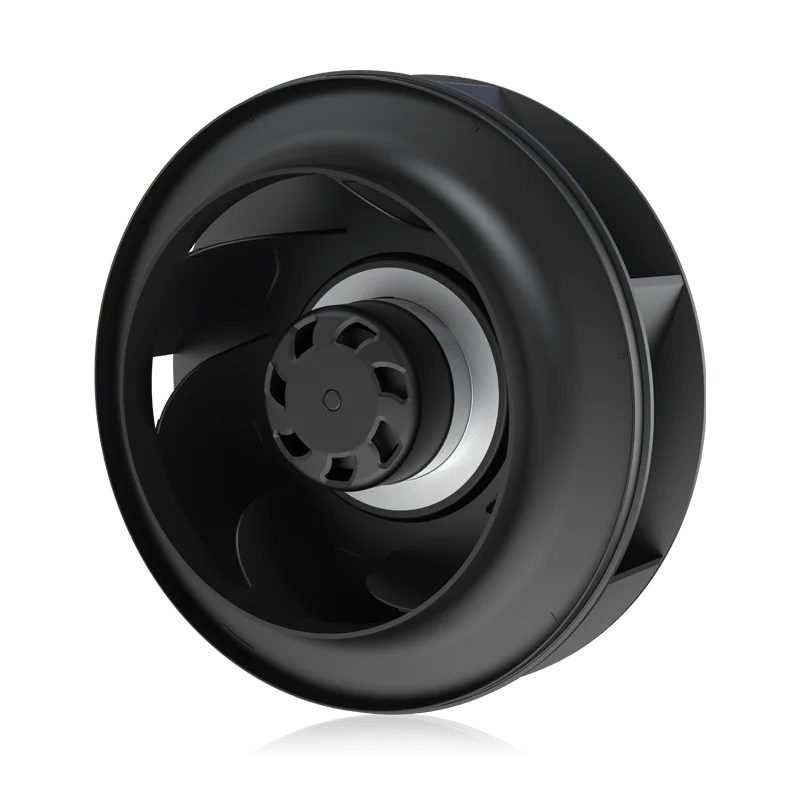
Backward-curved centrifugal fans
Review backward-curved centrifugal fans for cabinets with defined coil resistance and inlet geometry. Match the complete model to the available depth and operating range.
Explore this fan family →RLM plug-fan assemblies
Review plug-fan assemblies where the unit accepts their support frame and inlet arrangement. Confirm service access and the proposed controller connection before selection.
Explore this fan family →Product images show family configurations. Request the drawing, curve and electrical information for the exact model being considered.
What should your fan enquiry include?
Share these application details so the fan proposal can be reviewed against your equipment.
Reference material for the next step.
Use the series information to narrow the mechanical format; confirm inlet conditions, controls and the proposed model performance separately.
Series catalog · PDFRLM series plug fans ↗Review assembly formats and series dimensions, then request the current curve and approved drawing for the complete offered model.
Engineering checklistFan replacement: fit and controls ↗Check operating duty, mounting, supply, wiring and control behaviour before treating an existing fan and a proposed replacement as interchangeable.
Catalogs support initial selection. Confirm the current specification and approved configuration with the project team.
Does a fan selection define cooling capacity or humidity control?
The coil, refrigeration or water circuit, airflow and control sequence determine those equipment functions together. Supply the intended coil conditions and room requirements with the fan brief, then validate the complete precision-cooling unit at the agreed test conditions.
Can a replacement use the existing controller unchanged?
Check the actual supply, signal type, reference wiring, feedback and fault behaviour. Similar terminals or an EC label do not establish identical operation. Review start-up and reduced-speed response with the controller supplier before accepting the replacement configuration for the cabinet.
Continue with the equipment you are designing.
Share your equipment and operating conditions.
Send the drawing, target duty and project timing. Add the existing fan details when you need a replacement.