
Centrifugal fans for industrial air-handling units
Specify the fan around the complete industrial AHU: filters, coils, dampers, enclosure and distribution system. For a new unit or retrofit, bring the required airflow and pressure together with mounting, inlet clearance and control details so the proposed assembly can be assessed at a usable operating point.

Make the AHU operating point the starting point
This page helps equipment builders and retrofit teams compare plug-fan and centrifugal formats for an industrial AHU. Keep normal duty, filter loading and reduced-speed operation visible in the brief. Use one complete model and revision throughout the drawing, curve and electrical review.
Account for the complete air path
List the resistance across the coil, filters, dampers and downstream distribution. State the delivered airflow the building system needs and how the duty changes as filters load. Review candidate curves at those points with the AHU designer, including the intended speed range and available electrical supply.
- Clean and loaded filter states
- Internal and external pressure losses
- Required airflow at each operating mode
Fit the assembly into the fan section
A nominal impeller diameter does not describe the complete installation. Measure the access opening, inlet approach, support frame and discharge space. Review how the assembly can be mounted and removed, and identify transitions or nearby walls that could disturb the inlet before agreeing the final fan section drawing.
- Inlet clearance and support dimensions
- Replacement route through access doors
- Vibration mounts and service space
Make replacement comparisons traceable
Record the original nameplate, wiring and delivered duty before proposing a retrofit. Compare electrical input at the same airflow and pressure, with measurement conditions stated. Confirm how the replacement receives its command and reports a fault, then include the installed AHU in the commissioning plan.
- Baseline airflow, pressure and input
- Command, feedback and fault sequence
- Complete model and drawing revision
Match the fan family to the equipment.
Compare the proposed model at the required airflow and pressure, then check the installation and control interface.
RLM plug-fan assemblies
Review framed plug-fan assemblies when the AHU offers suitable inlet clearance and support space. Match the proposed assembly to its current performance curve and drawing.
Explore this fan family →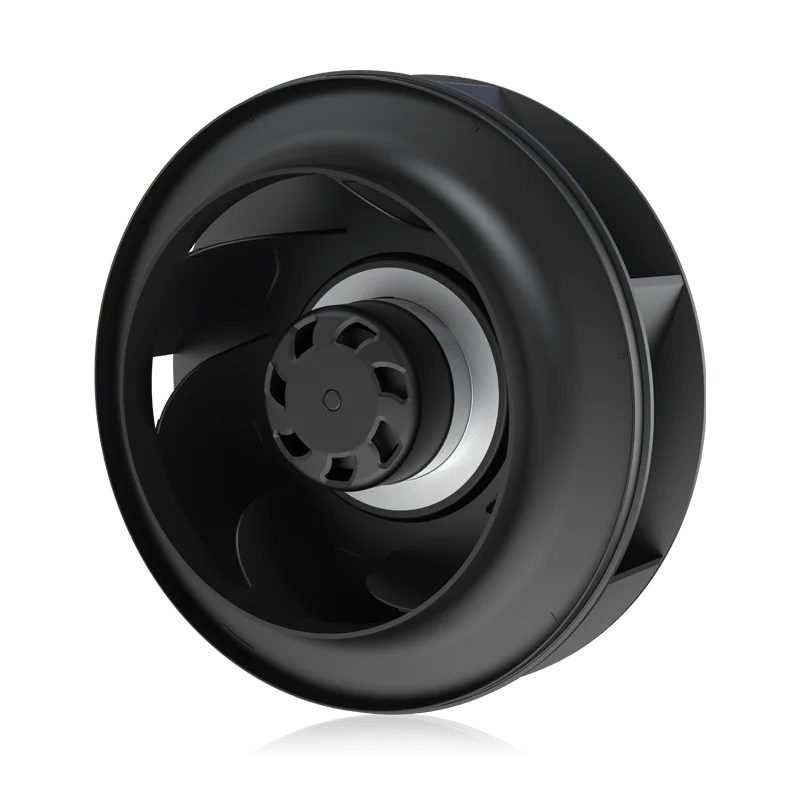
Backward-curved centrifugal fans
Review backward-curved formats for custom fan sections with defined inlet and discharge geometry. Confirm the operating range within the installed coil and filter resistance.
Explore this fan family →Product images show family configurations. Request the drawing, curve and electrical information for the exact model being considered.
What should your fan enquiry include?
Share these application details so the fan proposal can be reviewed against your equipment.
Reference material for the next step.
Review assembly formats and series dimensions, then request the current curve and approved drawing for the complete offered model.
Series catalog · PDFEC backward-curved centrifugal fans ↗Use the series information to narrow the mechanical format; confirm inlet conditions, controls and the proposed model performance separately.
Engineering checklistFan replacement: fit and controls ↗Check operating duty, mounting, supply, wiring and control behaviour before treating an existing fan and a proposed replacement as interchangeable.
Catalogs support initial selection. Confirm the current specification and approved configuration with the project team.
Can maximum airflow and maximum pressure form one selection point?
They usually describe different positions on the fan curve. Select the airflow and pressure that occur together at the proposed speed and configuration, then check input power at that same point. Keep the complete model and test conditions attached to the comparison.
Does an EC replacement establish the project saving?
Motor technology alone does not establish the saving. Measure the original and proposed installation at comparable delivered duty, include the actual operating schedule, and record any changes to filters, controls or ductwork. Use those results for the project comparison after commissioning.
Continue with the equipment you are designing.
Share your equipment and operating conditions.
Send the drawing, target duty and project timing. Add the existing fan details when you need a replacement.