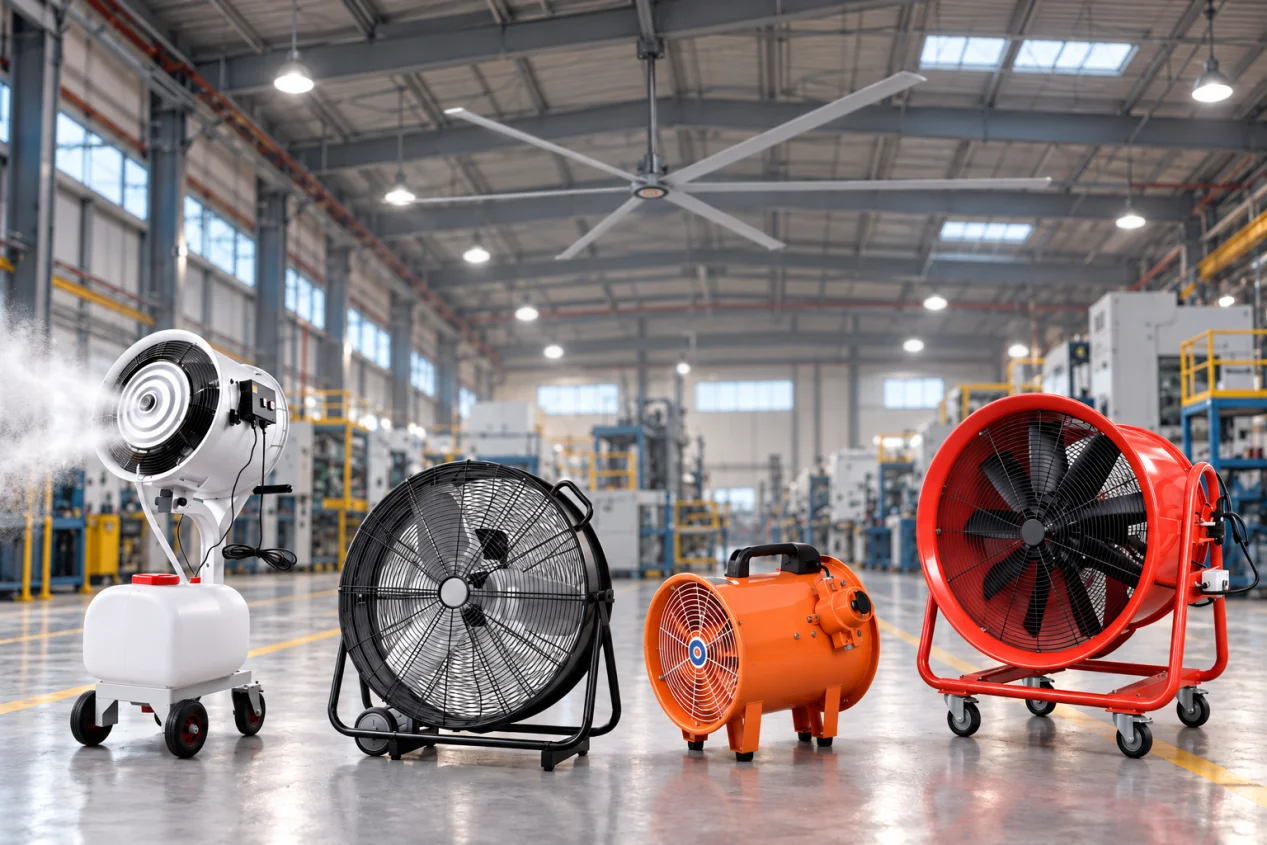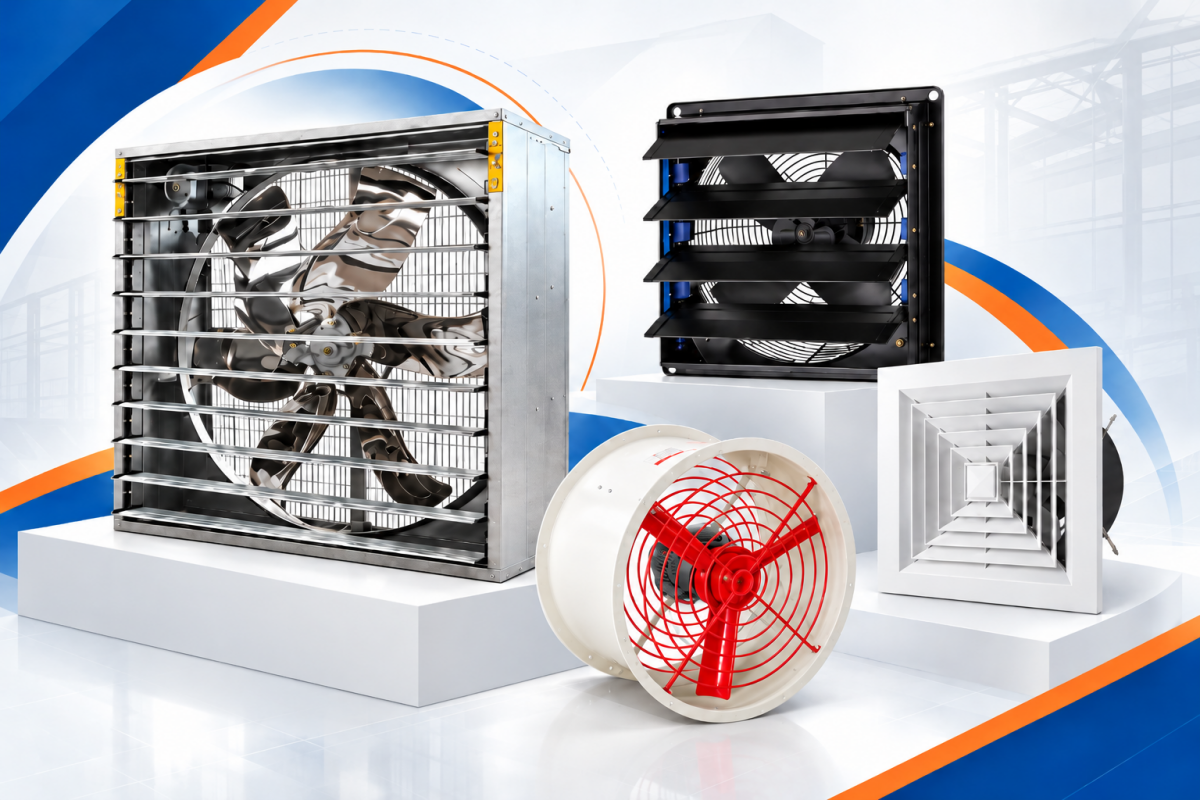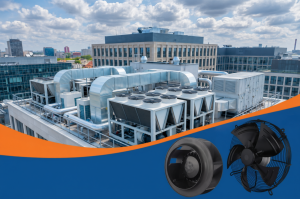
Fans operate in offices, hospitals, hotels, shopping centers, data centers, and other large facilities to maintain air quality, boost air ventilation, and support heating or cooling system. HVAC fan energy efficiency is an important factor in the operating cost, reliability, and performance of a commercial building. This guide explains what HVAC fan energy efficiency is, what factors affect HVAC fan efficiency, how to evaluate EC and AC fan technologies, and how to calculate annual kWh and payback.
What is HVAC Fan Energy Efficiency?
HVAC fan energy efficiency describes how effectively a fan converts electrical input power into useful airflow and pressure. It is the amount of useful air power a fan system delivers for each unit of electrical power it draws. Three principles help explain HVAC fan energy efficiency:
- Useful air power is what actually moves air: airflow multiplied by the pressure rise the fan has to generate. The electrical power drawn from the supply must also cover losses in the motor, electronic drive, transmission (if present), bearings, and impeller. The greater these losses, the more electricity the system consumes to deliver the same airflow and pressure.
- The whole chain counts. Controller, motor, transmission and impeller sit in series. A high-efficiency motor cannot 100% guarantee an energy-efficient fan system; aerodynamic performance and drive losses also matter.
- Annual performance matters more than peak performance alone. Commercial buildings rarely operate at maximum airflow throughout the day. Occupancy, outdoor conditions, and heating or cooling demand change over time, making part-load efficiency and speed control important when evaluating annual energy consumption.
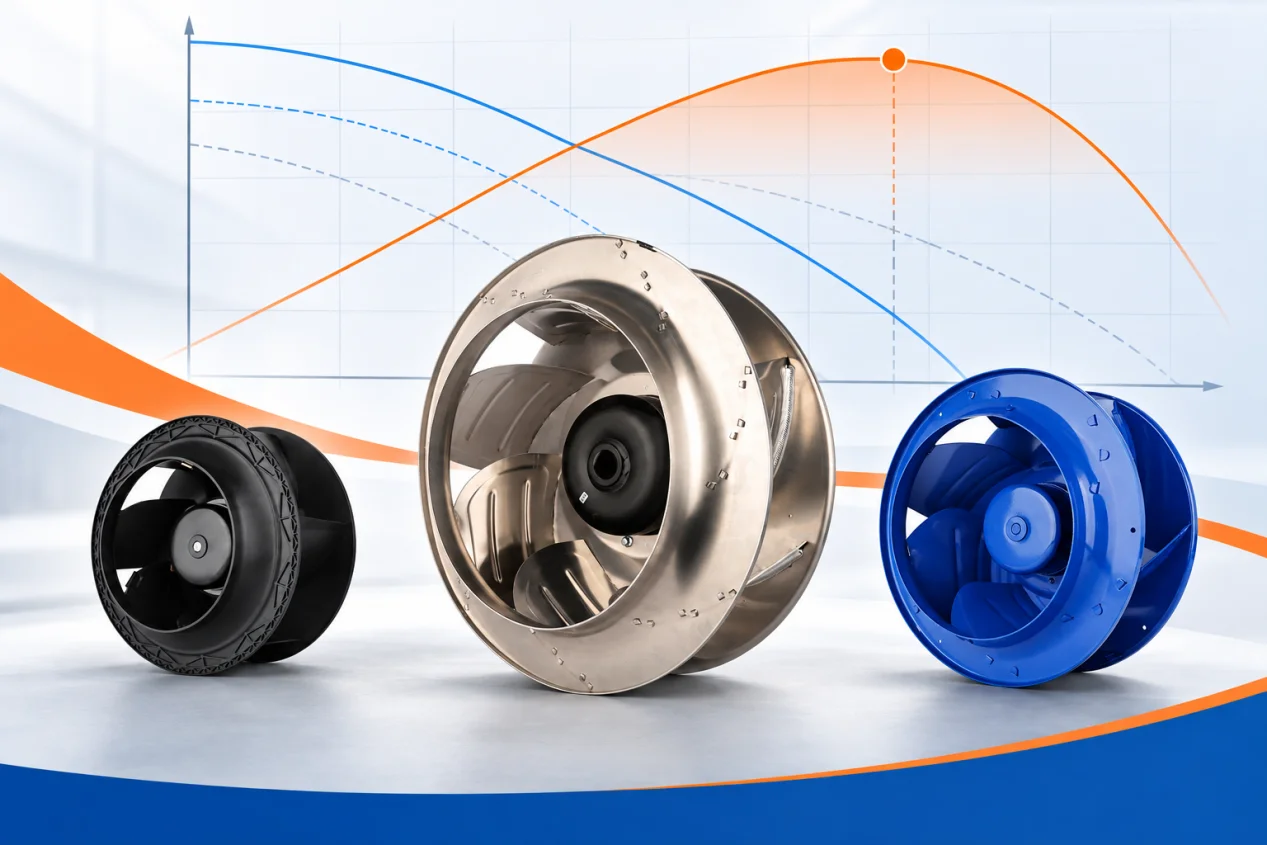
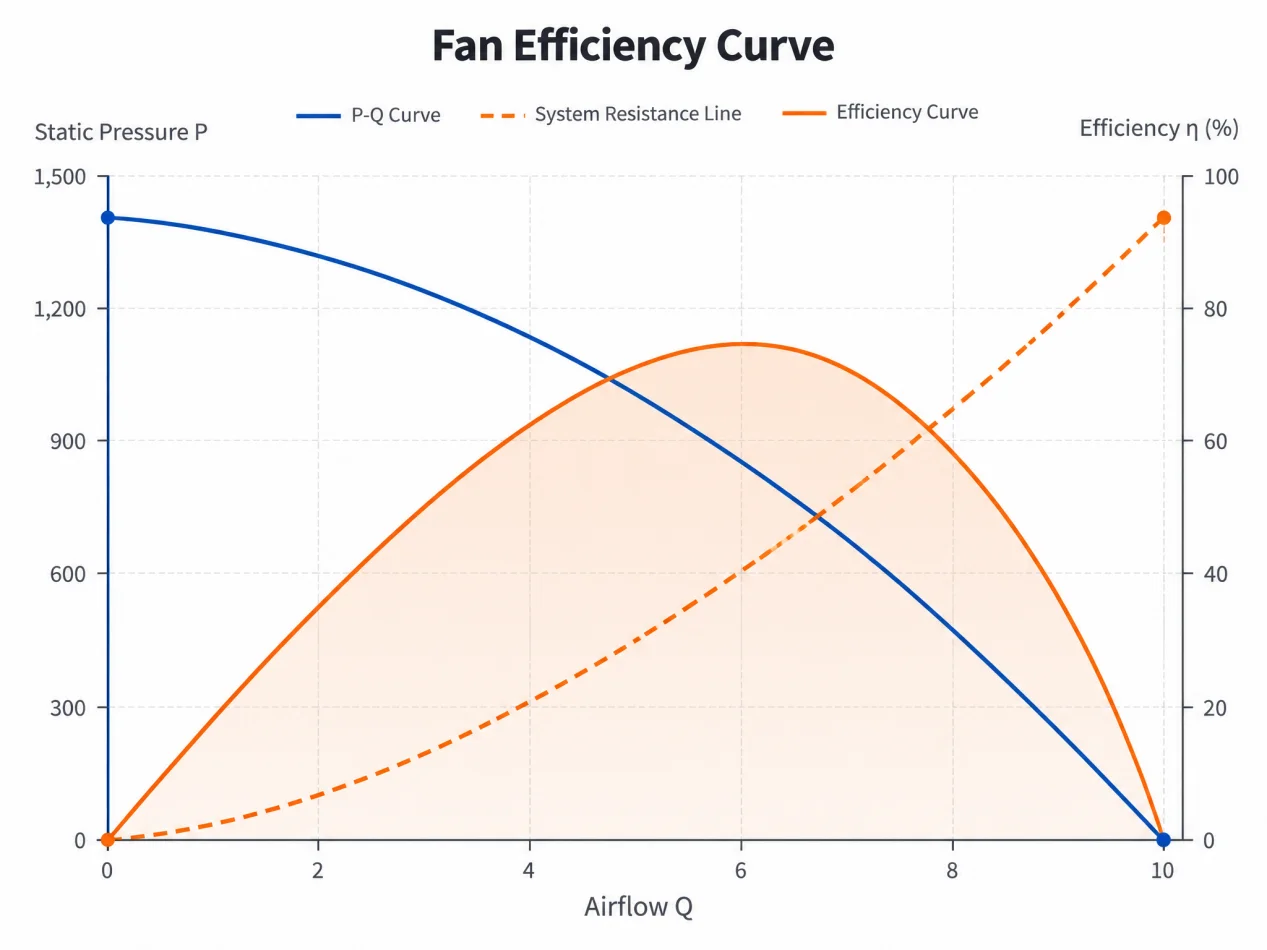
HVAC fan’s energy efficiency is usually indicated by a best efficiency point (BEP) — the one airflow and pressure combination where the impeller performs best — and efficiency falls away in every direction from it. Efficiency generally decreases as operation moves away from the BEP.
Fan Efficiency vs. Motor Efficiency
Fan efficiency and motor efficiency are related, but they are not the same thing. Fan efficiency refers to how effectively the fan converts mechanical power into aerodynamic power; while motor efficiency measures how much of the electricity entering the motors as usable torque at the shaft. Fan efficiency metric is also known as Fan Efficiency Grade (FEG) developed by AMCA International, indicating the aerodynamic quality of the fan.
Where Commercial Building Fan Energy Actually Goes?
Industry analyses consistently place heating, cooling and ventilation equipment at the top of the commercial energy stack — commonly one third to one half of total energy use, and the figure moves with climate, building type and equipment age. Colder climates push the share toward space heating. Warmer regions push it toward cooling, cooling towers and heat rejection.
Without the HVAC system itself, energy consumption is distributed across major functions such as cooling plant, heating plant, air movement, and pumping. The following breakdown chart provides a typical planning framework. Percentages should not be treated as fixed values or added together without a clearly defined measurement boundary.
|
Sub-system |
Typical share of HVAC energy |
Load behaviour |
Diagnostic read |
|---|---|---|---|
|
Supply and return fans |
15–35% |
Continuous whenever the building is occupied |
✅ Highest-value target. Retrofit economics work here because run hours are long. |
|
Cooling plant (chillers, compressors, condensing units) |
30–50% |
Follows cooling load; part-load most of the year |
⚠️ Right-sizing and variable-speed compression matter more than fan work here. |
|
Heating plant (boilers, furnaces, heat pumps) |
15–40% |
Strongly climate-driven and seasonal |
⚠️ Burner efficiency and distribution losses dominate. Fans are secondary. |
|
Cooling tower and heat rejection fans |
5–15% |
Runs with the cooling plant, often 24/7 in warm climates |
✅ Strong case for EC axial retrofit and two-speed or variable control. |
|
Pumps and auxiliaries |
5–15% |
Follows plant operation |
🔴 Frequently left at fixed speed after a plant upgrade. Easy waste. |
Why HVAC Fan Efficiency Matters in Commercial Buildings?
- Lower Operating Cost: Fans in large commercial building usually work continuously or for long hours. HVAC accounts for roughly one third to one half of a commercial building’s energy use, and supply and return fans commonly represent 15–35% of that HVAC total. HVAC fans with high efficiency can effectively lower operating expenses
- Improved Energy Performance: Reducing unnecessary fan power can support broader building energy-efficiency objective and help improve overall HVAC performance.
- Better Part-load Operation: Commercial buildings rarely require maximum airflow at all times. Fans that can adjust their speed avoid wasting energy when full airflow is not necessary.
- Reduced Maintenance and Controllability: Integrated EC fans remove belts, pulleys and alignment work, and carry their own protection and speed feedback, which required less maintenance and controllability.
5 Metrics for Fan Efficiency
|
Metric |
Unit |
What it tells you |
Where it is used |
|---|---|---|---|
|
EUI |
kBtu/ft²·yr |
Whole-building energy per unit of floor area. |
Baseline and benchmarking, ENERGY STAR Portfolio Manager, local reporting laws. |
|
W/cfm |
W per cfm |
Wire-to-air power needed per unit of airflow at a defined static pressure. This is the number that actually penalises an inefficient fan, an oversized motor or a bad duct layout. |
Code compliance, fan-power limits, comparing bids on equal terms. |
|
FEI |
Dimensionless |
Fan electrical input power at a given duty compared with a reference fan at the same duty. FEI = 1.0 means you match the reference; higher is better. It is a fan-level metric, so it isolates the fan from the system. |
ASHRAE 90.1 fan power provisions, AMCA 208 fan efficiency calculations. |
|
Part-load efficiency |
Dimensionless |
Weighted efficiency across 25%, 50%, 75% and 100% load. Matters because most equipment spends the majority of hours well below design capacity. |
Equipment selection, comparing variable-speed against fixed-capacity units. |
|
Static pressure budget |
Pa (or in. wg) |
Where the pressure goes: filters, coils, dampers, ductwork, diffusers. Every pascal you can remove is permanent energy you never have to buy. |
Design reviews, fault diagnosis, filter and coil upgrades. |
Fan Specification to Pay Attention To
Impeller Type
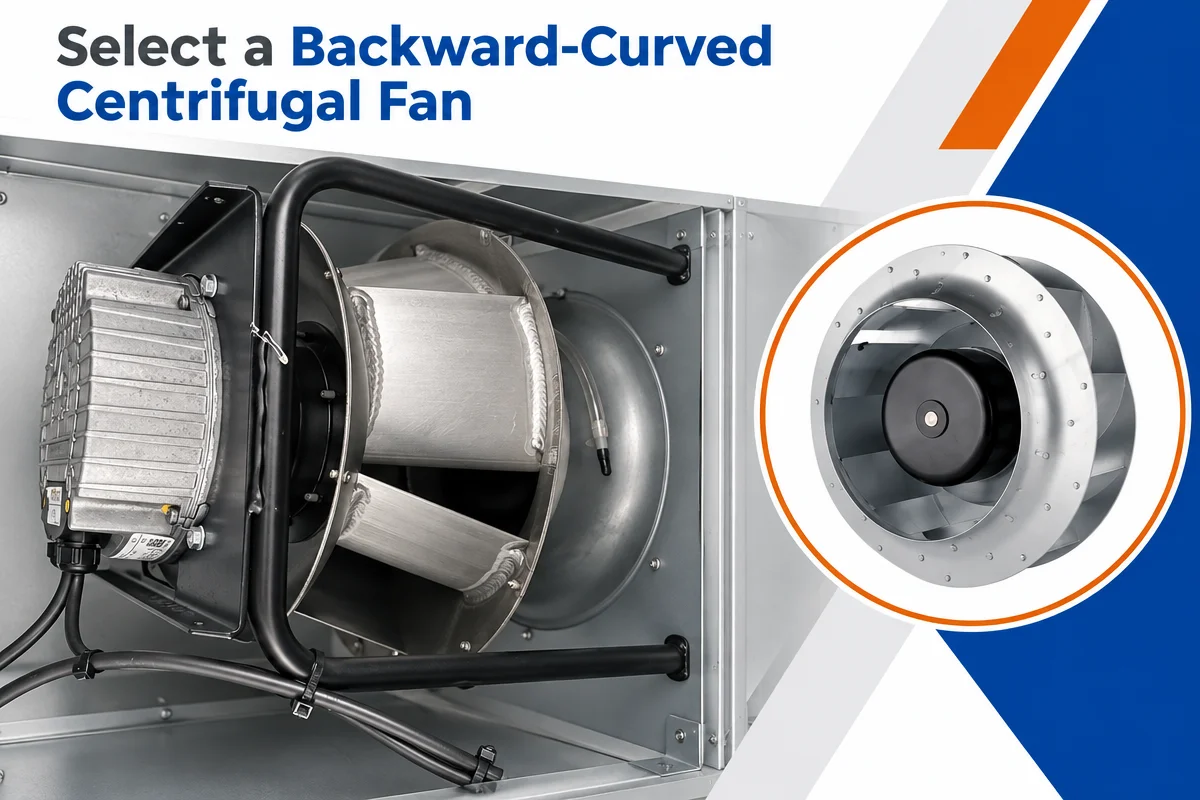
- Backward-curved centrifugal. The best efficiency in the high-static-pressure region, and non-overloading — power falls away past the peak instead of climbing. The default choice for AHU, RTU, CRAH and fan-array duty.
- Forward-curved centrifugal. Compact and quiet at lower pressures, but lower peak efficiency and prone to dust accumulation in the blade passages.
- Axial. Best for high flow at low pressure — cooling towers, condensers, tunnel and wall ventilation — where a large swept area is more valuable than pressure capability.
- Plug fans. A backward-curved impeller without a scroll housing, mounted directly in the AHU plenum. Removes scroll losses, shortens the unit and simplifies maintenance access.
Motor Technology
|
Features |
AC induction motor + external VFD |
Integrated EC fan (BLEC / PMSM) |
|---|---|---|
|
Standby / part-load energy |
Motor efficiency holds well at full load, falls at part load; VFD adds its own losses and harmonics |
✅ High efficiency across the whole speed range |
|
Published comparison |
Baseline |
✅ LONGWELL publishes around 30% less energy than AC equivalents |
|
Speed control |
Requires a separate VFD panel, screened cable, EMC assessment |
✅ Built in: 0–10 V, PWM, RS485 / Modbus options |
|
Transmission |
Direct or belt driven, both need alignment and maintenance |
✅ Direct drive — no belt, no pulley, no alignment |
|
Footprint and cabling |
Motor + VFD panel + control wiring |
✅ One package, one supply, one signal |
|
Protection |
Depends on external protection devices |
✅ Current limiting, over-temperature, over-current, locked-rotor and soft start integrated |
|
Status output |
Requires additional instrumentation |
✅ Speed output signal available for BMS trending |
Airflow&Speed
Airflow is typically expressed in cubic meters per hour (m³/h), liters per second (L/s), or cubic feet per minute (CFM). State the required airflow and the total static pressure at the same point, then ask for the input power and speed at that point. A fan quoted at “5,000 CFM” or “8,000 m³/h” says nothing about whether it will do the job in your system.
Static Pressure
Fans must overcome resistance from ductwork, filters, heating and cooling coils, dampers, grilles, heat exchangers, and other components. This resistance is commonly expressed as static pressure in pascals (Pa) or inches of water gauge (in. w.g.).
Higher system resistance generally requires more fan power to maintain the same airflow.
Noise Level
For fan applications in special environments like cleanroom and data centers, noise level is very important. Sound power is a property of the fan; sound pressure depends on the room. Ask for octave-band values from 63 Hz to 8 kHz rather than a single dB(A) number.
Physical Dimension
Fans must be physically compatible with their environment. For ceiling fans, match the blade sweep diameter to your room’s square footage to ensure adequate coverage. For electronics or HVAC installations, check millimeter specifications to guarantee proper physical housing clearance.
Smart Control
For electronic or PC fans, opt for 4-pin PWM support, which allows your system to dynamically scale the fan’s speed based on real-time temperature fluctuations.
How to Calculate Fan Energy Savings and Payback?
Step 1 — Convert airflow and pressure into power
Air power (kW) = Qm³/s × ΔPPa ÷ 1000
Shaft power (kW) = Air power ÷ ηfan
Electrical input (kW) = Shaft power ÷ ηmotor ÷ ηdrive
Imperial equivalent: brake horsepower = CFM × total static pressure (in. wg) ÷ (6356 × η). Note that this returns horsepower, not kW — divide by 0.7457 to convert.
Worked example. An AHU supply fan delivers 2.36 m³/s (about 5,000 CFM) at a total static pressure of 500 Pa (about 2.0 in. wg). Combined fan efficiency is 0.68. Motor and drive efficiency is 0.91.
Air power = 2.36 × 500 ÷ 1000 = 1.18 kW
Shaft power = 1.18 ÷ 0.68 = 1.74 kW
Electrical input = 1.74 ÷ 0.91 = 1.91 kW
Step 2 — Apply the real operating schedule
Do not use an average load factor. Build the hours table from the BMS trend or from the actual occupancy pattern.
Worked example — annual energy, speed control against damper control
|
Condition |
Hours per year |
Power with speed control |
kWh |
Power with damper control |
kWh |
|---|---|---|---|---|---|
|
100% airflow |
1,000 h |
1.91 kW |
1,910 |
1.91 kW |
1,910 |
|
75% airflow |
2,500 h |
0.42³ → 0.81 kW |
2,025 |
1.72 kW |
4,300 |
|
50% airflow |
2,500 h |
0.50³ → 0.24 kW |
600 |
1.53 kW |
3,825 |
|
Total |
6,000 h |
— |
4,535 kWh |
— |
10,035 kWh |
Assumptions: friction-dominated system curve, speed control tracking the cube law, damper control assumed to hold 90% and 80% of full-speed power at 75% and 50% airflow. Real results depend on the actual system curve and the measured part-load power of the existing fan. The 55% difference here sits inside the 50–85% energy cost saving that EPA attributes to premium-efficiency motors plus VFDs.
Step 3 — Turn kWh into money, then into payback
Simple payback sensitivity – retrofit cost against annual saving
|
Retrofit cost per fan |
Annual saving at $0.12/kWh |
Simple payback |
Annual saving at $0.20/kWh |
Simple payback |
|---|---|---|---|---|
|
$900 |
$660 |
✅ 1.4 years |
$1,100 |
✅ 0.8 years |
|
$1,200 |
$660 |
✅ 1.8 years |
$1,100 |
✅ 1.1 years |
|
$1,800 |
$660 |
⚠️ 2.7 years |
$1,100 |
✅ 1.6 years |
|
$2,500 |
$660 |
🔴 3.8 years |
$1,100 |
⚠️ 2.3 years |
Saving based on the 5,500 kWh difference in the worked example above. Retrofit cost must include the fan, any controls work, installation labour, commissioning and the cost of the downtime window — not just the unit price. Existing fan condition, existing control infrastructure and the length of the shutdown all move the number materially.
For a faster estimate, LONGWELL publishes two free tools: an EC fan savings calculator for the AC-to-EC delta, and an EC fan selection calculator that derives the fan family and motor power from airflow and pressure. The fuller methodology, including a worked retrofit model, is in the AC to EC retrofit ROI guide.
Specifying a LONGWELL Fan: Platform Map
LONGWELL platform map for commercial building fan efficiency work:
|
Platform |
Duty it covers |
|---|---|
|
LWBE3G backward-curved EC plug fan |
AHU, FCU, FFU, CRAH, fan grids and fan walls, data centre cooling |
|
LWDE3G / LWFE3G EC centrifugal fans |
Ducted and plenum duty across the EC range |
|
EC plug fan for AHU replacement |
Like-for-like replacement of scroll-housed AHU fans |
|
RLM plug fan range |
AHU, FFU, cold storage, industrial ventilation |
|
Fan Grid / fan wall systems |
AHU and CRAH arrays where turndown and redundancy both matter |
|
AC backward-curved centrifugal fans |
Where a VFD already exists or a like-for-like AC replacement is required |
|
Axial and condenser cooling fans |
Cooling towers, condensers, heat rejection |
CERTIFICATION AND TEST EVIDENCE
- ETL Recognized Component — Intertek, control number 5022563, listing LWBE3G, LWDE3G and LWFE3G models.
- CE, Low Voltage Directive (2014/35/EU) — KTS certificate KB2206066L01, listing LWBE3G models.
- RoHS (EU) 2015/863 — KTS certificate KB2206068R01, listing LWBE3G models.
- ISO 9001, ISO 14001 and ISO 45001 — management systems, valid to December 2028. These cover systems, not products.
- Air performance tested on a wind tunnel to the AMCA 210 method; sound power measured in a semi-anechoic room; outgoing sampling to AQL 2.5; test records retained for five years.
If the project is an existing AHU carrying a European-brand fan, LONGWELL publishes replacement guides for the common platforms, including ebm-papst R3G alternatives, the Nicotra alternative guide, and a full EC fan cross-reference table. Send the existing model number with airflow, static pressure, voltage, control signal and mounting dimensions, and the engineering team returns the closest platform with a written duty point.
FAQs
What is HVAC fan energy efficiency?
It is the amount of useful air power a fan system delivers for each unit of electrical power it draws — measured across a year of real operating conditions rather than at one design point. Everything upstream of that — the controller, the motor, the drive belt and the impeller — is a loss, and those efficiencies multiply. In a typical belt-driven AC AHU fan, close to half the metered electricity never moves air.
What is the difference between fan efficiency and motor efficiency?
Motor efficiency is electrical to mechanical: how much of the electricity entering the motor leaves as torque at the shaft. Fan efficiency is mechanical to aerodynamic: how much of that shaft power becomes moving air.
How much of a commercial building’s energy goes to HVAC fans?
HVAC as a whole typically accounts for one third to one half of a commercial building’s energy use, and supply and return fans commonly represent 15–35% of that HVAC total. The decisive factor is run hour. A small fan running 8,760 hours a year can out-consume a large fan running a few hundred hours.
What is the difference between an EC fan and an AC fan with a VFD?
Both can modulate speed, but they get there differently. An AC induction motor needs an external VFD panel, screened cable and an EMC assessment. An EC fan integrates a brushless commutated motor with its drive electronics in one package, so it accepts a 0–10 V, PWM or Modbus signal directly. LONGWELL publishes around 30% lower energy consumption for EC fans compared with AC equivalents.
What is a Fan Energy Index and why is it specified now?
Fan Energy Index (FEI) compares a fan’s electrical input power at a given duty with a reference fan at the same duty. An FEI of 1.0 means the fan matches the reference; higher is better. It is used in ASHRAE 90.1 fan power provisions because it evaluates the fan independently of the system, so it can be specified and verified at purchase rather than inferred from a whole-building model.