Key Takeaways:
- An EC fan pairs a permanent-magnet brushless motor with an integrated electronic controller — the variable-speed drive is built in, so no external VFD is required.
- There are several factors for energy losses in HVAC applications, like motor losses, belt losses, excess airflow at full speed, and system resistance.
- Published field figures put EC savings at roughly 15–50% versus AC, with around 30% the most commonly quoted number. Payback is typically quoted at 1–3 years.
- LONGWELL supports EC fan upgrades from initial fan selection through OEM production.
Fans are essential components of commercial HVAC systems, but their impact on energy consumption is often underestimated. They run inside air-handling units, rooftop units, fan-coil units, and condenser systems, often for thousands of hours each year. Even a small difference in fan efficiency can become a noticeable operating cost over the equipment’s service life.
Fan efficiency is also receiving more attention from regulators. From 2026, the updated EU Ecodesign Regulation 2024/1834 introduces new efficiency requirements for covered fans with an electrical input between 125 W and 500 kW. This does not mean every installed fan must be replaced, but manufacturers using older fan designs may need to review their equipment platforms. EC fans are one possible answer.
This article looks at where fan energy is lost, how EC technology reduces that consumption, and why actual savings vary. It also covers applications in rooftop units, AHUs, fan-coil units, condensers, and evaporators.
What is EC Fan Technology?
At the center of an EC fan is an EC motor, often described as a brushless DC motor. Its rotor contains permanent magnets, and its stator contains electrical windings. Instead of using brushes to switch the current, an integrated electronic controller energizes the stator windings in sequence. This creates a rotating magnetic field. The permanent-magnet rotor follows that field, turning the fan impeller with it.
Because there are no carbon brushes, an EC motor avoids the brush wear and sparking associated with brushed DC motors. The permanent magnets also provide the rotor magnetic field without the magnetizing losses required by an induction motor. This gives the controller more precise control over speed and torque, especially when the fan is operating below full speed. In HVAC equipment, that control makes it possible to match airflow more closely to actual demand.
Common Sources of Energy Loss in HVAC Fans
Motor Losses
Motor losses can increase when the motor type or motor size does not match the actual fan duty. Conventional induction and PSC motors may consume more electricity at reduced loads because their efficiency often declines away from the rated operating point. An oversized motor can create a similar problem. If a fan normally needs only part of the motor’s rated output, the motor may spend most of its operating time outside its efficient range.
In HVAC systems, this matters because fans rarely operate at full design airflow for the entire day. The extra electricity is released as heat in the windings, rotor, and other motor components instead of becoming useful fan power.
Belt and Drive Losses
In a belt-driven HVAC fan, the motor’s power must pass through belts, pulleys, shafts, and bearings before it reaches the impeller. This transmission process is not perfectly efficient. The belt bends repeatedly around the pulleys, creating internal friction and heat. Contact between the belt and pulley can also create friction. Any belt slip, poor tension, or misalignment increases the loss further.
Part of the electrical energy supplied to the motor is therefore converted into heat in the belt-drive assembly instead of useful power at the fan impeller. As belts wear, stretch, or lose alignment, the fan may receive less mechanical power and run below its intended speed.
Excess Airflow at Full Speed
HVAC fans are selected to meet the highest expected cooling, heating, or ventilation demand. In daily operation, those peak conditions occur only for limited periods. A fixed-speed fan may therefore deliver more airflow than the system needs for much of the day. Fan airflow changes approximately in direct proportion to fan speed. Fan power changes approximately with the cube of fan speed. This relationship means that reducing fan speed can lower energy consumption much faster than it reduces airflow.
System Resistance
System resistance is a normal part of HVAC operation. As the system runs, dust and other particles can build up in filters, on coils, and around fan components. This buildup increases pressure drop through the air path.
When system resistance rises, the original fan speed may no longer deliver the required airflow. A fixed-speed fan will provide less airflow. Over a long operating period, the variable-speed fan can move farther away from its intended duty point and best efficiency point.
How EC Fans Reduce HVAC Energy Consumption?
Higher Motor Efficiency
An EC motor uses permanent magnets in the rotor instead of relying on an induced rotor magnetic field. This design reduces rotor losses and the magnetizing energy required by conventional induction motors. More of the electrical input can be converted into useful mechanical power at the fan shaft. The EC fans’ soft-start function raises fan speed gradually at startup, reducing electrical inrush and mechanical stress on the fan assembly.
Many EC fans use a direct-drive design. The motor connects directly to the fan impeller, removing the belt-and-pulley transmission system. This eliminates belt-related friction, slip, and flexing losses. It also reduces mechanical noise and removes the need for routine belt tensioning and alignment.
Demand-based Speed Control
EC fans can receive speed commands through 0-10 V analog signals, PWM signals, or Modbus RTU communication over RS485. These signals are sent to the fan’s built-in EC controller. The controller adjusts the motor speed according to the required airflow.
In an HVAC system, the speed command can come from a temperature sensor, duct-pressure sensor, occupancy schedule, air-quality sensor, or building management system. When demand falls, the EC fan can reduce its speed. This helps prevent unnecessary airflow and the energy loss associated with damper throttling.
Fan power decreases rapidly as speed is reduced, so demand-based control can lower annual energy use in systems that operate at part load for long periods. The actual savings depend on the fan duty point, operating hours, system resistance, and control settings.
Efficient Performance at Part Load
Commercial AHUs in HVAC systems rarely operate at full output for the entire day. Variable air volume control, demand-controlled ventilation, occupancy changes, and overnight setback can all reduce the required fan load.
Under partial-load conditions, a conventional AC induction motor may draw less total power than it does at full load. Its efficiency and power factor can still decline as the mechanical load decreases. Some electrical and magnetic losses remain even when the motor is not delivering its rated output.
EC motors can maintain stronger efficiency across a wider operating range. This makes EC fan technology particularly suitable for HVAC systems that spend long periods operating below their peak duty point.
Practical Applications of EC Fans in HVAC
Rooftop and Air-Handling Units
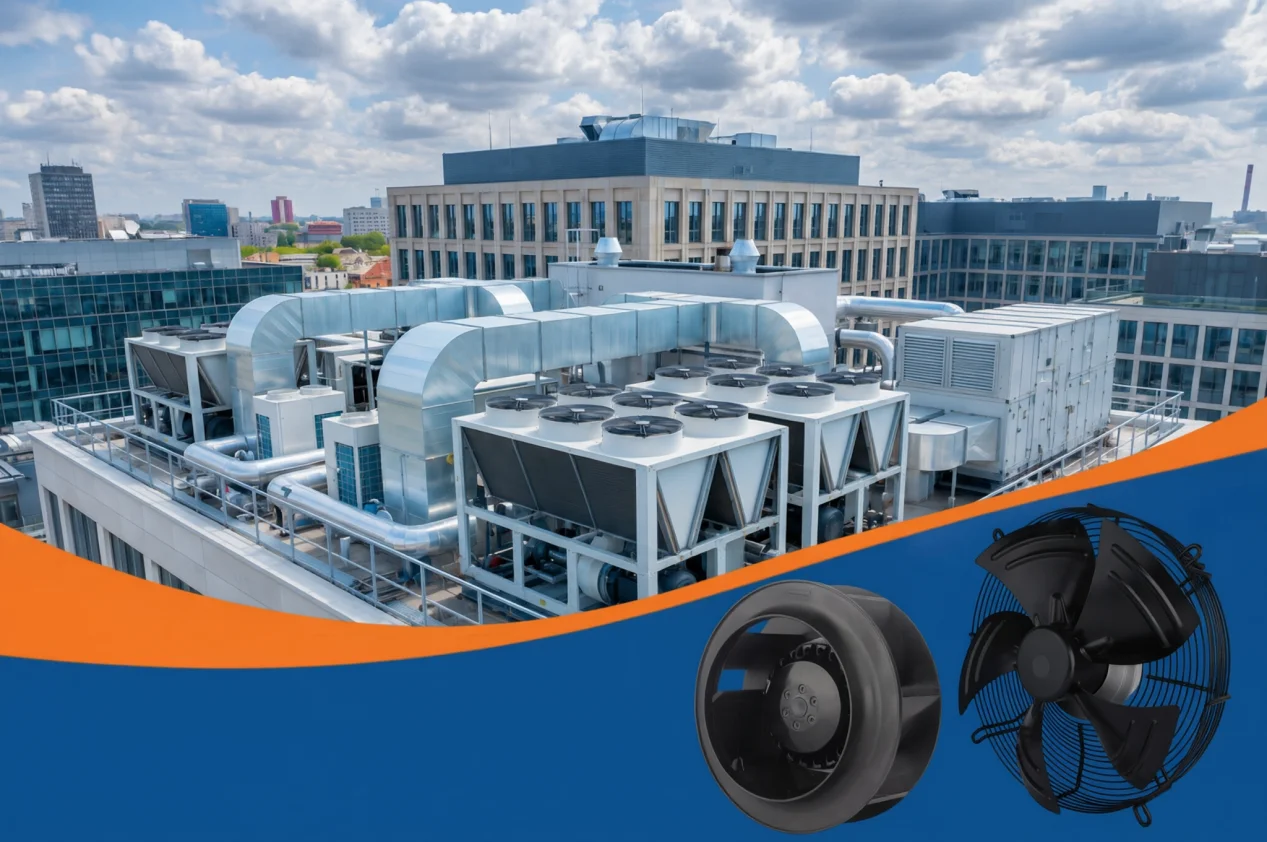
Rooftop units (RTUs) are packaged HVAC systems installed on commercial-building roofs. They usually mix return air with the required amount of outdoor air, filter the air, heat or cool it, and distribute it through ductwork.
Air-handling units (AHUs) perform a similar air-treatment role, although they may be installed indoors, in mechanical rooms or on rooftops. Both systems need supply fans that can overcome the pressure drop created by filters, coils, dampers, and ductwork.
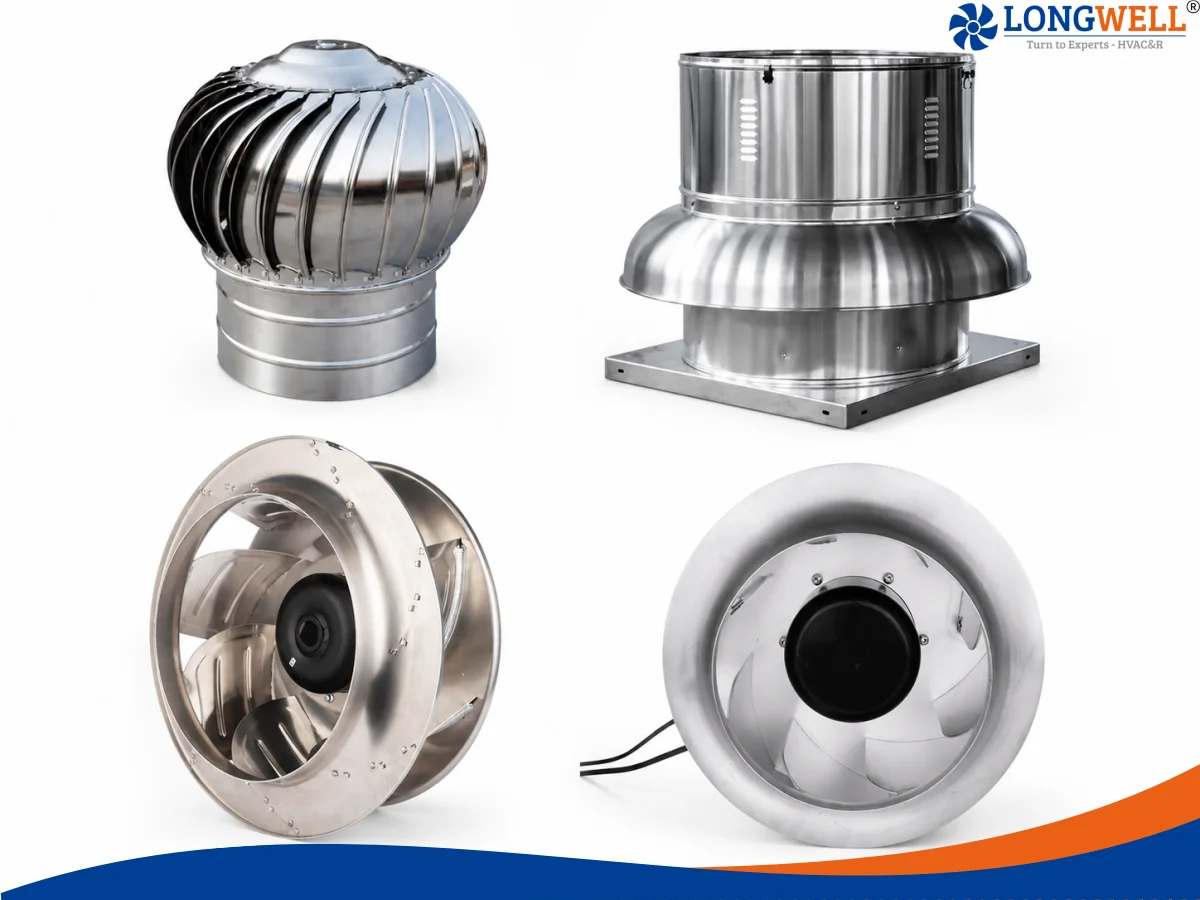
Backward-curved EC centrifugal fans are commonly used for these medium- and high-static-pressure duties. The integrated EC motor can adjust fan speed as airflow demand changes, helping the AHU or RTU avoid operating at full output when peak airflow is not required. Fan selection should still match the actual airflow and static-pressure duty point.
Fan-Coil Units
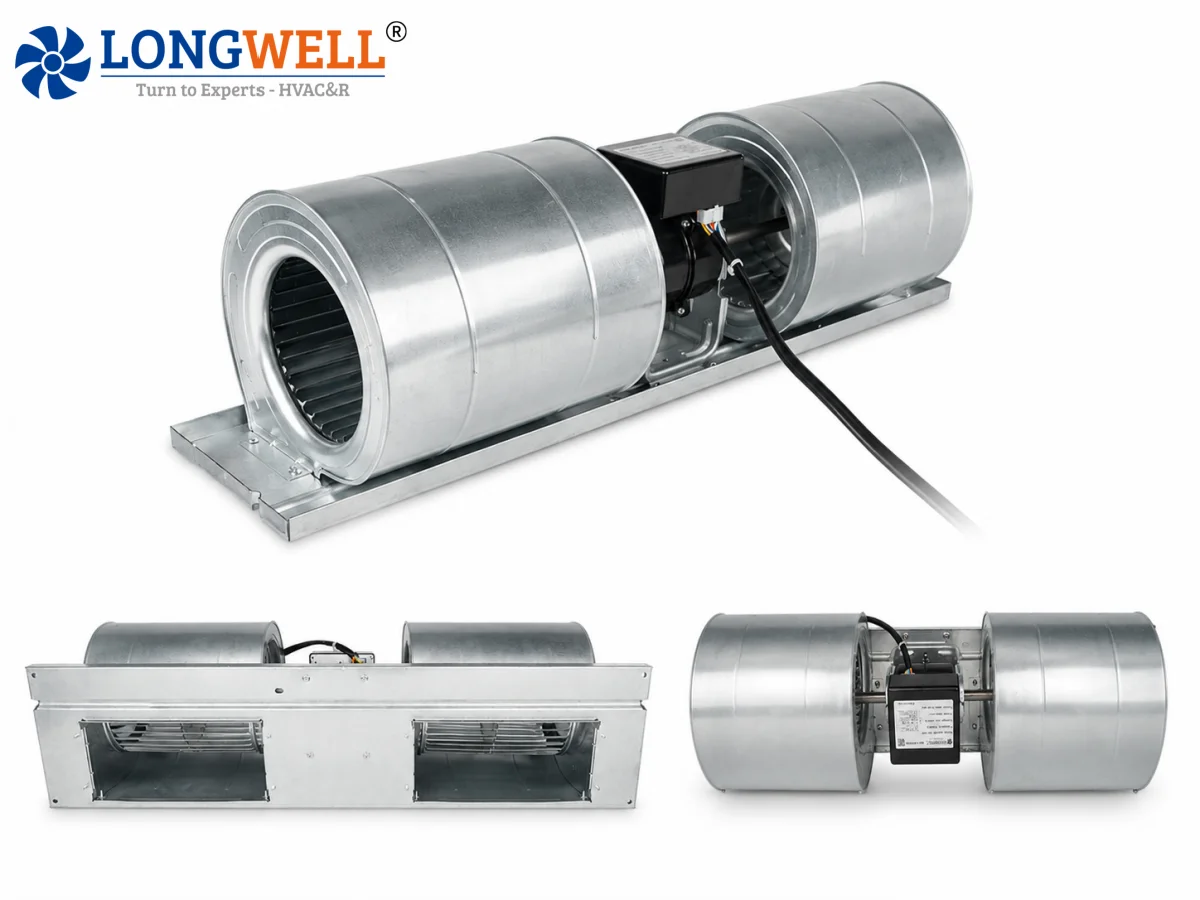
Fan-coil units are installed close to occupied spaces, so selection involves more than airflow alone. Designers need to consider the mounting location, such as ceiling, wall or floor installation, along with concealed or exposed construction, cooling and heating capacity, available static pressure, pipe arrangement and room noise requirements. Hotels, hospitals, offices and serviced apartments often need compact FCUs that can operate quietly for long periods.
EC fans are well suited to this duty because FCUs rarely need full airflow throughout the day. Room load changes with occupancy, outdoor conditions and thermostat settings. An EC fan can reduce its speed smoothly as heating or cooling demand falls. This lowers fan power and can reduce sound levels during night-time or low-occupancy operation. Smooth speed adjustment also helps the FCU maintain room temperature without repeated full-speed starts and stops.
Condensing Unit and Evaporator Coil
The condensing unit releases heat from the refrigeration system to the outdoor air. EC axial fans in condensing units can adjust airflow according to condensing pressure, outdoor temperature, and compressor load. At lower cooling loads or mild outdoor temperatures, the fan does not need to operate at full speed, reducing energy waste.
The evaporator coil is normally located inside an air-handling unit, fan-coil unit, or indoor air handler. Warm indoor air moves across the coil, and the refrigerant absorbs heat from that air. EC fans here can adjust airflow according to room cooling demand. Lower fan speed reduces fan power during part-load operation and may reduce noise in occupied areas. The cooled air is then supplied back to the occupied space.
Upgrade to Energy-Saving LONGWELL EC Fans
In a manufacturer-reported ten-ton rooftop-unit configuration, LONGWELL supplied an EC supply-air centrifugal fan and two EC axial condenser fans using the EC motor platform. The reported fan-system efficiency increased from about 58% for the AC baseline to at least 70% for the EC configuration. A common motor platform across the supply-air and condenser sides can also simplify component sourcing and spare-parts management.
| AHU/RTU Capacity | Recommended Model | EC Fan Efficiency |
|---|---|---|
| Small AHU / 3–5 ton RTU | LWBE3G-355 | 88% |
| Medium AHU / 7–10 ton RTU | LWBE3G-450 | 90% |
| Large AHU / 15–20 ton RTU | LWBE3G-560 | 91% |
LONGWELL supports EC fan upgrades from initial fan selection through OEM production. For legacy belt-driven and fixed-speed installations, LONGWELL EC fans provide a direct-drive upgrade path that can reduce mechanical transmission losses and add variable-speed control. Depending on the available space and airflow requirement, the solution may use a single EC plug fan or multiple EC fans operating in parallel.
Beyond standard catalog models, LONGWELL offers OEM/ODM options, including custom impeller geometry, housing materials, motor voltages, and control firmware. EC fans can be configured with 0–10 V, PWM, Modbus RTU, Modbus TCP, BACnet MS/TP, CANopen, and other control options for easier HVAC and BMS integration.
FAQ
Why are EC fans more efficient?
EC fans use a permanent-magnet, brushless motor with integrated electronic control. The design reduces rotor losses, and the controller adjusts motor current and speed.
What are the disadvantages of EC motors?
EC motors usually cost more than basic AC motors. Their integrated electronics can also make repair more specialized.
How to control an EC fan?
Most EC fans accept a 0–10 V analog signal, PWM signal, or digital communication such as Modbus RTU over RS-485.
What is the difference between EC and AC fans?
A conventional AC fan commonly uses an induction or PSC motor. EC fans convert AC to direct current internally using an integrated circuit board, offering much higher energy efficiency and precise speed control.