Key Takeaways
- Fan Energy Index (FEI) measures a fan system’s wire-to-air energy performance.
- FEI compares the reference fan’s electrical input with the selected fan’s input at the same airflow and pressure duty point.
- An FEI of 1.00 matches the common reference baseline. A higher value indicates lower power use; a lower value indicates higher power use.
- For HVAC fan selection, define the required airflow and pressure first. Then compare FEI ratings for suitable fan options and check the applicable code or project requirements.
AMCA developed the Fan Energy Index (FEI). ANSI/AMCA 214-21 provides a test procedure for calculating FEI for commercial and industrial fans and blowers. ISO later published its own FEI calculation standard, ISO 12759-6:2024. The standard sets out an international method for calculating FEI at a fan duty point. However, the index is not suitable for air curtains or circulating fans. FEI is used in U.S. codes and standards and is referenced as a voluntary metric in India’s draft Energy Conservation and Sustainable Building Code 2024.
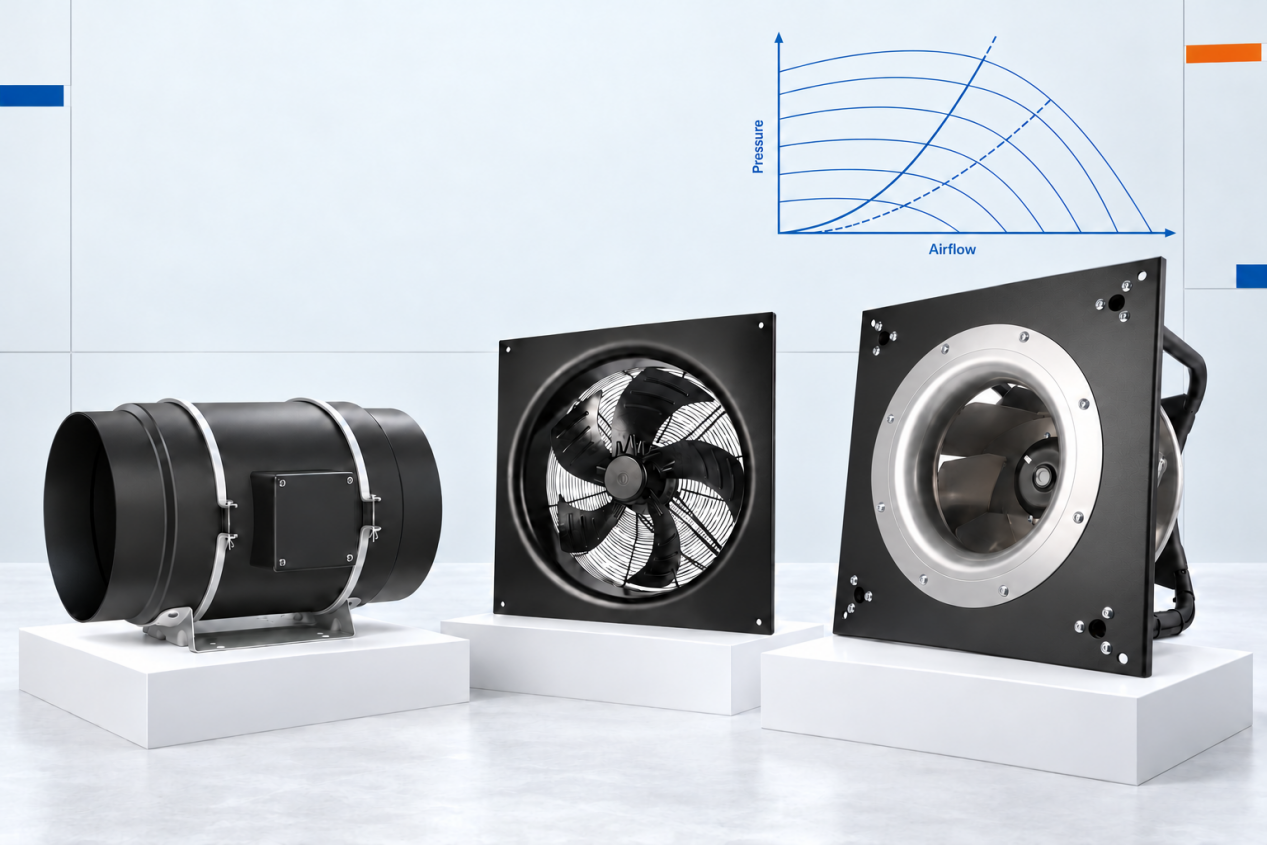
The FEI provides engineers a reference point while selecting fans for HVAC applications. This blog will introduce the Fan Energy Index (FEI) and the calculation method. It also points out the method for selecting HVAC fans using FEI.
What is Fan Energy Index (FEI)?
How to Calculate FEI for an HVAC Fan?
FEI compares the electrical input power of an actual fan system with that of a reference fan at the same airflow and pressure duty point. It can also be expressed as the ratio of actual overall fan efficiency to baseline overall fan efficiency:
- FEI = Actual Overall Fan Efficiency / Baseline Overall Fan Efficiency
Since these efficiencies are calculated under the same airflow and pressure. In electrical power terms, the equivalent formula is:
- FEI = Reference Fan Electrical Input Power / Actual Fan Electrical Input Power
Because airflow and pressure vary along a fan curve, FEI can be calculated at different duty points.
FEI vs. Other Metrics: What Are the Differences?
- Fan Efficiency Grade (FEG) measures the fan’s ability to convert its impeller or shaft power into air power. Engineers often use this metric to define HVAC project’s energy efficiency needs.
- Fan Motor Efficiency Grade (FMEG) has been the primary legal standard for regulating commercial and industrial ventilation fans in the European Economic Area. It measures the overall energy efficiency of a complete fan, motor, and drive assembly.
Both FEG and FMEG are measured based on peak-efficiency point. FEI compares the electrical power of the actual fan system with the reference fan at the same duty point. For HVAC fans, FEG describes the fan’s aerodynamic quality, FMEG rates the fan and drive combination, and FEI evaluates energy performance at the project’s specified operating point.
How to Interpret FEI Values?
What does FEI 1.00 Mean?
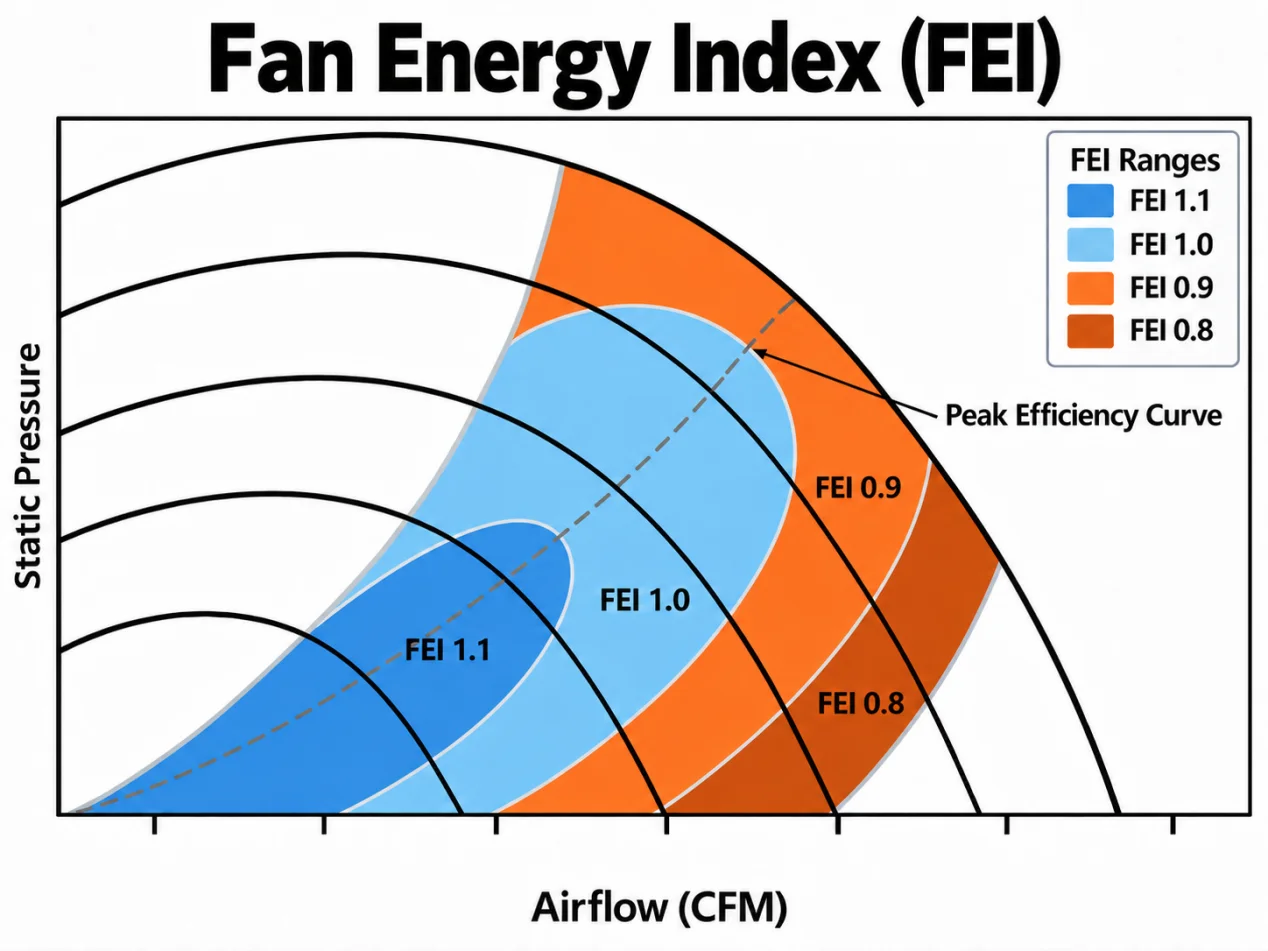
FEI uses a baseline value to evaluate how much electrical power a fan consumes at duty point. The baseline reference fan model is defined by AMCA. An FEI value of 1.00 means the actual fan consumes the same electrical power as the reference fan at the same duty point. However, it does not mean the selected fan is efficient. FEI assumes the fan efficiency, motor efficiency, and transmission losses, providing a common reference for comparing different HVAC fans.
What does FEI Above or Below 1.00 Indicate?
Some building energy codes, such as ASHRAE 90.1-2022, typically mandate a minimum FEI of 1.00. An FEI above 1.00 means a fan system uses less electrical power than the reference fan at the same airflow and pressure. For example, an FEI of 1.20 corresponds to about 20% less input power than the FEI 1.00 baseline. An FEI below 1.00 means the system uses more power. At 0.90, it uses about 10% to 11% more electrical power. Whether a fan meets code depends on the requirements that apply to the project.
Why must Fans be Compared at the Same Duty Point?
Fans must be compared at the same duty point, defined by the required airflow and pressure, because FEI compares actual and reference electrical input under the same operating conditions. FEI can change across a fan’s performance curve and with fan speed, so one fan may have different FEI values at different duty points. It is a wire-to-air metric that accounts for the fan system’s electrical input, including motor and drive losses. FEG, by contrast, describes the fan’s peak efficiency without including the drive.
A high FEG therefore does not guarantee a high FEI at the HVAC system’s design point. To assess energy performance, check the fan’s FEI at the airflow and pressure it needs to deliver; an oversized or poorly matched fan may operate away from its efficient range and have a lower FEI.
3 FEI Tips for HVAC Fan Selection
Check the System Requirements First
Before starting HVAC fan selection, make sure the system requirement is always the first thing. Then turn to define the required airflow and pressure, and also identify application needs such as available space and noise limits. If possible, also consider whether airflow demand will vary. These requirements establish the duty point and help narrow the options before comparing their FEI values.
Get FEI data for Each Fans
Use fan selection tools or product catalog to find the precious duty point with required airflow and pressure. Some fan selection tools can recommend the model types. Confirm that the selected fans using the same pressure basis and all the figures are comparable. If FEI data is not listed for the required duty point, request it from the manufacturer. Compare only ratings based on matching operating conditions.
Compare Energy Performance
Once the fan options meet the required airflow and pressure, compare their FEI ratings and electrical input power at the design duty point. A higher FEI indicates lower electrical input relative to the reference fan at that duty point. Compare only fans that can meet the system requirements. The highest FEI alone does not establish the best fit. For systems with variable airflow, check FEI at the relevant operating too. The designed point value does not describe every load condition.
Reference FEI for HVAC Applications
|
HVAC Application |
Reference FEI |
Standard / Reference |
|
Constant-air-volume (CAV) ventilation |
≥ 1.00 |
ASHRAE 90.1, IECC |
|
Variable-air-volume (VAV) systems |
≥ 0.95 |
ASHRAE 90.1, IECC |
|
Commercial supply and exhaust fans |
≥ 1.00 |
General requirement for covered fans under ASHRAE 90.1 |
|
Fan arrays in AHU systems |
≥ 1.00, or ≥ 0.95 for qualifying VAV systems |
AMCA 208 Annex C, applicable energy codes |
|
High-performance green buildings |
≥ 1.10 |
ASHRAE 189.1 FEI provisions |
|
California commercial HVAC installations |
≥ 1.00, or ≥ 0.95 for qualifying VAV systems |
California Title 24, Part 6 (2025) |
Notes:
- FEI is not assigned by fan application alone. An axial fan, centrifugal fan, or plug fan does not automatically have a different FEI requirement. The applicable code, system configuration, fan size, and exemptions determine the minimum.
- FEI 0.95 is a permitted minimum in qualifying VAV applications, not a general recommendation to select less efficient fans.
- FEI 1.10 is a higher-performance benchmark, but it should only be described as mandatory when the relevant standard or project specification applies.
- EI is evaluated at the specified design duty point, using the appropriate pressure basis.
LONGWELL HVAC Fan Selection Support
LONGWELL supports HVAC projects from fan selection through after-sales service. Its engineers help customers match fans to airflow and pressure requirements. LONGWELL’s commercial HVAC solution covers axial fans, backward-curved and forward-curved centrifugal fans.
If a standard model needs adjustment, its 90-day NPI program supports specification, design, prototyping, and mass production. After delivery, the support team responds to service cases within one business day and handles confirmed quality issues through an 8D process. LONGWELL products include a 12-month standard warranty, with 18–24-month terms available by project agreement.
|
Series |
Fan type |
HVAC application |
Airflow |
Static pressure |
Other listed specifications |
|
LWBE3G |
EC Backward-curved Centrifugal Fan |
AHU / RTU |
5,000–32,000 m³/h |
400–1,500 Pa |
12 sizes, 190–710 mm; EC efficiency at 88–92% |
|
LWFC |
EC Forward-curved Centrifugal Fan |
FCU / terminal units |
200–2,000 m³/h |
30–200 Pa |
All sizes; noise range 28–45 dB(A) |
|
LWAA |
EC Axial Fan |
Evaporators / condensers |
1,500–15,000 m³/h |
80–400 Pa |
13 sizes, 200–1,000 mm; IP54 standard, with IP55/66/68 options |
FAQ
Which method reduces energy consumption in buildings?
Under the fan laws, power consumption varies approximately with the cube of speed. Use external VSD or upgrade into EC motor fans can significantly reduce energy consumption.
What are the benefits of using high FEI fans?
A higher FEI means the fan uses less electrical power than the reference fan at the same airflow and pressure. This helps engineers compare the energy performance of fan options at the duty point.
What is a better FEI value?
A higher FEI indicates lower power use relative to the reference fan at the same duty point. An FEI of 1.00 matches the common reference baseline. Some energy codes set minimum FEI requirements, certain ASHRAE 90.1 provisions use 0.95 for covered variable-air-volume systems.
Does Europe use FEI?
No. The EU Ecodesign regulation (ErP) for covered fans sets requirements using minimum fan-efficiency levels rather than an FEI threshold.