Key Takeaways
- Axial fan noise can be mainly classified into two types: aerodynamic noise and mechanical noise.
- Decreasing the fan speed and keeping airflow paths clear at the inlet and outlet can reduce aerodynamic noise.
- Vibration isolators, flexible duct connections and regular cleaning address noise from mounting and vibration.
- Low-noise fan selection starts with airflow, static pressure and a noise target. Testing in the equipment confirms the final performance.
Axial fans are widely used in commercial building cooling and industrial ventilation. Industrial environments require efficient ventilation, but excessive fan noise can make a challenge. When an axial fan develops an unusual hum, rattle or whine, engineers need to find out what has changed. The excessive noise during operation may be caused by restricted airflow, worn bearings or unbalanced impellers. When workers are working in a continuous noisy environment for a long time, their communication will be disrupted. Identifying these noise sources is helpful for engineers to select effective mitigation methods. This article explains the causes of axial flow fan noise and the practical steps that engineers can take.
What is Axial Fan Noise?
Aerodynamic Noise
Aerodynamic noise gets its name from the airflow that produces it. As axial fan blades move through the air, they create chaotic airflow around the blade surfaces and tips. These turbulence interact with the housing or nearby obstructions adds further disturbances. These disturbances produce sound waves. A broad rushing or hissing sound is a common example. As a result, airflow noise will more pronounced as the fan speeds up.
Mechanical Noise
Mechanical noise comes from vibration in the fan’s motor and bearings. These vibrations can travel through the fan frame and its supports, producing humming, buzzing or rattling sounds. The noise often becomes more noticeable at higher operating speeds. Under high-speed rotation, the vibration force caused by imbalance will be amplified, and the noise will also become louder. Worn bearings or loose mounting hardware can add rough running sounds or rattling.
4 Practical Methods to Make Axial Fans Quieter
Method 1: Adjust Axial Fan Speed
When operating under the same airflow and static pressure, a larger axial fan running at a lower speed is often quieter than a smaller fan running faster. It is because larger impeller allows the required duty to be achieved at a lower blade tip speed, reducing aerodynamic noise.
An external variable speed drive (VSD) adjusts AC fan speed to match. EC axial fans usually integrated with speed control system such as 0-10V analog control, PWM, or Modbus digital communication. As an approximate guide, reducing speed by 10% can lower the sound power level by about 2 dB. A 20% reduction gives roughly 5 dB.
If noise becomes noticeably louder within a particular speed range, resonance may be involved. The drive can be adjusted to operate above or below that range. Its skip-frequency function can also prevent continuous operation at speeds that excite resonance in the fan or surrounding structure.
Method 2: Improve Inlet and Outlet Installation
Installation layout and surrounding conditions affect fan noise. A wall, cable bundle, sharp bend or heat exchanger placed too close to the inlet can create uneven airflow across the rotor. At the outlet, an obstruction can cause recirculation or force air through narrow gaps at high velocity. These all add to noise. Adequate inlet clearance, a straight approach section and gradual outlet transitions give air a smoother path through the installation.
Inlet and outlet silencers can further reduce airborne noise. These may be circular or rectangular to suit the flange and duct geometry. Their construction combines sound-absorbing materials with internal passages designed to guide airflow. In order to reduce the influence on the airflow, their connections must match with the axial fan.
Method 3: Install Vibration Isolation and Flexible Connections
Rigid duct connections can carry vibration from an axial fan into the inlet and outlet ducts. If this vibration excites the natural frequency of the surrounding structure, resonance can amplify the noise.
Rubber is a commonly used material in vibration isolation mounts. Its flexibility can cushion movements. The internal damping in it converts some of the vibrating energy into heat.
Fans installed on mezzanines or steel platforms often need isolators between the fan base and the supporting structure. They flexible connections here are used to to reduce vibration transmission. A rigid connection would transfer that movement into the duct joints, which can fatigue and crack over time.
Method 4: Maintain and Clean Axial Fan Components
Long working hours and harsh working conditions will accelerate the wear and tear of the motor and bearings. As these components deteriorate, vibration and mechanical noise may increase. Regular inspections help identify worn components for servicing or replacement. Maintenance includes checking whether the blades are damaged or warped. Damaged blades need to be replaced, and then a balance check is conducted on the rotating components.
The accumulation of dust caused by prolonged operation is another issue that deserves attention. The deposited substances will alter the surface of the blades. Even very little change might affects the aerodynamic performance and increase noise. Uneven accumulation can also cause the impeller to lose balance and increase vibration. Regular cleaning of the blades, guards, and casings is essential.
Step-by-step Guide to Choosing a Low-Noise Axial Fan
Key Parameters on Catalog: What do They Mean?
- Airflow (CFM or m³/h): The maximum volume of air it can move.
- Static Pressure (Pa): The maximum pressure generating to against the system resistance.
- Material: Plastic, aluminum,or steel.
- Noise Level (dB(A)): The A-weighted sound level. Lower values indicate quieter operation.
- Ingress Protection (IP) rating level: The protection against solid particles and water.
Step 1: Define the Airflow and Static Pressure Requirements
In the fan selection progress, the first step is usually define airflow and static pressure of the system. Combine the system requirements and axial rated parameters to define the target duty point. Using fan selection tool in this step would be a great convenience.
Some capacity margin is usually included for changes in system resistance. Too much margin can leave a fixed-speed fan delivering excess airflow, with additional noise.
Step 2: Set Noise Target
An axial fan’s catalogue rating describes its sound under the supplier’s stated test conditions. One common sound pressure in an anechoic chamber, with the microphone positioned 1 metre from the fan inlet. The chamber suppresses sound reflections, allowing the measurement to capture mainly direct fan noise. Actual readings can be higher. Nearby walls reflect sound, and the installed structures can introduce additional airflow noise or vibration. The following figures are approximate ASHRAE design targets for HVAC background sound in finished, unoccupied rooms.
|
Application |
Approximate HVAC Background Sound Range |
|
Drama theatres, concert and recital halls |
25 dB(A) |
|
Teleconference rooms |
30 dB(A) |
|
Private offices, conference rooms and classroom |
35 dB(A) |
|
Hospital wards,operating, and procedure rooms |
40 dB(A) |
|
Open-plan offices, corridors and lobbies |
45 dB(A) |
Step 3: Check Motor and Speed Control Options
Higher fan speeds generally produce more aerodynamic noise. EC motors use electronic commutation, and designs with lower electromagnetic noise. Compatible AC motors can operate with a variable frequency drive. DC fans commonly use PWM or voltage control. The choice of motor depends on the available power supply, budget, control interface and required speed range.
Step 4: Confirm Installation Compatibility
Since axial fans move air along the shaft, restricted space at either end can create turbulence and increase noise. The installation of axial fan needs enough clearance at both the inlet and outlet. When installed directly in a rigid location, surface resonance will amplify the noise. Rubber pads or brackets with shock absorbers should be installed to reduce the transfer of these vibrations.
Step 5: Low-Noise Axial Fan Validation
Sample validation checks the noise level after installation. Testing begins with a baseline reading in the completed installation. A Class 2 sound level meter is placed at a fixed measurement position, for example 1 metre from the fan inlet and 1.5 metres above the floor. The current drive frequency and corresponding dB(A) reading are recorded.
The actual validation resultes may have differences with rated value. For example, an axial fan rated at 35 dB(A) in an anechoic chamber could measure 42 dB(A) after installation in the system. If the results exceeds the project’s noise target, replacement with an axial fan better matched to the duty point can be evaluated.
How LONGWELL Supports Low-Noise Axial Fan Applications?
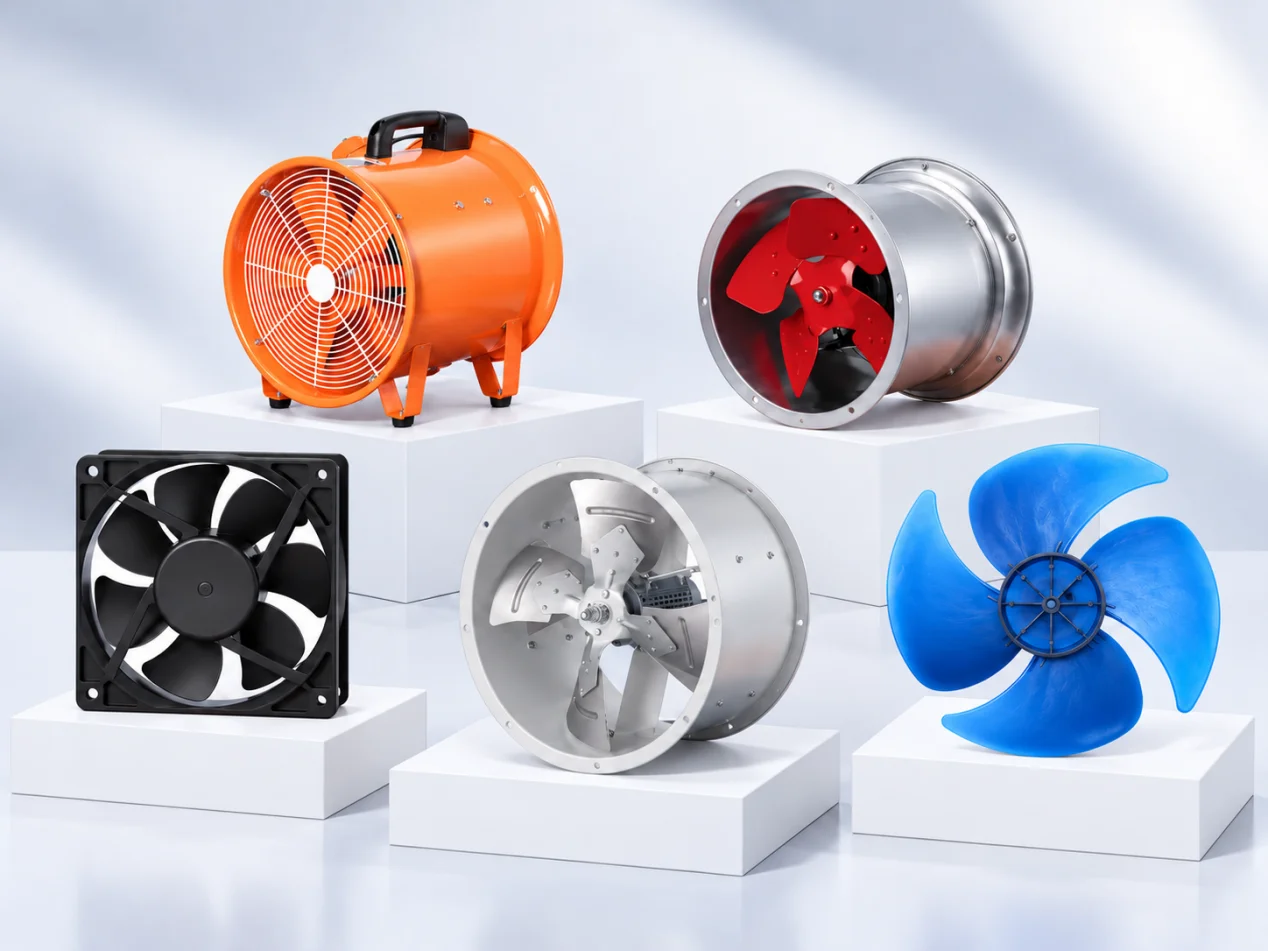
LONGWELL’s full range of axial fan series cover from condensers and electronic equipment cooling to cooling towers and tunnel ventilation. Dedicated noise-reduction features support quiet operation at higher speeds.
Blade design, motor control and equipment integration are part of LONGWELL’s approach to noise reduction. In a commercial HVAC project, the complete LONGWELL fan configuration achieved a reported reduction of 6.5 dB(A) compared with the customer’s previous solution.
For OEM projects, LONGWELL offers customization of fan dimensions, airflow parameters, materials and control functions. Selection support and sample validation cover how the fan performs once fitted into the customer’s equipment.
FAQ
Does blade design affect noise in industrial axial fans?
Yes. Much of the airflow noise comes from how air passes over the blades and around their tips. Poorly matched blade geometry can create additional turbulence, especially when the fan operates away from its intended duty point.
What role does fan speed control play in reducing overall noise?
Fan noise scales dramatically with the speed of the fan blades. Speed control allows the fan to slow down when full airflow is unnecessary. Lower blade speeds produce weaker pressure fluctuations and less aerodynamic noise.
Are axial fans quieter than centrifugal fans?
Their working condition is different and cannot be compared under the same condition. An axial fa may be quieter when moving large volumes of air in a relatively low resistance system. When the system resistance increase, a centrifugal fan may product less noise at the duty point.
What are some effective techniques for reducing fan noise?
Start by observing installation conditions. Check whether there is restricted inlet airflow and obstructions near the outlet. If condition is permitted, reducing the speed and add vibration isolators.
Choose the right axial fan
Longwell manufactures 1,086 axial fans in-house. Send airflow, static pressure and voltage — an engineer replies with a matching model, performance curve and price within one working day.