Key Takeaways
- Choosing the right backward-curved centrifugal fan starts with required airflow and total static pressure at that flow. Blade shape, diameter, speed, motor, and control come after.
- A backward-curved centrifugal fan has blades that angle away from the direction of rotation.
- The main backward-oriented designs include backward-inclined, backward-curved, and airfoil blades.
- The power curve protects the motor. Backward-curved shaft power peaks near the design point and then flattens. It does not remove the need to size the motor for worst-case duty.
- Select inside the efficiency island, near BEP. Not at the far low-flow or free-delivery ends of the curve.
- LONGWELL LWBE3G is the main platform for backward-curved EC plug-fan replacement and OEM integration.
Choosing the right backward-curved centrifugal fan is not just about selecting a fan with the right diameter. A backward-curved centrifugal fan is usually selected by two important factors: the airflow you need and the total static pressure at that flow. Blade shape, diameter, speed, motor, and control come after. So, how to select the backward-curved centrifugal fan especially for AHU suppliers, OEMs, and system engineers?
What is a Backward-Curved Centrifugal Fan?
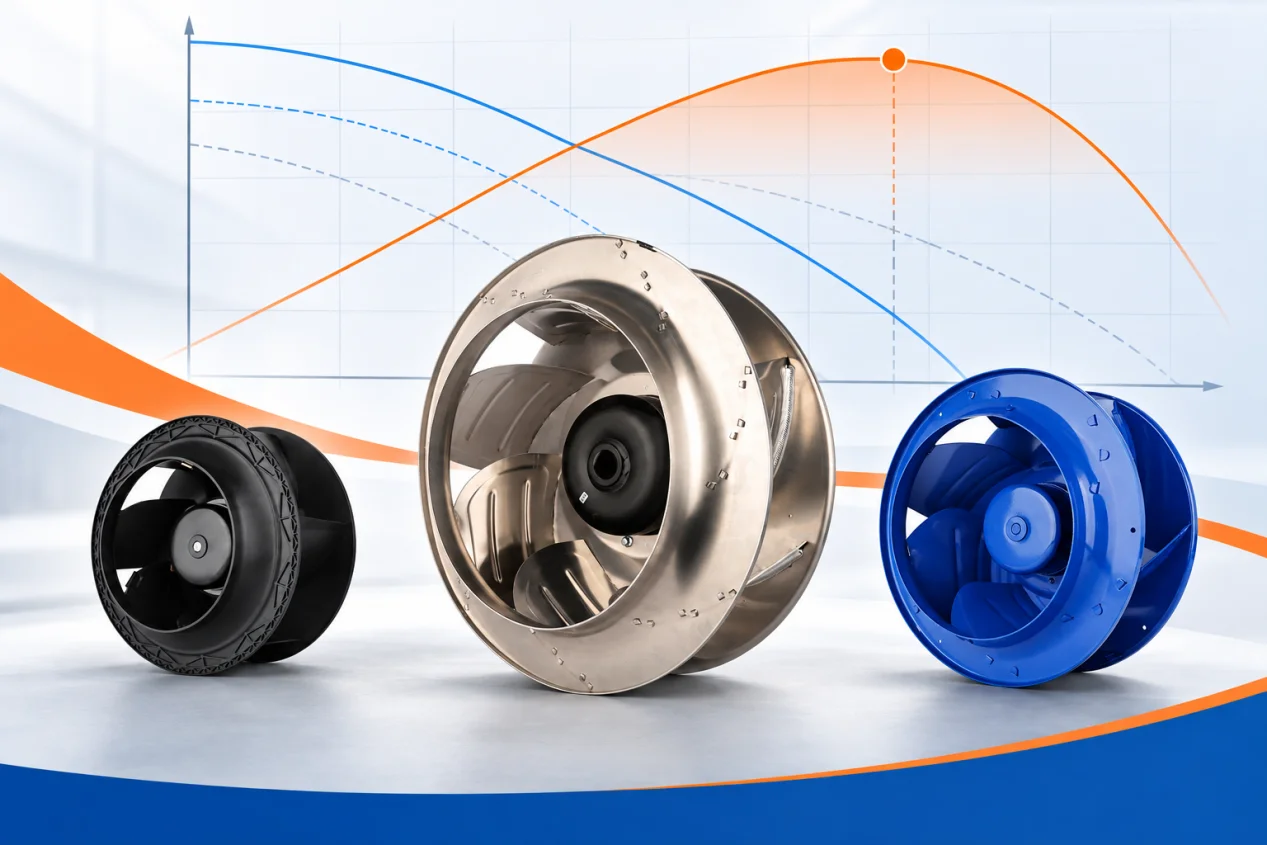
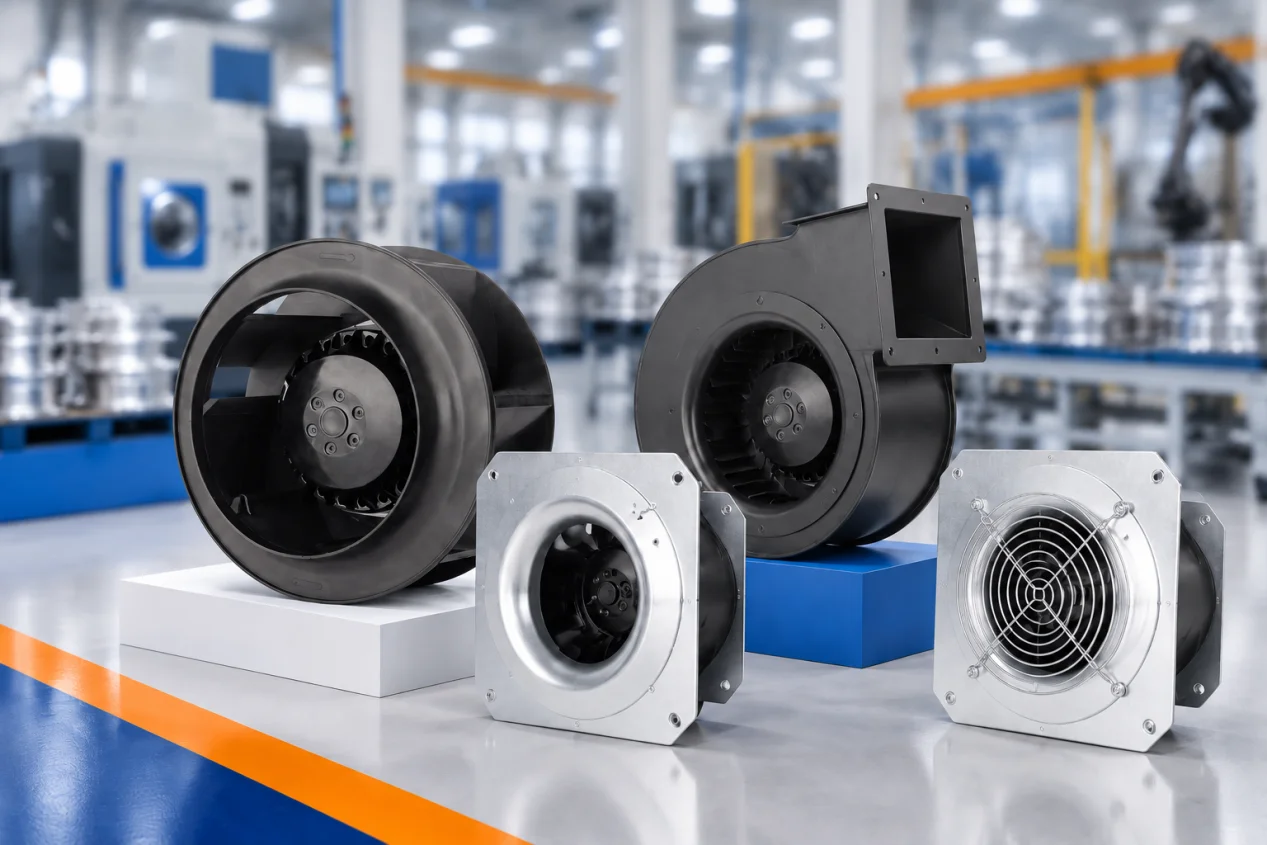
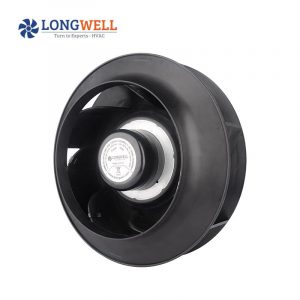
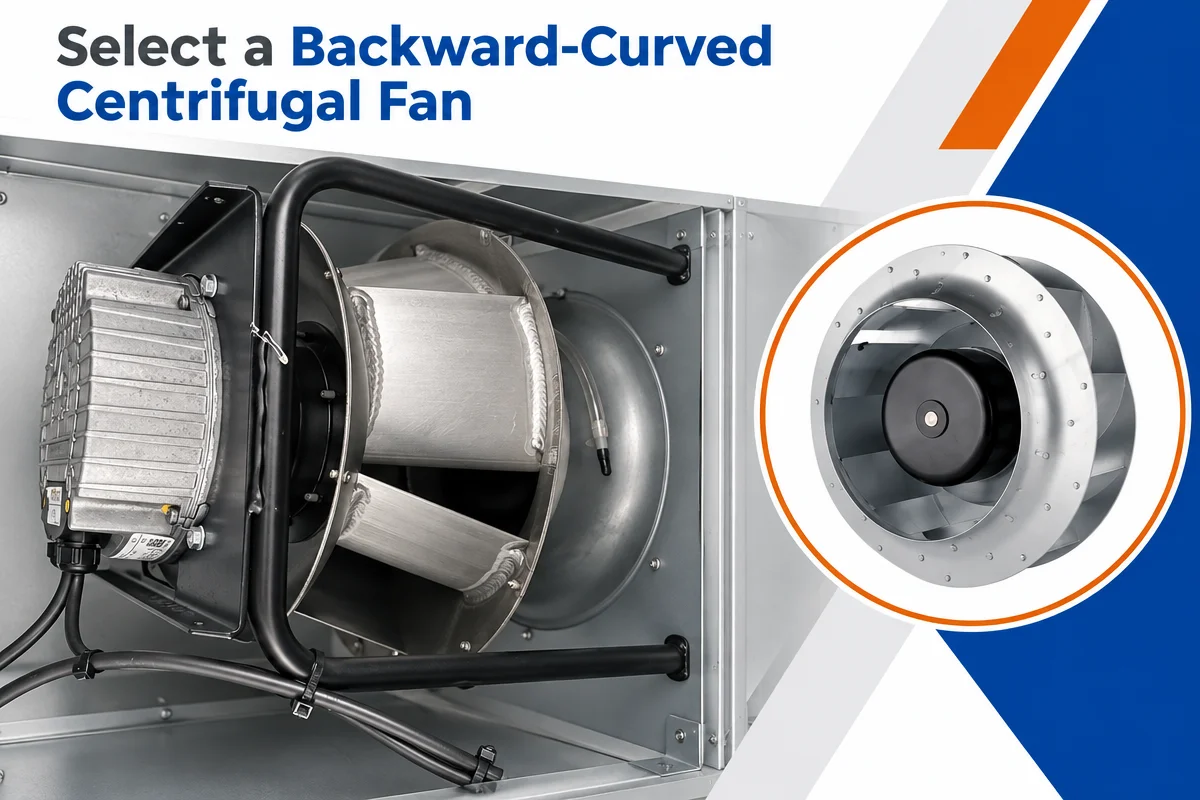
A backward-curved centrifugal fan has blades that angle away from the direction of rotation. Air enters axially through the inlet at the center of the impeller, is accelerated outward by centrifugal force along the blade surfaces. The rotating impeller converts mechanical energy into airflow and pressure, and the backward-curved blade geometry provides an operating range.
Because the blades lean away from rotation, the air leaves the impeller with less rotational velocity. Less swirl means less turbulence as the flow decelerates inside the scroll, so more of the input energy ends up as usable static pressure instead of heat and noise.
Please note that “Backward-curved” describes blade shape, not rotation direction.
Backward Centrifugal Fan Blade Types
Centrifugal fan impellers are available in several blade configurations. The main backward-oriented designs include backward-inclined, backward-curved, and airfoil blades. Radial blades are another option when handling heavily contaminated or abrasive air.
- Backward-inclined (BI) — flat, single-thickness blades tilted back. Simplest to build, lowest cost, roughly 70–80% static efficiency. Good for moderate pressure and dirtier, particulate-heavy air.
- Backward-curved (BC) — single-thickness blades with a real curve. Smoother flow, higher pressure per rpm, efficiency into the low 80s. The default for commercial ventilation and 24/7 process duty.
- Airfoil (AF) — hollow, wing-section blades. Highest efficiency, up to about 85–90% on clean-air designs, but the hollow section is vulnerable in dusty or wet streams.
Pre-Selection Checklist
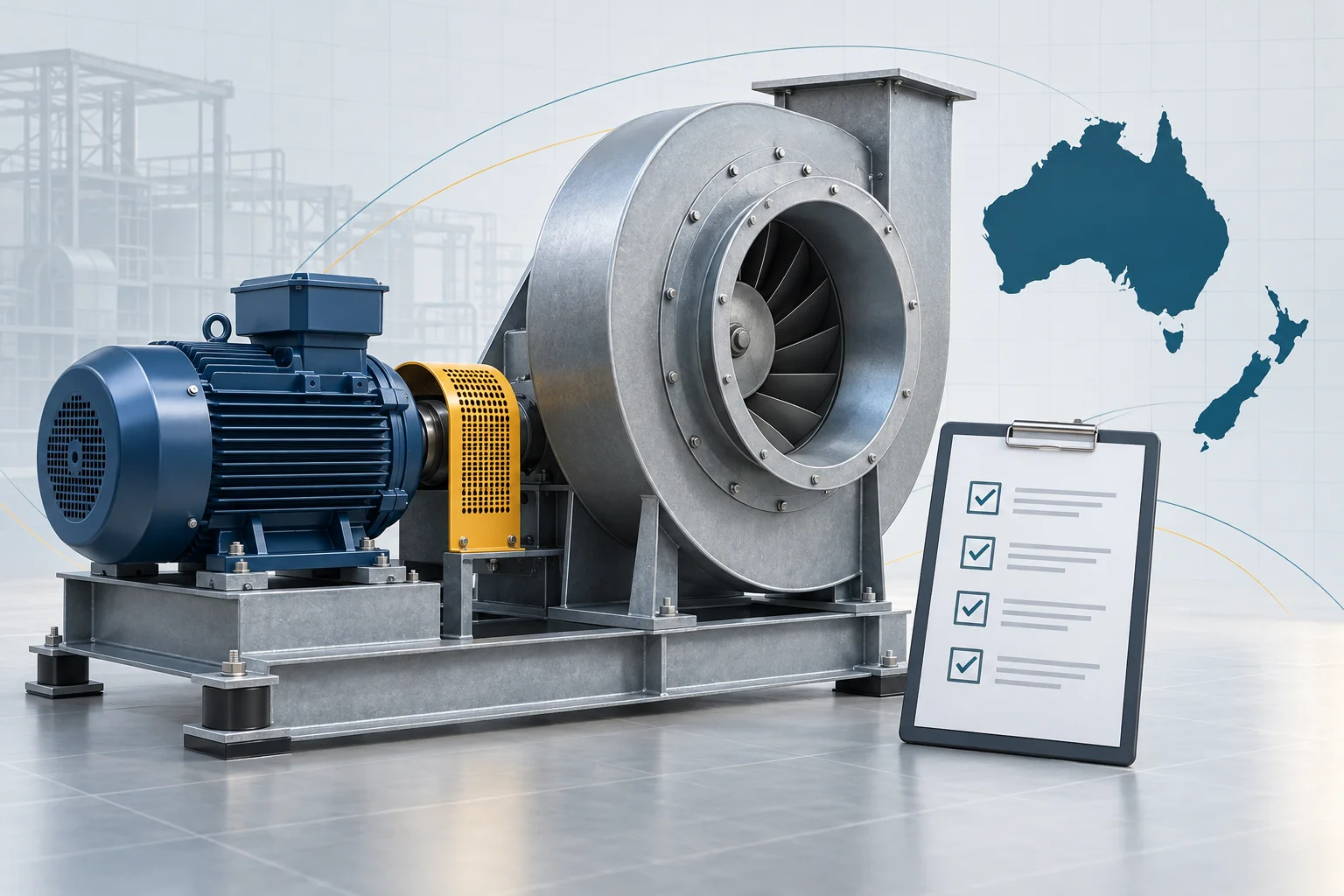
Before requesting a quotation or choosing a backward-curved centrifugal fan, prepare the following information.
- Required Airflow: Specify m³/h, m³/s, CFM
- Required Pressure: Total system static pressure at that flow
- Duty Point: Provide the airflow and pressure at the same time
- Air Conditions: Identify air temperature, density, humidity, and altitude
- Electrical Supply: Specify voltage, frequency, phase, and available power in advance
- Control Requirements: Identify VFD, EC control signal, or constant speed
- Installation Space: Provide maximum dimensions, mounting details, inlet geometry, and outlet clearance.
- Noise Limit: State the noise range that can meet your application needs
- Air Quality: Describe dust, moisture, corrosive gases, or abrasive particles
- Regulatory Requirements: Identify the target market and applicable safety, EMC, and ecodesign requirements
A complete specification helps suppliers recommend a suitable model and reduces the risk of costly changes after the produce has been designed.
How to Select the Right Backward-curved Centrifugal Fan?
When choosing the backward-curved centrifugal fan, consider your specific needs for your application. Here are some tips for OEMs to select the right backward-curved centrifugal fans. It is also wise to consult with professionals for correct installation and maintenance.
Consider Size and Capacity of the Fan
Choosing centrifugal fans with suitable sizes is very crucial. A fan that is too small won’t be able to meet airflow and ventilation demands; while a fan that is too large may lead to energy waste.
Capacity is another important factor. Check the volume flow your product needs, and the total static pressure the fan must develop at that flow. The airflow figure comes from your product’s thermal or ventilation requirement: heat load to remove, air change rate, or process flow. State whether it is a peak or a nominal value. The static pressure is the sum of every resistance the air crosses inside your product at that flow – filters, coils, heat exchangers, grilles, dampers and duct runs. Confirm whether the pressure specification is static or total pressure, and check whether the system design includes clean-filter and dirty-filter conditions.
Review the Fan Performance Curve
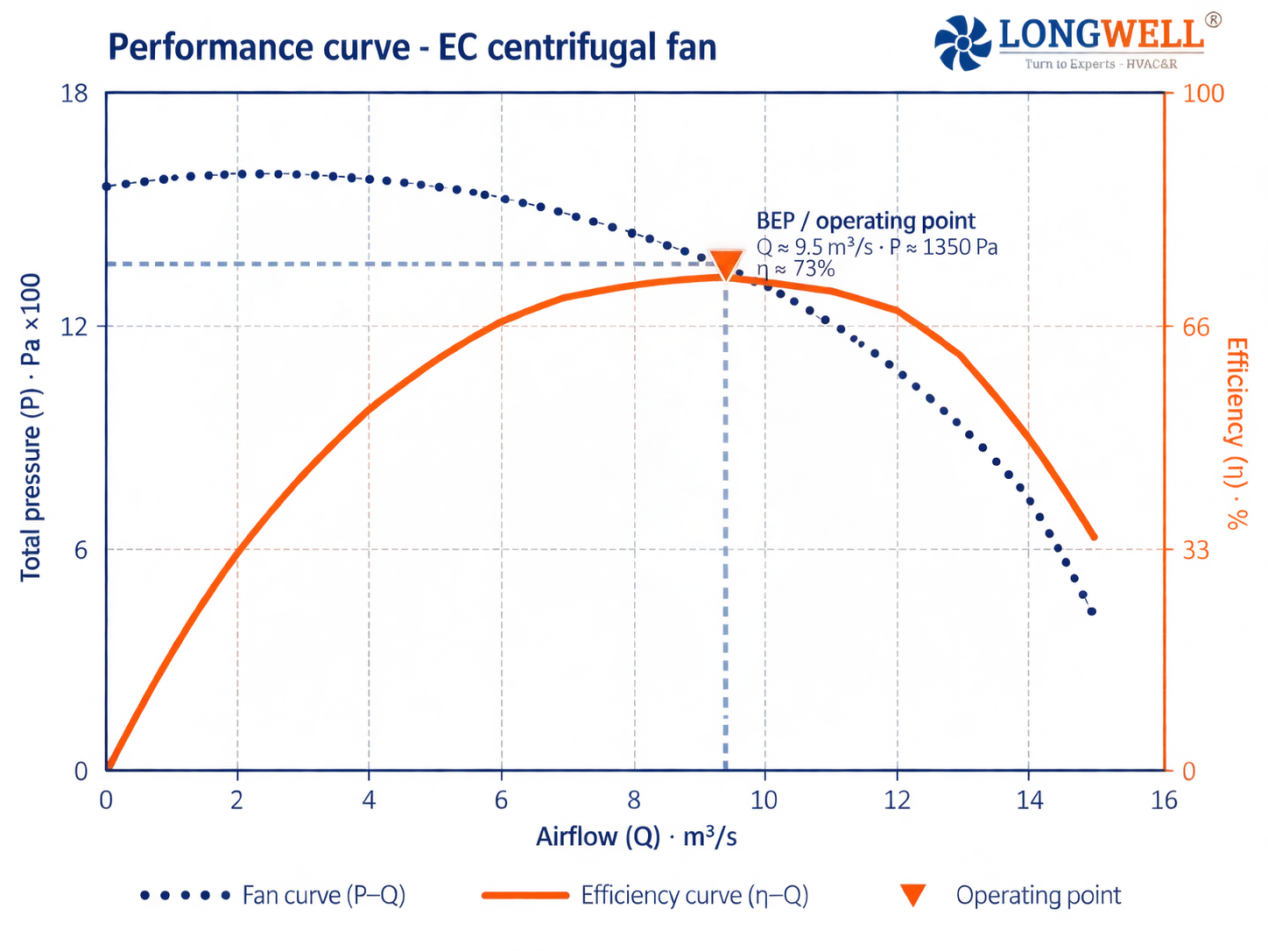
The performance curve is the selection too. Flow goes on the horizontal axis, pressure on the vertical. Where it crosses the fan curve is the operating point. The selection task is to choose a diameter and speed that put that intersection inside the fan’s efficiency island, near the best efficiency point.
A fan’s maximum airflow or maximum pressure alone is not enough to establish suitability. The duty point should fall within a stable, appropriate operating region and should not create unacceptable noise, vibration, or power consumption. For variable-speed applications, request performance curves at the relevant speeds.
Compare Efficiency and Input Power
The fan’s efficiency can range from 50% to 85%. A higher efficiency ratings usually mean lower operating cost. A motor efficiency figure, a controller efficiency figure and a fan wire-to-air figure are three different numbers, and suppliers quote whichever looks best.
Choose the Appropriate Motor Technology
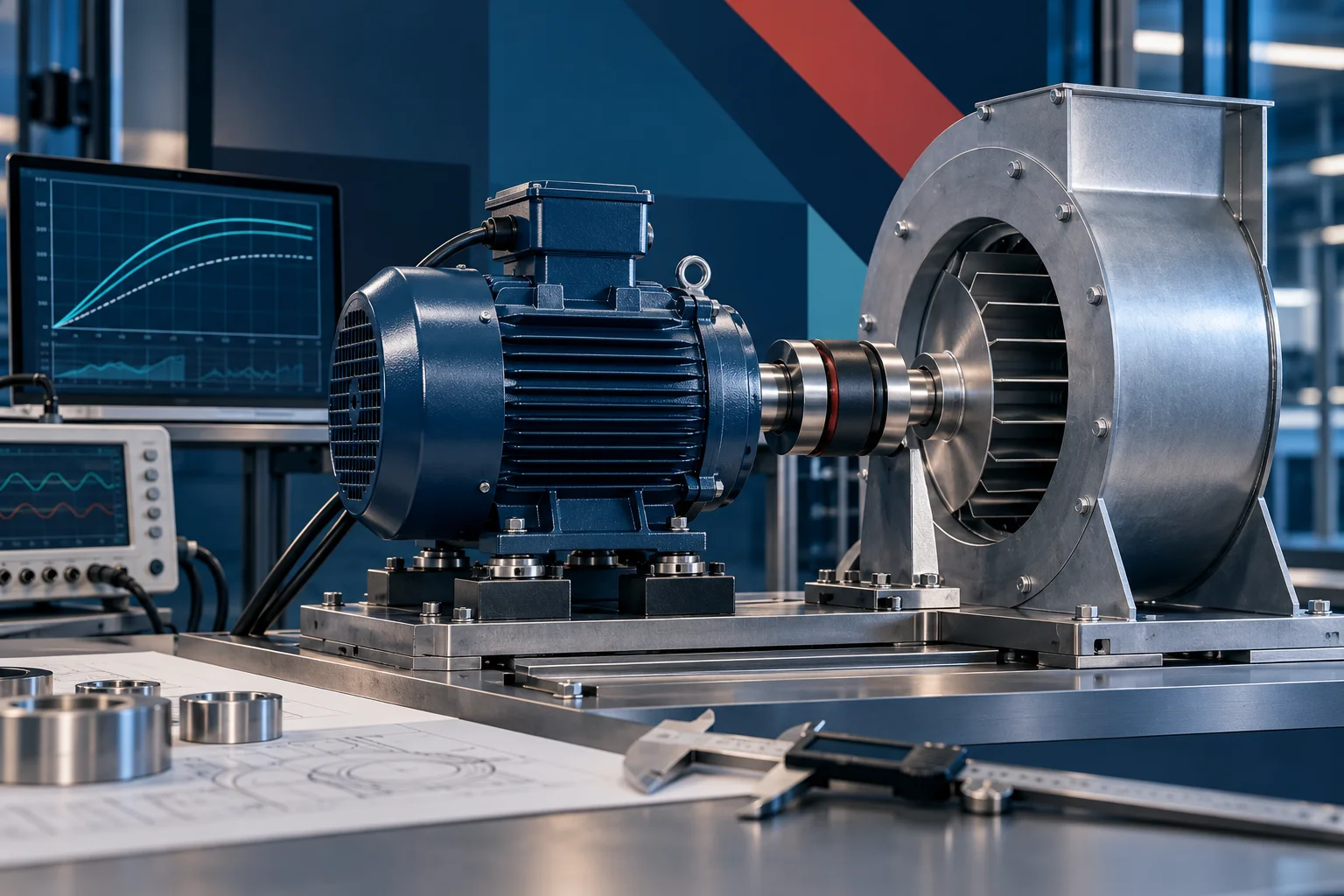
For a backward-curved centrifugal fan, you are really choosing between two architectures: an AC induction motor with fixed speed or an external VFD, and an EC motor with the drive electronics integrated. Both can hit the same duty point. They differ in part-load loss, control effort, wiring and total installed cost.
EC technology uses a permanent-magnet rotor with electronic commutation, so speed is set by a control signal like 0–10 V, PWM or Modbus. That integration improves part-load efficiency, simplifies the wiring harness and enables diagnostics. AC induction with an external VFD can still be the right call where unit cost dominates and running hours are low, but budget the cabinet space, EMC filtering and the fact that slip and copper losses climb at part load.
Check Part-Load Performance
Most products spend only a fraction of their hours at design flow. Filters load, dampers modulate, occupancy changes. So the duty point you selected in Section 1 is where the fan visits; part load is where it lives. Check the curve there, not just at 100%.
You need to check input power and efficiency at 60–80% of design flow, control response across the range, especially with Modbus or 0–10 V signals, and turndown ratio and minimum stable continuous speed.
Evaluate Noise and Vibration
Sound data is as important as efficiency data especially for some special applications like cleanrooms and data centers. A fan producing excessive noise may affect working environment. Sound power describes what the fan emits; sound pressure is what a microphone hears at a distance, in a room, on a mounting. OEMs should pay attention to the decibel ratings of fans. A fan with lower decibel ratings usually have quieter operation, but you should also consider the specific application and environments.
Three installation factors dominate. First, the operating point: peak efficiency is also the quietest region, and both curve extremes add turbulence noise. Second, the inlet ring: it should sit concentrically with the impeller and overlap slightly into the impeller inlet, which removes flow disturbances before the air reaches the blades. Third, clearances — starve the inlet or crowd the exhaust and turbulence does the rest.
Confirm Environmental Suitability and Documentation
Environment sets the hardware; documentation proves it. You should conform to the following environment requirement:
- Ambient temperature range, altitude and humidity at the installation site
- IP rating against dust and water exposure in your product’s environment
- Motor insulation class and thermal protection for the worst-case ambient
- Impeller and housing material: plastic, galvanized steel, aluminium alloy for general duty; FRP or PP for corrosive streams; a radial wheel instead if the air is abrasive
An OEM should require the following documentation:
|
Document |
Standard / scope |
|---|---|
|
Aerodynamic test curve |
AMCA 210 / ISO 5801 |
|
Sound test data |
AMCA 300 / ISO 13347 |
|
Duty-point input power |
Measured at your airflow and pressure |
|
EU market access |
CE / UKCA; Ecodesign Regulation (EU) No 327/2011 for fans in scope |
|
North America |
UL or ETL listing |
|
China market |
CCC |
|
Materials compliance |
RoHS, REACH |
|
EMC |
Emission and immunity reports for the motor/controller |
|
Bearing life data |
L10 at stated ambient and mounting orientation |
|
Sample validation |
Test report on production-representative samples |
Common Centrifugal Fan Selection Mistakes
- Selecting on diameter alone. Two fans at the same diameter can have totally different performance. You need to read the curve at your airflow and pressure.
- Ignoring Air Density: Air density changes with temperature, altitude, and other conditions. This affects fan pressure development, mass flow, and power requirements. You should give the supplier the actual air temperature and site conditions to find the right centrifugal fan.
- Oversizing “for safety”. Oversized centrifugal fan may cause energy waste. You need to size to the duty point, with a modest and stated margin.
- Ignoring Installation Geometry. Poor inlet flow, nearby obstructions, and inadequate discharge clearance can increase losses and affect noise. You should Review the actual installation arrangement with the fan supplier before finalizing the equipment design.
- Control signal not checked. Just confirm PWM / 0–10 V / Modbus before ordering.
- Documentation requested after design freeze. Make the documentation package part of supplier qualification.
LONGWELL Backward-Curved EC Platform
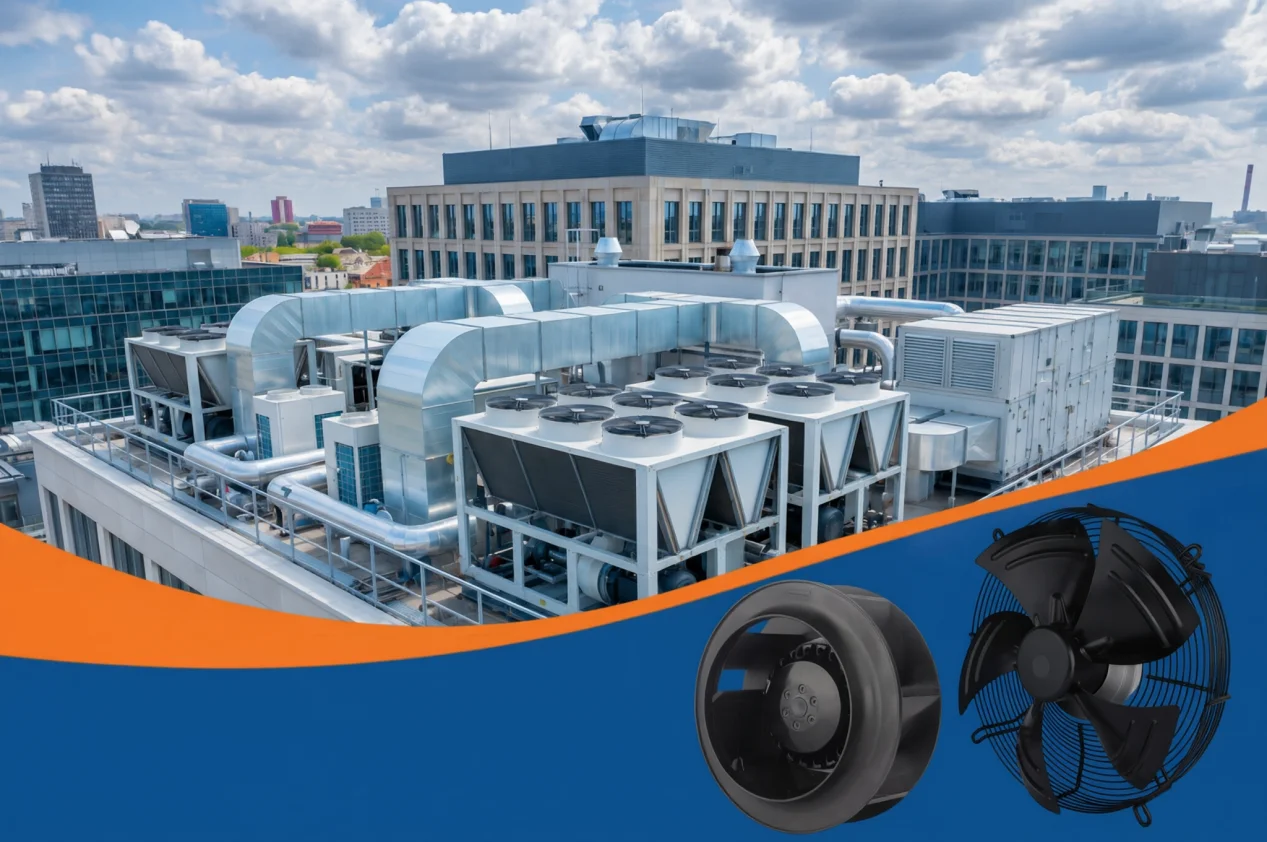
LONGWELL LWBE3G is the main platform for backward-curved EC plug-fan replacement and OEM integration. It is commonly evaluated against ebm-papst R3G/K3G and Ziehl-Abegg RH type requirements. Typical backward-curved plug-fan duties in AHU and CRAH service fall around 400–1,800 Pa, though the usable range must always be confirmed on the model curve.
|
Parameter |
LWBE3G published figure |
What to verify |
|---|---|---|
|
Static efficiency band |
73–82% |
Efficiency at your duty point, from the model curve |
|
Sound level |
4–6 dB(A) lower than comparable conventional wheels |
Measurement condition — free inlet, or installed |
|
Energy use |
8–12% lower than comparable conventional wheels at the same duty point |
Which duty point the comparison was run at |
|
Bearing life |
L10 60,000 h |
Ambient temperature and mounting orientation |
|
Control |
EC, speed set by control signal |
PWM, 0–10 V or Modbus availability on the specific model |
Drop-In Replacement Checklist
|
Item |
What to measure on the existing unit |
Why it decides the outcome |
|---|---|---|
|
Mounting |
Hole pattern, pitch circle, depth |
Decides whether it fits at all |
|
Inlet ring |
Diameter, overlap, concentricity |
Changes efficiency and sound at the duty point |
|
Electrical |
Voltage, frequency, phase, connector type |
Wiring rework cost on site |
|
Control |
Signal type and range — PWM, 0–10 V, Modbus |
A mismatch means no speed control |
|
Rotation |
Direction against housing arrow |
Reverse rotation moves a fraction of rated air |
|
Duty point |
Measured airflow and static pressure |
The only real basis for re-selection |
|
Sound |
dB(A) and measurement position |
Acoustic complaints usually come from here |
|
Environment |
IP requirement, ambient range, air composition |
Drives material and insulation class |
FAQs
Is diameter enough to select a fan?
No. Diameter is one variable. Airflow, static pressure, speed, air density, blade profile, noise limit, control signal and installation geometry all change the result.
What is the difference between backward-curved and backward-inclined?
Blade shape. Backward-inclined wheels use flat single-thickness blades tilted back and reach roughly 70–80% static efficiency at lower cost. Backward-curved wheels use a real curve, giving smoother flow, higher pressure per rpm, and efficiency into the low 80s.
How often should fans be cleaned?
It is recommended to clean and maintain your fans every 6 to 12 months to prevent performance errors.
What should be checked for drop-in replacement?
Mounting hole pattern, inlet ring geometry, installation depth, wiring and connector type, control signal, voltage and frequency, rotation direction, sound level, and measured performance at the duty point.
What materials should fans be made of in corrosive environments?
For fans operating in corrosive environments, materials like stainless steel, coated carbon steel, and aluminum alloys are often used. But the material selection should be based on type of corrosive agent, concentration, operating temperature, humidity, and expected service life.
Choose the right backward curved centrifugal fan
Longwell manufactures 587 backward curved centrifugal fans in-house. Send airflow, static pressure and voltage — an engineer replies with a matching model, performance curve and price within one working day.