Key Takeaways
- A fan’s efficiency changes with airflow. Read the efficiency curve alongside the performance curve to see how the fan performs at the required duty point.
- The Best Efficiency Point (BEP) marks the peak of the efficiency curve. Selecting a duty point near the BEP helps limit energy waste during operation.
- The fan’s operating point is where its performance curve meets the system resistance curve. Changes to ductwork, filters, or other components can shift that point.
- Fan types have different performance characteristics. Choose forward-curved or backward-curved centrifugal designs based on the system’s airflow, pressure, space, and efficiency requirements.
Digital fan selection tools help engineers turn airflow and pressure requirements into a shortlist of suitable centrifugal fans. Performance curves then provide the detail needed to compare those options: the pressure each fan delivers at a given airflow, its power consumption, and its efficiency at the required duty point.
Reading these curves helps engineers select a fan that operates close to its Best Efficiency Point (BEP). This guide explains how to read centrifugal fan efficiency curves, locate the operating point, and improve efficiency through fan selection and system design.
What is a Centrifugal Fan Efficiency Curve?
Key Parameters on a Centrifugal Fan Efficiency Curve
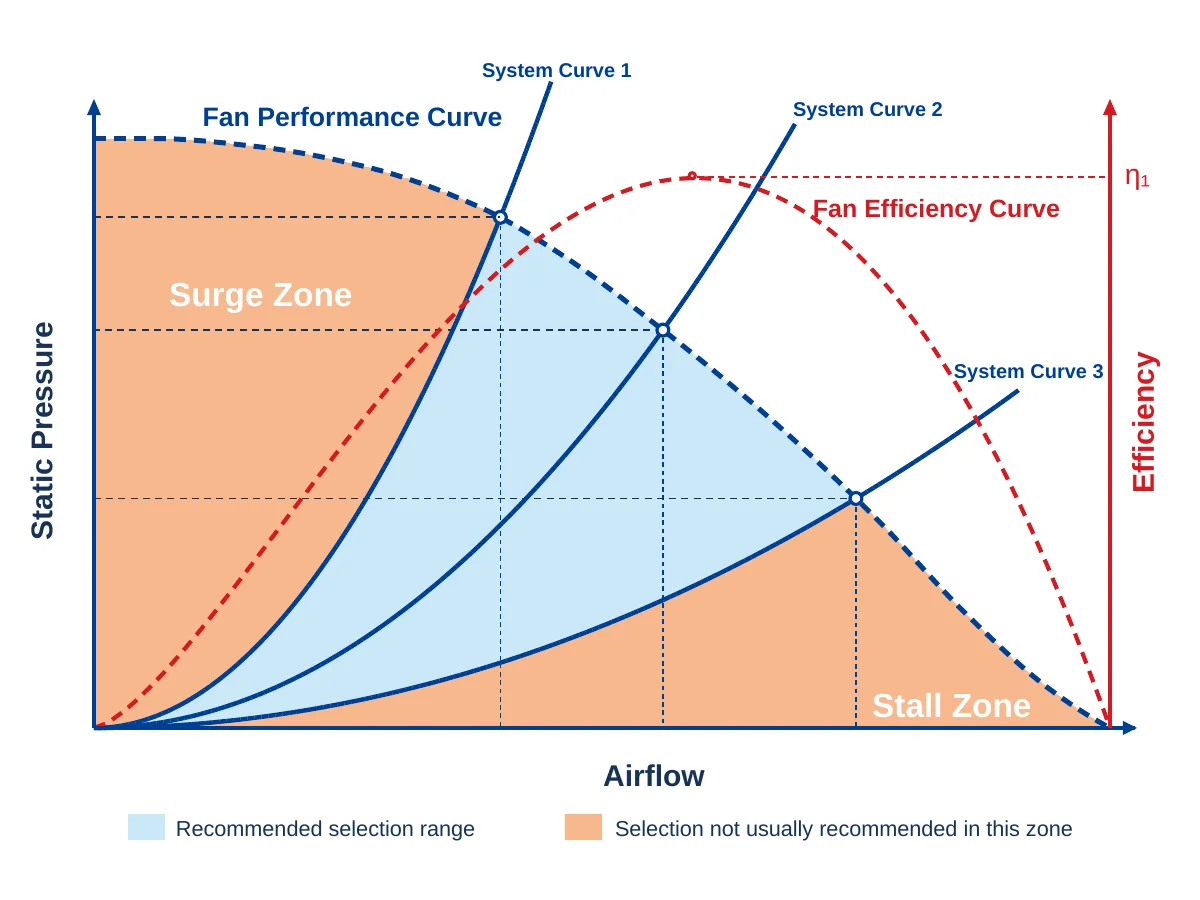
A centrifugal fan efficiency curve plots airflow on the horizontal axis and efficiency (%) on the vertical axis. Each point shows the fan’s efficiency at a particular airflow under the stated test conditions. The highest point is the Best Efficiency Point (BEP). When the efficiency curve appears alongside pressure and power curves, engineers can read all three values at the same airflow to evaluate a candidate fan at the required duty point. The graph should also identify whether it shows static or total efficiency and whether the power input refers to the fan shaft or the complete motor-and-drive system.
Why is the Centrifugal Fan Efficiency Curve Important?
The centrifugal fan efficiency curve shows how effectively a fan converts electrical or mechanical input power into useful airflow and pressure. Because efficiency changes across the operating range, the curve helps engineers assess performance at the required duty point. Read alongside the fan performance curve, it also helps compare candidate models and identify one that meets the airflow and pressure requirements with lower power demand.
Finding the Best Operating Point
Fan Curve vs System Curve vs Efficiency Curve
- Fan curve: The fan and the connected system each have a pressure–airflow curve. At a given speed, the fan curve shows the pressure available at different airflow rates.
- System curve: The pressure needed to move that air through the ducts, filters, coils, and other components.
- Efficiency curve: Plots how efficiently the fan operates across that airflow range.
The fan curve and system curve cross at the operating point. At this point, the fan delivers enough pressure to overcome the system resistance, which determines the airflow through the equipment. Combine these three curves together, engineers can read the corresponding efficiency and power demand on the accompanying curves. This makes it possible to assess both whether the fan meets the system requirement and how efficiently it does so.
A filter accumulating dust provides a practical example. Its pressure drop increases, changing the system curve. At an unchanged fan speed, the operating point shifts and airflow usually falls. Reading the curves together shows what that change means for fan performance.
Centrifugal Fan Efficiency Zones
The region around BEP is the preferred starting point for selection. Its width also matters: a broad efficiency peak gives engineers more room to accommodate changes in airflow while retaining high efficiency.
At lower airflow, the operating point moves toward the left of the graph. Efficiency falls, and some fan designs encounter stall or surge as flow becomes unstable. The manufacturer’s operating limits define how far the selection can extend into this region.
Beyond BEP, efficiency drops as airflow approaches free delivery. Power demand follows a different pattern for each impeller type. Forward-curved and radial fans can draw increasing power in this region, so engineers should check the power curve alongside efficiency when evaluating maximum airflow.
Use a Fan Selection Tool
When facing with multiple centrifugal fan models, checking each performance curve manually can take a lot of time.
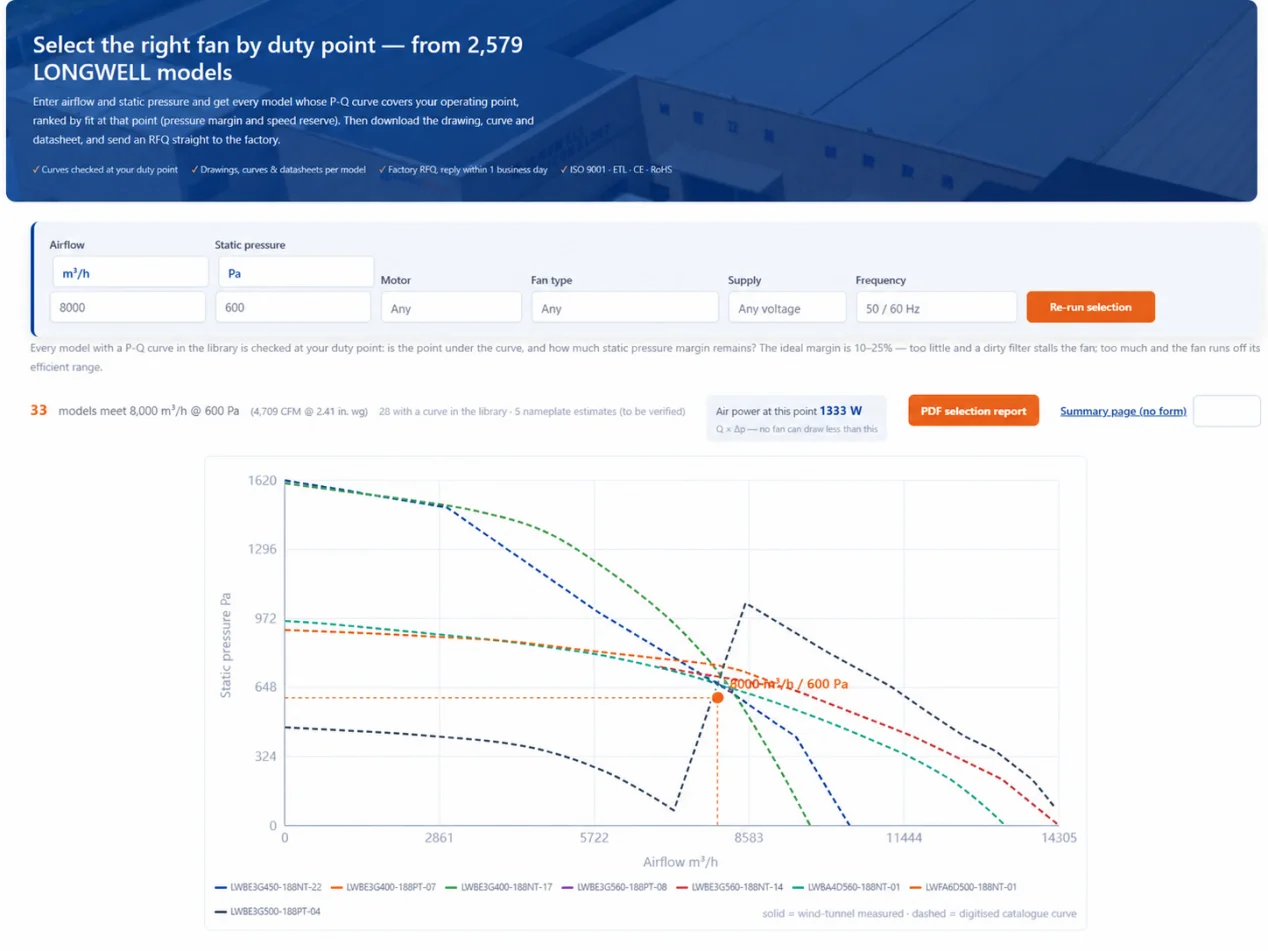
A fan selection tool provides a faster way to compare available options. Users can input the required airflow and static pressure as the basic selection conditions. Other parameters, including motor type, fan type, power supply, and frequency, can also be selected. After entering the requirements, the tool displays suitable fan models with their P-Q curves and marks the operating point on the curve.
For example, entering 8,000 m³/h airflow and 600 Pa static pressure can generate 28 candidate models with corresponding performance curves. Each candidate is checked against the duty point, making it easier to compare different fan solutions. The tool database is built on 2,579 centrifugal fan models.
How to Optimize Centrifugal Fan Efficiency?
Select Centrifugal Fans Based on Actual Requirements
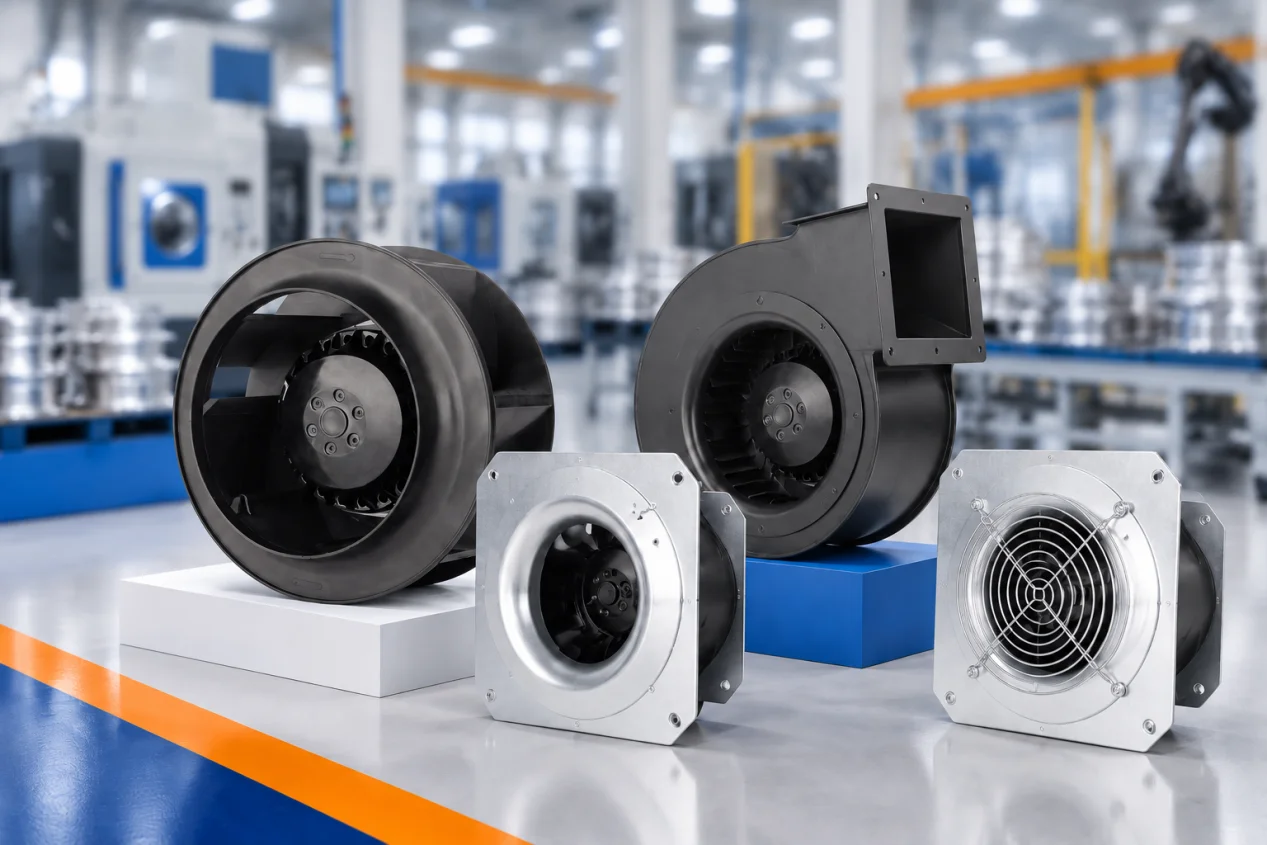
Start with the airflow and pressure the system needs, then choose an impeller suited to those conditions. Forward-curved fans can deliver high airflow from a compact unit, which can suit installations with limited space. Backward-curved designs are often selected for clean-air applications where efficiency across the required operating range matters. Airfoil refers to a blade profile used in some backward-curved impellers; it is not a separate basic blade direction. Radial-blade fans are better suited to applications that handle dust or light particles. The right choice depends on the duty point, air characteristics, available space, and expected operating range.
Use Variable Speed Control
Centrifugal fan demand often changes during operation, so running at one fixed speed can deliver more airflow than the system needs. A variable frequency drive (VFD) changes the supply frequency to adjust the speed of a compatible AC motor. An electronically commutated (EC) motor uses integrated electronics for speed control; depending on the model, the control input may use a 0–10 V signal, PWM, or a communication protocol such as RS485.
Both approaches let the centrifugal fan respond to changing airflow requirements. In an office building, for example, the control system can reduce fan speed when occupancy or ventilation demand falls, then increase it when more airflow is needed.
Installation Conditions
The installation layout around the centrifugal fan affects how evenly air reaches the impeller and how smoothly it leaves the outlet. An elbow, transition, or partly closed damper placed close to the inlet can create swirl or uneven airflow, adding system losses. Keep inlet connections clear and provide straight duct where the installation allows. Follow the centrifugal fan manufacturer’s guidance for the specific arrangement.
The outlet also needs room for the airflow to spread and develop before it reaches an elbow or other obstruction. It is recommended that an effective straight outlet duct length of at least 2.5 duct diameters when outlet velocity is 13 m/s or lower, with additional length at higher velocities. When space is limited, account for the resulting system effect during fan selection.
Improve System Design
When the system generates excessive resistance, the centrifugal fan may require a higher speed and power to deliver the required airflow. This will result in a difference between the theoretical output and the actual output. Long ducts, sharp turns, sudden changes and restrictive components all increase pressure loss. Choosing a smoother and appropriately sized duct system layout can reduce this resistance.
The fan laws also show why speed matters: for the same fan, pressure changes approximately with the square of speed, and the power changes roughly with the cube. Reducing avoidable system losses can therefore help limit the speed—and power—the centrifugal fan needs to maintain airflow.
Periodic Maintenance
Dust on the impeller can reduce airflow and efficiency. Uneven buildup may also throw the impeller out of balance, causing vibration that puts extra stress on bearings and other components. Check the impeller and clean it when deposits begin to affect airflow or balance. In dusty or debris-prone areas, monthly inspections may be appropriate. In cleaner facilities, quarterly checks can be a practical starting point. Adjust the schedule to the operating environment and the centrifugal fan manufacturer’s maintenance guidance.
LONGWELL Centrifugal Fan Supports
Fan Selection Supports
LONGWELL’s technical team can help with fan selection before purchase, including model recommendations, explanations of performance parameters, and relevant application examples. Support can also include CAD and 3D models, system design input, ductwork optimization, and other design services. For projects with specific requirements, the team can prepare custom performance curves and arrange samples, testing, or simulation and verification for special operating conditions.
The LONGWELL online fan selector lets users enter operating-point requirements to review suitable fan options and their performance. The tool includes 3D product displays, real-time performance curves, BIM model downloads, a total cost of ownership (TCO) calculator, and noise prediction.
Customized aerodynamic solutions
The process starts with reviewing system requirements, performance targets, and operating conditions. LONGWELL’s team can recommend a fan and plan system design. The fan can then be adapted to meet the project’s performance goals, including its control logic and interface requirements. The technical support continues from concept design through production and after-sales service.
FAQ
Which type of centrifugal fan is better, forward-curved or backward-curved?
Neither type is better for every application. Forward-curved fans are suited to compact systems that need high airflow at relatively low pressure. Backward-curved designs are often chosen for applications that prioritize higher efficiency and a non-overloading power curve. Impeller design selection is based on the system’s airflow, pressure, available space, and operating range.
What is fan efficiency and how is it calculated?
Fan efficiency describes how much of the input power becomes useful air-moving power. For total efficiency, the basic calculation is: Fan efficiency = Air Power ÷ Shaft Power.
How does a system resistance curve affect fan selection?
The fan operates where the system curve intersects the fan performance curve. If resistance changes—for example, because of a filter, damper, or duct layout—the operating point shifts, changing the airflow the fan delivers.
What does stall mean on a centrifugal fan curve?
Stall is an unstable operating region at low airflow. Flow separation over the impeller blades can cause pressure fluctuations, noise, or vibration.
Choose the right centrifugal fan
Longwell manufactures 1,130 centrifugal fans in-house. Send airflow, static pressure and voltage — an engineer replies with a matching model, performance curve and price within one working day.