GB/T 22257-2026 takes effect on 1 May 2027. Mobile-AC OEMs should validate installed airflow, sound, power and controls—not select a fan by free-air flow alone.

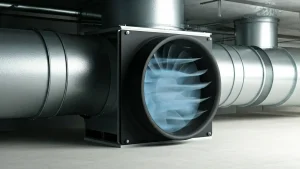
Concept illustration of a mobile-AC air path and cross-flow fan. Information checked on 23 November 2026.
The short answer: the standard evaluates the appliance, while the fan supplier supports the evidence chain
China’s State Administration for Market Regulation published its interpretation on 16 November 2026. The official standard record shows that GB/T 22257-2026 was published on 30 October 2026, takes effect on 1 May 2027 and fully replaces GB/T 22257-2008. The public summary highlights tighter declared-versus-measured capacity tolerances, revised efficiency grades, standby power, stricter sound limits, zero drainage and a new circulating-airflow metric.
This is a recommended national product standard for the mobile air conditioner as an appliance. It is not a separate certification for a cross-flow fan, motor or impeller. Where a design uses a cross-flow fan for indoor recirculation, the procurement question is whether the exact component can create the required airflow through the actual heat exchanger, filter, grille and housing—while the assembled appliance also meets its sound, power, control and thermal boundaries.
Longwell’s current public catalogue includes AC, DC and EC cross-flow / tangential fan families and air-conditioner impellers. Those pages support a candidate search. They do not prove that any listed model is suitable for a particular mobile AC or that an appliance complies with GB/T 22257-2026.
Map the new appliance focus to Longwell product families and selection data
|
External change / customer situation |
Relevant Longwell family and system role |
Data to confirm |
Evidence and boundary |
|---|---|---|---|
|
New circulating-airflow metric; a wide outlet in a shallow cabinet |
Cross-flow / tangential fans can create a long, distributed supply stream |
Target installed airflow, system resistance, wheel diameter/length, speed, outlet geometry and operating point |
Longwell pages prove the family exists; the appliance result requires installed testing |
|
Tighter sound expectation; housing and cutoff clearance become sensitive |
An EC cross-flow product example provides a variable-speed family candidate |
Test mode, measurement boundary, speed/control command, supports, grille, cutoff clearance and tonal content |
A product-page description is not the sound result of a mobile AC |
|
A custom air path or frozen envelope needs an impeller-level option |
Plastic cross-flow impeller for air-conditioning applications |
Material, diameter, length, shaft/interface, balance, housing and cutoff geometry |
Impeller availability does not establish drive, housing, safety or appliance performance |
|
A fixed-speed concept needs a documented catalogue starting point |
Supply, frequency, dimensions, duty point, temperature and exact sample revision |
A selector page narrows candidates; it is not a model recommendation for mobile ACs |
The table is a sourcing map, not a compliance declaration. It turns appliance-level changes into component questions and then closes the loop with controlled appliance tests.
What the four public highlights change in the validation plan
|
Publicly announced focus |
Do not assume |
Add or strengthen this OEM check |
|---|---|---|
|
Circulating airflow |
A fan’s free-air maximum equals appliance circulating airflow |
Measure the assembled appliance at its rated mode and record the fan sample, speed command, filter, coil, grille, damper and assembly state |
|
Sound limits and methods |
A “low-noise” product label replaces appliance acoustic testing |
Fix the room, operating mode, microphone location and background; investigate blade-pass tone, cutoff clearance, panel resonance, grille whistle and compressor coupling |
|
Standby power |
A high-efficiency running motor proves low appliance standby power |
Define which fan drive, power supply, main controller and receiver remain energized; measure at the appliance boundary under the final method |
|
Zero drainage |
The fan supplier can guarantee this appliance result |
Validate coil, drain pan, water distribution/re-evaporation, sealing, orientation and environmental conditions; the fan affects only part of the air-side condition |
Six evidence packages to request from a fan supplier
1. An installed duty point, not one maximum-airflow number
Put both target circulating airflow and estimated system resistance in the RFQ. Describe the filter, heat exchanger, inlet, outlet grille, bends and damper states. Ask for performance information tied to the exact candidate sample, then retest with the customer air path or representative restriction. Free-inlet/free-outlet data can screen a candidate; it cannot prove the installed result.
2. A reproducible acoustic boundary
Record voltage and frequency or control command, speed, housing revision, mounting support, measurement point, distance and background. If the result is close to a limit, review overall level and abnormal tones. Two dB(A) values taken under different setups are not a reliable comparison.
3. Running input and the standby supply boundary
AC, DC and EC concepts have different supply and control architectures. Specify rated supply, tolerance, the operating condition for input-power data, control interface and power-off/standby logic. Appliance standby power may include the power board, main control, receiver and fan drive; a fan nameplate cannot substitute for that measurement.
4. Geometry and air-side clearances
Cross-flow wheel diameter and length, end plates, shaft, bearings, housing and cutoff clearance all affect installed behaviour. Freeze the 2D drawing, critical tolerances, materials, rotation and datums before the sample build. A housing, wheel or tool revision should trigger a defined airflow and acoustic review.
5. Temperature, condensate and material boundaries
Provide inlet temperature/humidity, the lowest nearby coil temperature, possible condensate splash, continuous run time and any cleaning-chemical contact. The supplier can then review insulation, bearing, material and protection choices. Do not infer life or suitability from another application in the same family.
6. Traceability from sample to production
Tie each appliance report to the fan model, drawing revision, BOM/material revision, supplier lot, drive/firmware revision and appliance software mode. Keep a golden sample, change-notice rules and incoming checks for critical dimensions and electrical properties so the validated sample and production unit remain the same configuration.
A five-step installed validation workflow
1. Freeze the appliance targets: circulating airflow, cooling/heating mode, sound, input power, standby states, envelope and cost boundary.
2. Build a resistance table for clean and loaded-filter conditions, coil, grille, bends and damper states; do not substitute free-air flow.
3. Screen a small AC/DC/EC and impeller shortlist from the Longwell fan range using geometry, supply and control needs. Move a model to samples only after its documentation matches the project inputs.
4. Compare samples in the same appliance, software and environment. Measure circulating airflow, sound, power, temperature rise and condensate behaviour while recording sample identity.
5. Use risk-based revalidation for changes to drawings, materials, drive electronics, firmware or manufacturing process. A project close to a limit should not rely on document review alone.
Fields you can copy into an RFQ
- Market and version: China / GB/T 22257-2026; design-freeze and launch dates.
- Appliance configuration: single-duct or dual-duct; cooling-only or heat-pump; sketch of indoor and outdoor air paths.
- Target circulating airflow and system resistance, with measurement point, filter and coil condition.
- Envelope: wheel diameter/length, housing, inlet/outlet, shaft, mounting holes and critical clearances.
- Supply and control: voltage, frequency, DC bus, PWM/0–10 V/communications if applicable, and standby power-off logic.
- Sound target, operating mode, microphone point/distance and abnormal-tone acceptance method.
- Temperature/humidity, continuous run, condensate or cleaning-chemical exposure, material and protection needs.
- Deliverables: drawing, performance evidence, acoustic data, sample identity, change notice and production checks.
Frequently asked questions
Does GB/T 22257-2026 require the fan itself to be certified?
No. The official record classifies it as a recommended product standard for mobile air conditioners. The appliance manufacturer should confirm the final scope and test requirements. A fan supplier supports component data and sample evidence; that does not establish appliance compliance.
Can catalogue maximum airflow prove the circulating-airflow result?
No. The heat exchanger, filter, grille, air path, leakage and controls change the installed result. Catalogue data can screen candidates, but the conclusion must come from a controlled appliance test.
Which Longwell cross-flow fan is best for a mobile air conditioner?
There is no universal model without the project inputs. A fixed-speed concept may screen AC families; a variable-speed concept may screen DC or EC families; a frozen envelope may also require an impeller-and-housing geometry review. The duty point, sound, supply/control, temperature and dimensions decide the shortlist.
Will choosing DC or EC control automatically reduce sound and power?
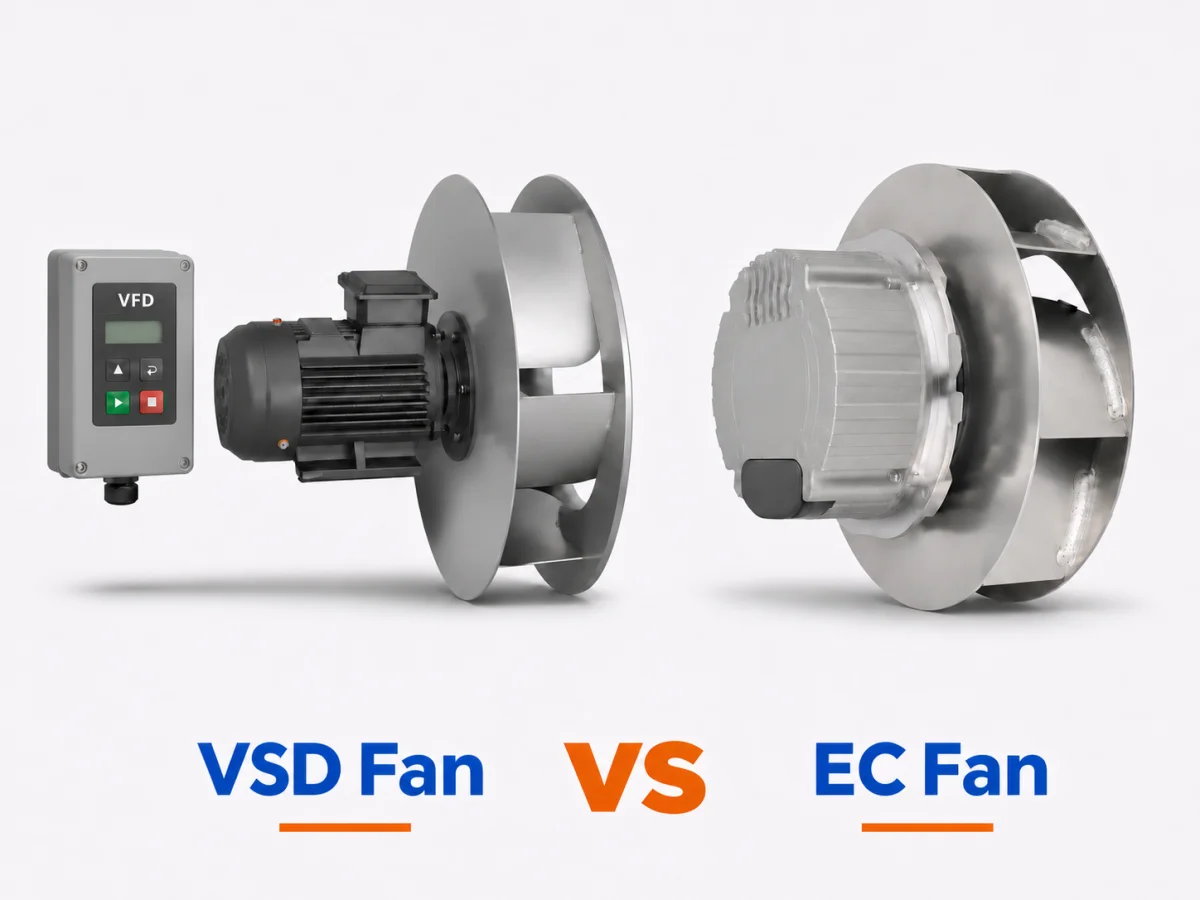
Speed control adds an optimization lever, but the outcome depends on the duty point, air path, control curve and drive efficiency. Lower speed may also miss the airflow target, so airflow, sound and power must be measured together in the appliance.
Can the fan supplier guarantee zero drainage?
No. Zero drainage is an appliance condensate-management result. Airflow may affect heat transfer and re-evaporation, but the coils, drain pan, water path, sealing, orientation and ambient condition remain part of the appliance design and test.
Primary sources and Longwell product evidence
- SAMR: New national standard for mobile air conditioners
- National standards platform: GB/T 22257-2026 official record
- Longwell fans and blowers range
- Longwell cross-flow impeller for air-conditioning applications
If you are shortlisting a cross-flow fan or impeller for a mobile air conditioner, send the air-path sketch, target circulating airflow and resistance, available envelope, supply/control, sound and temperature/humidity boundaries, plus the GB/T 22257-2026 version you plan to validate, to sales@longwellfans.com. Longwell can use those inputs to narrow the AC/DC/EC candidate set and prepare samples; the customer must confirm appliance conformity against the final standard text and controlled tests.
Choose the right cross flow fan
Longwell manufactures 495 cross flow fans in-house. Send airflow, static pressure and voltage — an engineer replies with a matching model, performance curve and price within one working day.