Key Takeaways
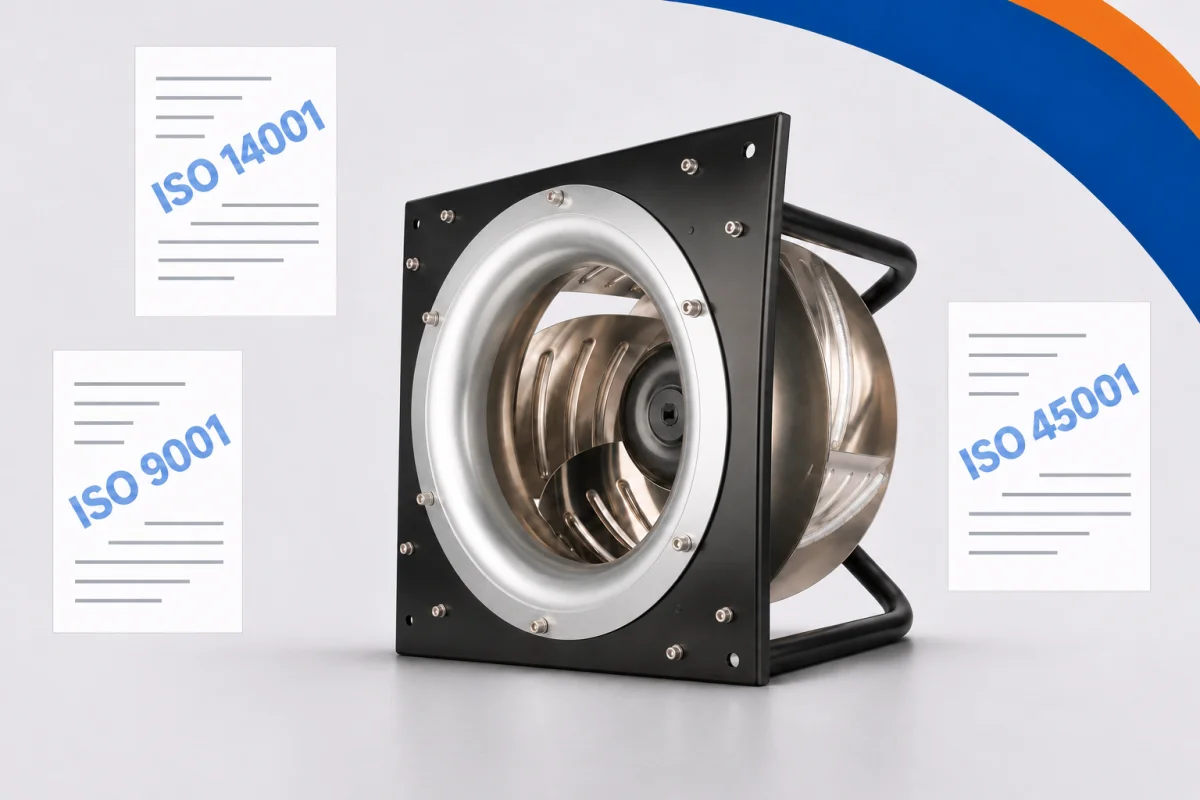
- ISO 9001, ISO 14001, and ISO 45001 are management system certifications. They certify how a manufacturer is run, not how any individual fan performs.
- ISO 9001 gives evidence that quality processes are documented, audited, and continually improved.
- ISO 14001 shows the factory manages its environmental aspects and legal compliance, which protects delivery continuity and supports the ESG documentation.
- ISO 45001 shows workplace hazards are identified and controlled. A stable, safe workforce is directly linked to consistent output and fewer delivery disruptions.
- Every certificate should be verified before it enters your supplier file: certificate holder and site, scope statement, standard edition, expiry date, and the accreditation of the certification body.
When a fan purchase project moves from quotation to order, most buyers will receive two kinds of documents from suppliers. One kind describes the product: fan curves, ETL or CE certificates, motor data, material specifications. The other kind describes the company behind the product: ISO 9001, ISO 14001 and ISO 45001 certificates, often printed side by side on a letterhead or a trade-show banner.
This blog explains what each of the three standards covers, what evidence each one gives a buyer during supplier evaluation, where their limits are, and how to verify that a certificate in a quotation is authentic.
ISO 9001: Quality Management
What is ISO 9001?
ISO 9001 is the international standard for quality management systems (QMS). It is the only standard in the ISO 9000 family that can be used for third-party conformity assessment, and it is the most widely used management system standard in the world. It requires the manufacturer to build a documented, repeatable system around seven principles: customer focus, leadership, engagement of people, process approach, improvement, evidence-based decision-making, and relationship management.
ISO has released ISO 9001:2026 to make an update to the 2015 version. The new edition retains the core framework while strengthening requirements for quality culture, ethical behavior, risk and opportunity management, and alignment with organizational strategy.
What does an ISO 9001 Fan Mean?
ISO 9001 does not certify a fan. It certifies the management system of the organization that builds it, so no fan is produced with an ISO 9001 mark on its nameplate like the way with an ETL, UL, or CE mark. When a buyer searches for an ISO 9001 fan, what is actually being sought is a fan supplier whose quality system has been audited against ISO 9001 by an accredited certification body.
Why it Matters for Buyers?
For a commercial or industrial fan order, the risk is rarely that the sample underperforms. The risk lies in the fact that some of the products from different production batches deviate from the approved specifications. ISO 9001 is the strongest publicly available signal that a factory manages batch-to-batch consistency through a system.
Two things are equally important for buyers to understand about what ISO 9001 does not do. First, it does not certify product performance. Performance data should be verified against AMCA 210 or equivalent methods, separately from the QMS certificate. Second, it does not guarantee zero defects. Scrap, rework, and field failures can still occur.
A new version release does not mean the 2015 version loses efficiency. A three-year transition period applies, so 2015-edition certificates remain valid until approximately September 2029, and during the transition buyers will see both editions in the market.
ISO 14001: Environmental Management
What is ISO 14001?
ISO 14001 is the international standard for environmental management systems (EMS). It requires the manufacturer to identify every aspect of its operations that interacts with the environment, evaluate which ones are significant, and keep them under documented control.
Core requirements include:
- Identification and evaluation of environmental aspects: energy and water use, waste streams, emissions, paint and surface treatment, coolant and oil handling.
- A register of applicable environmental legislation and a periodic evaluation of compliance, so regulatory requirements are tracked instead of discovered after an inspection.
- Operational controls for waste storage, wastewater and emissions, with emergency preparedness for spills and fires.
- Measurable environmental objectives with documented performance tracking, and continual improvement verified by third-party audits.
Why it Matters for Buyers?
The most direct benefit for a buyer is supply continuity. Fan manufacturing involves coating, winding, welding, and surface treatment, all of which carry environmental compliance obligations. An ISO 14001-certified supplier has documented processes for staying ahead of environmental regulations, which means fewer accidents.
ISO 14001 published a new version in 2026 as well. Certificates against the 2015 editions remain valid during the transition period, but certification bodies move to the new editions on a fixed timetable, and certificates against a superseded edition will stop being valid from 2027 to 2028 depending on the standard. When you review a certificate in the next two years, check which edition it was issued against and whether the supplier is mid-transition.
ISO 45001: Workplace Health and Safety
What is ISO 45001?
A serious workplace accident can stop a production line for days or weeks. For an OEM whose launch date depends on a fan shipment, safety management is delivery. The standard is organized into 10 clauses under the same Annex SL high-level structure used by ISO 9001 and ISO 14001. Clauses 1-3 provide foundational information, while Clauses 4-10 contain the auditable requirements based on the Plan-Do-Check-Act cycle.
Why it Matters for Buyers?
A serious workplace accident can stop a production line for days or weeks. For an OEM whose launch date depends on a fan shipment, safety management is delivery risk management. An ISO 45001 certificate is third-party evidence that the factory controls that risk systematically.
There is also a quality link that experienced auditors recognize: trained, protected operators who work in a stable environment make fewer handling and assembly errors. Batch consistency is built partly on the shop floor, and safety discipline is part of that foundation.
ISO 45001 allows manufacturers to self-declare conformity without third-party certification. For buyers, however, self-declaration and accredited certification are not equivalent evidence. A self-declaration costs the manufacturer nothing to issue, while an accredited certificate means an external auditor has verified the system through the three-year audit cycle.
ISO 9001 vs ISO 14001 vs ISO 45001: Summary for Fan Buyers
| ISO 9001 | ISO 14001 | ISO 45001 | |
| Management System | Quality Management System (QMS) | Environmental Management System (EMS) | Occupational Health and Safety Management System (OH&S MS) |
| Key Requirements | Process control, customer satisfaction, risk management, continual improvement | Environmental aspects, pollution prevention, compliance obligations, resource management | Hazard identification, risk control, worker participation, emergency preparedness |
| Manufacturing Applications | Production quality, inspection, traceability, corrective actions | Waste disposal, emissions, material use, energy consumption | Machine guarding, electrical safety, PPE, workplace hazards |
| What Buyers Can Verify | Whether the supplier has an audited quality management system | Whether environmental management practices are independently audited | Whether workplace safety management practices are independently audited |
How to Verify a Fan Manufacturer’s ISO Certificates?
- Ask for the full certificate document. The document shows the certificate number, the holder, the site address, the scope statement, the issuing body, and the validity dates. A logo on a website or a scanned thumbnail in a catalogue shows none of these.
- Confirm the certificate edition and expiry date. Confirm the standard edition, the issue date, the expiry date, and whether the supplier is inside a transition period for a newly published edition.
- Check the company, the plant, and the scope. The certificate must name the legal entity and the plant that will produce the order. The scope statement should then name the actual product range, for example, fans and ventilators.
- Verify the accreditation body. ISO itself does not give out certificates. The certificates come from certification bodies accredited by accreditation bodies. Verify the certificate through the national certification platform where the manufacturer is registered.
LONGWELL: An ISO-Certified Fan Manufacturer
LONGWELL, headquartered in Yuyao, Ningbo, designs and manufactures EC, DC, and AC fans and motors for HVACR applications including ventilation, refrigeration, data centers, heat pumps, and industrial equipment, exporting to more than 30 countries and regions.
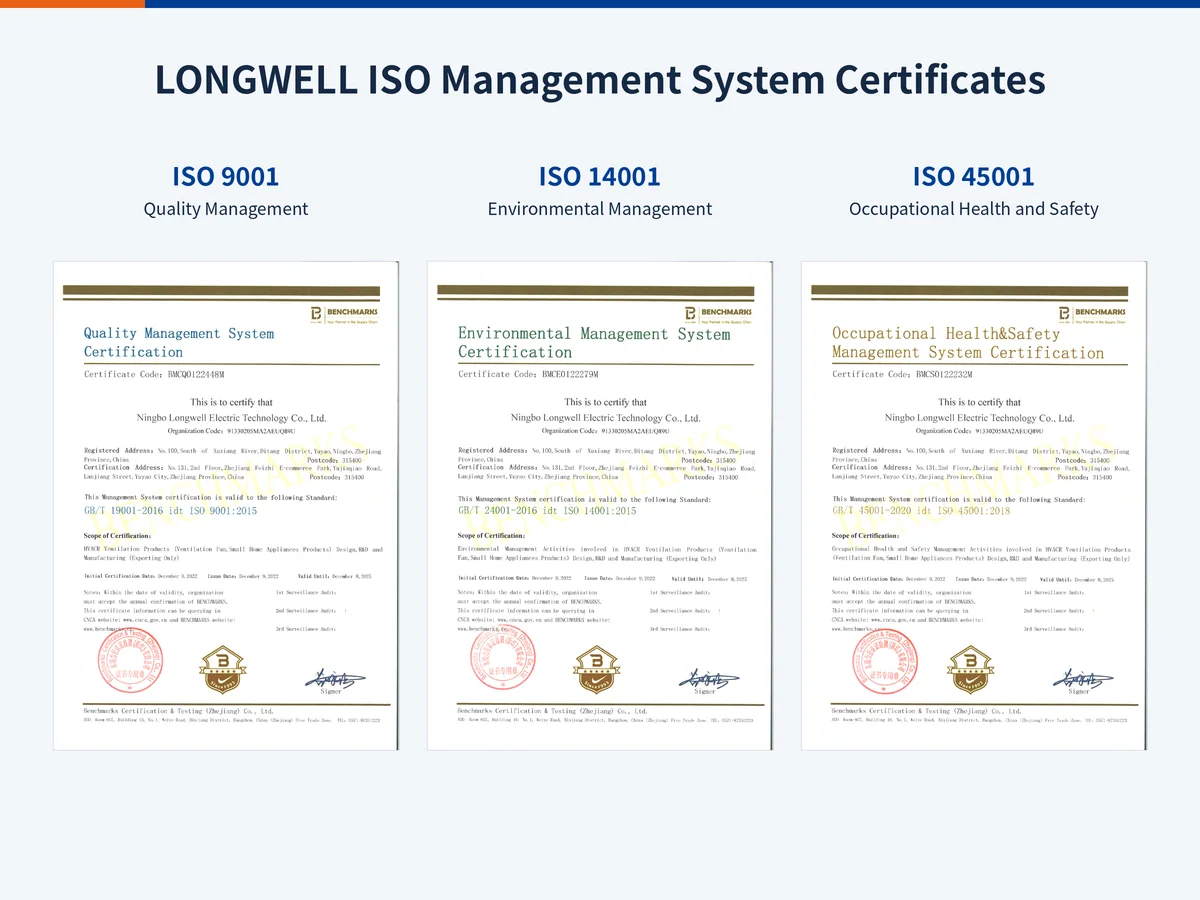
LONGWELL holds ISO 9001 quality, ISO 14001 environmental, and ISO 45001 occupational health and safety management system certifications. The production site also holds BSCI social compliance certification, and the product range carries North American ETL certification, together with CE and RoHS compliance. Air performance is tested to AMCA 210/211 methods, and third-party test reports are available on request.
FAQ
Can a fan manufacturer obtain all three certifications together?
Yes. ISO 9001, ISO 14001 and ISO 45001 share the same high-level structure. A manufacturer can build one integrated management system and certify all three standards in a single combined audit.
Can the three standards (ISO 9001, 14001 and 45001) be assessed in a combined audit?
Yes. Certification bodies regularly conduct combined audits in which one audit team assesses the shared clauses once for all three standards, then covers each standard’s operational requirements in turn.
What stages does its certification service involve?
ISO management system certification typically involves five stages: application and contract review, Stage 1 audit (documentation and readiness review), Stage 2 audit (on-site assessment of implementation), certification decision, and ongoing surveillance. Once certified, the manufacturer undergoes annual surveillance audits and recertification every three years.
Will an ISO 9001 certified fan have better quality or reliability?
Not automatically. ISO 9001 certifies the production process, not the product. It certifies a manufacturer’s quality management system. The ISO 9001 certificate demonstrates that the manufacturer has established a process for quality control, traceability, and continuous improvement.