Key Takeaways
- In washdown and condensing service, water typically enters a fan motor at the shaft seal and the terminal box, not through the housing.
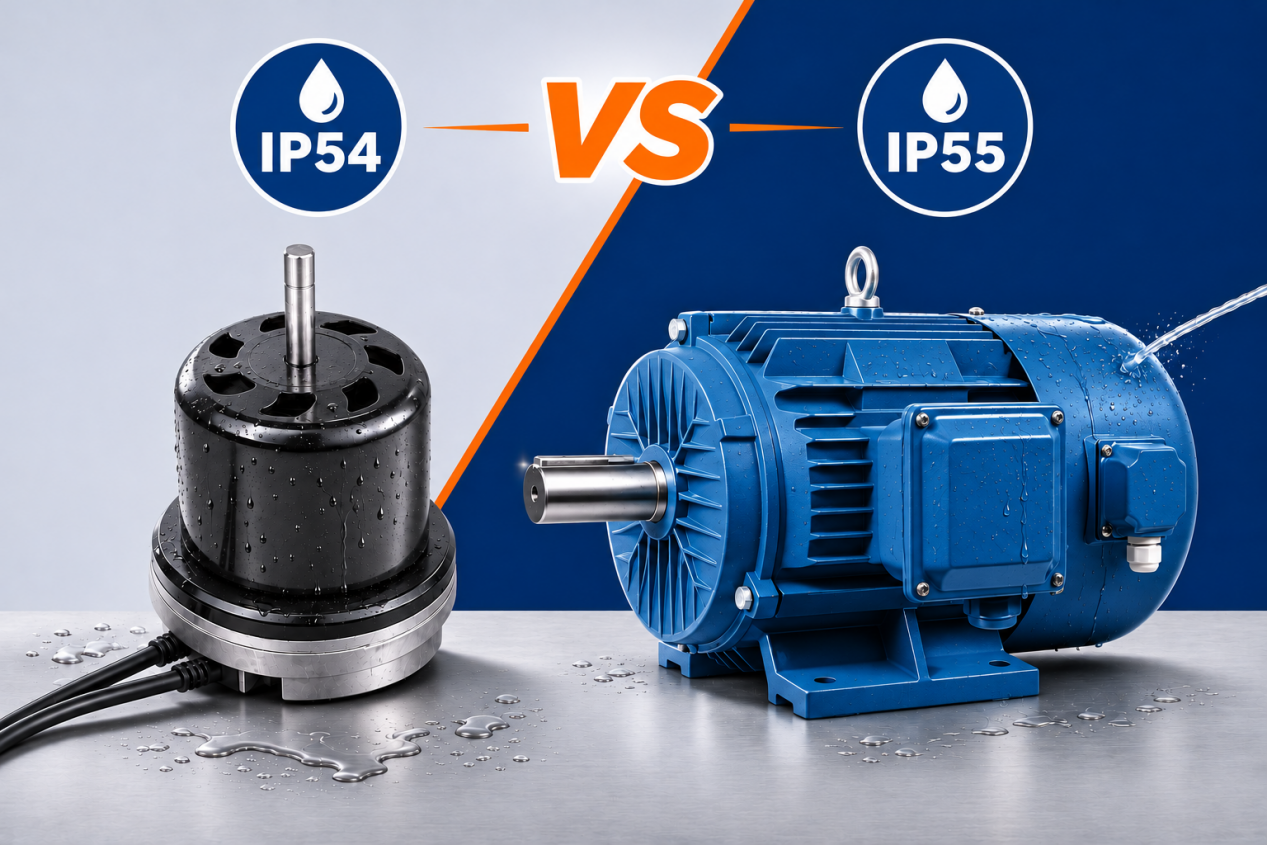
- IP54 and IP55 differ only in the water test: IPX4 protects from splash water, while IPX5 refers to water jet.
- For fan motors, that difference changes the shaft seal path, the terminal box, and the breather design.
- This blog compares IP54 and IP55 motors, from their key differences to the applications, and closes with three verification steps to run before the order is placed.
In washdown and condensing service, water typically enters a fan motor at the shaft seal and the terminal box, not through the housing. IP54 and IP55 differ only in the water test. IPX4 protects from splash water, while IPX5 refers to water jet. For fan motors, that difference changes the shaft seal path, the terminal box, and the breather design. IP55 is worth the premium only when the jet exposure is real, and the internal condensation path is managed. This blog compares IP54 and IP55 motors from their key differences to the applications.
How Does Water Get into a Sealed Motor?
A motor rarely fills with water. It takes it in a little at a time. The damage to the motor will cause: insulation resistance falls, terminal studs corrode, bearing grease emulsifies, and the bearing runs dry.
The motor is a breathing assembly; humid air can enter and condense. Winding and bearing losses heat the internal air while it runs; that air expands and pushes a small volume out through every leakage path. When the motor stops and cools, the remaining air contracts and draws moist ambient air back in through the same clearances: gland gaps, terminal box gasket joints, drain and breather openings.
Liquid water enters through sealing interfaces. A shaft seal is a rotating contact by design, and its lip wears against the shaft. A cable entry seals only when the gland matches the cable diameter and is tightened to the specified torque. A conduit connection carries water along the conduit and delivers it to the terminal box at the thread.
IP54 vs IP55: The Second Digit is the Whole Argument
What Does the First Digit of an IP Rating Mean?
The first digit in the IP rating code means the solid protection against solid objects. The level ranges from 0 to 6. The larger number means the higher protection against dust.
| First digit of IP rating code | Solid object protection |
| 0 | No protection against any size of object |
| 1 | Protects against large objects over 50 mm, such as hands |
| 2 | Protects against medium-sized objects over 12.5 mm |
| 3 | Protects against small objects over 2.5 mm |
| 4 | Protects against granular objects over 1 mm |
| 5 | Dust-protected. Some dust may enter, but it will not interfere with operation |
| 6 | Dust-tight. No dust ingress |
What does the IP5X Code Mean?
The second digit is not a more waterproof choice. It describes how much water momentum the enclosure must survive. It ranges from 0 to 9K, providing an enclosure’s level of protection against liquids (primarily water).
| Second digit of IP rating code | Water protection |
| 0 | No protection |
| 1 | Dripping water, vertical |
| 2 | Dripping water when the enclosure is tilted up to 15 degrees |
| 3 | Spraying water up to 60 degrees from vertical |
| 4 | Splashing water from any direction |
| 5 | Water jets from a 6.3 mm nozzle |
| 6 | Powerful water jets from a 12.5 mm nozzle |
| 7 | Temporary immersion, up to 1 m for 30 minutes |
| 8 | Continuous immersion under conditions agreed with the manufacturer |
| 9K | Powerful high-temperature water jets, defined in ISO 20653 rather than IEC 60529 |
IP54 and IP55 begin with the same first digit, so the comparison collapses to a single test. IP54 and IP55 make an identical claim on the first digit, which leaves the entire argument in the second.
IPX4 splashes water against the enclosure from all directions — a diffuse spray with low impact force per unit area. The design response is to deflect and shed: overlaps, drip edges, downward-facing openings.
IPX5 directs a 6.3 mm nozzle jet at roughly 30 kPa from a defined distance and angle. Water now arrives concentrated, with enough momentum to push through gaps that splash simply runs off. The design response changes from keeping water out by geometry to sealing against pressure.
Is IP55 Enough for Washdown Environments?
IP 55 is the ensure of protecting the motor from a 6.3mm jet at roughly 30kPa for at least three minutes. However, a washdown environment has three more situations that sit outside this situation. A high-pressure lance, which delivers two to three orders of magnitude more pressure than the test; submersion or flooding during clean-in-place; and internal condensation, which the water test never addresses because the water starts outside the enclosure.
Light Washdown
Light washdown typically uses low-pressure hose cleaning, hand spraying, and wet wipe-downs. When the IP55 meets the marking requirements, is properly assembled, and the cleaning procedure is maintained at the spray gun pressure, it can operate normally.
Plant Washdown
Industrial pressure washers deliver two to three orders of magnitude more pressure than the IP test. When the cleaning routine includes directed cleaning, IP55 should be considered as the baseline protection standard.
Heavy and Hot High-pressure Washdown
Daily cleaning with hot water, caustic or chlorinated foam, as practiced in meat, poultry, and dairy plants, IP54 or IP55 is not enough. Where the sanitation program includes steam or hot high-pressure cycles, the specification should move to a different part of the IP code.
When to Choose IP54 or IP55 Motors?
IP54 Motors for Splash Exposure
Where the fan sits clear of the spray line and cleaning is a wipe-down with an occasional low-pressure hose, splash and saturated air are the whole duty, and IP54 is the correct rating. IP54 motor with a breather, a drain fitted at the low point of the installed orientation, and a written cleaning procedure that keeps the lance off the shaft end and the terminal box lid may cost less than upgrading to IP55.
IP55 Motors for Direct Rinsing
When the fan sits in the spray line, the jet test becomes the governing one; IP55 is the baseline choice. Daily low-pressure hose cleaning, as in food and beverage washdown, is sustained moderate exposure and the classic IP55 application. The same exposure occurs on conveyor and pump drives beside the wash line, where the rinse stream can reach the motor housing. Where cleaning involves a close-range lance, hot water, or repeated exposure to aggressive sanitizers, the stricter IP rate is considered.
Application Comparison Conclusion
| Duty profile | Water Exposure | Recommendation |
| Enclosed plant room, wipe-down only, occasional low-pressure hose | Minimal | IP54 with breather and drain |
| Food and beverage washdown, low-pressure hoses daily | Moderate but sustained | IP55, glands matched to cable, breather and drain |
| High-pressure lance within a meter, daily | Severe | IP55 as the floor; verify seal type and sealed entries, consider IP65 |
| Outdoor, condensing, start-stop cycling | Rain plus condensation | IP55 with breather and drain; a drained IP54 can outperform a sealed IP55 |
3-Step Verification Before Specifying a Fan Motor
Since the IP rating is commonly self-declared, the results describe the motor in a test rig. Three verification steps need to be checked to narrow that gap before an order is placed.
Step 1: Establish the Actual Exposure
Check the rinse direction relative to the motor, the nozzle distance, the water pressure and temperature, and the cleaning frequency at the installed position. These four factors decide which side of the splash-to-rinse boundary the installation sits on.
Step 2: Check the Installed Configuration.
Confirm the shaft orientation and the cable gland fit against the cable actually supplied. Then verify which seals, breathers, and drains the manufacturer specifies for that mounting arrangement, because a sealing package that holds one orientation does not automatically hold another.
Step 3: Verify the Model Against the Cleaning Routine.
Take the exposure record from Step 1 and the configuration from Step 2 back to the supplier, and ask for confirmation that the motor, as installed, is suitable for those conditions. A confirmation worth having is specific: it names the exact model, the mounting orientation, the sealing package fitted, and the cleaning conditions it is cleared for. Ask for the test basis as well — the rating declared to IEC 60529 with the IPX5 water test, and a report reference tied to the part number rather than to the series.
LONGWELL Fans Options with IP54 or IP55
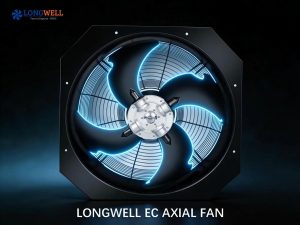
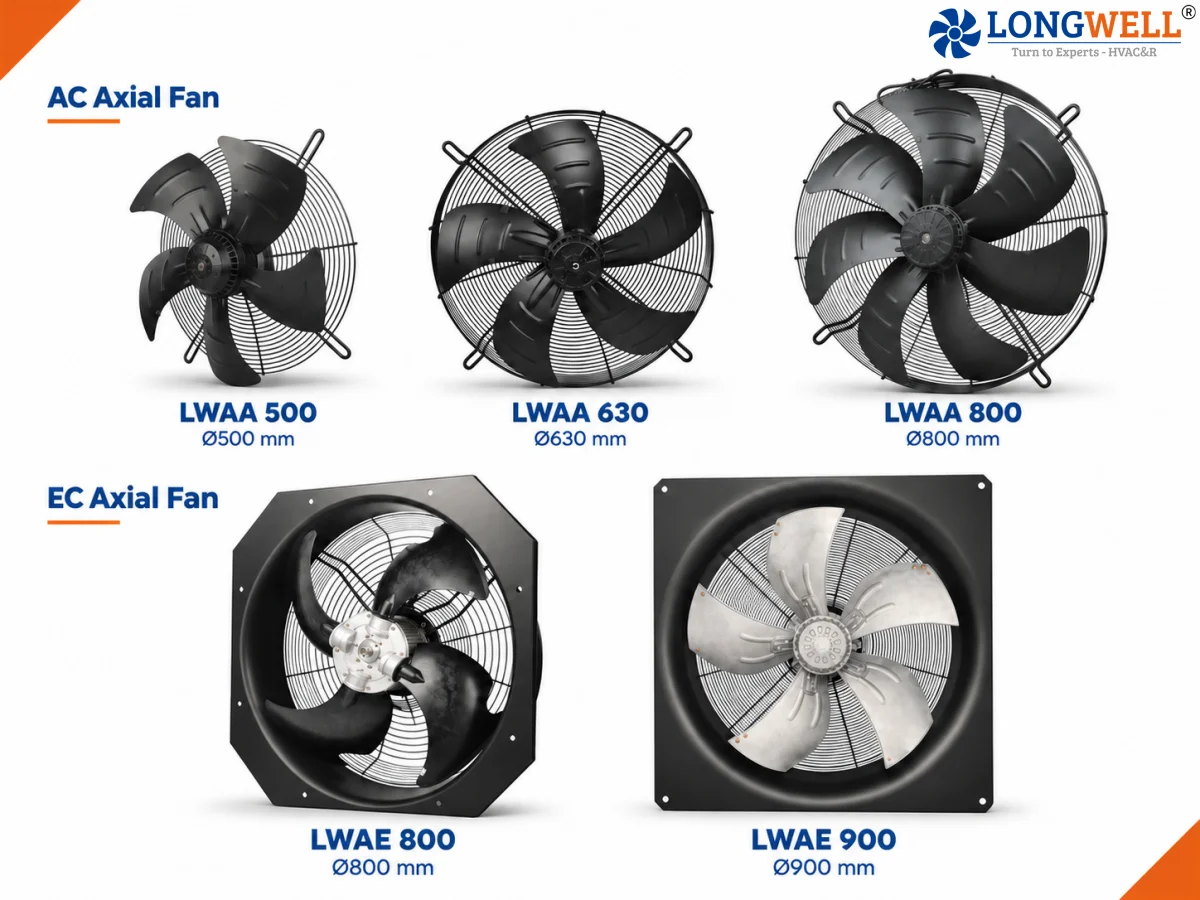
LONGWELL builds the IP rating into the same product series. In a data center cooling project, the EC axial fan series LWAE 710/800/900 for dry coolers, air cooling condensers, and cooling tower positions are with IP55 markings. The AC axial fan series LWAA 500/630/800 for fixed-speed applications is rated IP54.
The same graded logic carries into LONGWELL DC cooling fans, where the protection tier follows the exposure: IP44 for bathroom-humidity positions, IP54 for food-grade equipment where splash governs, IP55 for outdoor cleaning appliances where a directed rinse governs.
Behind these options of different IP codes, it lies LONGWELL’s strong manufacturing capabilities. With company-wide annual capacity above one million units and ISO 9001, 14001 and 45001 quality systems. When a standard configuration cannot fully match the application requirements, LONGWELL provides a structured 90-day custom NPI process, from requirements confirmation through design and sample validation to mass-production release.
FAQ
Is the IP rating for the motor or the fan assembly?
Usually the motor, while the buyer is specifying a fan. Glands, terminal boxes, covers, and mounting orientation set the realized assembly rating.
Can I retrofit existing IP54 fans with IP55 hardware?
Partly. Glands, terminal box lids, and sealed entries can be upgraded. The shaft seal path is a motor-level design decision, so the retrofit ceiling is set by the motor, not by the accessory kit.
Does IP55 need drainage?
Yes, for outdoor and condensing duty. IP55 handles external jets, not internal condensate. A sealed IP55 enclosure without a breather can trap moisture and fail earlier than a drained IP54 motor.
Is IP55 always better than IP54?
No. If IP55 sealing blocks pressure equalization and no breather is fitted, internal condensation can make it the worse choice for a fan motor in a humid location. If the motor is only under splashes, an IP54 model with a condensate drain may be better.