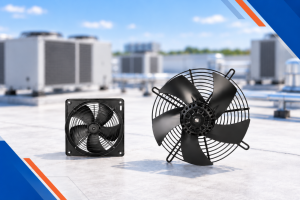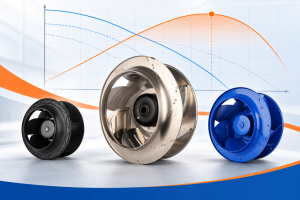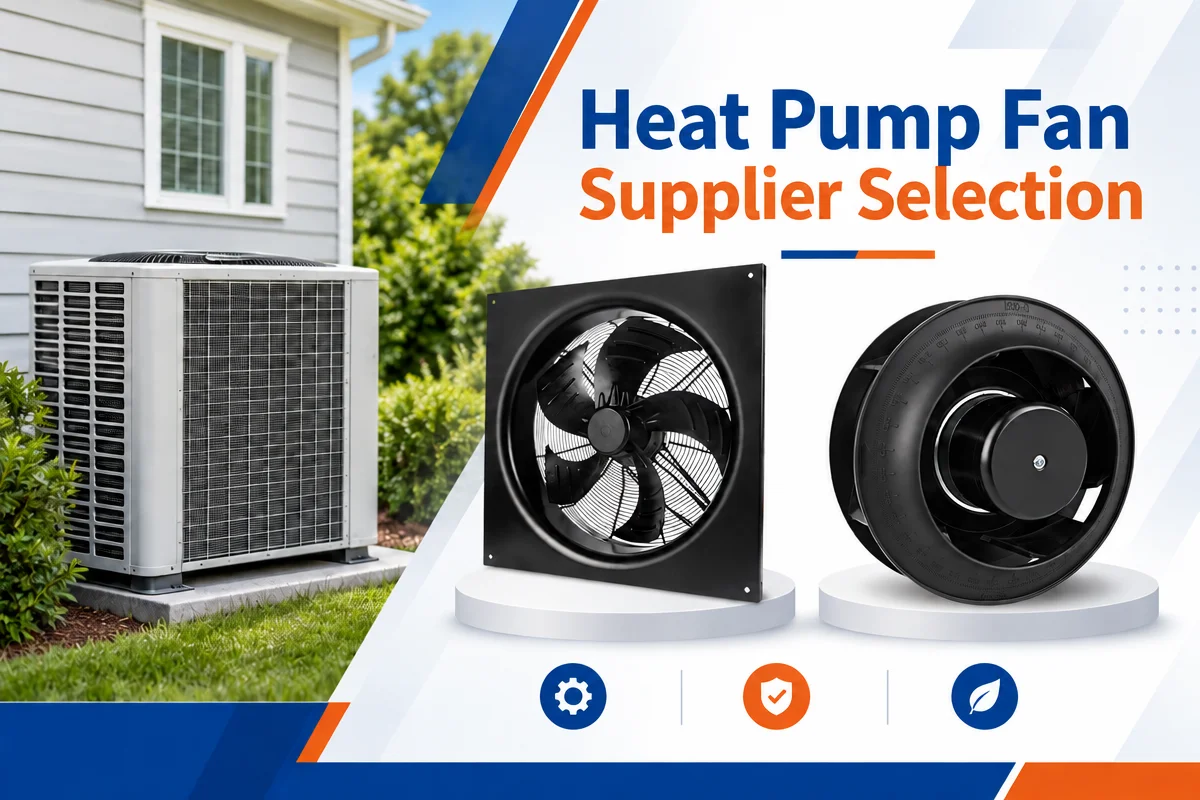
As the European heat pump market continues to evolve, selecting the right heat pump fan supplier becomes more and more important. Choosing the heat pump fan supplier is not simply a matter about choosing airflow, motor efficiency, noise level, or prices. For European heat pump OEMs, a reliable heat pump fan supplier should offer more than just a catalogue of axial fan or centrifugal fan. So, what should OEMs check before selecting the fan supplier? Read on to know more about heat pump suppliers checklists.
What is Heat Pump Fan?
Heat pump is an HVAC component that can both cool or heat your home. The heat pump fan is a key component in heat pump installation to move air across the heat exchange to facilitate heat transfer between the circuit and the surrounding air. In an air-source heat pump, fans are primarily used in two locations: outdoor unit and indoor unit. In outdoor unit, heat pump fan draws or pushes air through the outdoor heat exchanger; in indoor unit, the fan circulates air through the indoor air exchanger and distribute it. In heating mode, the fan absorbs heat energy from the outside air and transfer it indoors; in cooling mode, the fan absorbs heat indoors and circulate it outdoors.
Heat Pump Fan Types
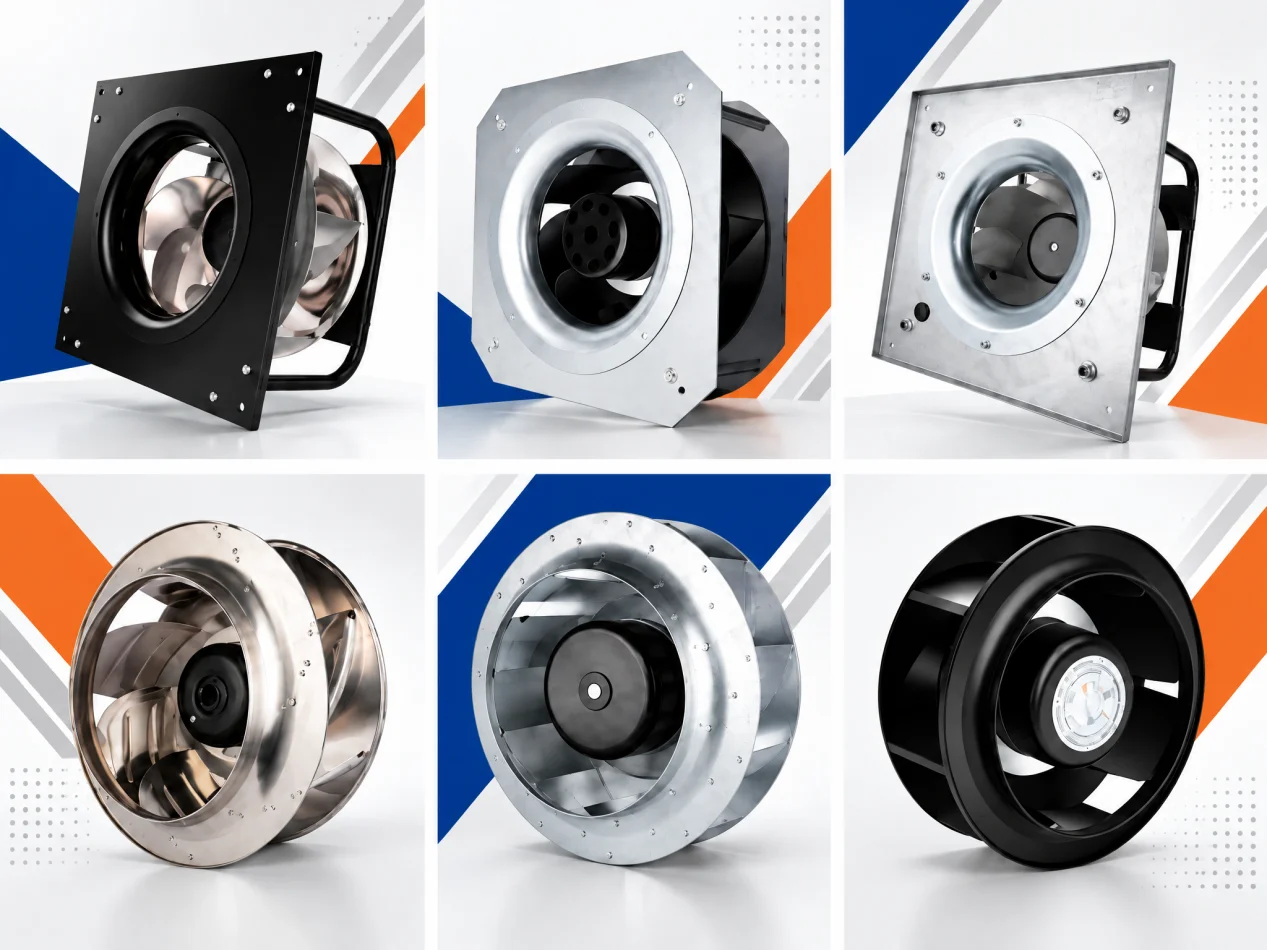
Heat pump fans are usually classified into the following three fan families.
|
Fan type |
Typical heat pump role |
What to verify |
|
Axial fan |
Outdoor unit, air-source monobloc and split |
Static pressure at the coil face; low-ambient startup; IP and corrosion class; speed control range |
|
Centrifugal / plug fan |
Indoor units, ducted and monobloc layouts with higher external static |
Curve at the real system resistance; noise at part load; mounting envelope |
|
Cross-flow (tangential) fan |
Compact indoor terminals and air curtains |
Even exit velocity profile; bearing life at continuous low-speed duty |
EC fans dominate new heat pump platforms for a reason: part-load efficiency compounds under modulating duty, and speed control integrates directly with the compressor signal. LONGWELL’s LWBE3G platform data shows 8–12% energy savings and 4–6 dB(A) noise reduction versus AC baseline in matched applications, with static efficiency of 73–82%.
Note: The honest counter-case: if annual run hours are low, or the duty is effectively fixed-speed, the EC price premium is hard to justify on energy savings alone. The argument then shifts to noise limits and control integration. State that plainly when defending the cost internally, and never quote nameplate efficiency without the actual duty point.
Heat Pump Fan Parameters
There are some heat pump fan parameters that you need to pay attention to before choosing the heat pump supplier.
Engineering Parameters
- Airflow and static pressure: he fan must deliver the required airflow against the resistance of the heat exchanger in heat pump applications.
- Operating Speed: Variable-speed operation allows the heat pump controller to adjust airflow based on heating or cooling demand.
- Air distribution:Even air distribution across the coil is important for heat exchanger effectiveness.
- Operating temperature: Outdoor heat pump systems may require additional requirements for fan operating temperature.
- Installation conditions: Fan position, clearance, grille geometry, and nearby structural components can influence aerodynamic performance and noise.
Motor Control and Communication
Modern heat pump applications require more accurate control strategies. You’d better confirm the following content:
- Supply voltage: It should be compatible with the heat pump electrical parameters.
- Speed control: PWM, 0–10 V, or other supported control methods.
- Communication: Modbus or other required communication protocols.
- EMC performance: Compatibility with the system’s electromagnetic environment.
4 Failure Points in Heat Pump Fan Sourcing
Ask most procurement teams how they evaluate a fan supplier and you get a parameter comparison: airflow, static pressure, efficiency, noise. Those numbers matter, but they only answer whether the fan performs.
Existing supplier checklists cover generic questions, yet almost nobody organizes sourcing risk around programme calendar impact. That is the lens this article uses.
The four failure points:
- Sample Delivery Cadence — how fast a supplier responds to sample requests and to revised sample requests after test feedback.
- Engineering Change Notification (ECN) — whether the supplier contractually commits to telling you when a motor, impeller or firmware revision changes a qualified part.
- Batch-to-Batch Consistency — whether unit #5,000 in year three matches the unit you validated in week eight.
- Certification and Technical Documentation Completeness — whether CE, ErP and test documentation arrives complete, current, and at the right duty point, with every shipment.
Each of these four failure points corresponds to a critical stage in the supplier evaluation process. Read it as a diagnostic sequence: identify which gate your programme is most likely to stall at, then apply the corresponding checks before you place the first order. LONGWELL approaches its own heat pump OEM programme work around these same four gates. For European OEMs, evaluating these capabilities can help prevent costly revisions, qualification delays, and supply disruption.
The Typical Ramp-Up Timeline for a 12kW Monobloc
A published OEM/ODM heat pump project timeline gives a credible phase skeleton: requirements definition in weeks 0–4, sample build and first article inspection in weeks 4–12, testing and certification in weeks 10–26, pilot run and mass production from weeks 24–40. That skeleton treats the fan as an invisible component. Here is the fan-specific overlay.
|
Phase |
Calendar window |
Fan-specific activity |
Where it stalls |
|
Requirements |
Weeks 0–4 |
Duty point definition, envelope, control interface |
Vague duty spec → wrong fan proposed |
|
Sample build & FAI |
Weeks 4–12 |
Impeller/motor customisation, first functional samples |
Sample lead time, revision turnaround |
|
Testing & certification |
Weeks 10–26 |
ErP data submission, noise/vibration reports for the unit dossier |
Missing or mis-measured fan paperwork |
|
Pilot & mass production |
Weeks 24–40 |
Batch process qualification, incoming inspection baseline |
Consistency drift, no agreed tolerances |
Our 12kW R290 monobloc use case — heat pump R290 monobloc 12kW OEM — walks through exactly this delivery sequence inside a real programme.
Sample Lead Time vs. Fan Parameters
A fan curve reveals design capability. A supplier’s sample response time reveals engineering bandwidth and backlog. A supplier that takes six weeks to send a first sample will not magically turn fast when your validation report demands a revised impeller in week 14. That is why sample cadence is a leading indicator of programme reliability, and it should outrank datasheet metrics in your RFQ scoring.
Here are some generic RFQ question lists to ask your supplier:
- What is your time to first functional sample, from PO to shipment?
- What is your time to a revised sample after test feedback?
- Are sample units built on the intended production line, or on an engineering line?
- Who owns the sample schedule internally — a named person, or “the factory”?
- Will you include a written sample schedule in the quotation itself?
- Does the sample configuration match the offered configuration exactly?
To compress the pre-sample stage, narrow your candidate configurations before the RFQ using the fan selector tool. Arriving at the supplier with two or three defined operating points shortens the first sample loop measurably.
Engineering Change Notification (ECN): Protecting Product Qualification and Supply Continuity
Electronics-lifecycle literature explains EOL and PCN definitions well. For heat pump OEMs, these concepts need to be translated into practical requirements.
- Minimum EOL notice window. A last-time-buy horizon long enough to run a substitution qualification inside your existing certification cycle — typically 12–18 months for a certified heat pump platform.
- Mandatory substitution proposal with equivalence data. When a part is discontinued or revised, the supplier must propose a replacement with supporting data, not just a part number change.
- Defined requalification scope. The contract states what you must retest for each change class — so requalification is negotiated in peacetime, not during a shipment hold.
Batch-to-Batch Consistency: Defining Incoming Inspection for Fans
For OEMs, batch consistency means more than confirming that every fan passes a basic functional test. It means ensuring that production units continue to match the performance, electrical, mechanical, and acoustic characteristics of the originally approved sample.
The solution is to translate the general concept of manufacturing consistency into four measurable acceptance parameters:
|
Criterion |
What to specify |
Where verified |
|
Airflow deviation at contract duty point |
Tolerance band vs. released baseline, e.g. ±[DATA NEEDED] % |
Supplier EOL 100% + OEM AQL sample |
|
Noise scatter |
Limit in dB(A) vs. baseline sample, same test rig [DATA NEEDED] |
OEM incoming, per AQL lot |
|
Vibration |
Velocity limit at defined points [DATA NEEDED] |
Supplier EOL |
|
Electrical parameters (current, power) at rated speed |
Tolerance vs. nameplate, e.g. ±[DATA NEEDED] % |
Supplier EOL 100% |
Heat pump OEMs should care more than AHU builders here. Outdoor fans run short seasonal duty cycles; a shifted operating point shows up directly in COP claims and field noise complaints, not buried in a duct system.
The Certification File: What Must Be Attached to Every Shipment?
ErP 2026 explainers are everywhere. What is missing is a shipment-level document list. This is the component-level package a European OEM needs:
- CE Declaration of Conformity citing the correct, current directives.
- ErP compliance data measured at the declared duty point — the point in your programme, not a catalogue best point.
- Test reports traceable to standards, with report numbers and accredited-lab identification.
- Material and RoHS declarations where applicable.
The ErP 2026 regulatory transition adds another layer of timing pressure for European heat pump OEMs. Fan suppliers and OEMs should review whether updated efficiency data, test reports, or technical documentation are required under the applicable regulatory framework.
Attach a per-shipment checklist to the purchasing contract: DoC version and date, ErP data at the contract duty point, report numbers, RoHS declaration. Two LONGWELL references for building this package: the ErP 2026 fan compliance guide and the ETL/UL equivalence explainer.
EC vs AC Fan in Heat Pump Applications
Heat pump outdoor fans run long hours at reduced speed, alongside modulating compressors. EC’s part-load efficiency advantage compounds under exactly that duty profile — LONGWELL’s LWBE3G platform data shows 8–12% energy savings and 4–6 dB(A) noise reduction versus AC baseline in matched applications, with static efficiency of 73–82%. But that advantage is conditional on one thing procurement often skips: knowing the real annual load profile.
If annual run hours are low, or the duty is effectively fixed-speed, the EC price premium is hard to justify on energy savings alone. In that case the argument shifts to noise limits and control integration (0-10V/PWM, compressor-synchronised speed). State this plainly when defending the cost internally.
5 Things to Evaluate AC to EC Upgrade:
- Annual operating hours (real, not nameplate assumption)
- Load profile — % of hours at each speed
- Energy tariff
- EC vs AC price delta per unit, including drive
- Payback period, plus noise and control benefits stated qualitatively
LONGWELL’s EC vs AC efficiency guide and the AC-to-EC retrofit ROI guide provide the calculation references; for outdoor-fan duty, the LWAE3G EC axial fan series is the standard fit.
Heat Pump Fan Supplier Checklist for European OEMs
|
Evaluation Category |
Key Questions |
|
Application Engineering |
Can the supplier evaluate the actual system operating point based on specific heat pump applications? |
|
Energy efficiency |
Can it provide more efficient fan solutions? |
|
Acoustic performance |
Are sound power and vibration data available? |
|
Motor control |
Do their fans support required control signals and communication interfaces? |
|
Environmental durability |
Has the fan been evaluated for the required temperature and outdoor conditions? |
|
Compliance |
Can the supplier provide relevant certification documents like CE and ErP regulation? |
|
Production capacity |
Can it support forecasted annual volumes and seasonal demand? |
|
Quality management |
Are production inspections and traceability procedures established? |
|
Customization |
Can the supplier modify dimensions, materials, and fan parameters? |
|
Engineering response |
Can it support prototype testing and technical modifications? |
|
Supply continuity |
Are lead times and engineering change procedures clearly defined? |
|
Total cost |
Can it demonstrate value beyond the initial unit price? |
Why Choose LONGWELL for Your Heat Pump Fan Supplier?
For European heat pump OEMs, choosing the heat pump fan supplier combines engineering capabilities, product complexity, and manufacturing capabilities. LONGWELL develops and manufactures EC fans, AC fans, DC fans, and motor solutions. For heat pump fan solutions, LONGWELL can provide:
- EC fan solutions: LONGWELL provides EC axial fans, EC centrifugal fans, and cross flow fans for energy-efficient airflow engagement.
- Application-based fan selection: LONGWELL engineering team can recommend fan models for specific application.
- 90-day custom NPI versus 12–24 months in Europe: The biggest pain point for heat pump OEMs is the long NPI cycle of European fan suppliers, which frequently holds up ErP upgrade windows and new model launches. LONGWELL’s 90-day custom NPI has been validated with multiple Tier-1 customers, and local China certification labs (TÜV Rheinland and SGS Ningbo) shorten certification cycles by 60–70%.
- A+++ ErP system-level support. Under EU Ecodesign 2024, fan energy consumption accounts for 15–20% of the overall SCOP rating, and the wrong fan can drop a heat pump from A+++ to A+. LONGWELL pairs an IE4+ EC platform with intelligent control and low noise, and also provides system-level ErP/SCOP calculation services.
Three Actions to Take This Week
- Send the six sample-cadence questions (section 3) to every active fan RFQ, and require a written sample schedule inside the quotation before you shortlist.
- Draft the ECN clause (section 4) into your next fan purchasing agreement — notice window, substitution procedure, requalification scope — and score current suppliers against it.
- Build the per-shipment documentation checklist (section 6) and demand the complete package — DoC, duty-point ErP data, numbered test reports — at offer stage, not after the first PO.
FAQs
What type of fan is commonly used in air source heat pumps?
Axial fans are often used in outdoor air source heat pump and centrifugal fans can be used in indoor air-to-water heat pump systems.
Why are EC fans suitable for heat pump applications?
EC fans use EC motors with variable-speed control capabilities and they can be more energy-efficient than other fans.
How can European OEMs evaluate a reliable heat pump fan manufacturer?
OEMs should evaluate suppliers’ engineering expertise, product quality, manufacturing capabilities, lead time reliability, customization flexibility, total cost, and after-sale engineering support.