Key Takeaways
- Estimate required airflow from the space’s volume, target ACH, application, and applicable requirements.
- Select an exhaust fan based on its delivered airflow at the system’s operating static pressure.
- Account for duct diameter, length, bends, filters, and discharge location, which affect installed airflow.
- Match the exhaust fan’s construction, noise level, and controls to the application and expected operating conditions.
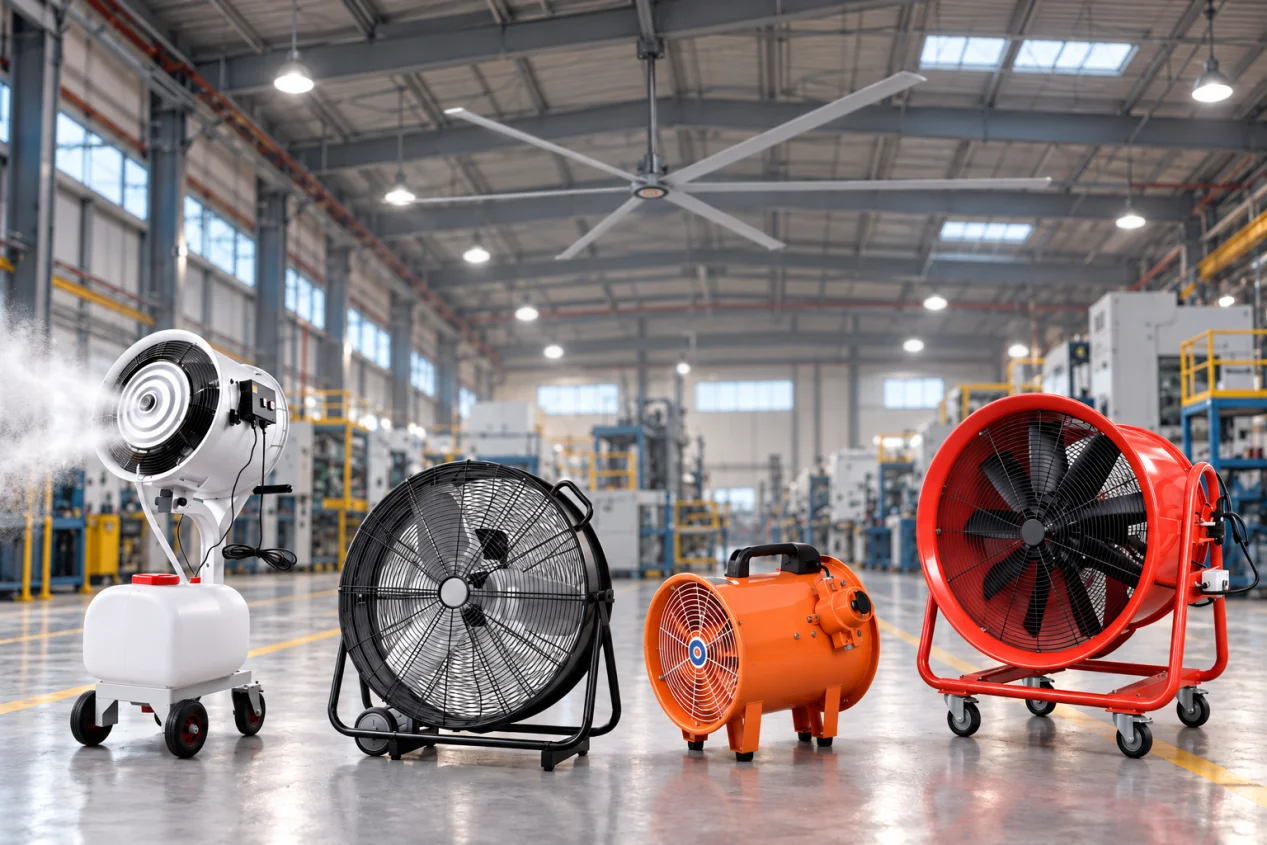
Whether an exhaust fan is used to control bathroom humidity, remove kitchen fumes, or ventilate an industrial or poultry facility, its capacity must match the application’s airflow requirements. Fan dimensions, price, and appearance alone cannot show whether it will deliver the required airflow through the system. The selection process also considers facility volume, duct resistance, and operating conditions. This guide explains how to estimate airflow and select an exhaust fan size suited to each application.
Key Parameters for Exhaust Fan Size
Airflow Capacity: CFM and m³/h
Exhaust fan airflow is commonly measured in cubic feet per minute (CFM) or cubic meters per hour (m³/h). Both units describe the volume of air a fan moves over time. CFM is commonly used in the United States. For European and international fan specifications, m³/h is more commonly used.
The units can be converted with these formulas:
- CFM to m³/h: m³/h = CFM × 1.699
Example: 1,000 CFM ≈ 1,699 m³/h. - m³/h to CFM: CFM = m³/h × 0.5886
For a quick estimate, divide m³/h by 1.7.
Installation Dimension
Installation dimensions vary by application. A residential bathroom often uses a compact ceiling or wall fan that fits a specific housing opening and duct connection. Under normal conditions, residential bathroom fans use 3-, 4-, or 6-inch duct connections. A kitchen may require a range hood or a wall-mounted fan with dimensions suited to the cooking area and exhaust route. Garages, industrial facilities, and poultry houses often use larger wall- or roof-mounted fans that fit structural openings and allow access for maintenance. Selection should account for the fan housing, mounting opening, duct or discharge connection, and available clearance at the installation site.
What Factors Affect Exhaust Fan Selection?
Exhaust Air Type
Exhaust air composition and operating conditions help determine an exhaust fan’s materials and construction. A bathroom exhaust fan mainly handles water vapor, but a residential kitchen fan also encounters warm air, oil mist, and cooking residue. Restaurant hood exhaust carries heavier grease loads, so it calls for an exhaust fan designed for grease exhaust and regular cleaning.
Industrial exhaust varies by process: a woodworking area produces airborne dust, a paint booth may contain solvent fumes, and a process line may release hot or corrosive gases. Those contaminants affect the exhaust fan’s blade and housing materials, motor protection, and required safety features. Poultry-house exhaust brings a different mix of humidity, ammonia, and dust, recommending corrosion-resistant fan blades for these harsh conditions. Identifying the exhaust stream helps narrow the suitable fan type and construction before airflow is finalized.
Space Volume, Occupancy and Required ACH
Start by calculating the room volume: multiply its length, width, and height. For example, a room measuring 20 ft × 15 ft × 10 ft has a volume of 3,000 ft³. Air changes per hour (ACH) compares the airflow through a space with its volume. The basic estimate is:
Required CFM = Room Volume × Target ACH ÷ 60
If a design target calls for 6 ACH, the example room would need an estimated 300 CFM. This number demonstrates the calculation; it is not a universal recommendation. The required ventilation depends on the application, occupancy, contaminants, and applicable codes. Occupied spaces may have ventilation requirements based on the number of people or floor area, so ACH alone may not set the fan’s required airflow.
Use the applicable standard or design requirement to establish the target ACH or airflow. Then select a fan that can deliver that airflow in the installed system. Avoid adding an arbitrary safety margin: duct length, bends, grilles, and other components affect the airflow the fan actually delivers.
Discharge Location
The discharge point determines how the exhaust duct should be routed and can affect the airflow the fan delivers. In a residential bathroom, the exhaust fan may hide in the ceiling, but its duct should terminate outdoors through a wall or roof. The duct diameter should match the fan manufacturer’s specification, and the route should be as direct as possible, with few bends. A kitchen hood may need a roof outlet to suit its duct path. In an industrial system, the exhaust stack should discharge high enough and far enough from air intakes to keep contaminants from re-entering the work area.
Duct diameter matters too: connecting a fan with a 6-inch outlet to narrower ductwork increases resistance and can lower its delivered airflow. The fan should be selected for the actual route and duct size so it can remove humid air effectively.
Exhaust Fan Size in Different Ventilation Systems
Residential Bathroom Ventilation
Residential bathroom exhaust fans are available in nominal 4-, 5-, and 6-inch sizes, with a wide range of airflow capacities. Wall, window, and ceiling models have different designs and installation layouts, so the required airflow depends on the room and the duct route. The fan’s listed maximum airflow may differ from what it delivers once connected to the installed ductwork.
ASHRAE 62.2 provides ventilation and local-exhaust requirements for residential dwelling units. Requirements depend on the edition adopted by the jurisdiction and any local amendments, so check the applicable code before installation.
Garage Ventilation
Under the 2024 International Mechanical Code (IMC) Section 404.1, an enclosed parking garage requires a full-on exhaust rate of at least 0.75 CFM per square foot. That means, for a 2,000-square-foot garage, that equals 1,500 CFM at full operation and 100 CFM in standby. A system using automatic CO and NO₂ detection can cycle to a standby rate of at least 0.05 CFM per square foot.
In an attached home garage, an exhaust fan can help remove vehicle exhaust that builds up in the space. Air can also move from the garage into the home, so ventilation works alongside measures such as a carbon monoxide alarm and keeping the garage separated from living areas. Enclosed parking garages need a system designed around vehicle activity, pollutant levels, airflow distribution, and applicable code requirements. CO or nitrogen dioxide sensors may control fan operation where permitted by code.
Industrial Ventilation
Industrial exhaust fan sizing starts with the material the system needs to capture or convey. For example, wood dust, welding fumes, and hot process air create different airflow and equipment requirements. The material type and concentration help establish the required capture airflow and, in dust systems, the conveying velocity.
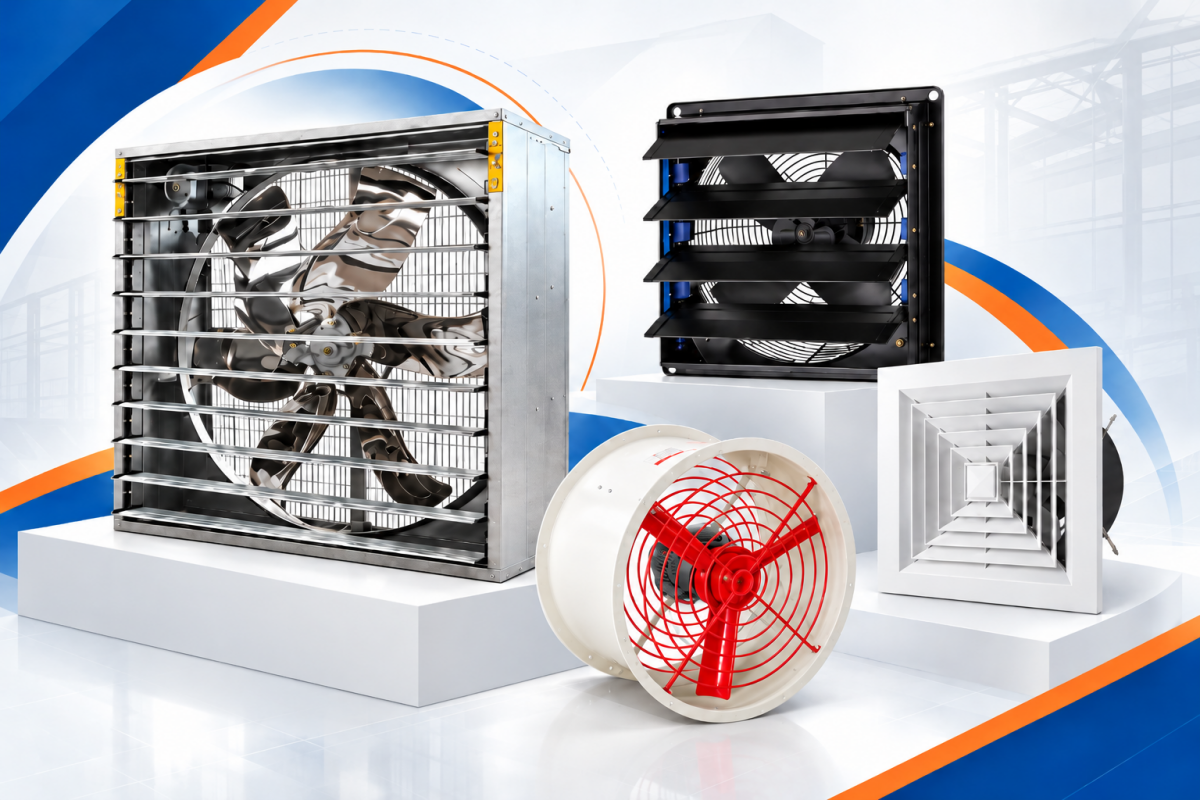
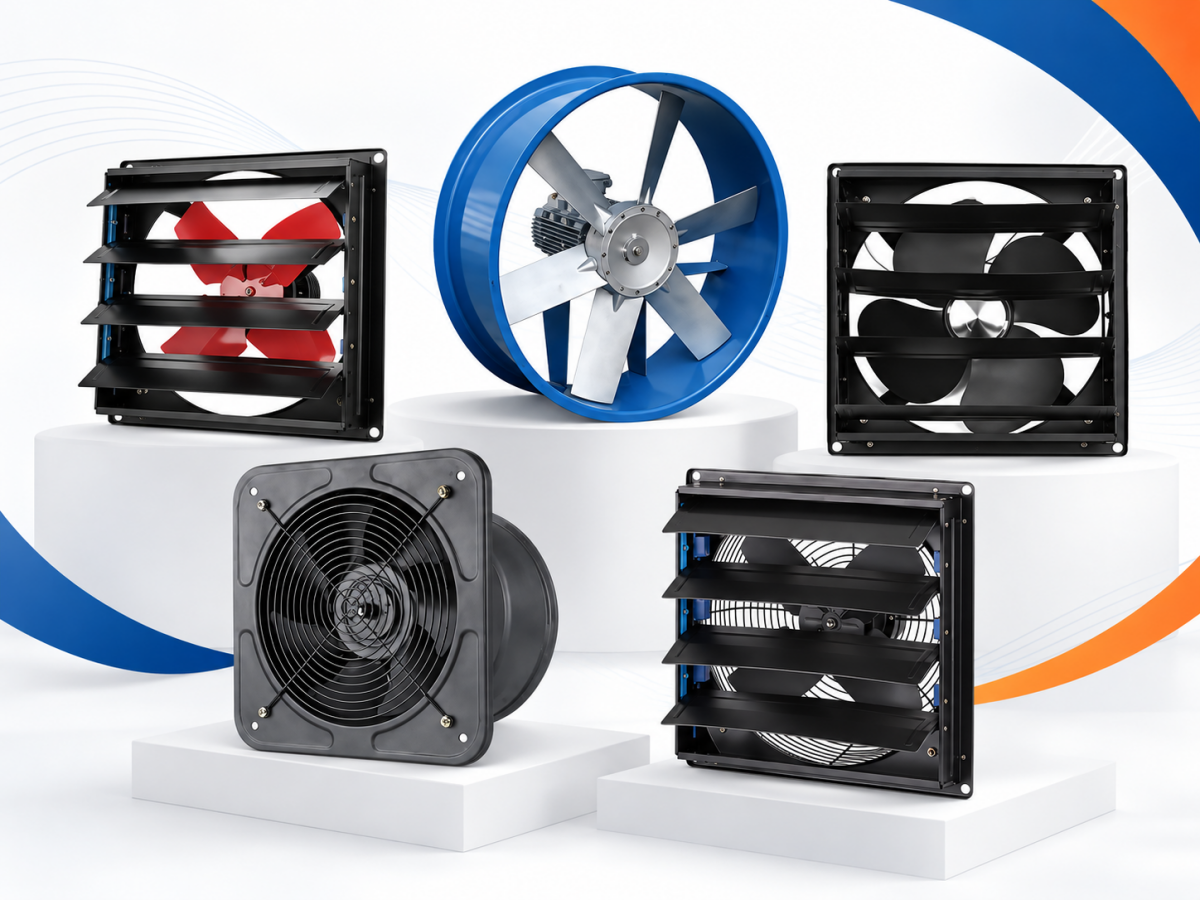
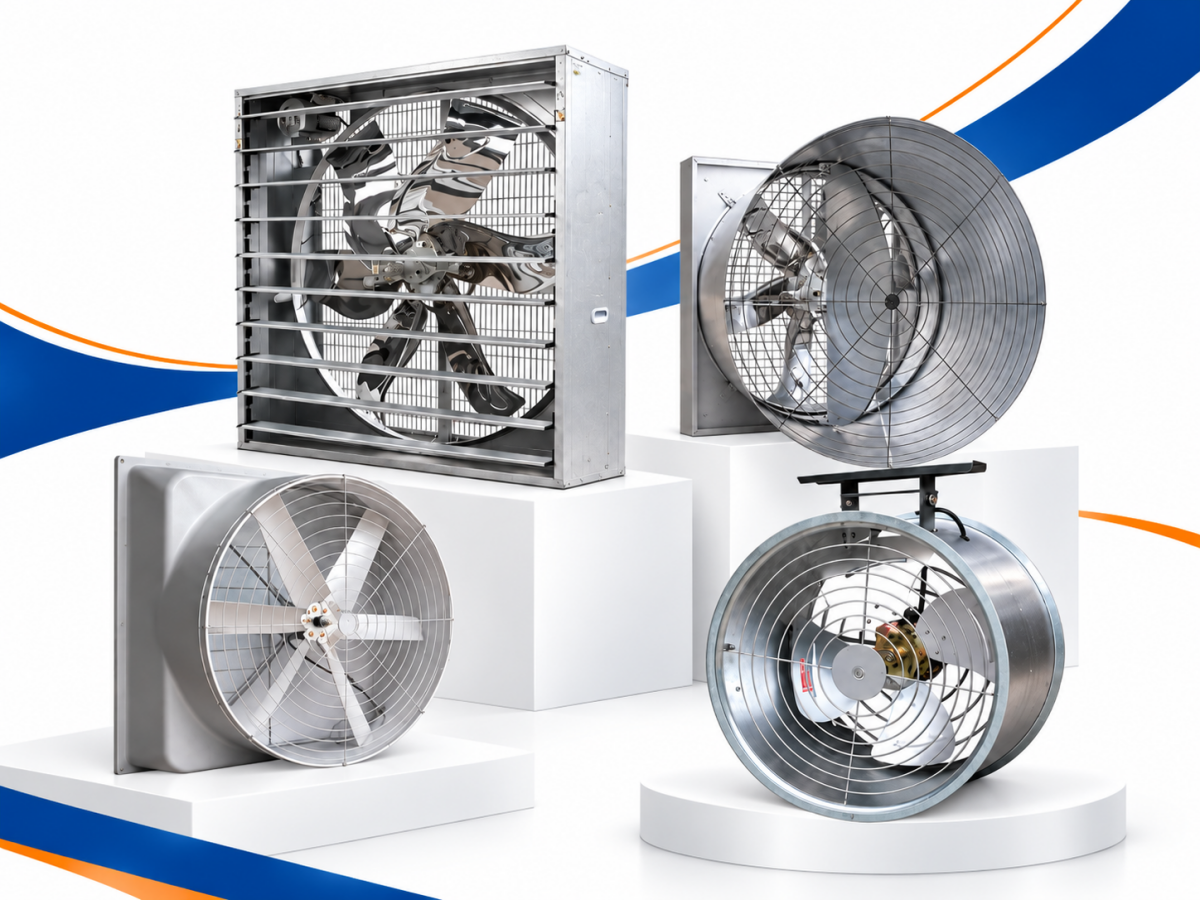
The exhaust fan must deliver that airflow at the system’s operating static pressure, accounting for ducts, filters, louvers, and other components. Temperature, humidity, dust, chemicals, and corrosive substances guide the fan’s materials and construction. The table shows how nominal size and rated airflow vary across models:
| LONGWELL Industrial Exhaust Fan type | Size range | Airflow range |
| Wall-mounted industrial exhaust fan | 8–24 in (200–600 mm) | 540–8,700 m³/h |
| Square axial fan with shutter | 200–600 mm | 500–13,000 m³/h |
| High-speed metal exhaust fan | 4–20 in (100–500 mm) | 100–5,100 m³/h |
| Heavy-duty exhaust fan | 12–24 in (300–600 mm) | 2,100–12,000 m³/h |
| Tobacco-curing axial fan | 300–1,000 mm | 2,400–40,500 m³/h |
| Explosion-proof axial fan | 280–1,000 mm | 1,605–48,326 m³/h |
| Flameproof axial fan | 300–750 mm | 2,200–10,500 m³/h |
| Louvered fan | 4–5 in (100–120 mm) | About 1,104–2,039 m³/h |
| EC brushless exhaust fan | 10–16 in | 1,005–4,300 m³/h |
Poultry Ventilation
Fans drive mechanical ventilation in poultry houses, where exhaust capacity is selected according to the airflow the building needs at its operating static pressure. Many tunnel-ventilation models use impellers around 710–1,400 mm in diameter, but diameter alone does not determine delivered airflow. Fan capacity should be checked at the system’s operating pressure, with a modest margin for losses from dust buildup, component wear, and peak heat loads.
Common Exhaust Fan Sizing Mistakes to Avoid
Oversized Exhaust Fan
A modest capacity margin can account for future changes or expected performance losses. An exhaust fan sized well above the required duty point may create excess airflow, high local air speeds, drafts, and noise. In fixed-speed systems, it will also increase energy use. Select an exhaust fan that delivers the required airflow at the design static pressure. Use staging or speed control when the system needs a wider operating range.
Ignoring Noise Level
Noise should be considered alongside airflow and static pressure when selecting an exhaust fan. Buyers who compare only price or brand may overlook how disruptive a fan can be in occupied rooms. This is especially relevant in residential places such as bathrooms and bedrooms, as well as commercial places such as offices. Check the fan’s sound rating at the intended operating condition, and consider noise from vibration and the duct system.
LONGWELL Exhaust Fan Support
LONGWELL’s residential ventilation solution brings together six fan series for different applications. AC axial fans with 100–150 mm impellers serve bathroom exhaust, while forward-curved centrifugal fans handle kitchen exhaust. Other series support HRV/ERV systems, apartment ventilation, smart-home ventilation, and air purification. Across the solution, the relevant products and systems address quiet operation, Matter 1.2 integration, and heat recovery of up to 92%.
The product range also covers wall-mounted, industrial, and poultry ventilation, along with motor-cooling applications. LONGWELL provides free pre-sales selection consultation. Project support can include factory acceptance, installation guidance, commissioning, and BMS integration. After-sales services include a 12–24-month warranty, 24/7 technical response, and spare-parts supply.
FAQ
Does bathroom size alone determine the exhaust fan size selection?
No. Bathroom size only provides the airflow estimate. Moisture sources such as showers or tubs, and duct layout shape the final fan selection.
Why does continuous ventilation matter?
In a closed home, moisture and odors will persist. Continuous ventilation allows the air to circulate within the space and helps to remove them.
Does duct size affect CFM?
Yes. Consider a 6-inch exhaust fan connected to a 4-inch duct. The narrower duct increases resistance, and a long run or several sharp elbows add more. The fan may then deliver less airflow than its catalog rating.
How to decide exhaust fan size?
Start with the airflow required for the application. Room area, ceiling height, occupancy, fixtures, and moisture or heat sources can all affect that requirement. Then select a fan that can deliver the target airflow at the system’s operating static pressure.
Choose the right exhaust fan
Longwell manufactures 241 exhaust fans in-house. Send airflow, static pressure and voltage — an engineer replies with a matching model, performance curve and price within one working day.