Why can two industrial fans that look alike carry different quotations? The visible impeller is only one part of the purchase. A quote also defines an operating duty, electrical and control options, verification work, quantity and delivery responsibility. When those fields differ, a lower unit price may describe a different product or a shorter list of obligations. This guide gives buyers a way to compare fan offers without assuming that every manufacturer has the same cost structure.
Freeze the operating duty before comparing prices
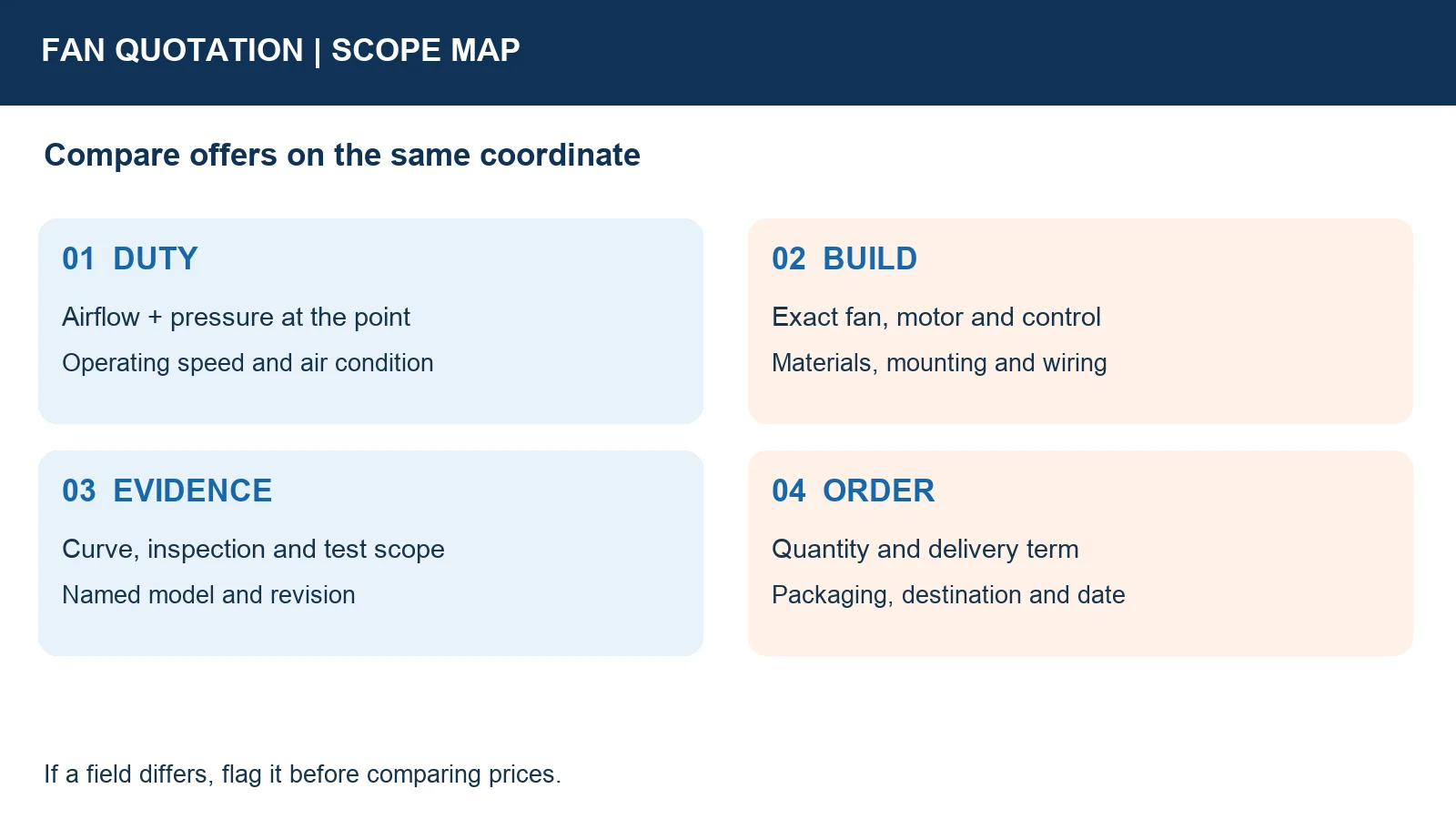
Give every supplier the required airflow and pressure at the intended operating point, air conditions, allowable speed range, supply voltage and installation boundary. A free-air airflow number and a duty point through a filter or enclosure are not interchangeable. Ask for the curve and the exact model revision corresponding to each offer. If a buyer has already chosen a complete catalog model, confirm that model and the remaining commercial gaps rather than sending a generic questionnaire asking the buyer to rediscover published parameters. When the model is still open, the duty point and installation data are essential inputs.
Read the complete fan and drive architecture
Compare the impeller and housing, motor type, electronics, control interface, materials, protective features, connection method and mounting arrangement. An EC fan with integrated electronics and a differently controlled AC assembly should not be treated as the same bill of materials. A changed bracket, cable or connector may also require a separate drawing and validation decision. A controlled Longwell bill of materials for one LWBE3G280-102PS-19 custom bracket confirms that model-specific components can be defined separately; it supplies no general price split for other fan designs.
The Longwell EC axial fan family is a starting point for identifying one category of products. Its family page does not prove a quoted price, the suitability of a particular model or the specifications of a different fan type. Request the full suffix and current drawing for a real offer.
Separate recurring units from one-time project work
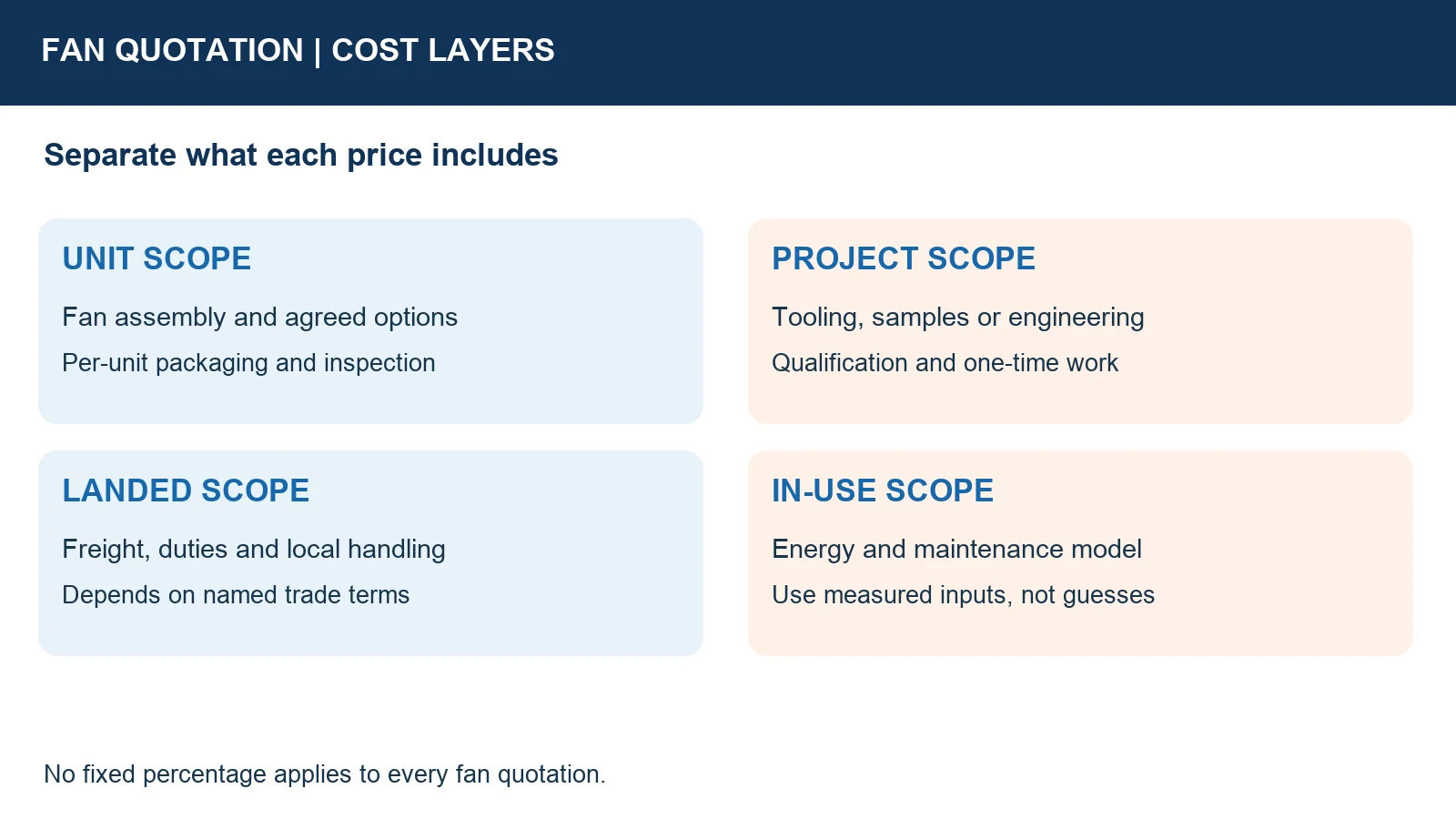
A quotation may include a recurring assembled unit, tooling or fixture work, prototype samples, engineering changes, application validation and document preparation. Ask which items are charged once, which repeat for each unit and which depend on a later design freeze. The custom impeller tooling guide helps frame those questions, but its example language is not a quote for your model. Confirm tooling ownership, maintenance and any future change charges in the actual agreement.
Define the inspection and test evidence you will receive
Balancing, dimensional inspection, electrical checks, airflow testing, acoustic measurements and traceability can mean different deliverables. Specify the exact method, sample or unit coverage, acceptance criteria, report format and model revision. A factory-process video shows that a process exists; it does not prove that a particular shipment passed a particular test. If a market requires a certificate or approval, name the product and applicable scope instead of treating a family brochure as proof. Include the agreed evidence in the comparison sheet so an apparent price difference is not merely an omitted requirement.
Quantity changes the commercial calculation
Give a realistic initial order, forecast cadence and expected variation by model. Suppliers may price sample preparation, setup and recurring procurement differently across quantities, but there is no universal volume discount or minimum order that can be quoted without the configuration and commercial terms. Ask whether a price assumes a firm order, a forecast, a mixed-model batch or a blanket schedule. Where tooling or validation is separate, compare it on its own line instead of hiding it in a hypothetical per-unit average.
Compare unit price, landed cost and in-use cost separately
State currency, payment terms, packaging, delivery location and the named Incoterms rule and place. A factory-gate unit price is not the same as a delivered cost. Freight, customs charges and local handling depend on the agreed route and responsibility; the fan importing terms guide describes the distinctions but does not supply your freight bill. For in-use cost, model energy and maintenance only with a measured duty point, operating hours, tariff and service assumptions. Do not promise payback or lower ownership cost from motor labels alone.
Normalize offers in one comparison sheet
Put each supplier’s exact model, curve revision, operating duty, electrical and control specification, material and mounting options, testing deliverables, quantity, one-time charges, unit price, delivery term and exclusions in adjacent columns. Mark missing entries instead of filling them with assumptions. The industrial fan sourcing guide offers additional supplier-review questions. Negotiate an identified cost driver or a changed obligation explicitly; do not remove a necessary test or safety requirement merely to make two totals match.
Watch the quotation scope walkthrough
For a model-specific comparison, send the duty point, configuration, quantity and delivery scope to sales@longwellfans.com.