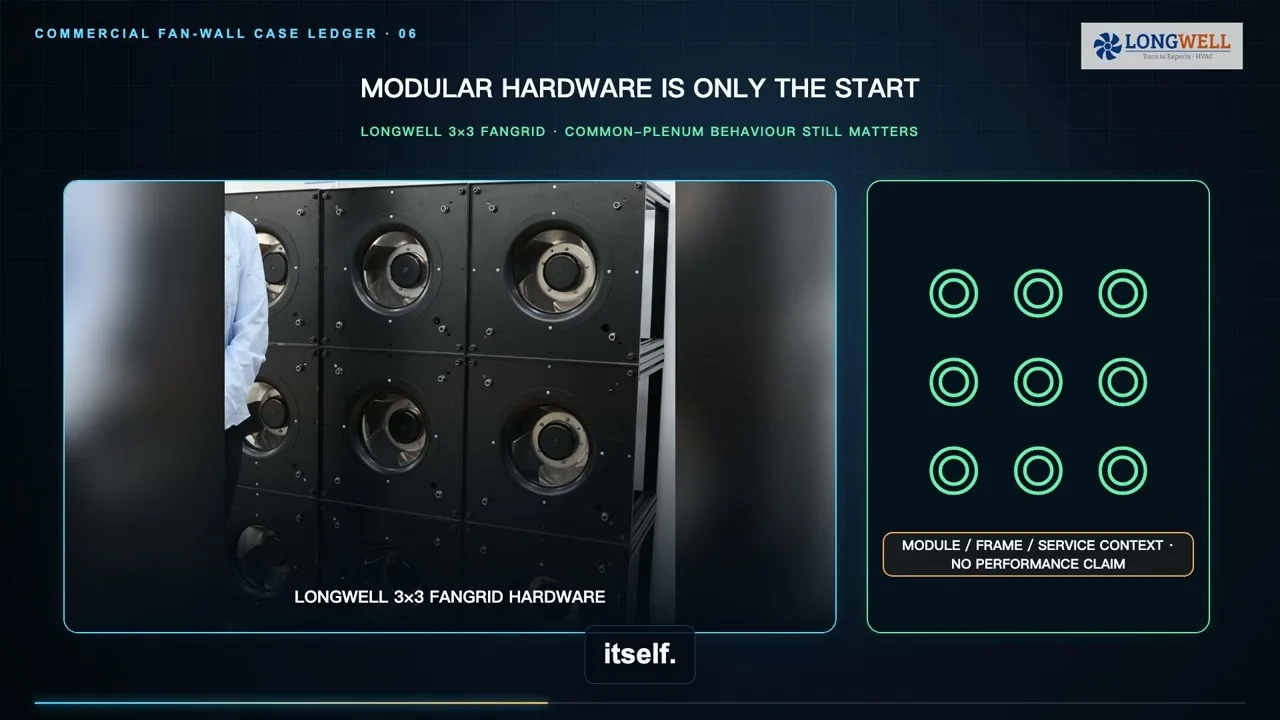
This is a composite case study of a fan wall retrofit in a commercial office, built from the pattern we see repeatedly on this type of project.
It starts, as these usually do, with a failure rather than an energy strategy.
A typical commercial fan wall retrofit replaces one belt-driven AHU fan with six to eight EC plug fans. Expect roughly 30 percent lower fan energy on a variable duty, N+1 availability, the removal of belt maintenance and a shorter cabinet section that can take better filtration. The survey, not the fan, determines whether the project runs smoothly.
The trigger: a failed belt drive
A supply fan in a 1990s air handling unit shed a belt on a Monday morning. The floor it served then lost ventilation for two days while somebody chased parts.
The building manager asked the obvious question. Could the replacement avoid a repeat of both the outage and the belt maintenance that preceded it?
So that question, rather than an energy audit, is usually what starts a fan wall conversation.
The survey
- Measured airflow came in at 22,000 m³/h, against a design figure of 25,000 m³/h.
- Static pressure read 780 Pa with loaded filters.
- Absorbed power averaged 9.4 kW across a working day.
- Cabinet depth measured 1,400 mm, although the access door was only 900 mm.
- The supply checked out, since two spare breaker ways were available.
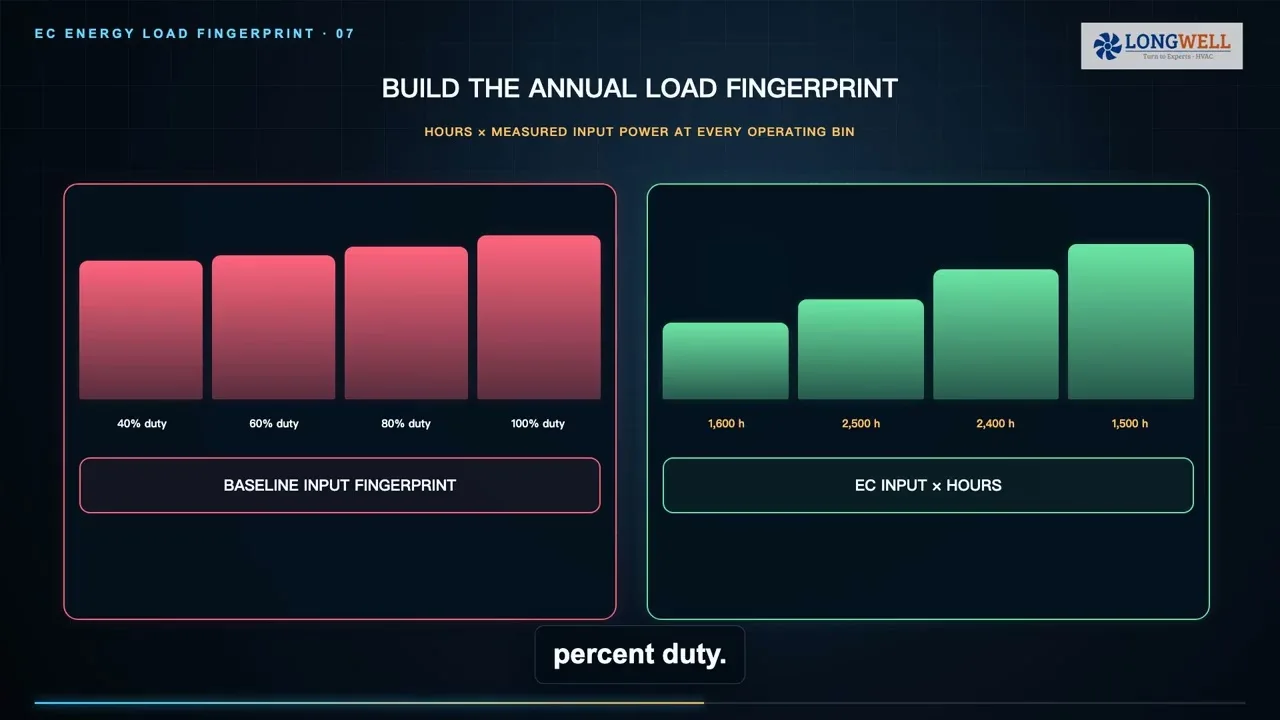
- Finally, the load profile showed 60 percent of hours below 70 percent airflow.
That last line is the one that decides the business case. A unit spending most of its life at part load is exactly where an EC plug fan array pays.
Sizing the array
Six 450 mm EC plug fans covered the duty. Each one delivered around 4,200 m³/h at 780 Pa, close to peak efficiency.
| Before | After | |
|---|---|---|
| Fan | 1 × belt-driven DIDW | 6 × 450 mm EC plug fans |
| Motor rating | 15 kW | 6 × 2.2 kW |
| Average absorbed power | 9.4 kW | 6.3 kW |
| Loss of one fan | Total outage | −17% airflow |
| Cabinet length used | 1,850 mm | 1,200 mm |
| Belt maintenance | Quarterly | None |
Each fan kept 18 percent speed headroom at design duty. That headroom is what makes the redundancy real rather than nominal.
What complicated the installation
Two issues appeared, and the survey had already flagged both. That is exactly why the survey mattered.
- The old fan base came out entirely, and a sealed bulkhead replaced it.
- Cable gland positions ran short, so the team made a new gland plate.
- Every position needed a backdraft damper to stop short-circuiting.
- The freed cabinet length took a deeper filter, which cut system pressure.
- Control cabling needed screening and a route away from the mains feed.
- Finally, the old starter panel stayed, feeding a new distribution board.
None of these were surprises, and that is the point. Our AHU retrofit guide lists the survey items that prevent them becoming surprises.
Commissioning
Engineers commissioned the array as one machine rather than fan by fan.
Engineers set a fixed speed, measured total airflow by duct traverse, then handed control to the building system on duct static pressure. Afterwards they recorded power at four load points to compare against the survey baseline.
One fan was stopped deliberately at full duty. The remaining five recovered airflow within 40 seconds, which proved the redundancy claim rather than assuming it.
Outcome after twelve months
The measured saving came out near 33 percent of fan energy, so slightly better than the 30 percent estimate.
Part of that came from the deeper filter, which cut system pressure for good. Meanwhile the building logged no ventilation outages, and the quarterly belt inspection dropped off the maintenance schedule.
For general guidance on air handling unit design and commissioning, ASHRAE remains the reference used on this type of project.
Fan wall project FAQ
How disruptive is a fan wall retrofit?
Typically one to three days per unit, with the plant off during that window. However, most of the disruption comes from cabling and the support frame rather than from fitting the fans.
Do I need to replace the control system?
Usually not. Most building systems already provide a 0-10V output, and the array simply becomes one controlled device on that signal.
What if the cabinet is too small?
Removing the scroll normally frees enough length. Where it genuinely does not, a single larger plug fan may still fit, even though an array will not.
Is the payback really under three years?
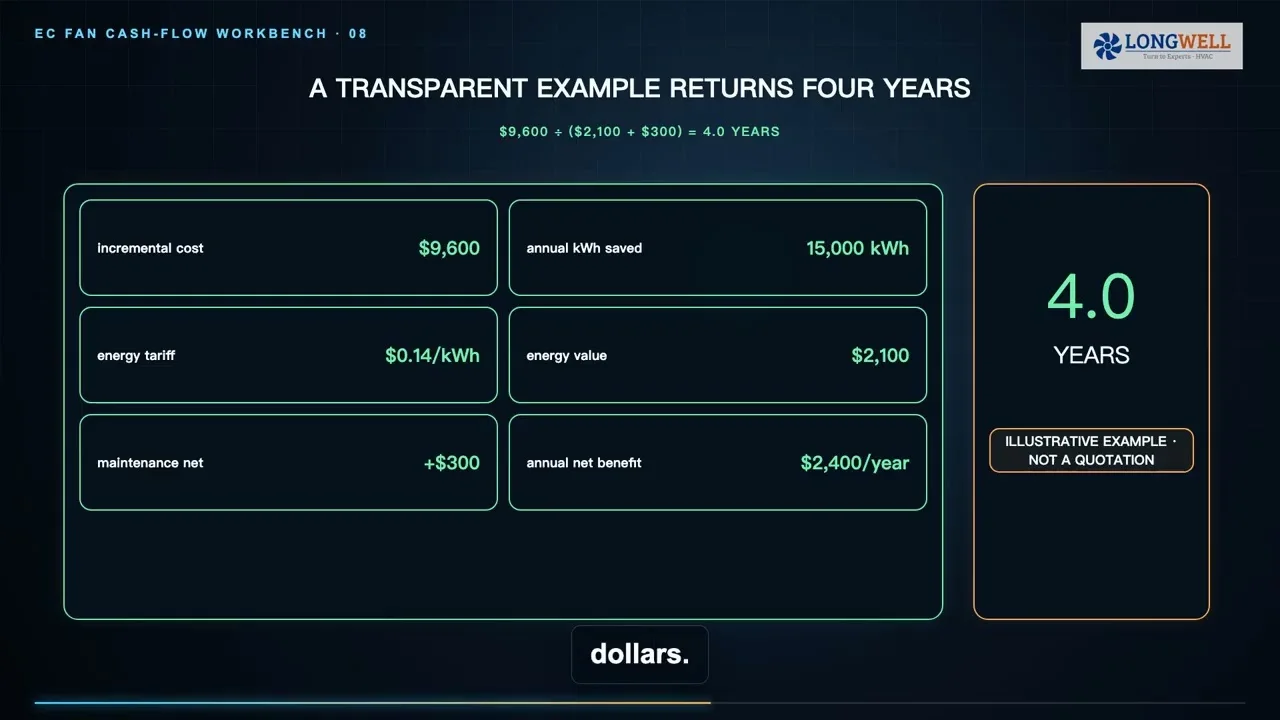
On a unit with a varying load and long run hours, frequently yes. On constant-volume plant that runs at full duty all year, the case is much weaker.
A fan wall project succeeds on survey quality rather than on fan choice. Measure the baseline, prove the failure case at commissioning, and the numbers speak for themselves.