Key Takeaways
- AHU types overlap. Construction, installation, and fan position are separate ways of describing the same unit.
- Single-skin casing is compact and cheaper. Double-skin casing adds insulation for humid or outdoor sites.
- Draw-through units place the fan after the coil; blow-through units place it before.
- The application decides the specification: filtration, humidity control, and corrosion protection vary by industry.
Urban growth and new construction continue to push up demand for air handling units (AHUs), and energy efficiency has become a design requirement rather than an extra. An AHU conditions and circulates air throughout a building: it draws in air, filters it, heats or cools it to the required condition, and a supply fan delivers the treated air through the ductwork to the spaces served. The type of unit selected decides how well that cycle fits the space, the climate, and the way the building is used.
Different types of AHU suit different spaces, ventilation needs, and operating conditions. This guide compares them by construction, installation, fan position, and application, then sets out the factors that decide the selection.
What is an Air Handling Unit (AHU)?
Air handling units (AHUs) act as the lung of HVAC system. The working principle of AHU follows a simple cycle. Air enters the unit and passes through filters. Alongside the path, coils adjust the temperature of air. The conditioned air finally distributed by the fan through the ducts.
AHUs commonly serve medium to large commercial and industrial buildings. They can be installed in dedicated plant rooms, basements, or on rooftops, depending on available space and layout. Larger buildings often use several AHUs to serve separate areas.

What are the Main Types of AHU?
AHUs can be classified by different aspects. These categories overlap, so the same AHU can belong to several types. This overlap makes it difficult to give a single count of AHU types. This blog organizes them into four main categories to explain their features and applications.
Construction Types of AHU
Modular AHU
AHU components are produced as several modules, such as filters, heating or cooling, and fans. The modules are easy to assemble on site. Some customer might also tailor specific functions to satisfy their requirements. This flexibility suits commercial and industrial projects with specific design requirements.
Packaged AHU
An all-in-one assembly AHU. The factory assembles enclosure that brings the fan, filters, coils, and controls together. When placed on the project, it acts as a plug-and-play solution. It is best for stable environments. However, it limits space for future expansion or deep customization.
Single Skin AHU
A single skin AHU has only one layer of casing material. The overall structure is very compact. Its cost is typically lower, but hard to control temperature loss precisely. It is not suitable for outdoor or harsh weather exposure.
Double Skin AHU
The double-skin AHU has a cooling coil attached to a condensing unit or cold-water line, which is the fundamental difference between single- and double-skin AHUs. There are two layers of casing material in a double-skin AHU. Between the inner and outer panels, there is usually insulation to limit heat transfer.
AHU Installation and Layout
Ceiling Suspended AHU
A ceiling-suspended AHU is a compact air handling unit mounted overhead. It usually has a low-height, compact profile with double-skin or insulated panels . It filters and heats or cools air before distributing it through ductwork. Access panels provide entry for servicing filters, coils, and fans, with clearance needed below or beside the unit.
Floor Mounted AHU
Floor mounted AHU sit directly on the floor. These units are in a compact size. They come with strong filtration, temperature control, and humidity regulation. The size options are quite diverse, and there are various airflow settings available. Since they’re on the floor, it’s easy for maintenance staffs to get in and work when needed.
Rooftop AHU
Rooftop AHUs are installed on the roof of a building, making them ideal for buildings with limited indoor space. For larger commercial buildings, rooftop AHU are used to handle larger air volumes. As they are located in accessible location, they are easier to maintain.
AHU Fan in Different Position
Draw-Through AHU
The supply fan in draw-through AHU is placed after the heating or cooling coil. The coil or heating element draws the air, which is subsequently forced into the conditioned room. This arrangement can support uniform airflow across the coil.
Blow-Though AHU
A blow-through AHU positions the supply fan before the heating or cooling coil. The fan pushes air through the coil adjust the temperature. The conditioned air then flows into the supply ducts and reaches the spaces served.
Main Types of AHU Conclusion
|
AHU Type |
Main Features |
Typical Applications |
|---|---|---|
|
Modular AHU |
Separate functional sections allow flexible configuration. |
Commercial buildings and industrial facilities. |
|
Packaged AHU |
Factory-assembled enclosure simplifies on-site installation. |
Offices, retail buildings, and retrofit projects. |
|
Single-Skin AHU |
Single-layer casing provides a simple, economical structure. |
General ventilation and utility spaces. |
|
Double-Skin AHU |
Insulation between inner and outer panels reduces heat transfer. |
Commercial HVAC and controlled indoor environments. |
|
Ceiling-Suspended AHU |
Compact overhead installation saves floor space. |
Offices and shops with suitable ceiling space. |
|
Floor-Mounted AHU |
Floor-supported installation accommodates larger assemblies. |
Plant rooms and industrial facilities. |
|
Rooftop AHU |
Weather-protected construction frees up indoor space. |
Commercial and industrial buildings with suitable roofs. |
|
Draw-Through AHU |
Supply fan sits after the coil and pulls air through it. |
HVAC systems requiring a downstream fan arrangement. |
|
Blow-Through AHU |
Supply fan sits before the coil and pushes air through it. |
HVAC systems requiring an upstream fan arrangement. |
AHU Types for Different Applications
Commercial Buildings
Commercial buildings such as offices, shopping malls, hotels, and airports rely on AHUs to keep each zone at a stable temperature. Internal loads change through the day, so the units run at part load for most of their working hours. Engineers usually split a building into several AHUs, so that each zone can be served, adjusted, or shut down on its own. Modular and packaged units are common here.
Hospital and Healthcare Facilities
As air quality become par of patient safety in hospitals, the AHUs are running continuously. Different departments need different pressure relationships: operating theatres and clean rooms are held at positive pressure, while isolation rooms are held at negative pressure. Redundancy in this kind of application is common, so a standby unit or a second fan section can take over during service.
Data Centers
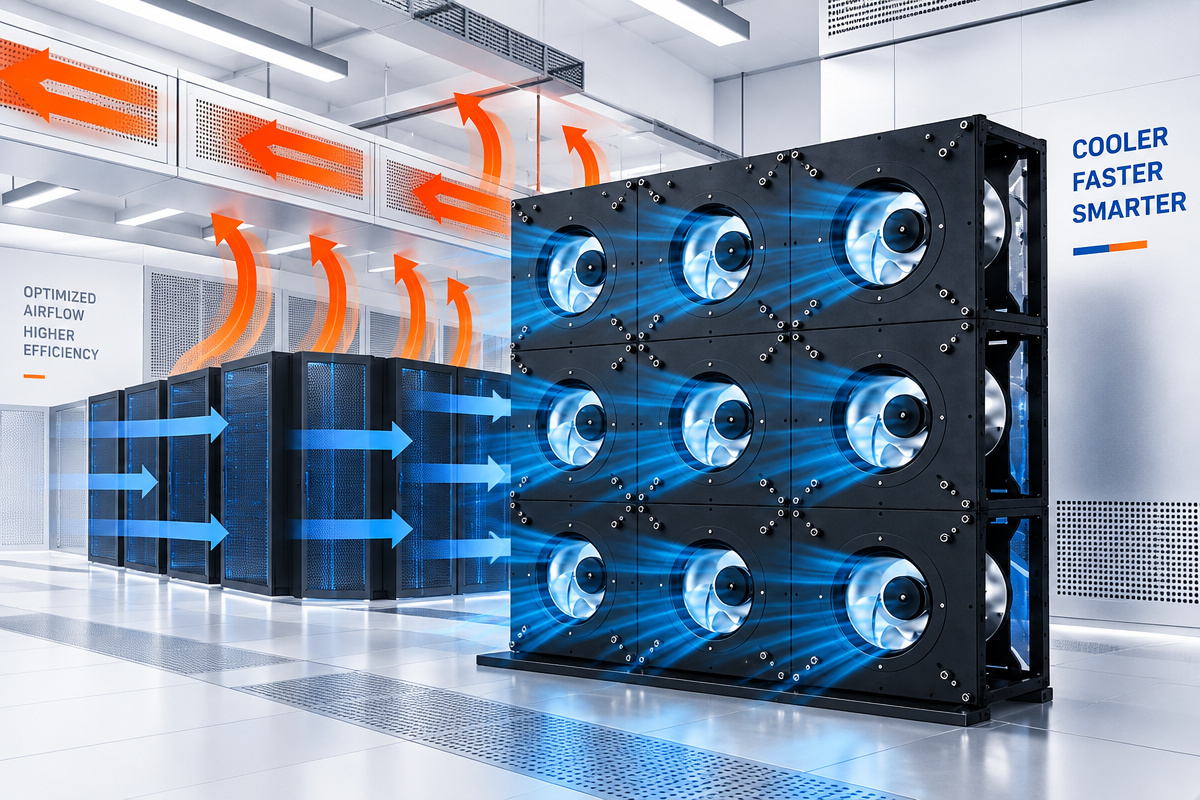
Data centers release a large amount of sensible heat and very little moisture, so an AHU here works with a high sensible heat ratio and a low latent load. Air volume is large and the units run 24 hours a day, while temperature and humidity must stay inside a narrow range. Units are commonly built as CRAH or large air handlers with EC plug fans. In data center cooling, reliability weighs more than first cost. Fan N+1 redundancy and remote monitoring are the standard configuration.
Food Processing Industries
Food plants need air that will not contaminate the product. AHUs for these areas use stainless steel or food-grade coated panels, smooth internal surfaces. Supply air is filtered, and the production hall is held at a slight positive pressure to keep dust and insects out. Many processes also call for low temperature or high humidity, which makes coil design and condensate removal critical.
Swimming Pool
A swimming pool is one of the hardest duties for an AHU, because warm water keeps the air humid and chlorine attacks metal parts. The latent load is very high, so these units focus on dehumidification instead of simple cooling, and most of them recover heat from the exhaust air to reheat the supply air. Coils, fans, and casing are protected against chlorine, typically with epoxy-coated coils and corrosion-resistant panels.
Maintenance for Types of AHU
- Regular check. Walk the unit every month with a log sheet. If a current reading that falls without a set point change usually means a slipping belt or a loaded filter, record the numbers instead of judging by sound.
- Filter and air coil cleaning. Change filters on pressure drop rather than on the calendar, once the filter reaches 75 to 80% of its final rated resistance. Clean the coils every one to three month.
- Damper check. Inspect the outside air, return air, and relief dampers every six months. Wipe the blades and seals, then check the actuator stroke against the command.
- Belt, bearing, and fan drive cleaning. Check belt cracks and pulley alignment every quarter. A loose belt will lead to slips, glazes, and overheats. Lubricate fan and motor bearings by running hours.
Choose LONGWELL AHU Fans for Your Application
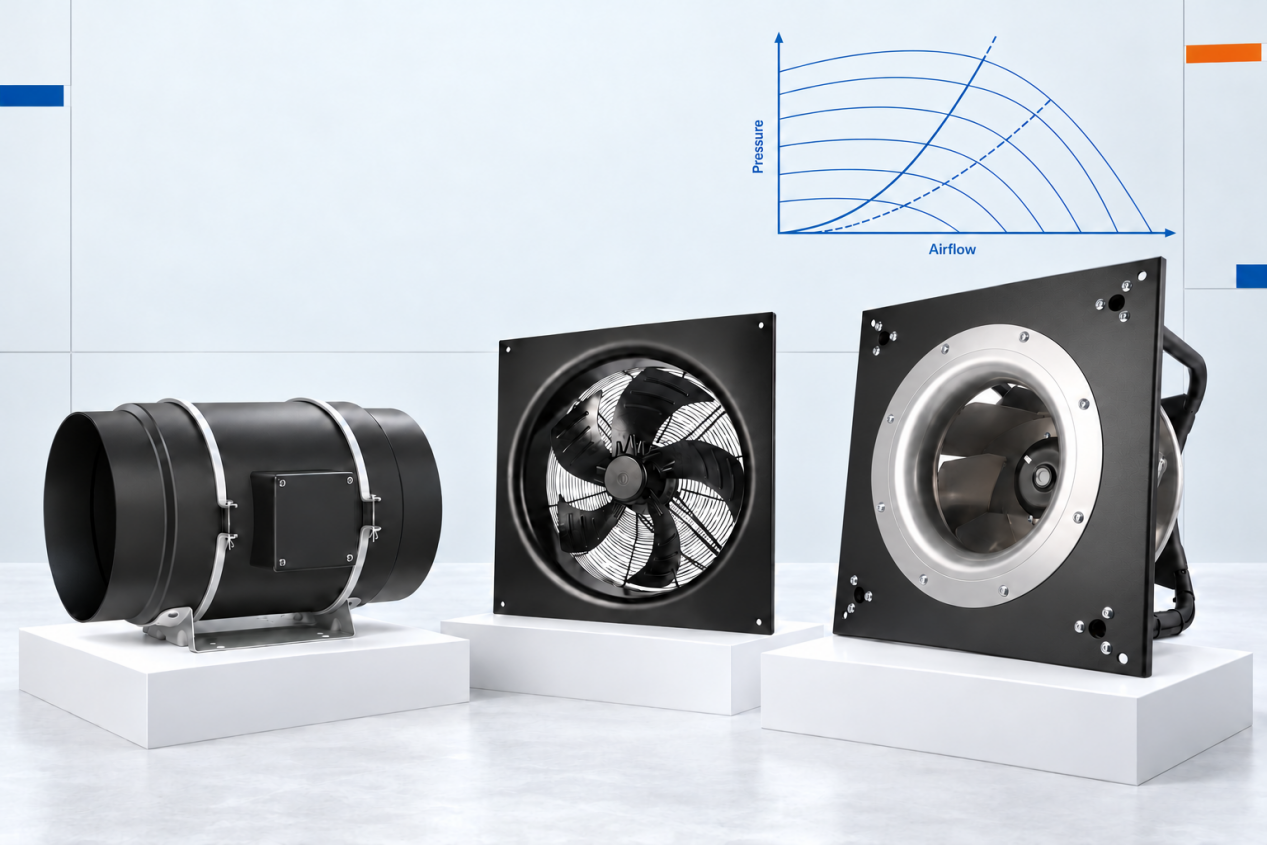
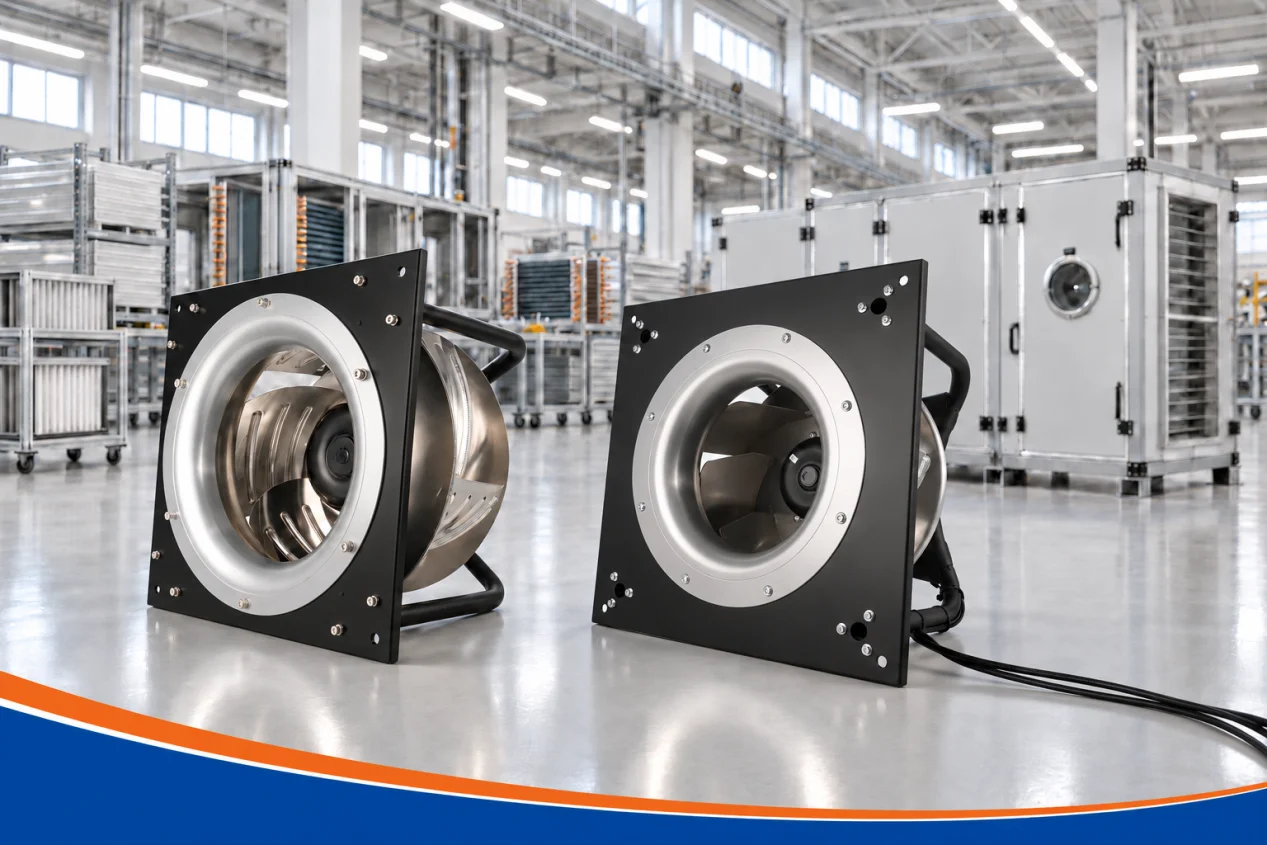
LONGWELL supplies backward-curved centrifugal fans and plug fans for commercial air handling units. The range supports ventilation in offices, hospitals, schools, and large commercial buildings.
|
Capacity |
Recommended model |
Airflow |
Static pressure |
EC efficiency |
|
Small AHU / 3-5 ton RTU |
LWBE3G-355 |
3,500-7,000 m³/h |
400-800 Pa |
88% |
|
Medium AHU / 7-10 ton RTU |
LWBE3G-450 |
7,500-13,000 m³/h |
500-1,000 Pa |
90% |
|
Large AHU / 15-20 ton RTU |
LWBE3G-560 |
14,000-22,000 m³/h |
600-1,200 Pa |
91% |
|
XL AHU / 25 ton RTU |
LWBE3G-710 |
22,000-30,000 m³/h |
800-1,800 Pa |
92% |
LONGWELL also offers fan grid solutions for AHU upgrades, providing fan wall configurations with 2×2, 2×3, and 3×3 arrays. An N+1 design provides reserve capacity to maintain the specified airflow if one fan stops. LONGWELL engineers select the array based on airflow, static pressure, installation dimensions, and control requirements.
FAQ
What is a clean room air handler unit (AHU)?
A clean room AHU conditions and circulated air to support controlled levels of airborne contamination as small as 0.3 microns. The AHU also supports pressure differences between rooms to help direct air movement and limit contamination entering cleaner areas.
How to choose the right type of AHU?
Start with the application’s airflow, temperature, humidity, and filtration requirements. These define the performance the AHU must deliver. Then review four configuration choices: construction, installation, fan position, and application.
How long does an AHU last?
It depends on the components. Worn components have shorter lifespans: fans, motors, bearings, and controllers usually need replacement after about 10 years. The belts and filters require much more frequent replacement.
Are rooftop AHUs more efficient than indoor units?
Not certain. A rooftop AHU shorten the duct run, and a shorter run means lower external static pressure and lower fan energy. However, the unit also places outdoor, the solar rain and dirt also brings more loss. An indoor unit works in a stable ambient and is easier to service.