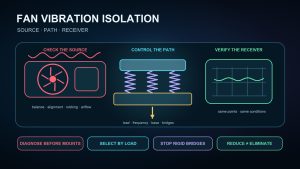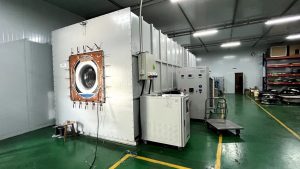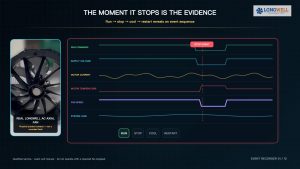
A centrifugal fan that pulses at low flow may be operating near an unstable part of its pressure–flow range. The sound is a warning to investigate, but it does not identify the cause. Blade stall, rotating stall and system surge describe different behavior. The useful first decision is whether the disturbance is local to the wheel, moves around it, or involves the connected duct and air volume.
The video below shows the mechanism schematically. To diagnose a real installation, pair the tested curve for the exact fan configuration and speed with the measured system behavior. A generic curve, a nameplate rating or a sound recording cannot locate the operating point.
Start with the fan and system curves
At a fixed speed, the fan curve shows the pressure that a particular fan can produce at different airflows. The system curve describes the pressure the ducts, filters, dampers and connected equipment require. Their intersection is the operating point. A restriction can move that point toward lower flow, while a change in speed changes the fan curve itself. Neither change alone proves surge.
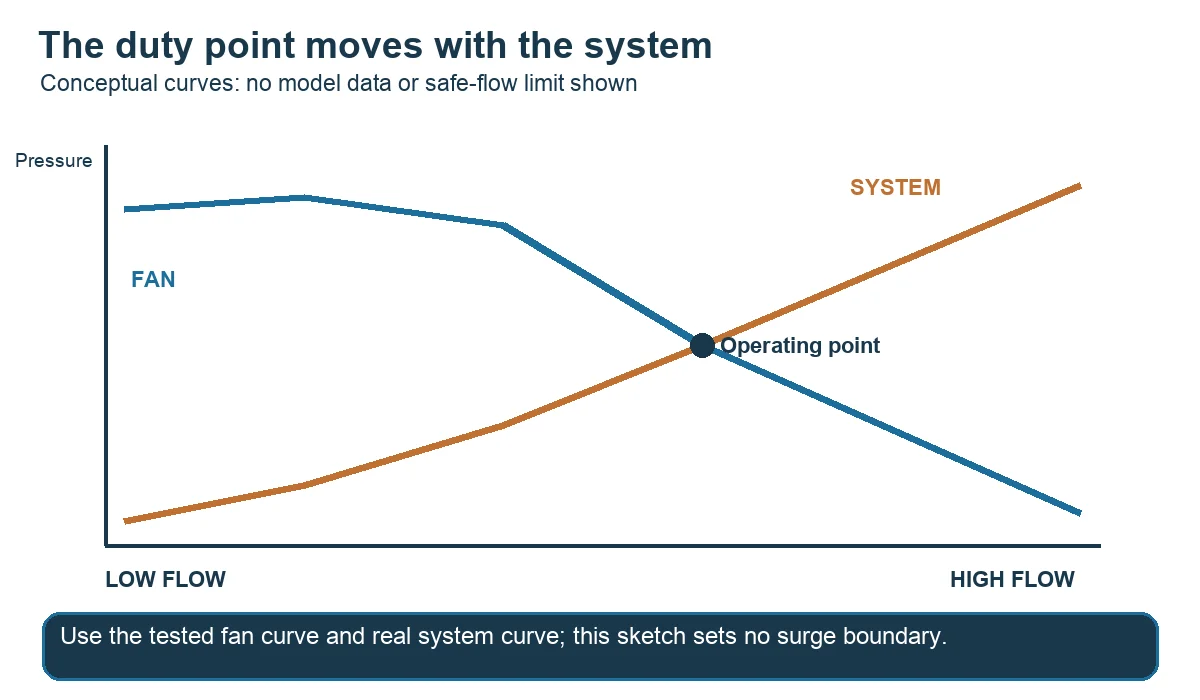
The selected LONGWELL centrifugal family and a real project still need an exact model, speed and configuration match. A source drawing labeled LWFA-E-500-02 shows a pressure curve only over its published range; it does not identify a surge limit or validate another fan. Browse the LONGWELL industrial centrifugal fan family as a starting point, then request the controlled performance curve for the proposed unit. The family page identifies available product types; it is not a stability certificate.
Separate blade stall, rotating stall and system surge
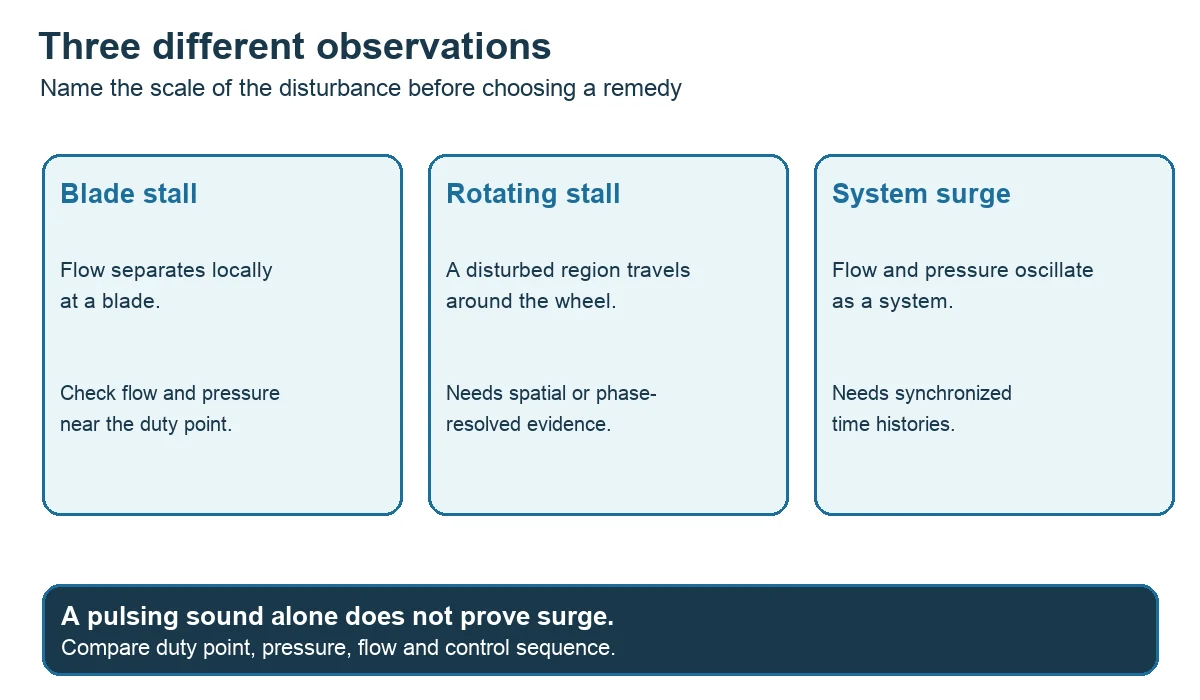
Blade stall is local flow separation as air meets a blade at an unfavorable condition. Rotating stall is a nonuniform disturbed region that travels around the annulus. Surge is a larger system-level oscillation in flow and pressure. They can be related, but they are not interchangeable labels and one does not automatically progress to the next. The connected system volume, fan characteristic and controls affect what happens.
A manufacturer application guide illustrates why selecting close to a published surge region can leave little margin for system changes. Its curves concern its own selections; the practical lesson is to use the selected fan’s tested data. See Greenheck’s guide to fan performance tables for an example of a fan curve, system curve and surge region. Do not transfer its plotted boundary to a LONGWELL fan.
What should you measure on site?
Record airflow and pressure over the same time window as fan speed, damper position, filter differential pressure and motor input. Keep the sampling and instrument positions appropriate to the suspected oscillation. A slow building-management trend may establish that the control sequence is hunting, while a faster synchronized measurement may be needed to see a pressure or flow cycle. Save the operating condition as well as the trace: filter state, active fans, setpoint, duct arrangement and any process change.
A repeated low-frequency whoosh, duct movement or changing current can motivate this test. None is diagnostic alone. A loose panel, damaged bearing, control loop, inlet obstruction or periodic process load can produce a similar impression. If the evidence does not establish surge, label the observation as an instability symptom and keep the competing explanations open.
Why can the duty point become unstable?
A partially shut damper or loaded filter increases resistance. A poor inlet can distort flow before it reaches the wheel. Parallel fans may interact if their curves and control sequence are not coordinated. A speed change can move the operating envelope. Each is a plausible check, but the article cannot rank them for a particular installation without the fan curve and field data. Opening a damper and hearing a change is useful evidence of a system relationship; it is not proof of the exact mechanism.
Work from the whole air path. Confirm that the inlet has the intended clearance and that the downstream path matches the design. Compare the measured duty point with the tested fan curve at the actual speed and air density. If the installation differs from the rating setup, quantify the effect before changing the wheel or controls.
Choose a correction from the verified cause
If excessive restriction is confirmed, restore the intended filter and damper condition and remeasure. If control hunting is the driver, review sensor placement, loop tuning and the damper/speed sequence. If low-flow operation is genuinely required, ask the system designer and fan supplier to define a validated operating envelope and evaluate a suitable control or bypass approach. A minimum-speed setting cannot be prescribed from this page: speed, system resistance and required process flow must be considered together.
A different fan or wheel can be considered only after the required range and mechanical constraints are documented. Forward-curved, backward-curved and other constructions do not have a universal stability ranking. The exact tested pressure–flow curve and the actual system duty decide whether a candidate is acceptable.
Bring the right package for a stability review
Send the exact model and revision, tested fan curve, operating speeds, required airflow and pressure, duct and inlet layout, filter condition, control sequence and synchronized pressure/flow histories. Mark any missing information. The reviewer can then distinguish a curve-selection issue from a system or control issue and propose a testable correction. Until that evidence exists, treat the diagrams here as a way to organize the investigation, not a diagnosis of your unit.
For a LONGWELL application review, email the fan and system data to sales@longwellfans.com.
Choose the right centrifugal fan
Longwell manufactures 1,136 centrifugal fans in-house. Send airflow, static pressure and voltage — an engineer replies with a matching model, performance curve and price within one working day.