A custom impeller tool is a project investment, but its cost and timing cannot be read from wheel diameter alone. The geometry, material, cavity plan, inspection scope and number of correction rounds all matter. A useful buying decision starts with a controlled part definition and ends with agreed evidence for production release. This guide shows what to ask before comparing quotations; it does not offer a universal mould price, lead time or annual-volume break point.
Define the wheel before asking for a tooling price
Supply the complete impeller drawing and revision, not just its outside diameter. Identify blade profile, hub and shaft interface, material system, operating speed, duty point, surrounding housing and temperature or chemical exposure. The mould designer also needs an agreed dimensional and inspection plan. A drawing used for an early fit study may be enough to discuss feasibility but not enough to lock the cost of a production tool. Record open questions and who will resolve them before the quoted scope is frozen.
For a visible example of a finished plastic wheel, the LWPI-Φ107X762-01 cross-flow impeller page identifies one specific product. Its geometry does not establish the mould construction, price, tool ownership or suitability of a different custom wheel. Ask for the correct suffix and drawing for your own application.
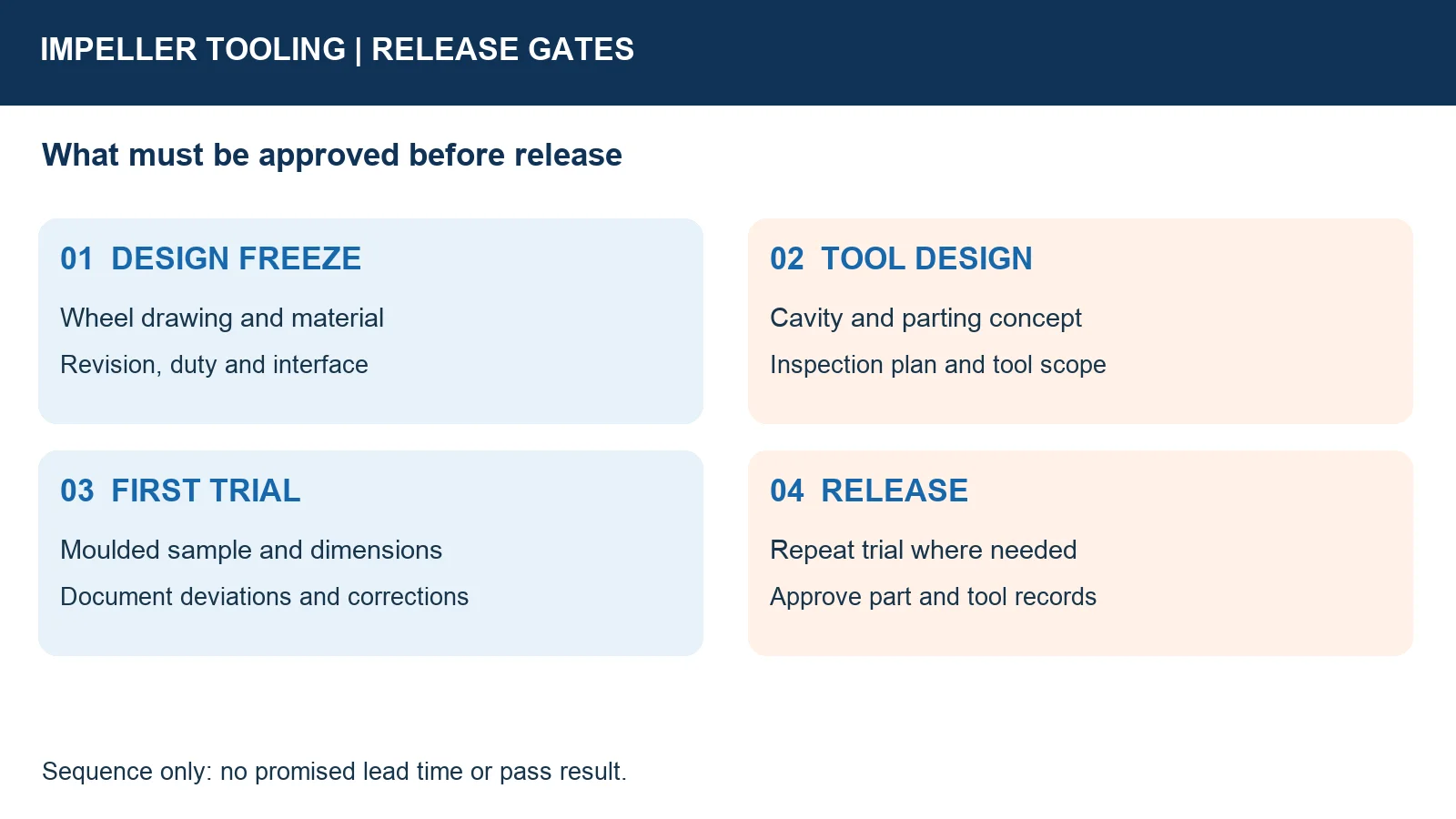
Plan design, machining and trials as separate gates
Longwell’s moulding material shows a process path from product samples or 3D drawings through mould design, material preparation, CNC and EDM machining, mould trial, sample inspection and production. That is a useful map of activities, not a dated commitment for any one order. A trial can reveal a dimension or moulding issue that needs correction and another review. Agree which drawing revision enters each gate, what report closes it and who can authorize a change. A calendar estimate is meaningful only when these gates and their dependencies appear in the project plan.
Know what is inside the tooling quotation
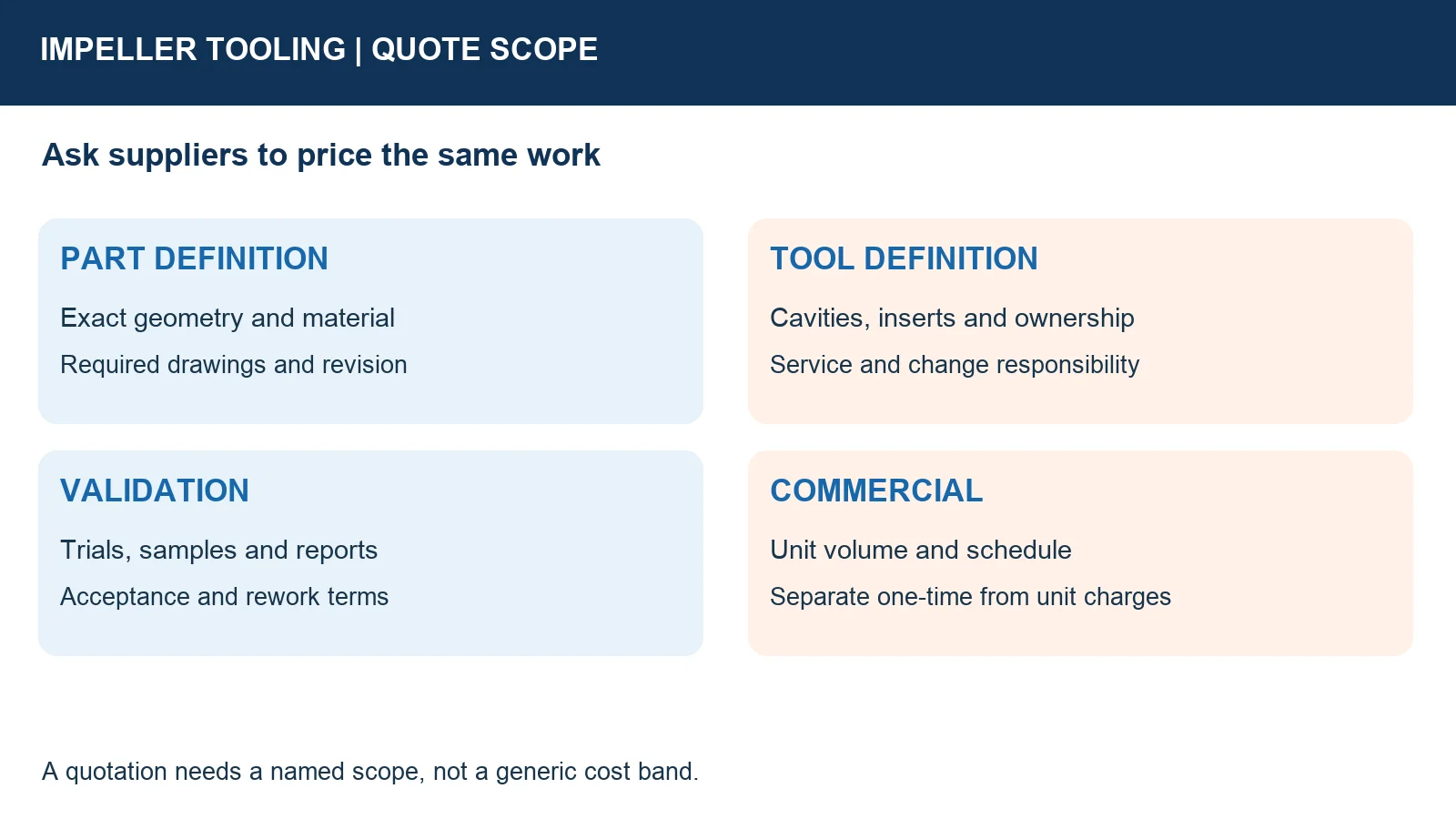
Request a line-by-line scope for tool design, mould base, cavity and insert arrangement, machining, first trial, sample quantities, dimensional reports and planned correction work. Ask whether the quote includes resin selection and application validation or assumes these are already complete. More cavities may change capacity and tool complexity, but neither the direction nor size of a unit-price effect can be assumed for an unquoted design. Put any change-control and rework terms in writing. This makes two offers comparable even when their headline tool prices differ.
Compare tooling with other manufacturing routes
Injection moulding is only one route. A fabricated metal wheel, a machined sample or a printed fit model may answer a different stage of the project. A prototype can reveal envelope or assembly interference; it should not be treated as proof that the final moulded part has the same strength, balance or aerodynamic curve. The metal versus plastic impeller guide frames material questions, while the backward-curved metal impeller manufacturing guide describes a distinct fabrication path. Neither article supplies a price for your drawing.
Use expected quantity as an input to a comparison, not as a generic threshold. Ask for the unit price at your forecast quantities, a separate tooling charge, sample and validation costs, and the assumptions behind each figure. If demand changes, recalculate with the actual quoted values. Material, wheel geometry and quality obligations can move the result enough that a blanket “moulded wins above X units” statement is unreliable.
Set ownership, maintenance and change rules
The purchase agreement should identify who owns the tool, where it will be stored, who pays for maintenance, what records accompany it and what happens if the wheel drawing changes. Ask how wear will be monitored and which dimensions and sample checks trigger repair. A nominal number of shots without a named material, process, maintenance plan and acceptance criteria is not a dependable life promise. If future transfer matters, discuss machine and process compatibility and access to the tool records before committing to a supplier.
Release the part only with matching evidence
At first trial, compare samples against the current drawing and record every deviation. Define who approves correction, another trial and final release. For a rotating impeller, the application may also need balance, material and assembled-fan performance checks; the exact requirements belong in the specification and test plan. The existence of moulding equipment or a family photograph does not prove that a particular tool or wheel passed those checks. Keep the approved part revision, tool revision, sample report and production control plan aligned.
Watch the impeller tooling overview
For a scope-based tooling review, send your wheel drawing, duty, material and forecast to sales@longwellfans.com.
Choose the right fan impeller
Longwell manufactures 10 fan impellers in-house. Send airflow, static pressure and voltage — an engineer replies with a matching model, performance curve and price within one working day.