An EC fan payback period is the time needed for a documented annual net benefit to recover an incremental installed cost. It cannot be read from a motor label, a catalogue efficiency claim or the word “EC.” First define the air service that both options must deliver. Then measure or estimate electrical input across the actual operating schedule, price the complete change and test the assumptions that matter.
The video below walks through one replaceable teaching example. Its figures are arithmetic inputs, not a quotation, customer result or promised return for a LONGWELL fan.
1. Keep the air duty and meter boundary the same
Before comparing watts, write down the airflow, static pressure, air density, filter state, setpoint and control position that define the required service. Record electrical input at the same declared boundary for the existing and proposed systems. A motor-only rating cannot be compared fairly with the input of a complete replacement assembly. If the fan changes the system resistance or the control sequence, account for that difference rather than treating it as an EC motor benefit.
Hours matter just as much as the duty point. Divide a year into meaningful high-demand, part-load and minimum-load periods. For each period, multiply comparable input power by its hours, then sum the periods. The EC fan energy-savings method explains the same-duty comparison in more detail. A short survey can identify candidate bins, but the final business case should use site logs or a defensible operating schedule.
2. Put the right costs and benefits in the ratio
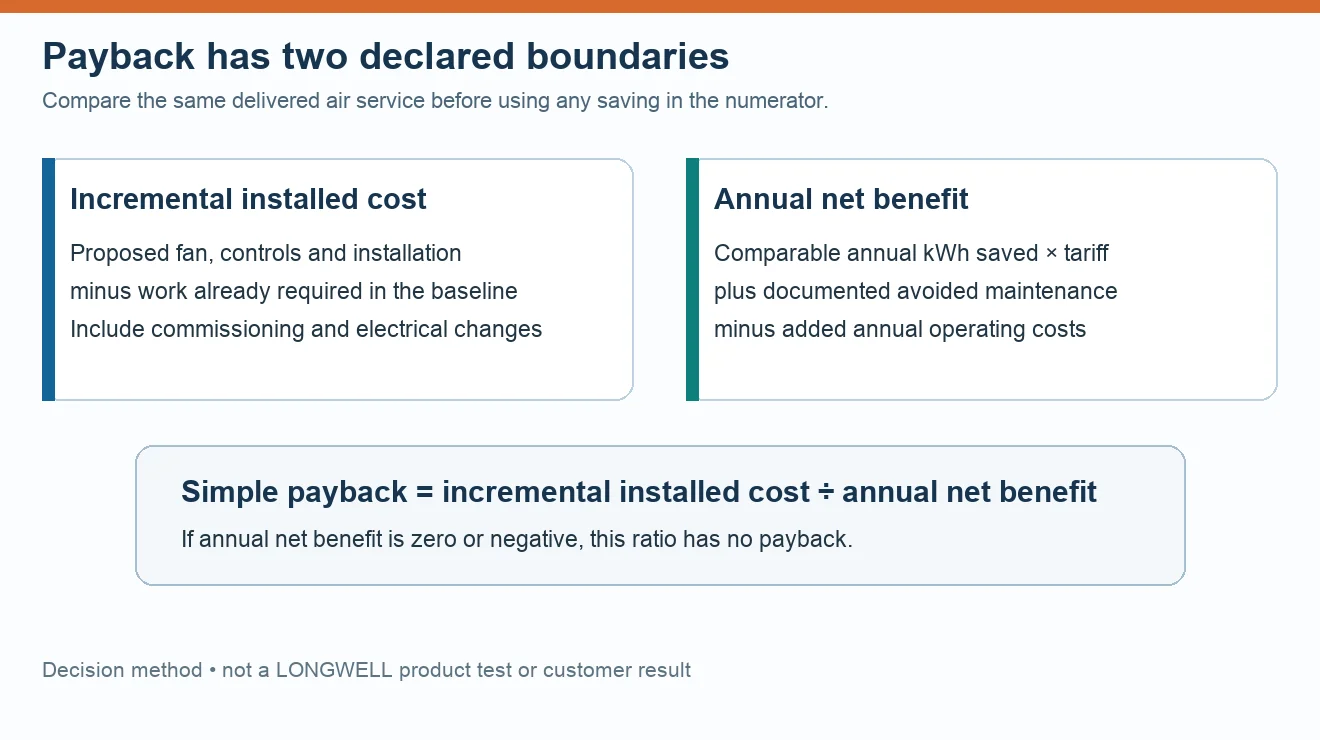
The numerator is incremental installed cost: the proposed fan and any support, wiring, controls, access, installation and commissioning, minus work the baseline option already requires. Do not charge an EC retrofit for a cabinet repair that would be needed with either fan. Conversely, leaving the controls or electrical work out of the proposed cost makes the project look artificially cheap.
The denominator is annual net benefit. Start with the difference in annual electrical energy, multiplied by the applicable tariff. Add maintenance savings only when a baseline service history and a credible replacement plan support them. Deduct any new recurring service costs. Keep cooling-plant effects, incentives and downtime out unless a separate calculation establishes their scope. If annual net benefit is zero or negative, simple payback does not occur.
3. Work one transparent example
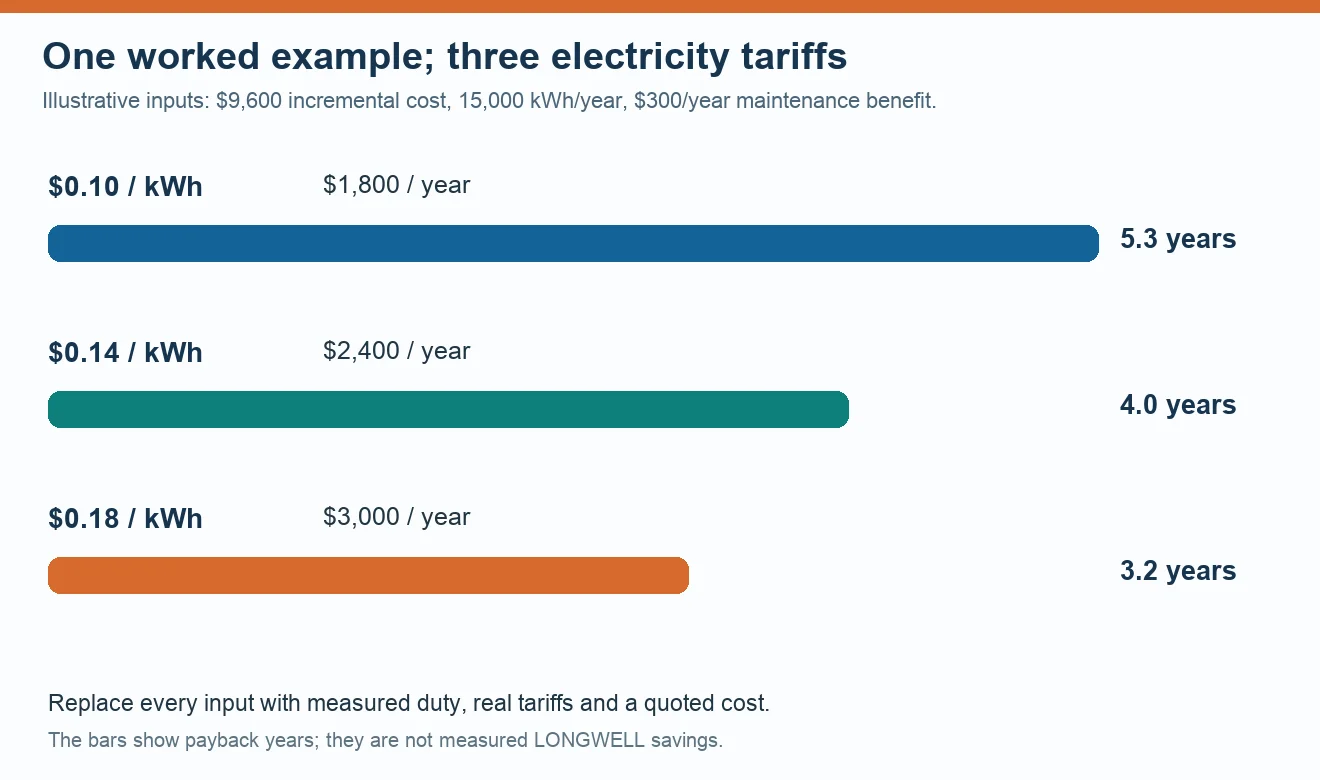
Assume an incremental installed cost of $9,600, a comparable annual reduction of 15,000 kWh, a tariff of $0.14/kWh and a documented $300/year maintenance benefit. Energy value is 15,000 × 0.14 = $2,100/year. Annual net benefit is $2,100 + $300 = $2,400/year. Simple payback is $9,600 ÷ $2,400 = 4.0 years. These are the video’s illustrative inputs and should all be replaced for a real project.
Now change only the tariff. At $0.10/kWh, annual net benefit becomes $1,800 and payback is about 5.3 years. At $0.18/kWh, net benefit becomes $3,000 and payback is 3.2 years. This spread explains why a single universal “typical payback” is not a useful specification. A tariff with demand charges or time-of-use rates needs a matching calculation; multiplying all kWh by one flat number may be inadequate.
4. Connect the calculation to a real fan selection
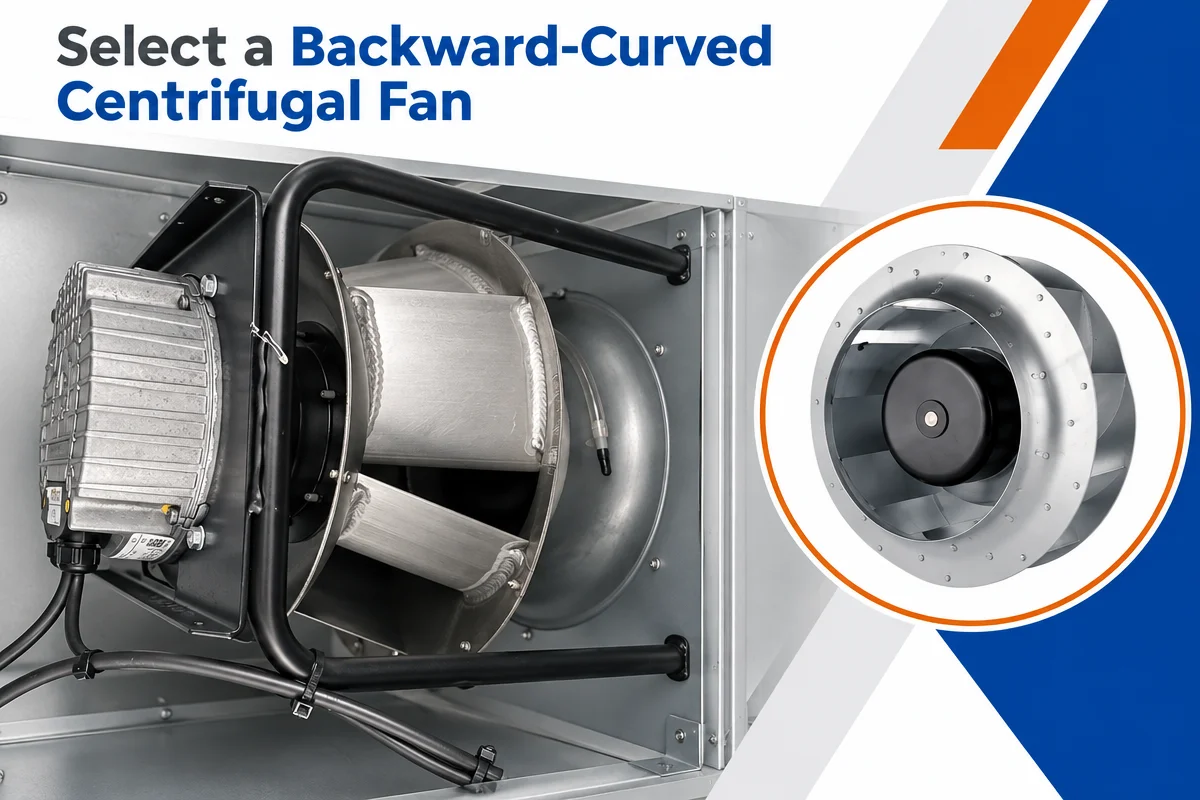
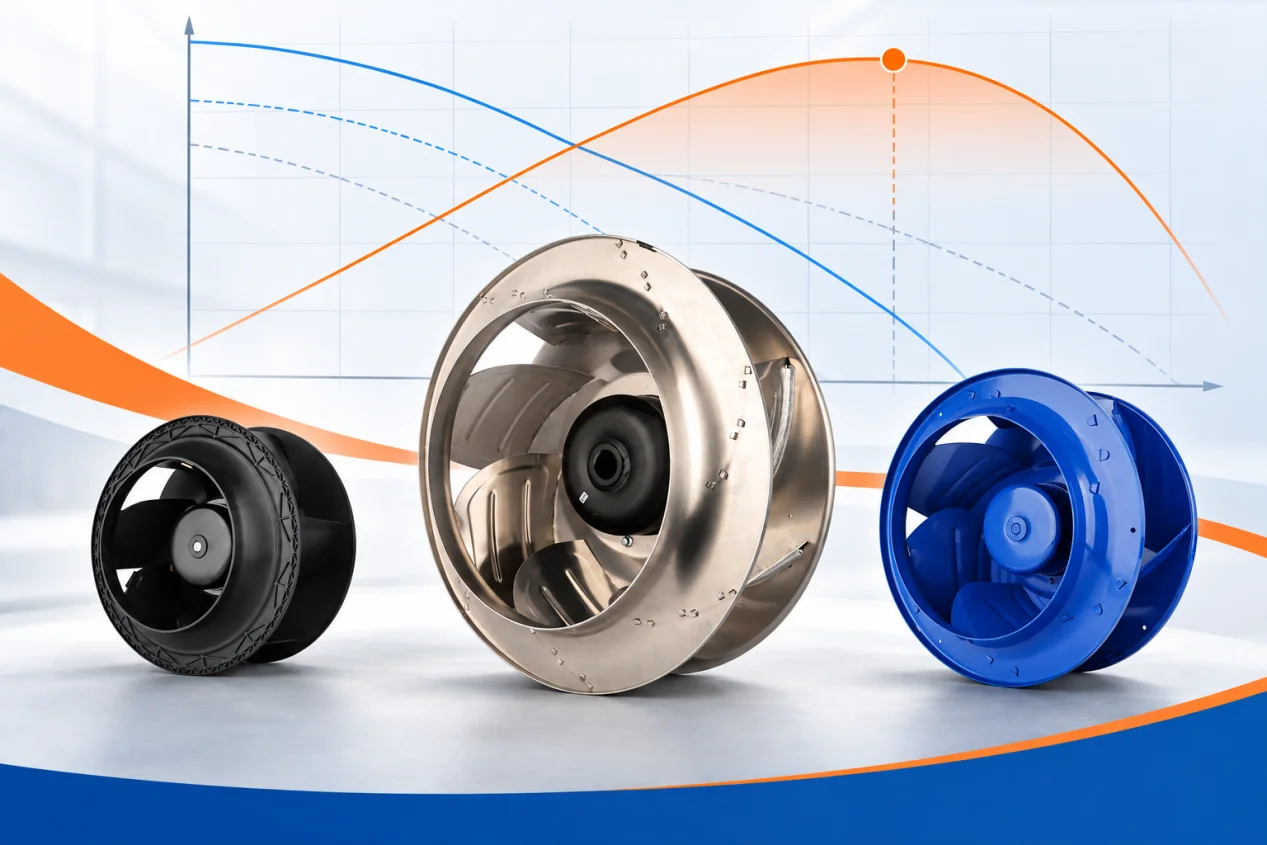
LONGWELL’s EC backward-curved centrifugal fan family contains multiple sizes and suffixes. A current LWBE-250 series catalogue lists, for example, LWBE3G250-072PS-02 and shows a fan curve, dimensions and a series control-input description of 0–10 VDC/PWM. That establishes a candidate to examine; it does not establish the proposed fan’s input at this project’s duty point, a drop-in mechanical fit or the four-year example above.
For a selected suffix, obtain its current revision, curve and electrical/control information, then check the proposed duty point and installation geometry. Include the full control and electrical path in the meter boundary. An exact model and curve are especially important when several related variants have different supply voltages or ratings. The family page is a starting point for selection, not proof that any one fan fits an AHU, CRAH or refrigeration unit.
5. Test the business case before approval
Present at least a low, base and high case for operating hours, input power, tariff and installed cost. Note which inputs were measured, which came from a current model-specific record and which remain estimates. If the baseline is a belt-driven assembly, maintenance benefits may be relevant; they should reflect actual belt and service records, not an assumed allowance. If the existing unit is direct drive, do not assign it belt-maintenance savings.
Simple payback ignores the timing of cash flows, financing, discount rates, future tariff changes and replacement timing. For a capital decision, supplement it with the finance method used by the buyer. The EC-versus-AC ROI calculator can organize replaceable inputs, but its output is only as reliable as those inputs. Use a model-specific quote and an agreed measurement plan before approving a project.
6. Verify the result after commissioning
Record the accepted airflow, pressure, control setpoint and electrical input after installation. Compare the same operating conditions used for the baseline or normalize for documented differences. Then update the annual hour bins and cost model with actual data. The U.S. Department of Energy’s fan-system sourcebook also treats operating hours, electricity cost and measured power as important economic inputs.
The decision is therefore specific: does the selected fan deliver the required air duty, and do the measured annual benefits justify the incremental cost under realistic tariff and operating assumptions? If one of those inputs is missing, identify the test, quote or site log needed before claiming payback.