A private-label fan can carry your name, but the logo alone does not define the product you are releasing. A buyer needs one controlled link between the fan configuration, approved artwork, product identification, market obligations and production records. That link is the practical answer to the question in the video: when is a branded fan ready to sell?
Start with the fan configuration, then approve the brand
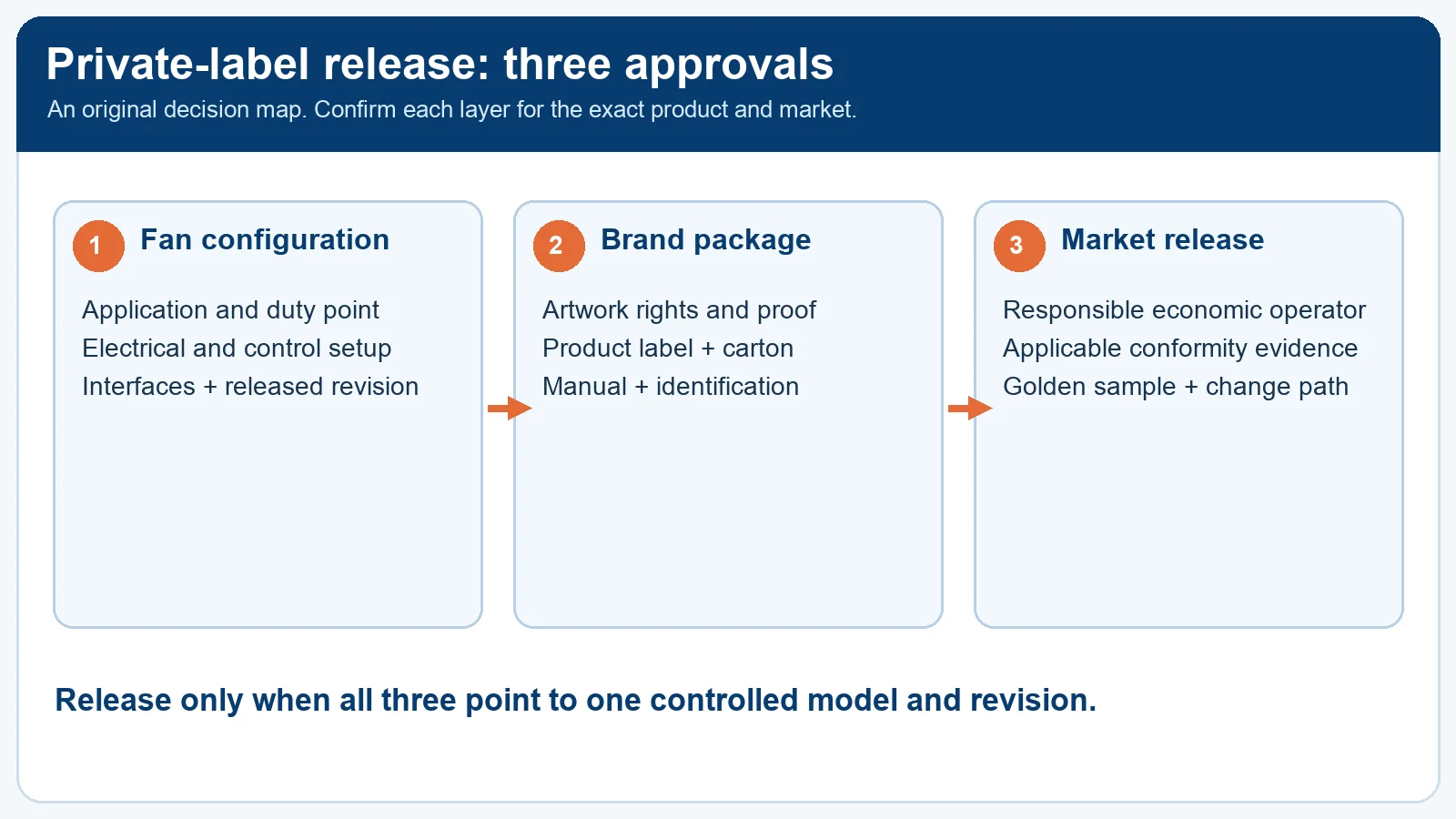
Freeze the application and installed operating point first: required airflow and pressure, supply voltage and frequency, control method, connector, cable, mounting interface and the exact model suffix. The result should point to a released drawing or specification revision. A visual colour change in the video illustrates appearance only; it does not prove that a colour, coating or electrical variant is available for a particular model.
LONGWELL describes OEM project support publicly, including customization discussions. That page establishes a route for asking about a project, not approval for a specific fan or private-label arrangement. Its cross-flow family selector can identify candidate families if a broad linear airstream is relevant; a family page cannot establish the duty point, fit or label rights of any selected model. Request model-specific drawings, curves and electrical data before agreeing the branded release.
Build a brand package with controlled proofs
Specify where the brand appears: on the fan, rating label, carton, manual and any supplied accessories. Have the trademark owner approve artwork rights, colour references, placement and a dated proof revision. Keep required identification and safety information legible. A logo overlay must not silently remove a model identifier, electrical rating, responsible party or market-specific warning.
Separate requested changes into an approval matrix. A label change, a connector change and an impeller change have different engineering and documentation consequences. Do not assume any one is free of tooling, schedule, testing or minimum-order effects. Record the supplier’s written feasibility and the buyer’s approval for the exact variant. The OEM, ODM and private-label comparison gives broader terminology; the release matrix should carry the actual project decision.
Check market responsibility and conformity scope
The responsible economic operator depends on the destination market and how the finished product is placed on that market. For the EU, official product-compliance guidance treats a person who has a product made and markets it under their own name or trademark as a manufacturer under the applicable framework. That is a reason to identify roles early, not a universal rule for every destination or every fan component.
List the exact product, model suffix, market, applicable rules and person responsible for each declaration or technical file. The official EU guidance on signing a declaration of conformity explains why the finished product and named party matter. For a UL-marked product, UL Solutions offers a Multiple Listing Service for eligible identical certified products under another brand. Its existence does not mean an unreviewed fan can carry a UL mark: verify the exact certified file, product, label and permitted arrangement with UL Solutions. Do not copy a certificate or alter a mark based on a sales image.
Connect the approved sample to every production file
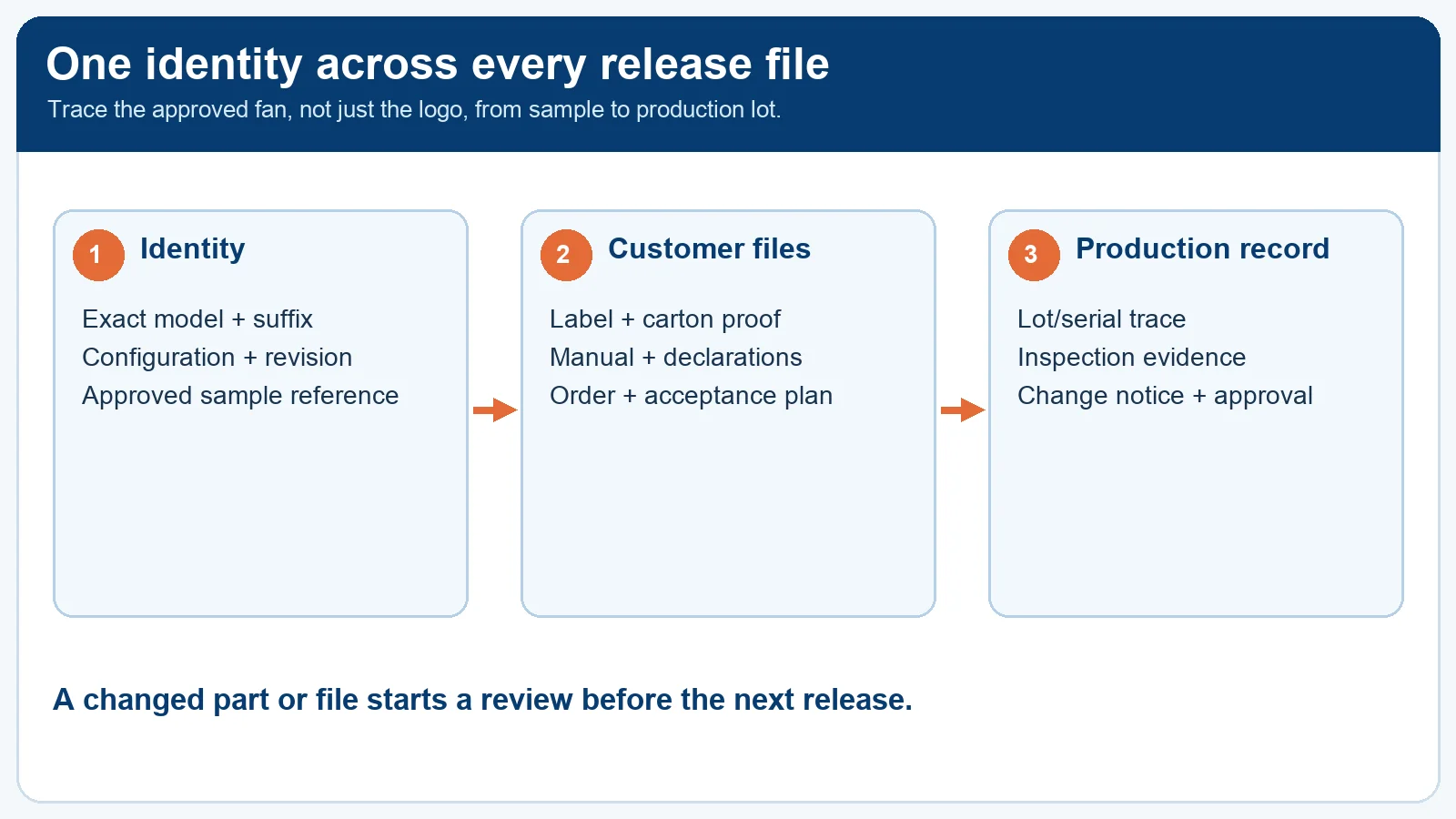
A useful golden sample has a traceable model, suffix, drawing revision and agreed acceptance checks. Compare its label, carton and manual to the order and engineering release. Retain the evidence that matters to this configuration: dimensions, wiring and controls, performance at the declared duty point, and the applicable inspection result. A photograph of a nameplate may identify a fan; it cannot by itself prove its performance or market conformity.
Before repeat production, decide how a supplier will flag a component, artwork, document or process change. The contract can set notification, sample review and approval steps, but there is no universal notice period. A changed part or file should trigger a scope review against the released sample and any affected conformity evidence before the next lot is accepted. The buyer also needs a practical route for lot identification, warranty triage and spare-part questions; set those terms in the actual agreement.
Use six questions as the release check
- Which application, operating point and electrical/control configuration is this exact fan for?
- Which model suffix, drawing revision and sample reference does the order approve?
- Who owns and approves each artwork proof, including label, carton and manual?
- Which identification and conformity obligations apply in the destination market, and who carries them?
- What measurable checks release the first sample and subsequent lots?
- How will a part, file or process change be reviewed before use?
If one answer is missing, hold the branded release and request the relevant evidence. That is more useful than a generic promise that a fan is “OEM ready.” For a specific LONGWELL inquiry, gather the application, duty point, electrical and control needs, target market, proposed brand assets and expected order context. An engineer can then discuss a candidate route and the records needed to evaluate it.