Wiring a fan speed controller starts with identifying the fan, motor and controller. A wall control, an AC voltage regulator, a variable-frequency drive and an EC fan command device may all be called a “speed controller,” yet their power and signal paths differ. This guide gives a sequence for deciding which document and checks are needed. It is not a terminal-by-terminal installation instruction for an unidentified fan.
Step 1: identify the control architecture
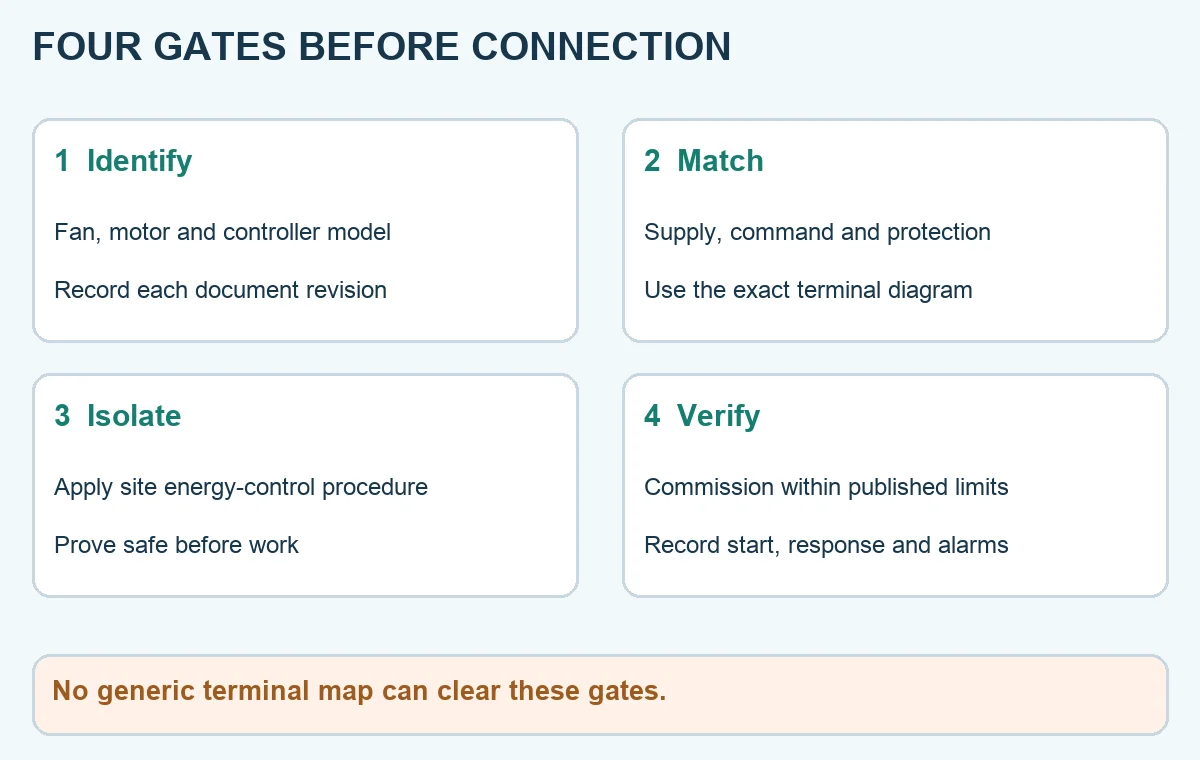
Read the fan assembly label, motor label and proposed controller label separately. Note the supply voltage, motor type, controller input and output type, and document revision. A motor nameplate does not establish the terminal map of the assembled fan. If one label is missing or the manual belongs to a different suffix, stop and obtain the matching documentation before connecting anything.
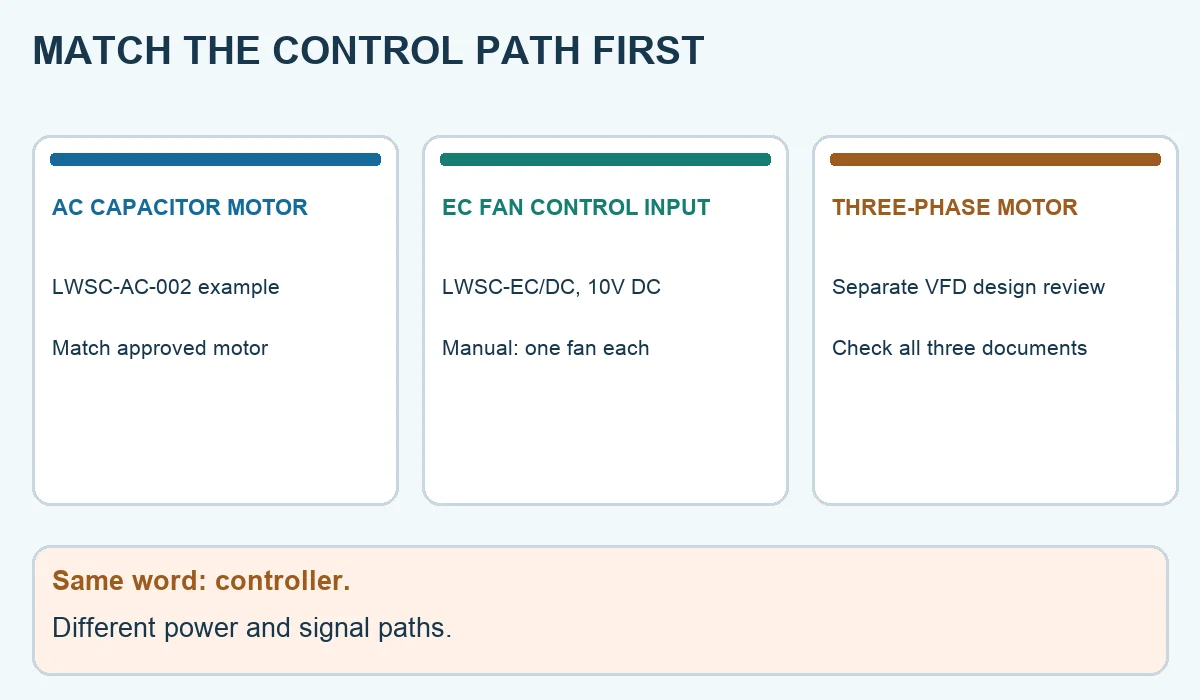
LONGWELL’s controller documents show why product names cannot be treated as interchangeable. Its LWSC-AC-002 catalog entry describes a regulator for an AC capacitor single-phase motor load. A separate LWSC-EC/DC operating instruction describes a controller powered from a fan’s 10 V DC output and says one controller controls one fan. The LWSC-EC-002 A0 document is another 10 V DC controller record with adjustable limits. These are examples of different interfaces, not approval to fit any of them to the fan in your cabinet. Confirm the exact controller revision and fan wiring page together.
Step 2: match the AC controller to the motor
For an AC capacitor motor, check whether its own documentation permits voltage speed control and whether the exact controller is rated for that motor and supply. The LWSC-AC-002 catalog entry identifies a load category; it does not provide a universal installation diagram for every capacitor motor. Do not infer wiring from a photograph of a similar wall knob, a conductor color, or the fact that another fan changes speed when connected.
A conventional three-phase VFD is a different route. It needs a documented motor and fan speed range, drive compatibility, protection settings and commissioning plan. A single-phase controller is not a substitute for that review. The practical test is whether the exact motor, fan assembly and selected controller have a compatible documented interface, rather than whether the two products share the word “fan.”
Step 3: separate an EC command from its supply
An EC fan assembly can have a supply circuit and a separate speed-command interface. The command might be analog, PWM or digital, depending on the exact fan; none should be guessed from the motor category alone. The LWSC-EC/DC instruction explicitly describes a 10 V DC powered controller and a model-specific diagram. Its one-controller-per-fan rule is specific and should not be replaced by a generic claim that any controller can operate several fans.
For a useful comparison of command formats, see LONGWELL’s 0–10 V, PWM and Modbus guide. Its EC wiring guide explains the information to gather before connecting a specific fan. Those articles help frame the questions; the current model’s approved terminal diagram remains the installation authority.
Step 4: clear the pre-connection safety gates
Before work begins, the qualified installer should reconcile the power source, command source, protective earth, overcurrent protection, enclosure and any stored-energy hazards against the exact documents and local requirements. Apply the site’s energy-control procedure and verify isolation using the required test method. OSHA’s energy-control guidance describes isolation, control of stored energy and verification before servicing. It is a safety principle, not a substitute for local law or equipment instructions.
Do not use the old article’s generic “incoming live, neutral, switched output” sequence as a connection plan. Terminal names, protective measures and control polarity vary by design. When the fan and controller sheets disagree, or an interface is absent from either sheet, resolve that conflict with the equipment maker before a conductor is moved.
Step 5: commission against documented limits
After installation is checked and the equipment is released under the site procedure, verify the fan starts as intended, responds through its documented command range and reports any available fault or speed feedback correctly. Record the final controller settings, the measured response and the conditions under which they were checked. The LWSC-EC/DC instruction describes adjustable upper and lower limits and says to recheck both after adjustment; it does not establish a universal minimum-speed percentage for other fans.
Low-speed operation also has a system consequence: the process may need minimum cooling or ventilation even when the motor can turn more slowly. Check that duty requirement and the fan maker’s published operating limits. A short run, a motor that feels comfortable to the hand, or the absence of audible buzz is not an acceptance test for insulation, temperature or airflow.
What to send for a compatibility review
Send the exact fan and motor labels, controller model and revision, their wiring pages, supply details, intended speed range, required airflow or pressure, and enclosure conditions. LONGWELL’s speed-regulator range is a family-level starting point; it does not prove a listed controller suits a particular motor. A model-specific recommendation requires the current documents and operating requirements.
Choose the right speed regulator
Longwell manufactures 5 speed regulators in-house. Send airflow, static pressure and voltage — an engineer replies with a matching model, performance curve and price within one working day.