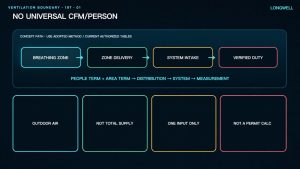
An attic ventilation fan is a piece of an air path, not a cure for every hot roof. Before choosing a rated flow or cutting a roof opening, identify the actual problem: summertime heat, moisture, an obstructed passive vent route, or a requirement in the building design. The answer may be to improve ceiling air sealing, insulation or passive venting rather than add powered exhaust. The video below illustrates the decision sequence; the checks that follow turn it into a useful project brief.
Diagnose the attic before choosing a fan
A hot attic alone does not show that a fan will improve occupied-room comfort. Roof color, solar exposure, insulation, ceiling leakage and ducts in the roof space all matter. The US Department of Energy Building America guidance on attic ventilation fans explains that powered fans can remove attic heat while their effect on the living area is often smaller than expected; in some houses they can increase energy or moisture problems. Record the attic type, climate, existing vent arrangement, ceiling condition and objective before setting a target.
That first check also avoids confusing an attic-only fan with a whole-house fan. The latter intentionally moves outdoor air through living rooms; an attic fan should draw outdoor air through attic intakes and keep the conditioned rooms outside that flow circuit. Our whole-house versus attic-fan comparison explains the difference in target zones. Neither path establishes a particular cooling or savings result without site measurements.
Draw the intended intake-to-exhaust route
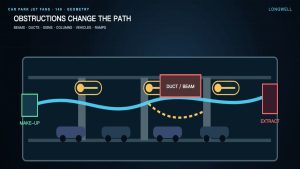
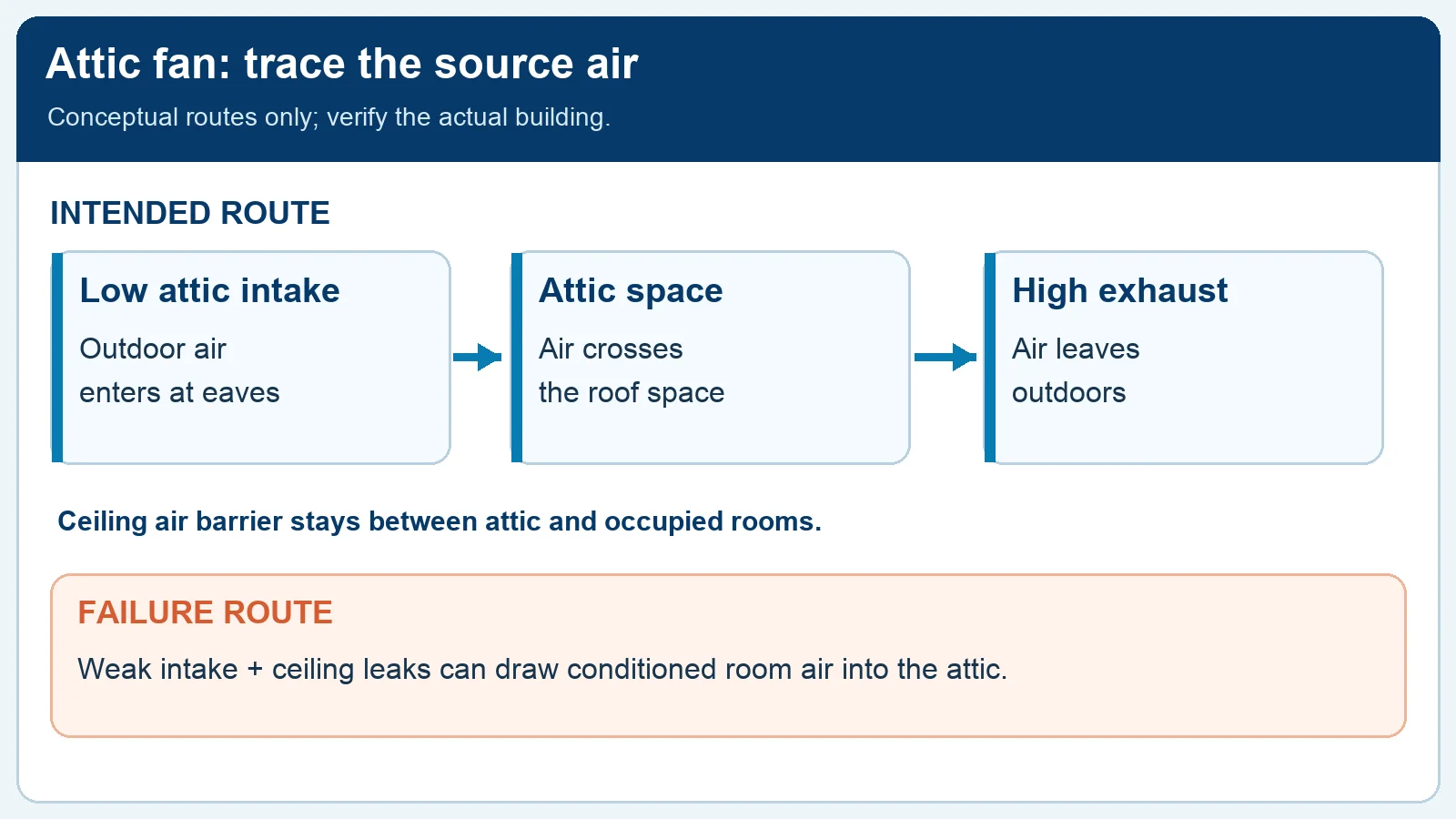
For a vented attic, start with the openings low in the roof assembly, such as soffit vents, then trace the route across the attic to a high roof or gable outlet. Check whether insulation, screens, debris or construction details obstruct any section. A powered outlet cannot create its intended route when there is too little outside-air intake. The attic may then become a low-pressure zone that draws conditioned air through ceiling penetrations. That failure mode is a reason to examine the air barrier, not a reason to buy a stronger motor.
Location matters as much as area. An outlet close to another high vent can take the shortest path instead of pulling air across the attic. The building-specific vent layout and applicable code must be checked by the designer or installer. The schematic below shows the conceptual routes; it is not a drawing for roof cutting or a measured ventilation result.
Use measured openings and a real duty point
Net free vent area is the usable opening after louvers, mesh and other restrictions. The nominal width and height of a vent do not establish it. Obtain the intake and exhaust manufacturers’ current net-free-area data, confirm how the openings are distributed, and check the relevant local requirements. A passive-vent area rule cannot simply be converted into a powered-fan size; nor does a single air-change multiplier describe every roof assembly.
Then compare fan candidates at the resistance of the assembled route. A published free-air number is not the delivered flow after a grille, screen, shutter, curb and roof outlet are added. Request the exact model and suffix, current curve or certified rating where relevant, electrical data, control behavior and installation instructions. Longwell’s controlled roof-fan catalogue identifies LWCRF, LWARF and related roof-fan series and includes model tables; those tables describe products, not a verified attic installation or a guarantee of delivered flow in your roof. The Longwell roof-exhaust family can start an equipment discussion after the building route has been defined. The solar roof-fan family is a family option, not proof that a listed item fits a given roof or meets its duty.
Hold installation and safety as separate gates
Roof penetration, curb, flashing, weatherproofing, structural attachment and wiring belong to the selected manufacturer’s instructions and qualified local trades. A generic article cannot approve a fastener location, electrical connection or waterproofing detail. The same applies to controls: a thermostat or solar input changes when the fan operates, but it does not solve a blocked intake or leaky ceiling. Do not substitute a universal temperature setpoint for a climate and moisture review.
Combustion appliances deserve an explicit stop check. Negative pressure caused by an attic fan can affect natural-draft equipment, especially if the appliance or its air source is connected to the attic. The DOE guidance calls for ceiling air sealing, adequate intakes and a combustion-safety review when powered attic ventilation is considered. A qualified professional should also assess fire, moisture and local-code constraints. If those conditions cannot be verified, pause equipment selection.
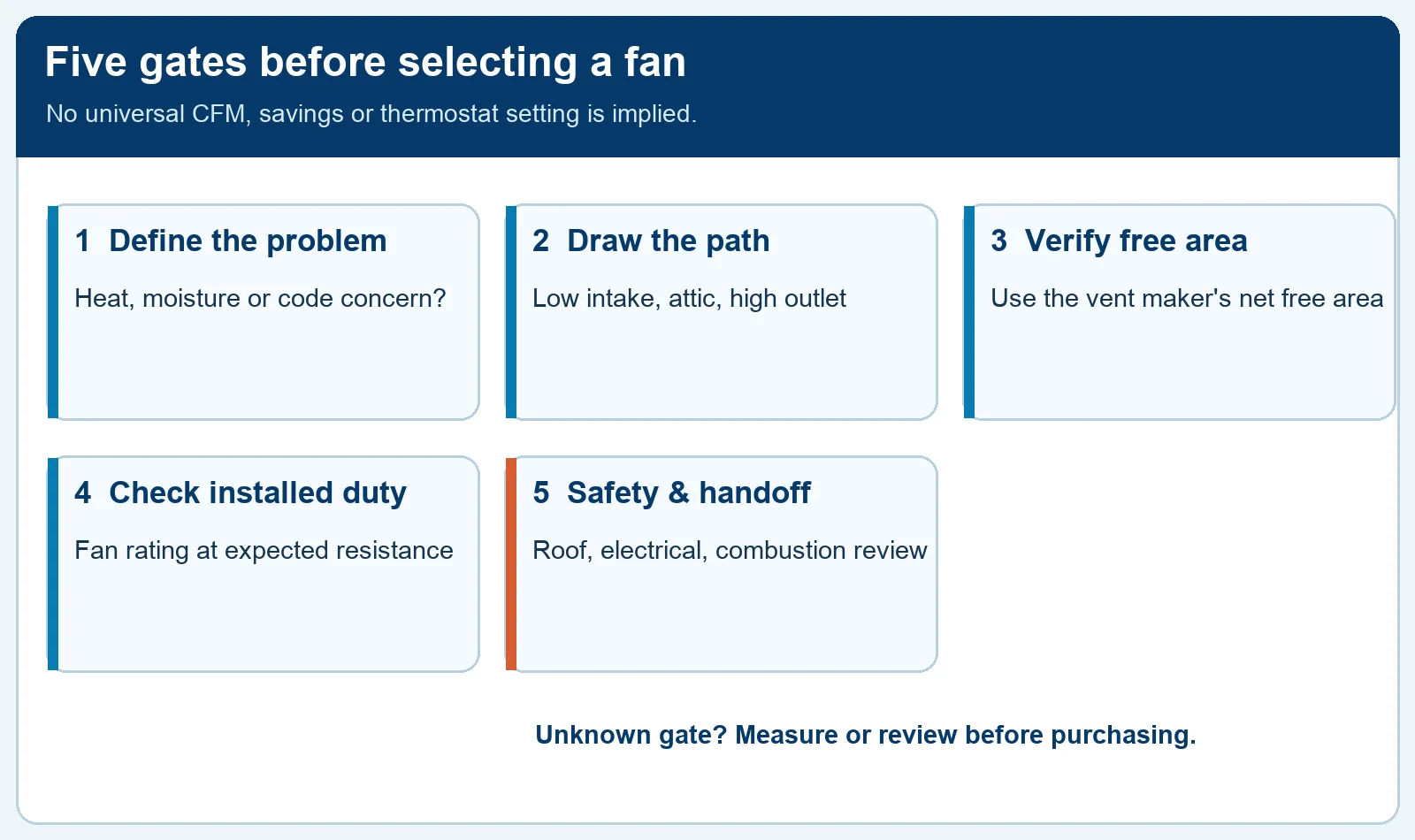
Hand off five facts before purchase
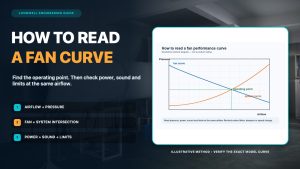
A useful request for a fan supplier contains five items: the problem being solved; a drawing of low intake, attic and high outlet; measured or documented net free areas; the required operating duty with expected resistance; and the building-safety and installation review. If one of these is unknown, mark it as an open measurement rather than filling the blank with an assumed CFM, savings percentage or thermostat setting. The diagram below keeps the equipment question downstream from the building question.
Commission the actual route
After an approved installation, inspect that the intended low intakes are open and that air moves toward the planned exhaust rather than from the rooms below or a nearby high vent. Confirm the controls, electrical protection and access for service against the exact product instructions. Document the installed configuration and any observed airflow or pressure check with the method used. Fan rotation or a warm exhaust stream alone does not prove the designed flow rate.
The practical decision is conditional. If passive venting, ceiling air sealing or insulation addresses the original problem, adding a powered unit may provide little value. If a powered path remains justified, size it from a verified building route and equipment duty, then let the appropriate professionals own roof and safety approval. The goal is a traceable specification, not a bigger advertised fan.
Choose the right roof exhaust fan
Longwell manufactures 23 roof exhaust fans in-house. Send airflow, static pressure and voltage — an engineer replies with a matching model, performance curve and price within one working day.