Which cools a home better: a whole-house fan or an attic fan? The useful answer starts at the pressure boundary. A whole-house fan is intended to move acceptable outdoor air through occupied rooms and then out of the building. An attic fan moves air through the roof space. It may change attic conditions, but it is not a direct room-air cooling system. Neither label promises a temperature drop, utility saving or suitable installation at a particular house.
Trace the air before comparing fan sizes
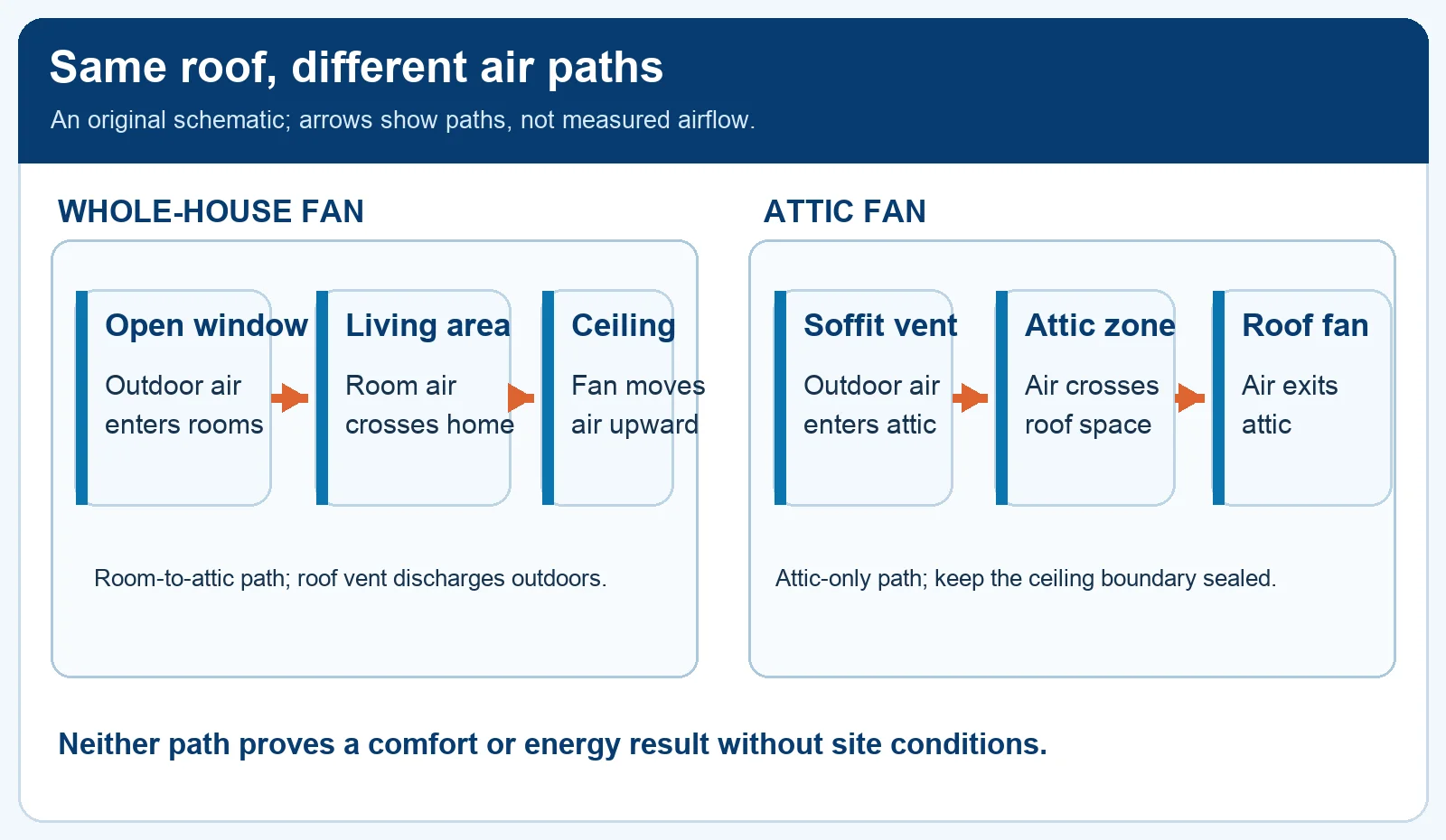
For a conventional whole-house path, outdoor air enters through planned open windows, crosses the living space, passes through a ceiling fan opening and leaves through an adequate roof or attic outlet. The occupied space is part of the airflow circuit. If the outdoor air is warmer, too humid, polluted or otherwise unacceptable, bringing more of it indoors is a poor cooling strategy. The US Department of Energy’s HVAC renovation guide describes the dry, moderate-climate conditions and the need for open windows and adequate attic venting.
An attic exhaust fan has a different intake: outside air should enter the attic through appropriate soffit or other vents, cross the roof space and leave through the fan. The ceiling between attic and living area should remain an air barrier. If the attic intake is inadequate and the ceiling leaks, a powered attic fan can instead pull conditioned room air into the attic. That is why an attic temperature alone is a weak basis for a purchase decision.
Decide which zone needs a change
If the goal is to flush warm indoor air during a period with cooler, acceptable outside air, a whole-house fan addresses the occupied rooms more directly. It still requires a safe intake, a suitable discharge route and a professional review of the building. If the goal is to ventilate the attic without intentionally exchanging indoor air, start with the attic’s existing intake and exhaust path, roof assembly and ceiling air sealing. In either case, separate the target zone from the equipment location: a roof-mounted product can serve many duties besides residential attic ventilation.
The difference also matters when the house has mechanical cooling. A whole-house fan and an air conditioner are different operating modes; bringing warm or humid outdoor air indoors while cooling can work against the intended condition. An attic fan may lower attic air temperature under some conditions, yet that does not establish a corresponding household energy saving. The DOE guide specifically cautions that powered attic fans have not generally demonstrated air-conditioning-bill reductions and may remove conditioned air through a leaky ceiling. Avoid a simple “winner” claim without the house’s climate, insulation, air leakage and operating pattern.
Check openings, resistance and installation scope
Fan catalogue airflow is a starting datum, not the delivered flow through an installed house. Window opening, grilles, soffit net free area, dampers, roof vents and the fan’s operating point all affect the path. Ask for the required airflow at the actual resistance and for a drawing of the assembled route. A fan spinning at the roof does not prove that the intended intake supplies it. A commissioning check can verify the intake direction and that the intended zone, rather than an unintended gap, is being ventilated.
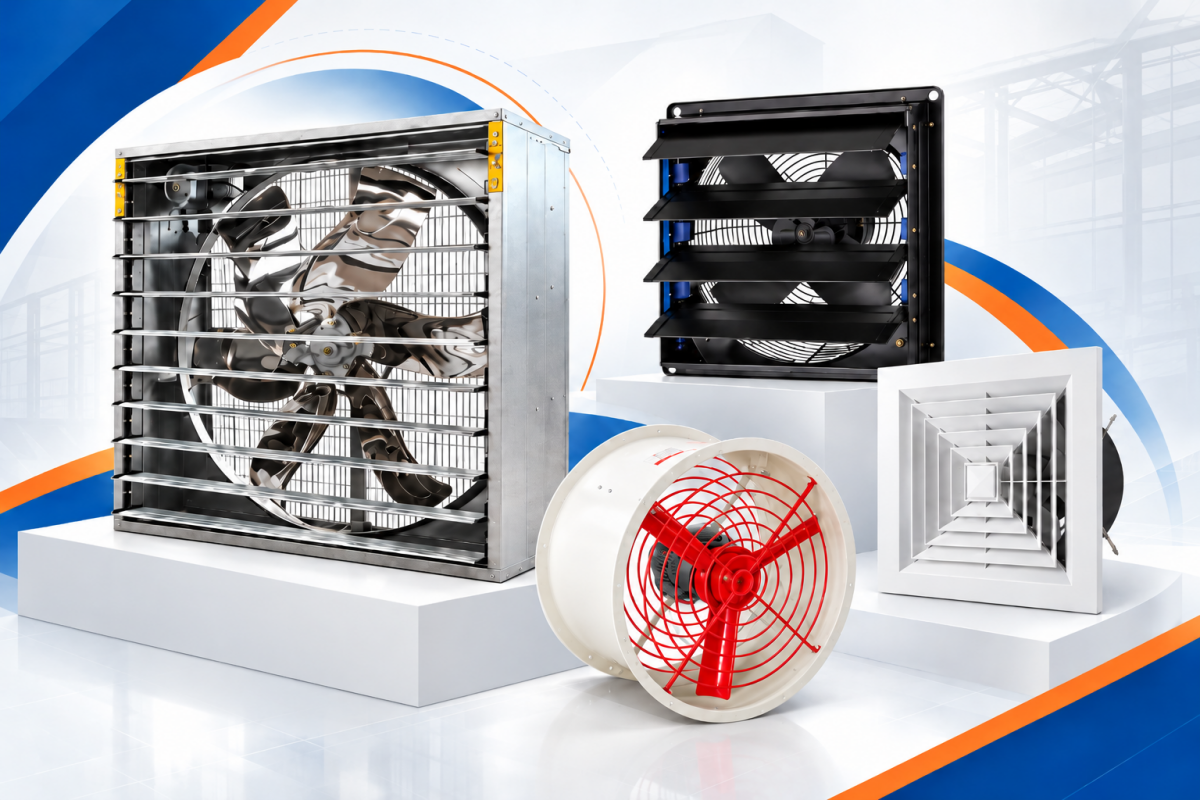
For product context, LONGWELL’s roof exhaust fan family lists centrifugal, axial and other roof-side categories. Its catalogue identifies model series such as LWCRF and LWARF. These are roof-fan family identities; their published descriptions and tables do not establish that any listed model is a suitable whole-house fan or a fit for a particular residential attic. Ask for the exact suffix, current drawing, duty-point curve, electrical data and installation requirements before treating a roof product as a candidate. The roof-fan application overview is likewise a route to discuss roof-side duty, not a residential performance test.
Use five project inputs as the decision card
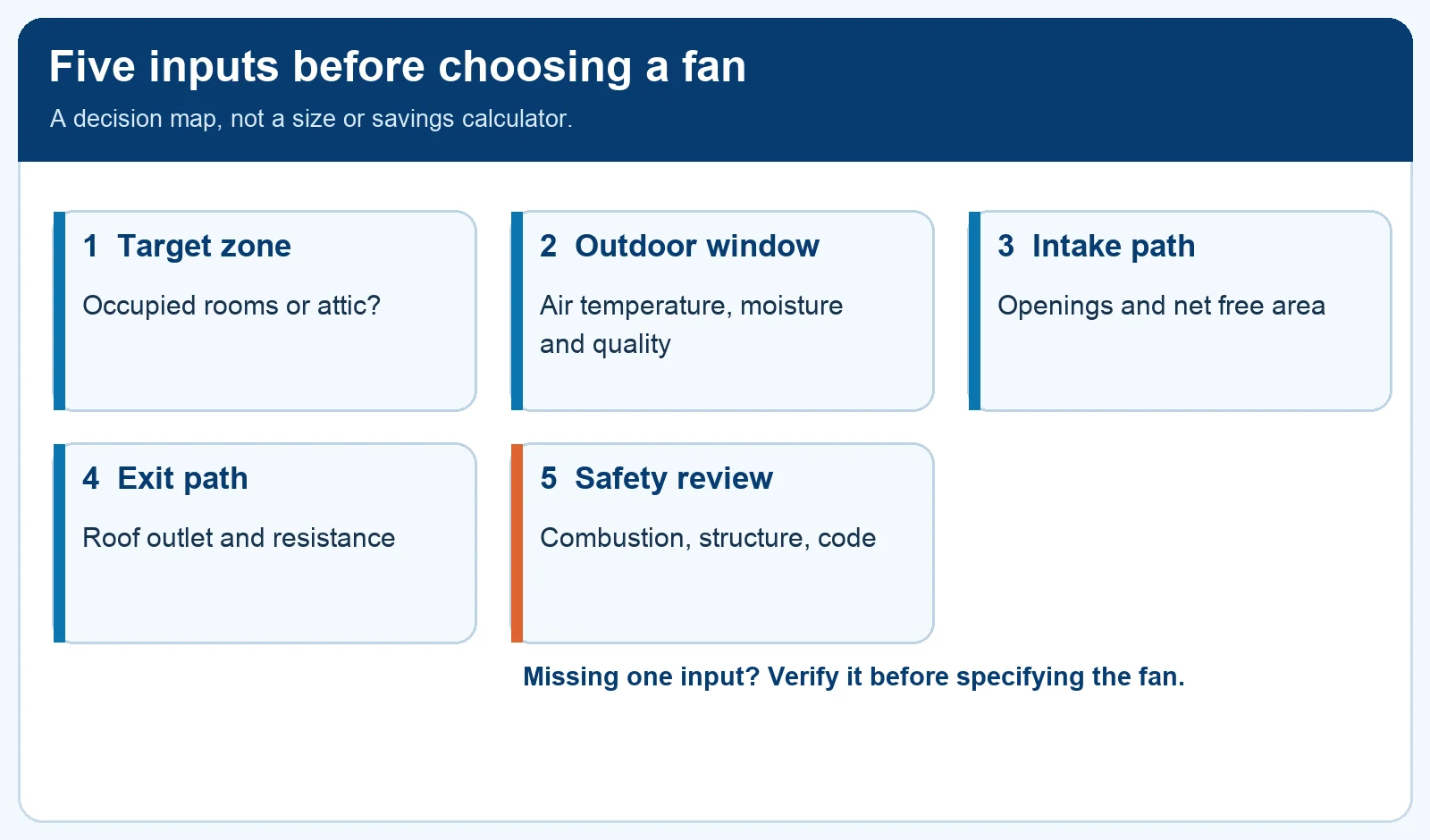
Write down the intended zone, the periods when outdoor air is acceptable, the net free intake area, the complete discharge route and the safety review. For a whole-house option, include window operation, security, outdoor air quality and a way to seal and insulate the ceiling opening when unused. For an attic-only option, include soffit or equivalent intake, ceiling air sealing and the roof outlet. If an input is unknown, request a site measurement or design review before translating a nominal flow rate into a model number.
Keep combustion and building safety in the selection
A powerful exhaust path can depressurize rooms or interact with naturally vented combustion appliances when outdoor openings are inadequate. The DOE’s ventilation-cooling measure guide calls for careful combustion-appliance and window-opening review for whole-house fans. Roof penetrations, framing, fire separation, moisture, weatherproofing, wiring and local requirements also depend on the specific building. This article is a comparison guide, not an installation instruction or approval for an uninspected home.
The practical verdict is conditional: select a whole-house path when you need direct room-air exchange and have suitable outdoor conditions and a safe, complete flow route. Consider attic-only ventilation when the target is the roof space and the intake and ceiling boundary are verified. If neither path is sound, fix the building or operating assumptions first. For a stalled existing installation, a separate whole-house fan troubleshooting order helps distinguish supply, controls, airflow and service questions before replacing hardware.
Choose the right roof exhaust fan
Longwell manufactures 23 roof exhaust fans in-house. Send airflow, static pressure and voltage — an engineer replies with a matching model, performance curve and price within one working day.