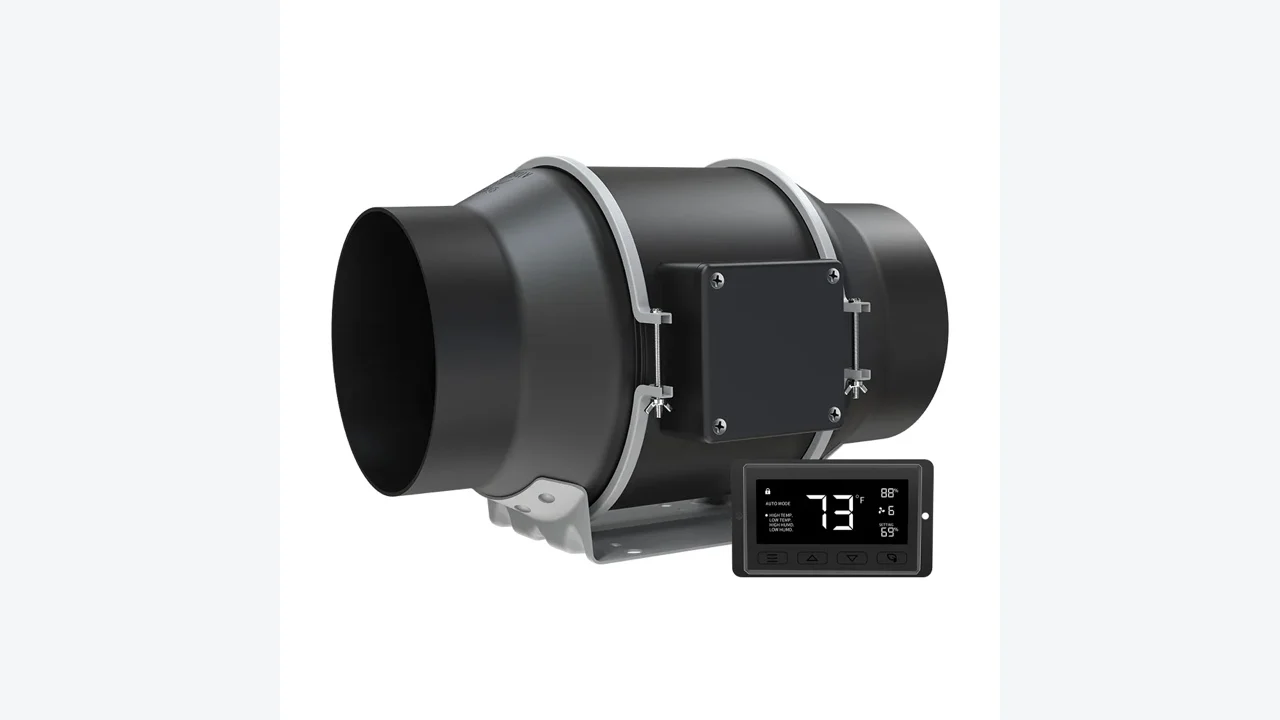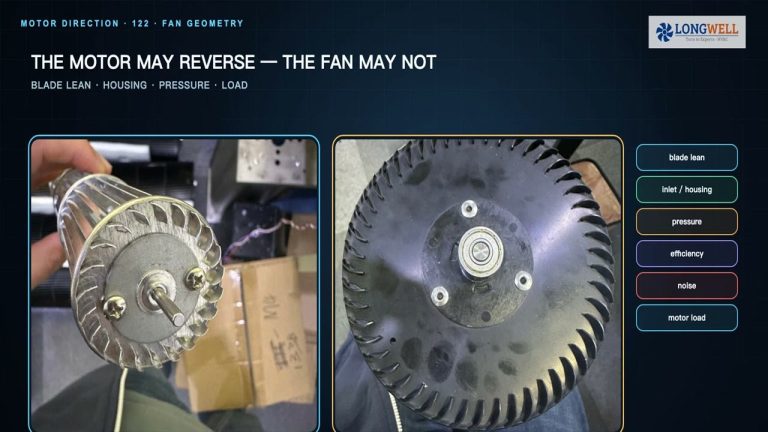
A plug fan is a backward-curved centrifugal wheel with no scroll around it. Air enters the wheel normally and then simply leaves into the surrounding plenum.
That sounds like a downgrade, and aerodynamically it is one. In an air handling unit, though, the packaging advantages usually outweigh the loss.
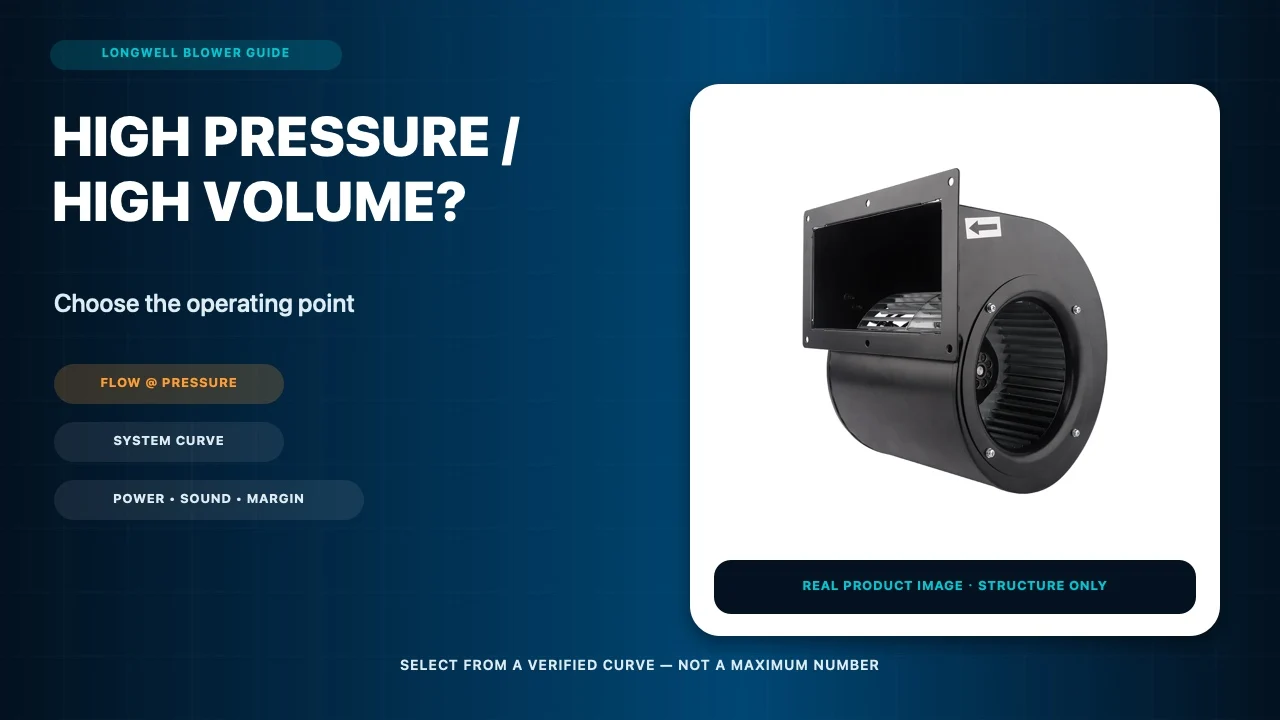
A housed fan uses a scroll to recover velocity as static pressure, so it delivers slightly more useful pressure for the same power. A plug fan drops the scroll, losing roughly 5 to 10 percent of pressure recovery but saving substantial cabinet length, allowing free discharge in any direction and making fan arrays practical. For modern air handling units the plug fan usually wins.
What the scroll actually does
Air leaves a backward-curved wheel fast. The scroll widens progressively, so that fast air slows down and part of its kinetic energy becomes static pressure.
Remove the scroll and the air still slows down, but it does so by mixing turbulently into the plenum. Consequently the recovery is less efficient, and the difference typically lands between 5 and 10 percent of total pressure.
Because outlet velocity on a plug fan is fairly low anyway, usually 10 to 14 m/s, the absolute loss is modest. At 12 m/s the velocity pressure is only about 85 Pa.
Where the plug fan wins
- Cabinet length falls sharply, often by 400 to 700 mm on a mid-size unit.
- Discharge direction no longer matters, so unit layout becomes flexible.
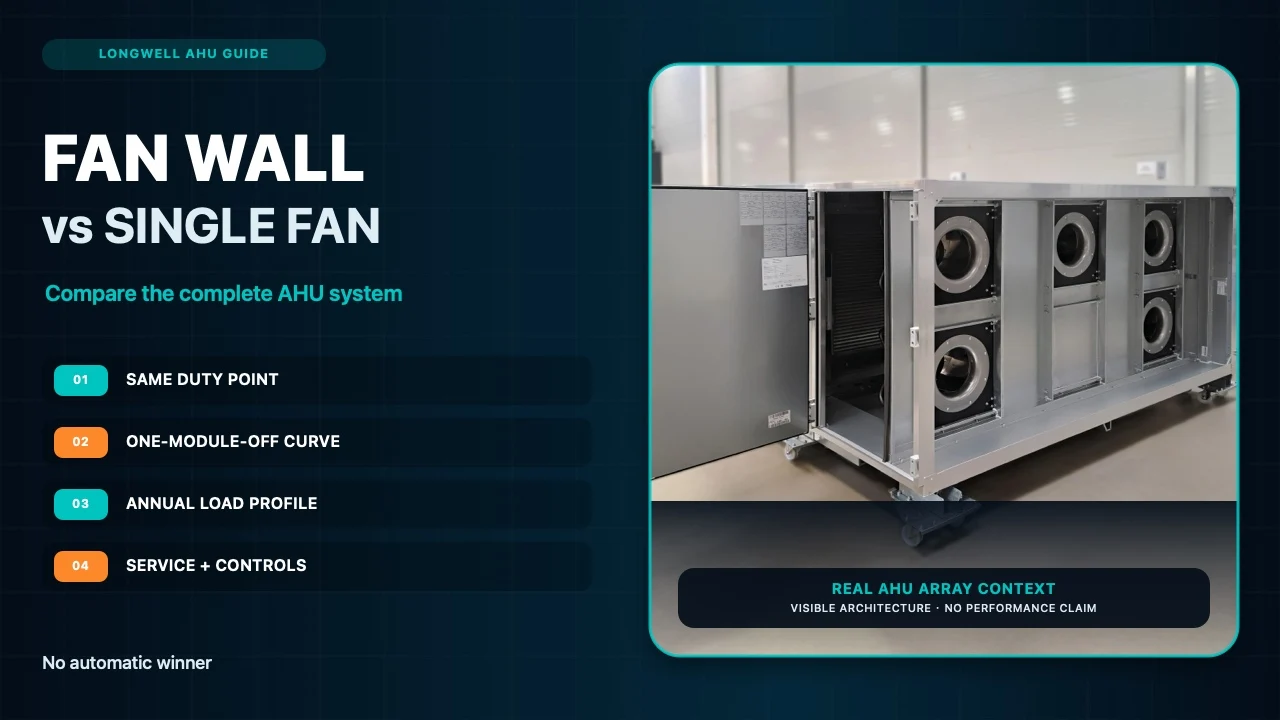
- Arrays become possible, since several small wheels share one plenum.
- Direct drive removes belts, pulleys and the dust they shed.
- Access improves, because the wheel is reachable without opening a housing.
- Balance and vibration are easier to manage on a single overhung wheel.
The freed length is the argument that usually closes the deal. Many retrofits use the recovered space for a deeper filter, which lowers system resistance and hands back more than the scroll ever gave.
Where a housed fan is still right
Scroll housings have not disappeared, and for good reason.
| Situation | Better choice | Why |
|---|---|---|
| Ducted discharge required | Housed fan | Concentrated outlet connects directly |
| Very high pressure, above 2,500 Pa | Housed fan | Recovery matters more at high velocity |
| Dirty or greasy air | Housed fan | Contained wheel, easier to clean out |
| Roof or wall mounted unit | Housed fan | Weather protection and directed flow |
| Cabinet already long enough | Either | Choose on cost and efficiency |
For ducted industrial work our industrial centrifugal fans remain housed, while the AHU plug fan range covers plenum installations.
Pressure comparison in practice
Comparing quotations across the two types confuses people, because they are rated differently.
A housed fan is normally quoted on total pressure or fan static pressure at a defined outlet. A plug fan is quoted on static pressure only, since there is no outlet to define. So the plug fan number looks lower even when the machines are equivalent.
Add the housed fan outlet velocity pressure back before comparing. A housed fan quoting 700 Pa static with 15 m/s outlet velocity is really doing about 835 Pa total, so a plug fan at 800 Pa static is the stronger machine, not the weaker one.
Noise and vibration
Plug fans discharge into a large volume, which naturally attenuates some high-frequency content. Meanwhile the absence of a cut-off removes one classic tonal source.
On the other hand, plenum turbulence adds low-frequency energy, and that travels further through a building. Consequently the total sound power is often similar while the character differs, so compare octave band data rather than a single dB figure.
Vibration is generally easier on a plug fan, since the wheel sits on a direct-drive motor shaft with no belt tension pulling sideways. Our impeller balancing guide covers the field procedure either way.
Choosing for a new project
- Decide whether the fan discharges into a plenum or straight into a duct.
- Check available cabinet length against the scroll depth you would need.
- Confirm the duty pressure, since very high pressure favours a housed fan.
- Consider redundancy, because arrays are only practical with plug fans.
- Compare on total pressure, converting the housed fan figures properly.
- Finally, check maintenance access from the side you can actually reach.
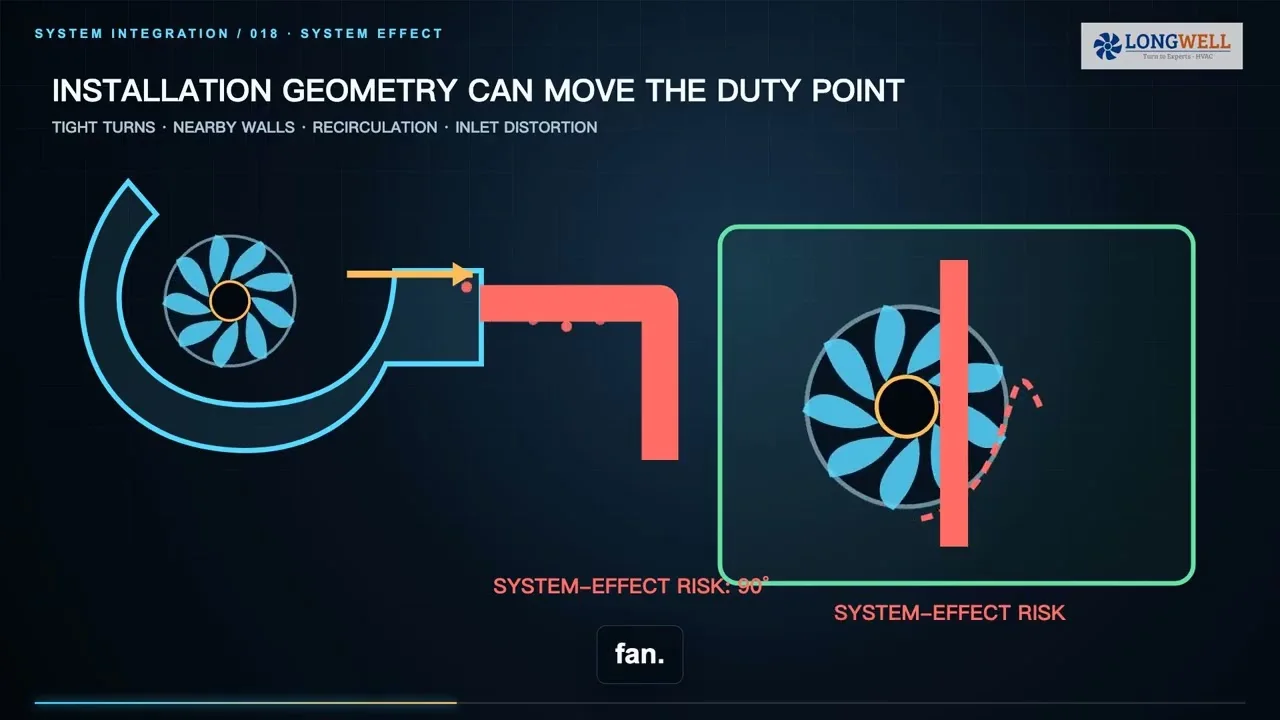
For background on plenum design and fan inlet conditions, ASHRAE guidance is the usual reference, and AMCA Publication 201 explains the system effect losses that hurt badly placed inlets.
Plug fan FAQ
Is a plug fan less efficient than a housed fan?
Slightly, on paper. In a real air handling unit the freed space usually allows lower system resistance, so total unit efficiency often improves despite the lost recovery.
Can I replace a housed fan with a plug fan?
Frequently yes, and it is one of the most common AHU upgrades. Check the plenum can be sealed properly and that the discharge does not blow straight into a coil face.
Do plug fans need a backdraft damper?
In an array, yes. A stopped fan without one becomes a short circuit, so the running fans push air backwards through it. See our fan wall design guide.
What size plug fans are available?
Common wheel diameters run from 250 mm to 800 mm, with larger sizes for industrial duties. Our EC plug fan range covers that span with integrated control.
The plug fan traded a little aerodynamic recovery for a lot of packaging freedom. In air handling units that trade has already been settled by the market.
Choose the right ec plug fan
Longwell manufactures 83 ec plug fans in-house. Send airflow, static pressure and voltage — an engineer replies with a matching model, performance curve and price within one working day.