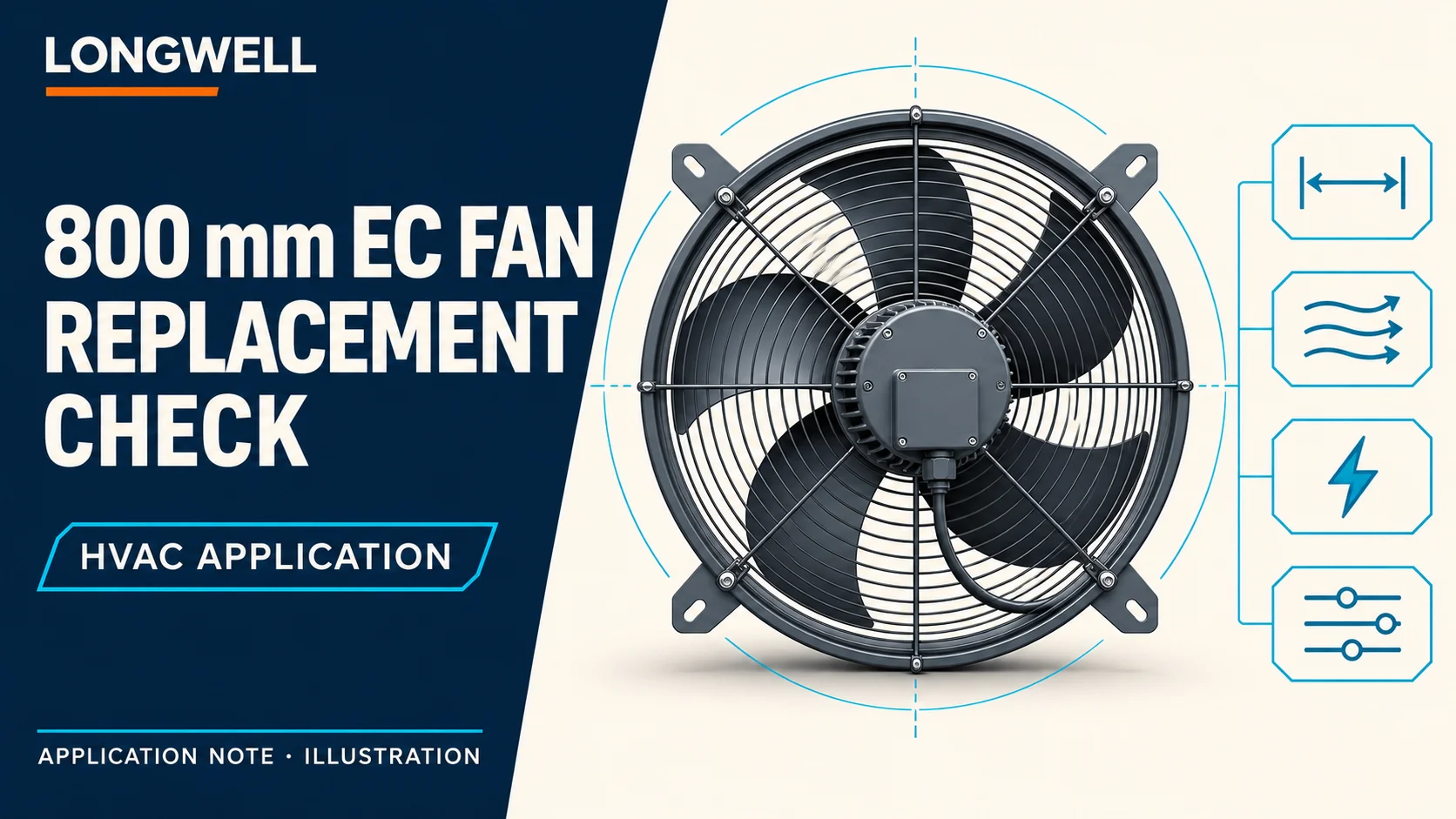
An HVAC user in the Middle East needed to replace an 800mm EC axial fan in a condenser that was still in service. The request came with a nameplate photograph and a practical constraint: keep the existing mounting arrangement wherever possible.
The initial candidate range was LONGWELL’s LWAE3G800 family. Choosing a family was only the starting point. A specific replacement model still depended on the mounting dimensions, operating duty and electrical connections.
What the original nameplate told us
The reference fan was an 800mm-class EC axial unit. Its nameplate information included a three-phase 380–480V AC supply, 50/60Hz, 2.2kW, approximately 1,000rpm and IP55 protection, with integrated speed control. These are the original fan’s reference values; they are not specifications assigned to a LONGWELL replacement.
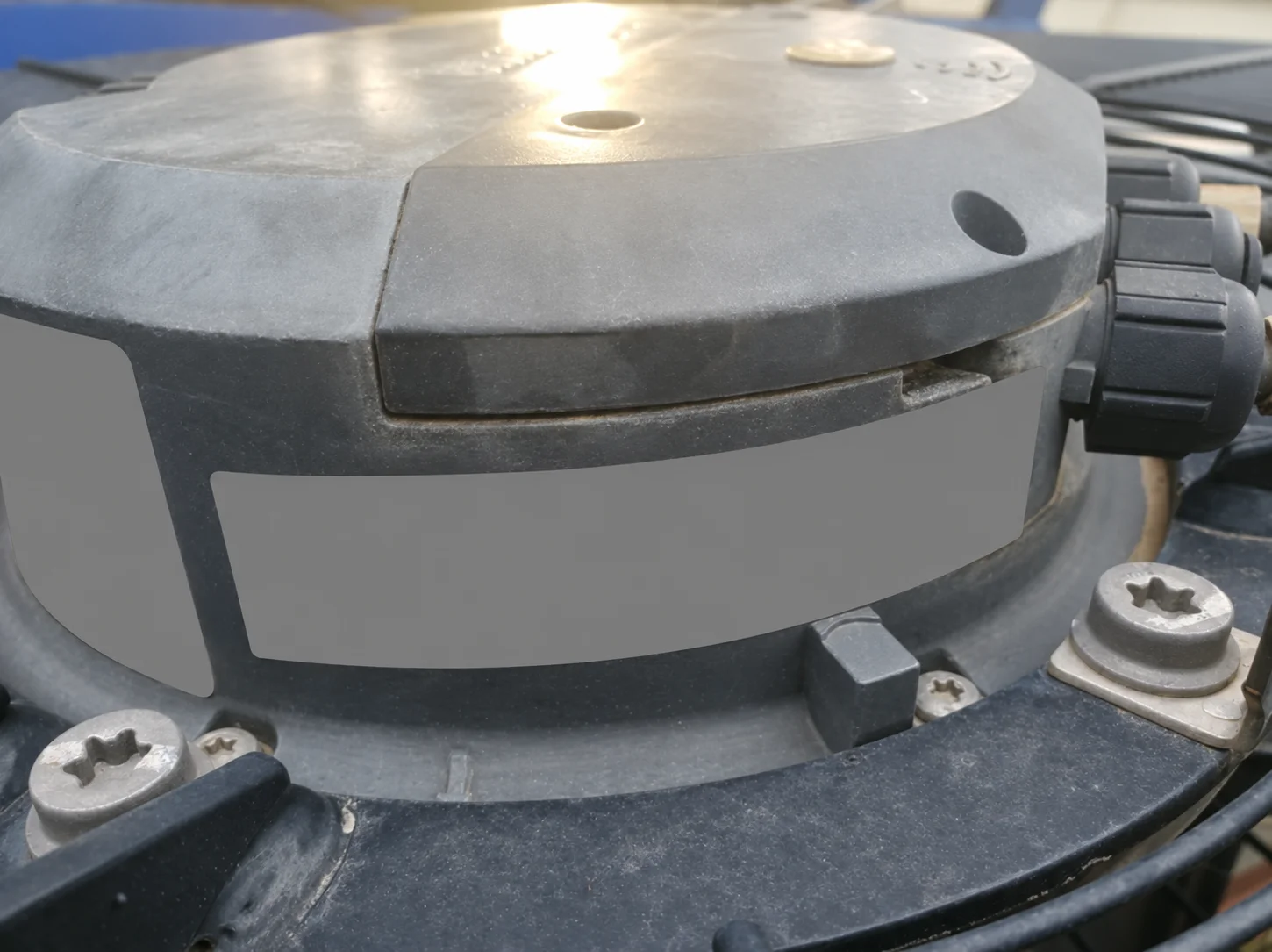
A nameplate helps narrow the search. It does not show the mounting hole pattern, available depth or resistance through the condenser. Motor power alone cannot establish whether another fan will deliver the airflow the unit needs.
Check the mounting envelope before calling it a drop-in replacement
Two fans with the same impeller diameter can have different mounting rings, guards and motor positions. For this enquiry, keeping the existing structure meant comparing the complete dimensional drawing against the installation.
| Check | Information needed | Reason |
|---|---|---|
| Mounting ring | Outside diameter, hole count, hole diameter and centres | Confirm the existing fixing positions |
| Axial clearance | Space behind the mounting face and guard depth | Check motor, impeller and terminal-box clearance |
| Airflow direction | Installation-side photographs and the unit’s air path | Match the condenser layout |
| Cable arrangement | Cable exit, available length and terminal position | Assess the connection route |
A few measured photographs can make the first drawing comparison easier when an original assembly drawing is unavailable.
Compare airflow and pressure at one operating point
The condenser coil, guard and surrounding structure influence the fan’s operating point. Selection therefore needs the required airflow together with its corresponding static pressure. That combined point must be checked on the proposed model’s performance curve.
Maximum airflow and maximum static pressure are different endpoints. Combining the two catalogue maxima would describe a duty the fan has not demonstrated. If the design duty is missing, the next step is to gather the original fan documentation, condenser identification and available operating information before confirming a model.
Ambient conditions also need a number. A Middle East location signals the need to investigate temperature, but it does not define the air temperature at the fan inlet. The selected model’s operating limits must be checked against that actual condition.
Match the supply and control connections separately
The original 380–480V range should be treated as a requirement to investigate. It does not mean every model in the LWAE3G800 family accepts that range. Rated voltage, permitted supply variation, current and protection rating need checking for the exact part number.
The same applies to controls. Identify the existing speed command, the terminal assignments and any speed or fault feedback the condenser controller expects. Even where both units use a 0–10V command, the wiring diagrams still need comparison. A shared control description is not enough to establish a direct connection.
The LONGWELL EC axial fan range provides a starting point for this comparison. The project conditions determine which model, if any, is suitable.
What to send for an 800mm EC fan replacement check
A clear nameplate photograph can start the conversation. To move from a candidate family to a specific model, add the installation measurements, airflow and pressure requirement, ambient temperature, supply details and control wiring. Include the original datasheet or curve if available.
Where drawings are missing, photograph the guard, mounting ring, cable exit and surrounding space. Mark the critical dimensions. This gives the selection engineer a usable picture of both the mechanical constraints and the information still to resolve.
The aim is to establish a fan that fits the installation and meets its operating duty. Final confirmation requires the dimensional drawing, performance curve and wiring diagram for the proposed model; an 800mm diameter by itself cannot answer those questions.
Choose the right axial fan
Longwell manufactures 1,048 axial fans in-house. Send airflow, static pressure and voltage — an engineer replies with a matching model, performance curve and price within one working day.