What the facility manager asked for
A facilities manager running a large logistics building asked us to quote three sizes of HVLS fan.
They wanted air circulation and staff cooling across a big open floor, on a 380V three-phase supply. Nothing custom was needed. Instead they asked for standard papers and prices on three HVLS fan models: 2.0-meter, 2.5-meter and 3.0-meter.
The real question behind the enquiry
Asking for three diameters is not indecision. It means someone is weighing coverage area against unit count and total installed cost, which is exactly the right way to approach this.
- First, coverage had to run from roughly 60 m2 to 140 m2 per fan.
- Next, airflow ran from 1,000 m3/min at 100 RPM up to 2,300 m3/min at 90 RPM.
- Air destratification mattered, meaning pulling warm ceiling air back down in winter.
- Finally, choosing the EC series showed that efficiency and control both mattered to them.
ISO 9001 manufacturing and CE marking were assumed rather than stated, as they usually are on a project like this.
Comparing the three HVLS fan sizes
These are catalog products, so the task was comparison rather than design. In truth the question was strategy. Many small fans covering zones, or fewer large ones covering open floor?
Why every model uses an EC motor
A plain AC motor with a separate drive was possible. Even so, we dismissed it quickly.
Every HVLS fan in this series carries a built-in gear motor with an EC core, part of our SmartEC platform. That gives better efficiency at the part loads these fans really run at. Moreover 0-10V, PWM and RS485 Modbus control all come as standard.
Consequently the fan connects straight to a temperature sensor or a building system, with no third-party gateway to buy and program.
How the three sizes compare
Here is the figure that surprises people. All three use the same 0.55 kW motor, yet output scales sharply with diameter.
- The 2.5-meter fan moves 60% more air than the 2.0-meter version.
- The 3.0-meter fan moves 130% more air, and covers 133% more floor.
In a large open warehouse, the 3.0-meter HVLS fan cuts the number of units needed. Consequently there are fewer mounting points, fewer electrical drops and less labor on site. Installation labor usually dominates the cost on a job like this.
Why six blades
All three use a six-blade design. That balances high volume against low noise, following our AcousticFlow principles. In short, the goal is airflow people can work under all day, rather than the biggest number on a datasheet.
Technical Specifications
All three rows below share one power figure. That is the point worth noticing before you compare anything else.
| Parameter | LW-ECCF-2.0-01 | LW-ECCF-2.5-01 | LW-ECCF-3.0-03 |
|---|---|---|---|
| Diameter (mm) | 2000 | 2500 | 3000 |
| Blade Count | 6 | 6 | 6 |
| Air Flow (m³/min) | 1,000 | 1,600 | 2,300 |
| Air Flow (m³/h) | 60,000 | 96,000 | 138,000 |
| Air Flow (CFM) | ~35,315 | ~56,500 | ~81,225 |
| Max Speed (RPM) | 100 | 100 | 90 |
| Input Power (kW) | 0.55 | 0.55 | 0.55 |
| Voltage (V) | 380 | 380 | 380 |
| Coverage Area (m²) | 60 | 90 | 140 |
| Weight (kg) | 80 | 85 | 90 |
Technical Documentation
The following documents were provided to the customer to support their internal evaluation and system design. These files contain all necessary dimensional, mechanical, and performance data.
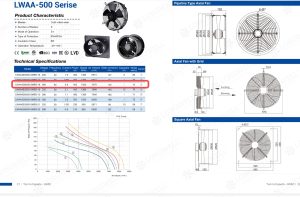
LW-ECCF-2.0-01 Technical Drawing
The technical drawing for the LW-ECCF-2.0-01 provides dimensional data and key performance specifications for installation planning.
LW-ECCF-2.5-01 Specification Sheet
The specification sheet for the LW-ECCF-2.5-01 details the fan’s airflow, power, and coverage area for system designers.
LW-ECCF-3.0-03 Technical Drawing
The LW-ECCF-3.0-03 drawing confirms the top-end performance parameters for large-scale facility ventilation.

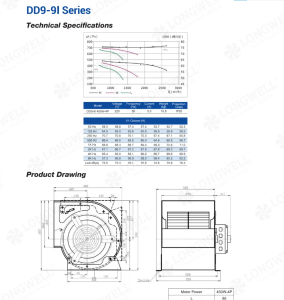
Here the summary provides a broader view of the Industrial Energy Fan family, showing how the selected models fit within the complete product range.
Why the buyer chose us
For a standard HVLS fan, the supplier choice usually turns on things the datasheet never shows.
- Project cost, directly. Manufacturing in Ningbo with our own engineering puts these EC-powered fans materially below imported European brands. Across a multi-unit installation that is real capital saving, with no compromise in technology.
- Timelines that hold. Standard make-to-order lead time for industrial fans is 25 to 35 days. European sources commonly quote 12 to 18 weeks, which decides whether a project lands this season or next.
- Building integration is built in. The SmartEC controller in every fan takes RS485 Modbus, 0-10V and PWM natively. Consequently there is no gateway to source, install and program, which is a common hidden cost with other brands.
- We make the motors. Building our own EC motors and fan components since 1990 means motor, gearbox and blades are matched rather than assembled. That shows up in efficiency, in reliability and in the quality of support you get.
Browse our industrial fan range, or the ceiling fan section. Comfort criteria come from ASHRAE 55.
Questions about these fans
What is the lead time for 20 of the 3.0-meter units?
Standard make-to-order lead time for this series is 25 to 35 days from purchase order. Meanwhile customers with a frame agreement and rolling forecast often get inside 15 days. Every fan gets a 24-hour full-load burn-in before shipment, which is what stops failures on site.
Can a third-party sensor control the speed?
Yes. Every model carries the SmartEC controller, which accepts a standard 0-10V analog input. So any temperature, humidity or air quality sensor with a 0-10V output drives the fan directly, giving demand-based speed control without a building management system. PWM and RS485 Modbus are supported too.
How does the EC motor compare with AC on running cost?
An EC motor is substantially more efficient than an equivalent AC one, and the gap widens at the reduced speeds these fans normally run at. Furthermore the integrated electronics remove the cost and the losses of a separate variable frequency drive. Actual savings depend on your run hours and tariff, so ask us to run the numbers for your site.
Is one big fan always better than two smaller ones?
Not always. A single 3.0-meter HVLS fan wins in open space, where nothing blocks the airflow column. However, racking, mezzanines and partition walls break that column up. So in a divided building, several smaller fans per zone often give better comfort than one big fan fighting obstructions.
Technical Documentation & Resources
Need the same thing for your own unit?
Give us the numbers and the envelope, and you get a shortlist rather than a catalog. Meanwhile custom spec sheets and samples run to 90 days. Since 1990 Longwell has supplied EC fans and blowers to OEMs in HVAC, cold chain, data center and industrial markets.
Browse Related Products:
🏆 ISO 9001 / ISO 14001 / ISO 45001 | CE (TÜV) | UL/ETL | ATEX Zone 21/22 | AMCA 210/211 / ISO 5801 tested