A car park jet fan helps move air across the parking level toward an extract point. It cannot provide make-up air, remove air from the building, or establish a fire strategy by itself. The useful procurement question is therefore not “How many jet fans fit this floor?” It is “What air path and operating sequence must the complete system achieve?” This guide separates those decisions and shows what a fan drawing can actually prove.
Start with the complete air path
An impulse fan transfers momentum to nearby air. Placed within a planned route, it can reduce dependence on distribution ductwork across part of the car park. The extract plant still has to remove the required air, and the space still needs a defined replacement-air path. Shafts and discharge locations determine where that air finally goes. An isolated jet-fan layout without those endpoints is not a ventilation design.
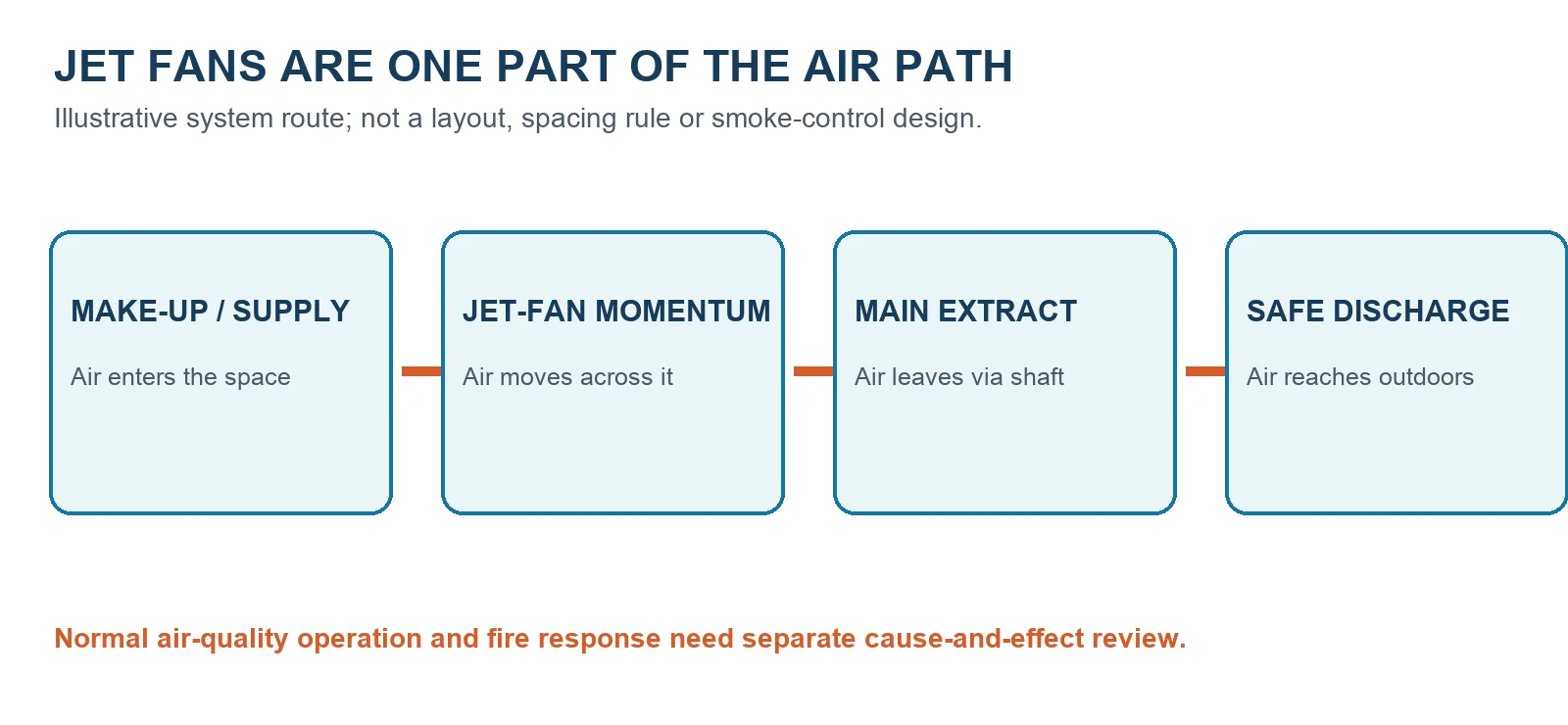
Draw the route across real geometry: entrances, ramps, downstand beams, columns, parked vehicles and any enclosed corners. A fan jet can be diverted or blocked before it reaches the intended extract zone. That is why a repeated spacing number does not travel safely from one project to another. The plan needs the actual obstructions and a method for demonstrating that the required areas receive a useful flow path.
Keep normal ventilation and fire response distinct
Normal operation addresses vehicle-related air quality under the applicable local design basis. Define the contaminant or monitoring approach, detector locations, control stages, make-up air, extract operation and fault response. The designer should also state how the installed system will be measured and commissioned. “Demand control” is a control concept; its sensors, thresholds and savings cannot be inferred from a fan brochure.
Fire response is a separate cause-and-effect question. Fan start, stop, direction, emergency power, alarms and manual control depend on the approved fire strategy and the jurisdiction. Do not assume all jet fans must keep running at full speed during a fire. For example, the AFAC guidance hosted by Queensland Fire describes early jet-fan shutdown in the Australian framework it discusses and a project review for multiple fans in series. That document is useful evidence of why controls and authority review matter; it is not a universal rule for every country or a current project approval.
Ask for performance evidence for the exact installed fan
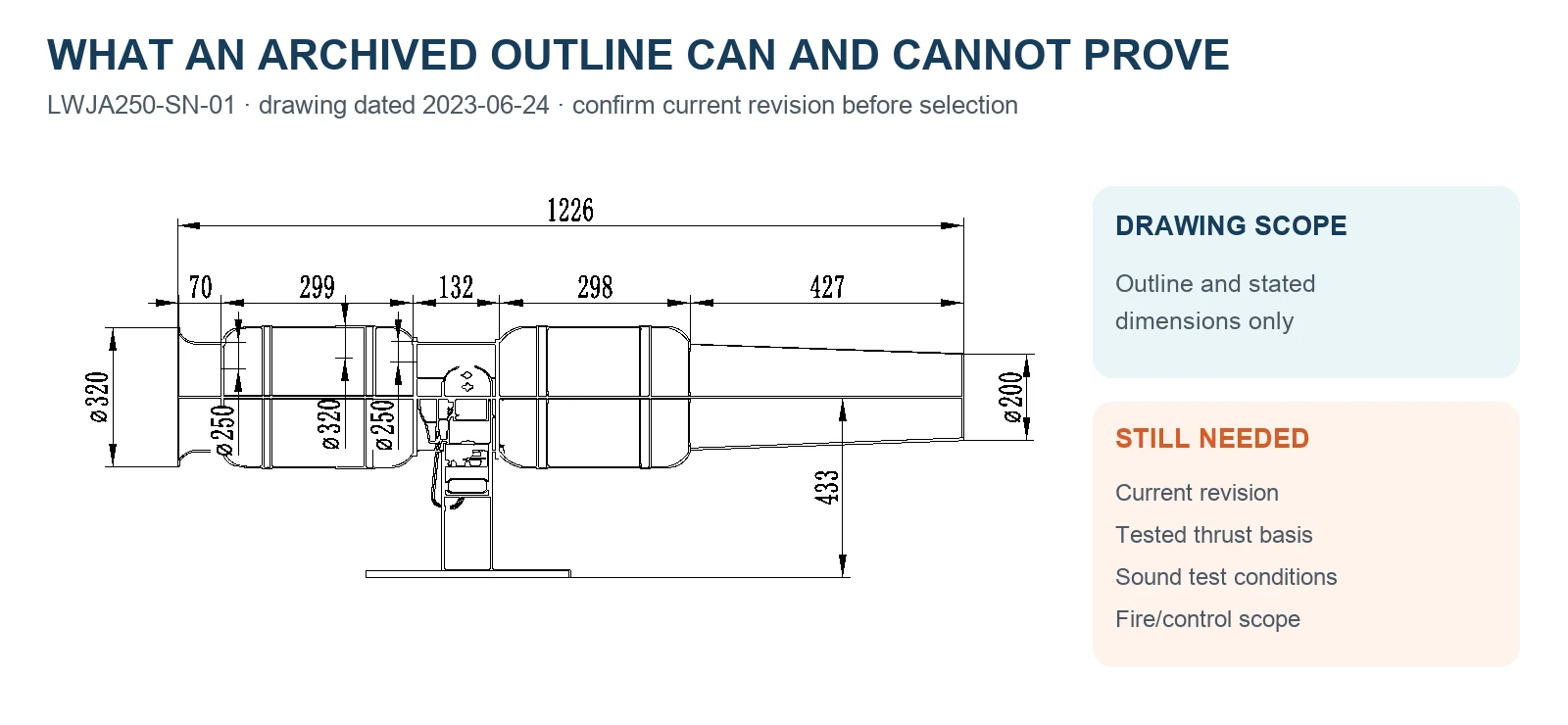
For a candidate jet fan, ask for the model and revision, tested thrust and direction, sound conditions, power and electrical details, mounting arrangement and any environmental or temperature-time duty the project requires. The data should name the complete configuration being proposed. Diameter, motor power and free-air volume do not establish the installed momentum path. Neither a family image nor a drawing certifies a smoke-control duty.
The Longwell archive includes an outline headed LWJA250-SN-01, dated 2023-06-24. It shows the arrangement and stated dimensions of that particular drawing. It does not establish current availability, tested thrust, a fire rating or suitability for this car park. Before using this model in a schedule, request the current revision and the controlled performance and compliance records that match the proposed assembly.
Longwell’s industrial axial fan family provides product-family context for axial construction. It is not a claim that every fan on that page is a car park jet fan or has any fire-duty approval. The exact application is decided by the model record and project evidence, not the category label. The tunnel ventilation guide explains related momentum concepts at another scale; its design assumptions should not be copied into a car park.
Use modelling to test a defined design
Computational modelling can test whether a proposed flow route remains useful around beams, ramps, signage and vehicle zones. Before accepting a coloured airflow image, ask for the actual geometry, mesh or modelling method, supply and extract boundary conditions, fan representation, control scenario, sensitivity cases and acceptance criteria. Review the relevant normal and fire cases separately. A model is evidence only within its stated assumptions; it does not replace tested fan data or approval of the project fire strategy.
Use the model to identify decisions: move a fan, change a discharge direction, adjust a supply opening, reconsider an extract point or test a failure case. Keep those design changes tied to the mechanical and fire engineers’ documented review. A generic fan-count or 20–35 m spacing statement cannot take that place.
Commission the system, not just the fans
On site, first verify the installed model and rotation or flow direction against the approved schedule. Then test the whole route: make-up and extract operation, normal staging, detector input, fan feedback, power-loss response and the project’s approved fire cause-and-effect sequence. Check access for maintenance and the mounting condition, including how thrust reaction is carried. Record measured results against the project acceptance method rather than comparing one fan’s nameplate to a whole-garage claim.
If the engineer cannot yet provide a plan, a control narrative and an exact candidate model, the next step is to gather those three inputs. They allow the supplier to check the right evidence instead of guessing a universal quantity or spacing from the floor area.