Short answer: choose metal when the verified alloy, construction and inspection route give the required margin for temperature, rotational load, size or low-volume customization. Choose an engineered polymer when the exact grade, molded geometry, exposure limits and production volume are qualified for the duty. Neither material family has a universal durability or cost advantage.
The useful comparison is not “steel versus plastic” on a sales chart. It is one complete impeller assembly versus another at the same airflow, pressure, speed range, air condition and service life. Start with the failure modes, then ask what evidence will release the design for production.
Start with a complete impeller specification
Write the metal option as an alloy or grade, product form, thickness, forming route, joint method, heat treatment if relevant, surface treatment and hub construction. Write the polymer option as a resin grade, reinforcement, additives, moisture condition, molding route, inserts and hub interface. “Aluminum” and “PA66” are still incomplete specifications.
Keep the component boundary clear. A blade material review is useful, but purchasing releases a rotating assembly with blades, hub, side plates, inserts, fasteners and balance correction. The related metal-versus-plastic fan blade guide covers blade-level industrial-cooling questions; this article goes one step further and closes the complete-impeller decision.
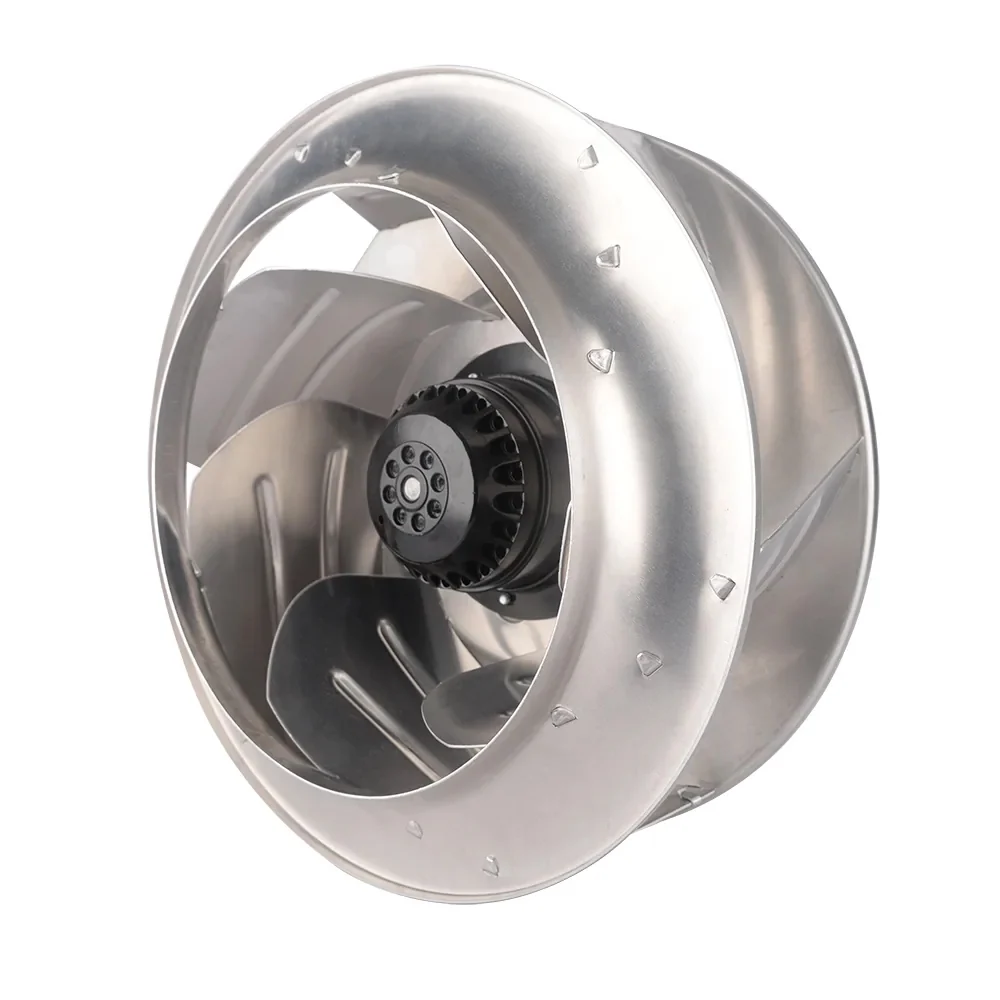
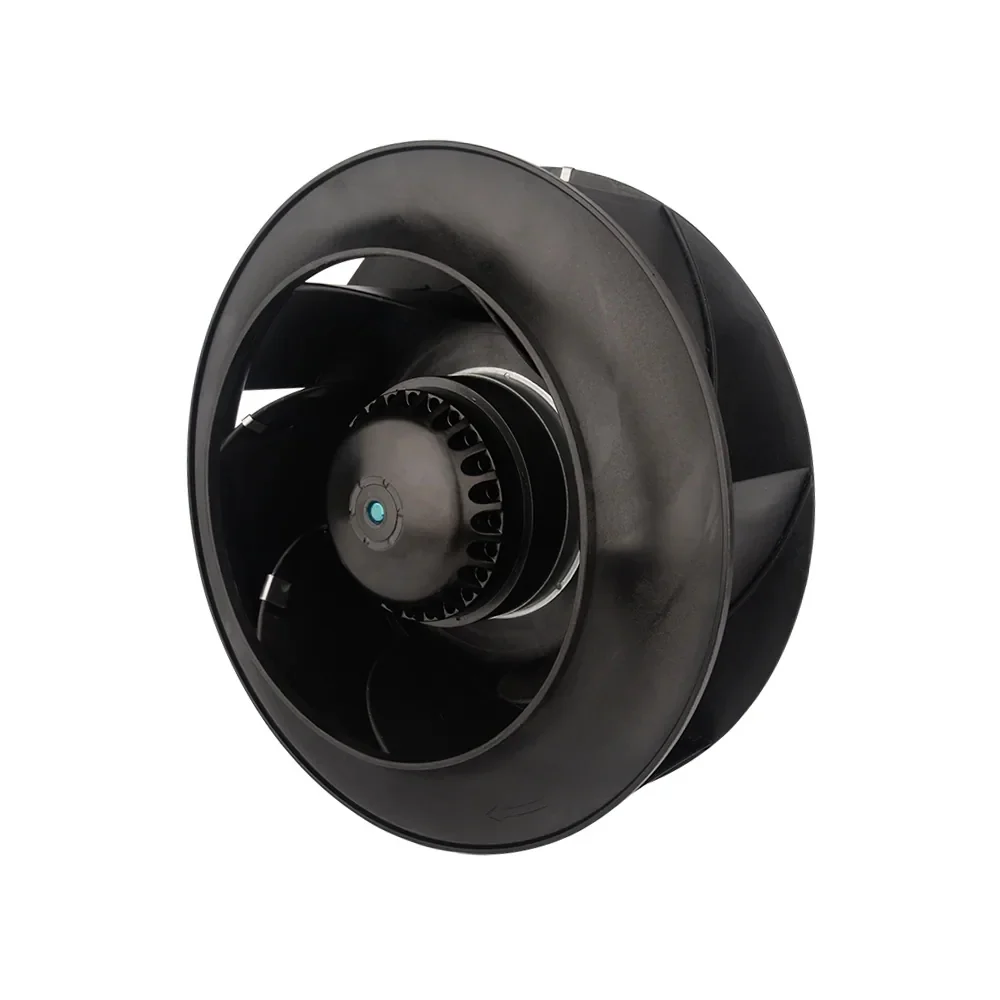
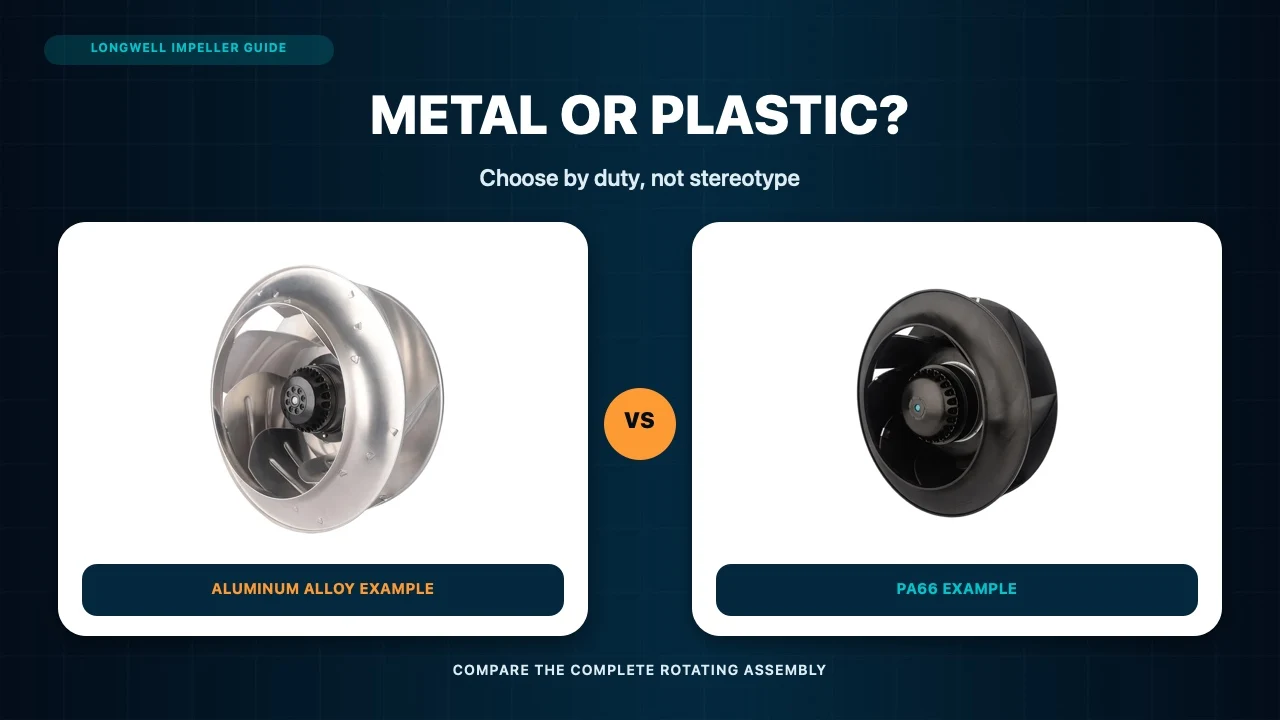
These two real LONGWELL library photographs are labelled LWBA2E250-092NS-05 and LWBA2E250-092NS-07. The internal master data places both in the AC backward-curved centrifugal fan family and identifies their impellers as aluminum alloy and plastic PA66. They are useful visual examples, not a controlled A/B test. Their motors, protection details and other configuration fields differ, so their catalog numbers must not be compared as proof of material performance.
Let temperature and exposure eliminate unsafe choices
Ask for continuous temperature, the duration and frequency of every peak, temperature at the wheel rather than elsewhere in the machine, and the condition during startup, cleaning and shutdown. A generic melting point is not a design limit. Polymer stiffness, creep, impact behaviour and dimensions can change with time, temperature and moisture. Metal strength, joints and coatings also have temperature-dependent limits.
List every medium that can reach the impeller: condensate, salt, humidity, cleaners, oils, refrigerants, acids, alkalis, ozone, ultraviolet light and abrasive dust. Carbon steel may need a controlled coating system; aluminum can face galvanic or chemical attack; a stainless grade is not corrosion-proof in every medium. A polymer must be checked against the exact chemical concentration and temperature. Request current grade data and, when the consequence matters, test conditioned samples or an assembly.
Qualify rotational strength, fatigue and balance
Rotational stress depends on the finished geometry, mass distribution, radius, speed and local details. A lower-density material can reduce inertia, but it does not prove adequate hub strength or overspeed margin. Molded knit lines, fiber orientation, inserts and creep may govern a polymer wheel. Weld toes, bends, cast defects, residual stress and corrosion allowance may govern a metal wheel.
Define normal speed, permitted transients, starts and stops, temperature during operation, expected cycles and the acceptance method for any overspeed evaluation. Then balance the complete retained assembly. ANSI/AMCA 204-20 provides fan balance-quality and vibration guidance, while ISO 21940-11 addresses procedures and tolerances for rigid rotors. The application still has to select the appropriate category, planes, speed and installed vibration boundary. The centrifugal fan balancing guide explains the practical sequence without turning a generic grade into product approval.
Hold geometry and duty constant before comparing performance
A material change often changes blade thickness, surface finish, hub shape, tip clearance or the geometry that can be manufactured consistently. Any airflow, pressure, efficiency or sound difference may come from that redesign rather than the material itself.
Compare exact configurations at the same airflow, static or total pressure basis, air density, speed and test setup. Ask for the full curve around the required operating point, electrical input on one boundary and sound data measured on one declared basis. Maximum airflow and maximum pressure from separate points do not describe the duty. A broader impeller material-selection passport shows how to keep grade, process, geometry and evidence revisions attached to each offer.
Build the cost model around the manufacturing route
Fabricated metal can avoid a production mold and accommodate lower volumes or design changes, but cutting, forming, welding, machining, coating, inspection and balance correction add operations. Injection molding concentrates cost in tool design, trials and process validation, then may integrate blades, ribs and locating features with fewer secondary steps. Neither route owns the lowest lifecycle cost.
Compare tooling, fixtures, samples, scrap, inspection time, minimum order, tool maintenance, engineering changes, freight, spares and end-of-life replacement. Use at least three volume scenarios and identify who owns the tool. A cheap unit price can be misleading if the mold becomes obsolete after a geometry change; a low tooling bill can be misleading if manual correction and inspection repeat on every metal wheel.
Run a prototype plan that can fail the design
A serious validation plan includes acceptance limits before testing starts. Depending on risk and application, the plan may cover:
- material-grade and process records tied to the prototype revision;
- critical dimensions, runout, hub fit, mass and retained hardware;
- balance and vibration before and after conditioning;
- speed or overspeed qualification with guarding and a defined inspection;
- thermal, moisture, chemical or abrasive conditioning that represents service;
- fan curves, electrical input and sound on a common test boundary;
- post-test checks for cracks, creep, joint damage, coating loss and dimensional change.
Do not accept an attractive CAD render, simulation screenshot, resin brochure or generic certificate as this evidence. The LONGWELL fan impeller range is a useful architecture and sourcing route, but the exact model, suffix, drawing revision and controlled test records still govern approval.
Send an RFQ that closes the decision
- impeller type, diameter, complete geometry and interface drawing;
- required airflow, pressure basis, density and operating speed range;
- continuous and peak temperatures with time at each condition;
- chemicals, humidity, particles, cleaning method and outdoor exposure;
- target life, start-stop cycles, permitted repairs and inspection access;
- exact material grade, manufacturing route and traceable revision;
- balance, vibration, speed, performance, sound and conditioning evidence;
- prototype quantity, annual volumes, tooling ownership, spares and change policy.
Metal is the right answer only when the qualified metal assembly meets that sheet better. Plastic is the right answer only when the qualified polymer assembly does. Put both offers on the same boundary, price the whole manufacturing route, and release the option whose evidence survives the intended duty.
Choose the right fan impeller
Longwell manufactures 10 fan impellers in-house. Send airflow, static pressure and voltage — an engineer replies with a matching model, performance curve and price within one working day.