A centrifugal blower cannot be selected from airflow alone. A catalog or search result may say “1,000 CFM,” but that number means little until it is paired with pressure, air density, installation boundary, control method, and the resistance of the connected equipment.
This guide keeps the selection method separate from model approval. The worked duty-point language is illustrative: it shows how to read airflow and static pressure together, not that one visible model, curve image, PDF filename, or family page is approved for every project with a similar airflow number.
Start with a duty point, not maximum CFM
Maximum airflow is normally measured near free delivery, where external pressure is close to zero. Most real systems are not free delivery. Filters, coils, ducts, silencers, heat exchangers, guards, hoods, outlets, and process components all add resistance.
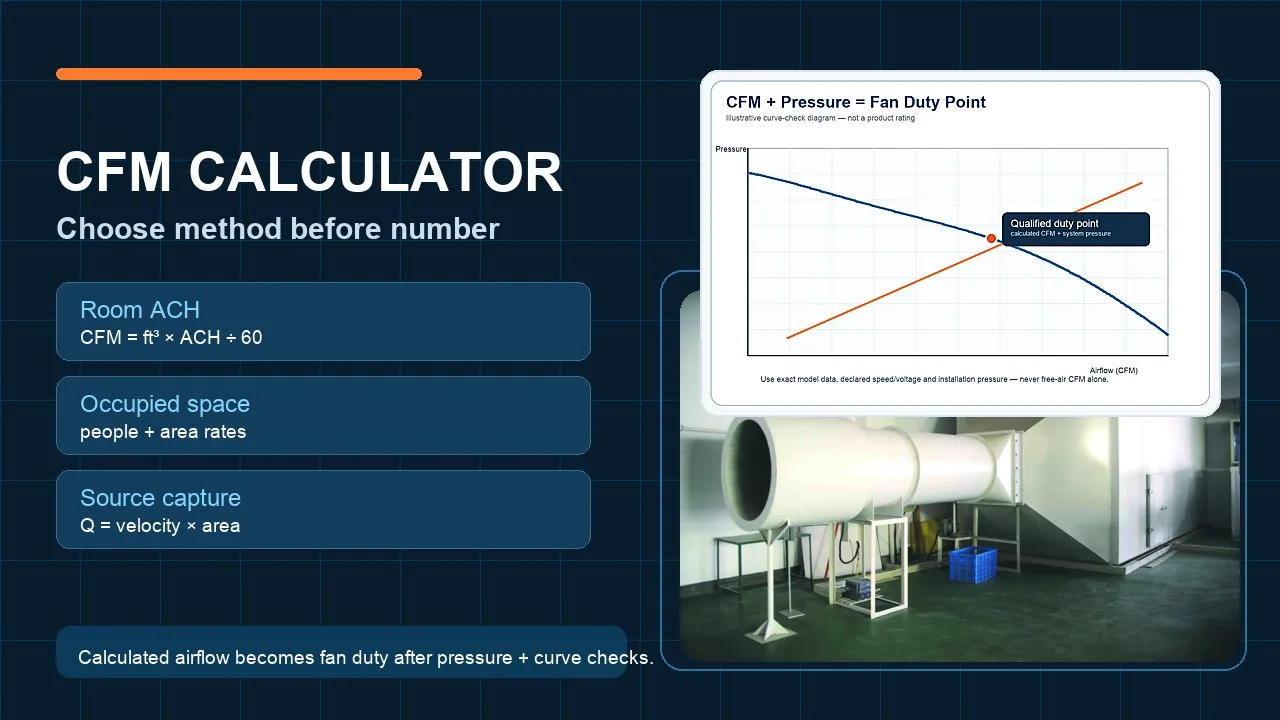
A useful request therefore begins with an airflow-pressure pair: for example, a required flow at a named static-pressure or total-pressure basis. The pressure definition must match the curve being read. A static-pressure target should not be compared casually with a total-pressure chart, and free-air airflow should not be treated as installed airflow.
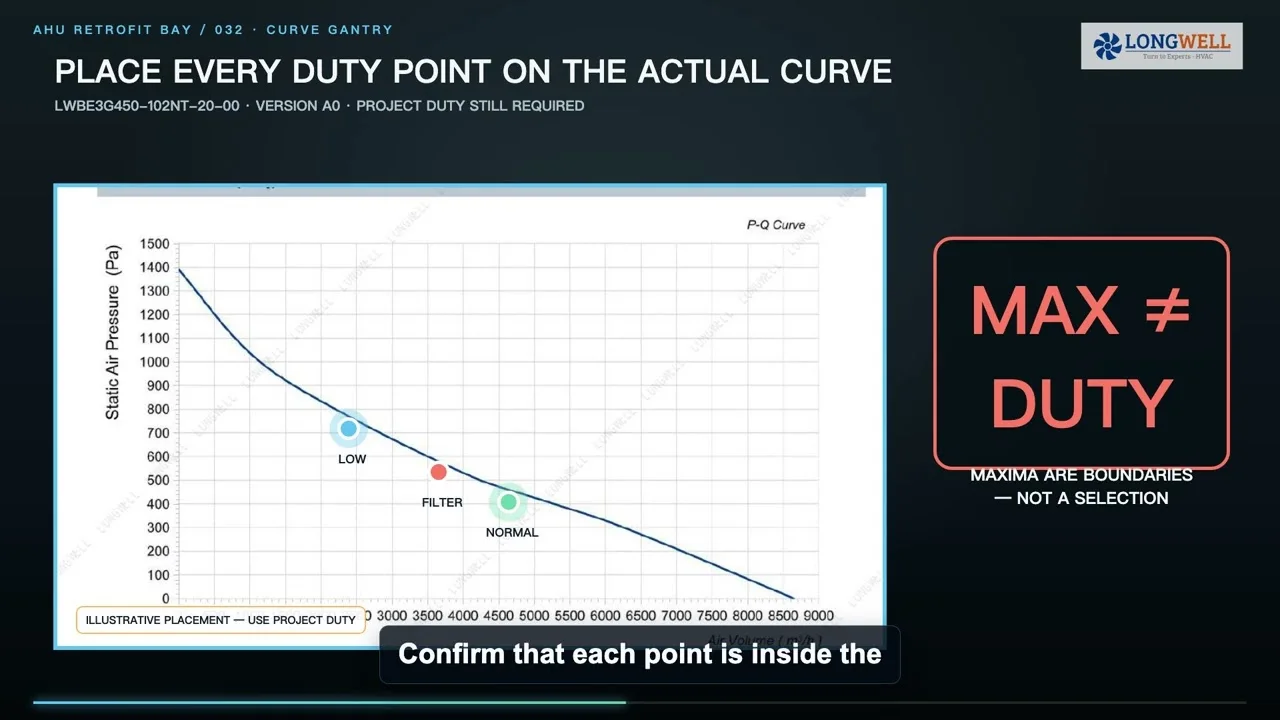
If the application has several operating modes, list each one separately. Clean and loaded filters, summer and winter air density, minimum and maximum speed command, or normal and emergency modes can lead to different operating points on the same fan family.
Build the pressure budget before comparing fans
The blower is only one part of the air path. Estimate or measure the pressure loss of every relevant component at the required airflow: inlet screen, duct length, bends, transitions, filter, coil, outlet, damper, and downstream equipment. Use measured data for the actual geometry when possible.
This is where many selections fail. A candidate that appears acceptable at a clean operating point may run out of reserve when resistance increases. Another may be so oversized that it spends its life throttled, noisy, or unstable at a low command. Margin should answer named uncertainty, not hide missing data.
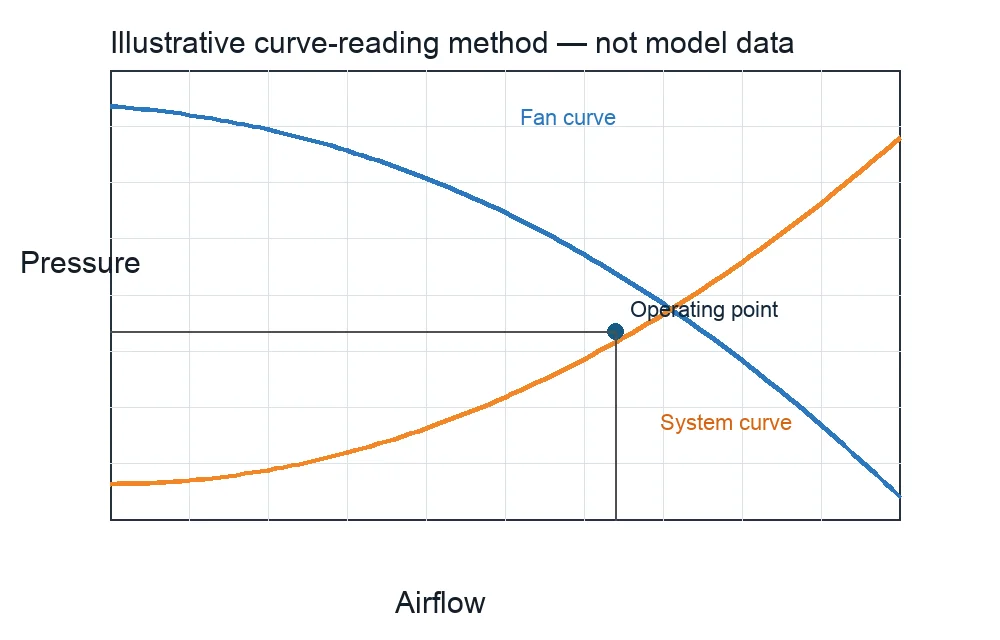
Find the fan and system curve intersection
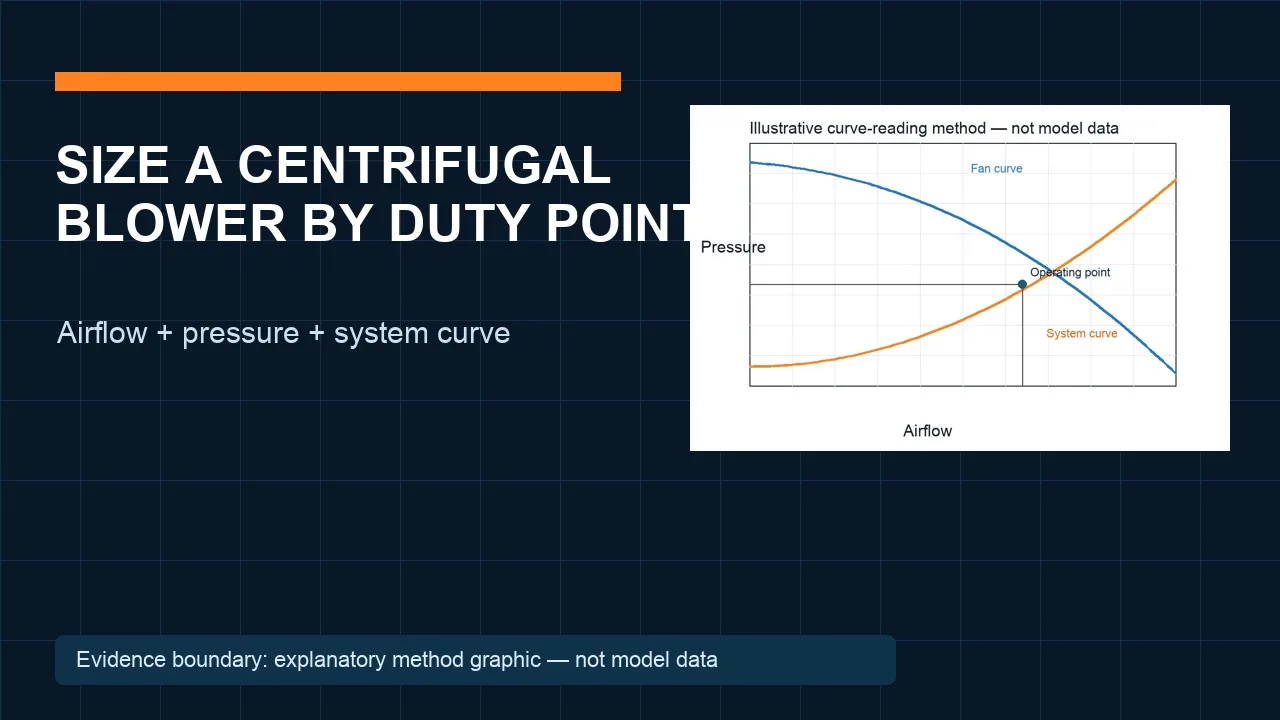
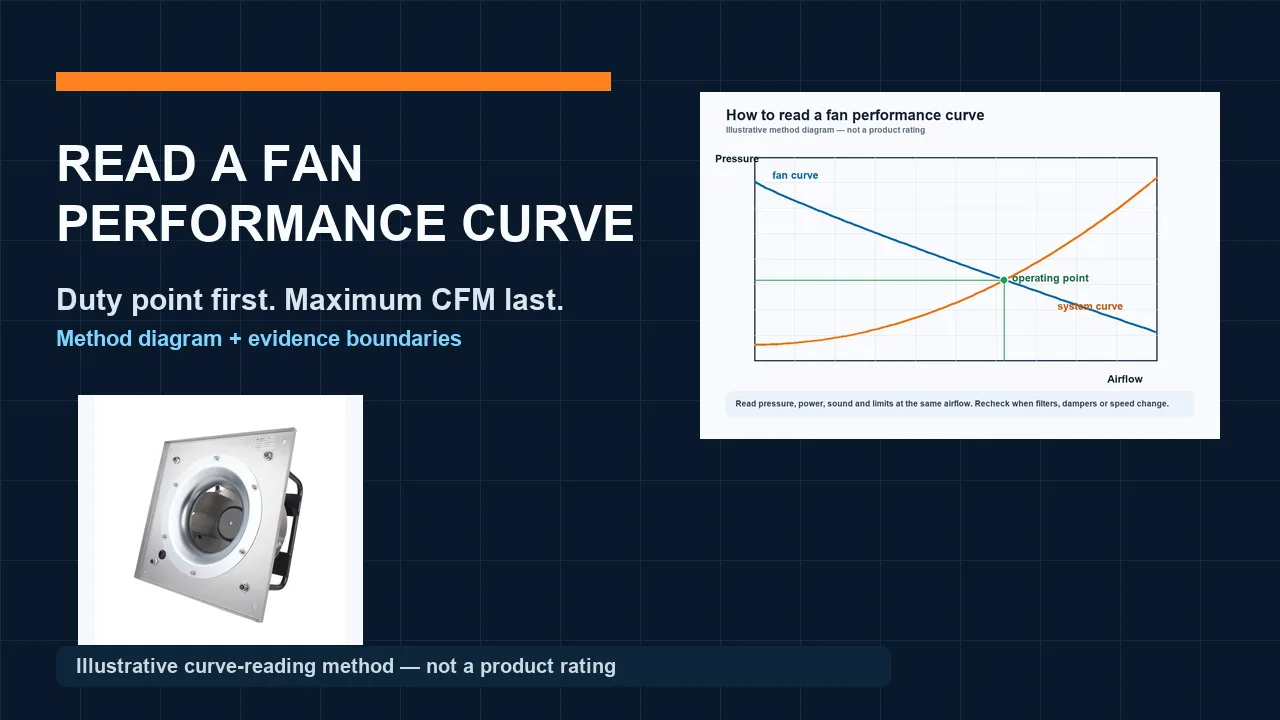
For a friction-dominated air path, pressure loss often rises roughly with the square of airflow. Plot the required point and the likely system curve. The blower operates where the fan curve and system curve intersect; it does not automatically deliver the largest airflow printed on the chart.
Use the centrifugal fan curve guide when you need a deeper explanation of the axes, curve families, and operating point. Then use the EC fan selection checklist to collect speed, voltage, control, envelope, and acceptance details before asking for a final review.
Check power, density, and operating limits together
Air power is airflow multiplied by pressure, but electrical input is higher because the fan, motor, electronics, and drive are not perfectly efficient. A maximum input rating is not the same thing as duty-point input power. Ask which power boundary the curve uses: shaft power, motor input, or complete electrical input.
Air density also matters. Temperature, altitude, humidity, and gas composition can shift pressure, power, and motor loading. If a variable-speed blower is planned, confirm command range, feedback, alarm logic, current limit, thermal limit, and stable operation across the clean and loaded resistance cases.
Keep product-family links in the right role
Product pages and category pages are useful discovery paths, but they do not replace a project-specific duty-point review. A buyer can start with the Longwell centrifugal blower fan category or the backward-curved centrifugal fan family to narrow construction type and envelope style.
Those family links should be read as identity and application routes only. They do not prove airflow, sound, efficiency, certification, stock status, compatibility, or installed performance for a specific project. Final approval needs the exact ordered variant, current curve table, drawing, electrical boundary, operating limits, and installation assumptions.
Separate method guidance from approval evidence
The safest buying process keeps every claim tied to its evidence. A curve graphic can support a curve-reading method. A drawing can support visible dimensions on that drawing. A product photograph can support visible structure. None of those assets automatically proves a certified rating, a customer result, a replacement equivalence, or a complete installed outcome.
If a model name, PDF metadata, product photo, drawing revision, or catalog family label disagrees with the visible model identity, stop and reconcile before publishing a selection. For this repaired post, the public article uses only an explanatory method graphic and avoids transferring any unresolved model, certificate, or project-result claim into buyer guidance.
Prepare an RFQ that engineers can answer
Send airflow, pressure definition, clean and loaded resistance, air condition, target voltage, control signal, speed range, mounting envelope, inlet and discharge layout, sound requirement, duty cycle, environment, and acceptance method. Add a sketch when the inlet or discharge is close to walls, bends, guards, filters, or other restrictions.
Ask the supplier to mark the operating point, power, current, sound basis, allowable speed, motor margin, and installation assumptions on the selected curve. That review is slower than buying by maximum CFM, but it is much less likely to produce a blower that misses the real system requirement.
Choose the right blower
Longwell manufactures 247 blowers in-house. Send airflow, static pressure and voltage — an engineer replies with a matching model, performance curve and price within one working day.