HVACR Vietnam runs from 4 to 6 November 2026 at SECC in Ho Chi Minh City. Buyers can use its HVAC, factory-efficiency and digital-infrastructure meetings to compare fan and motor evidence against real duty points instead of collecting unqualified display claims.
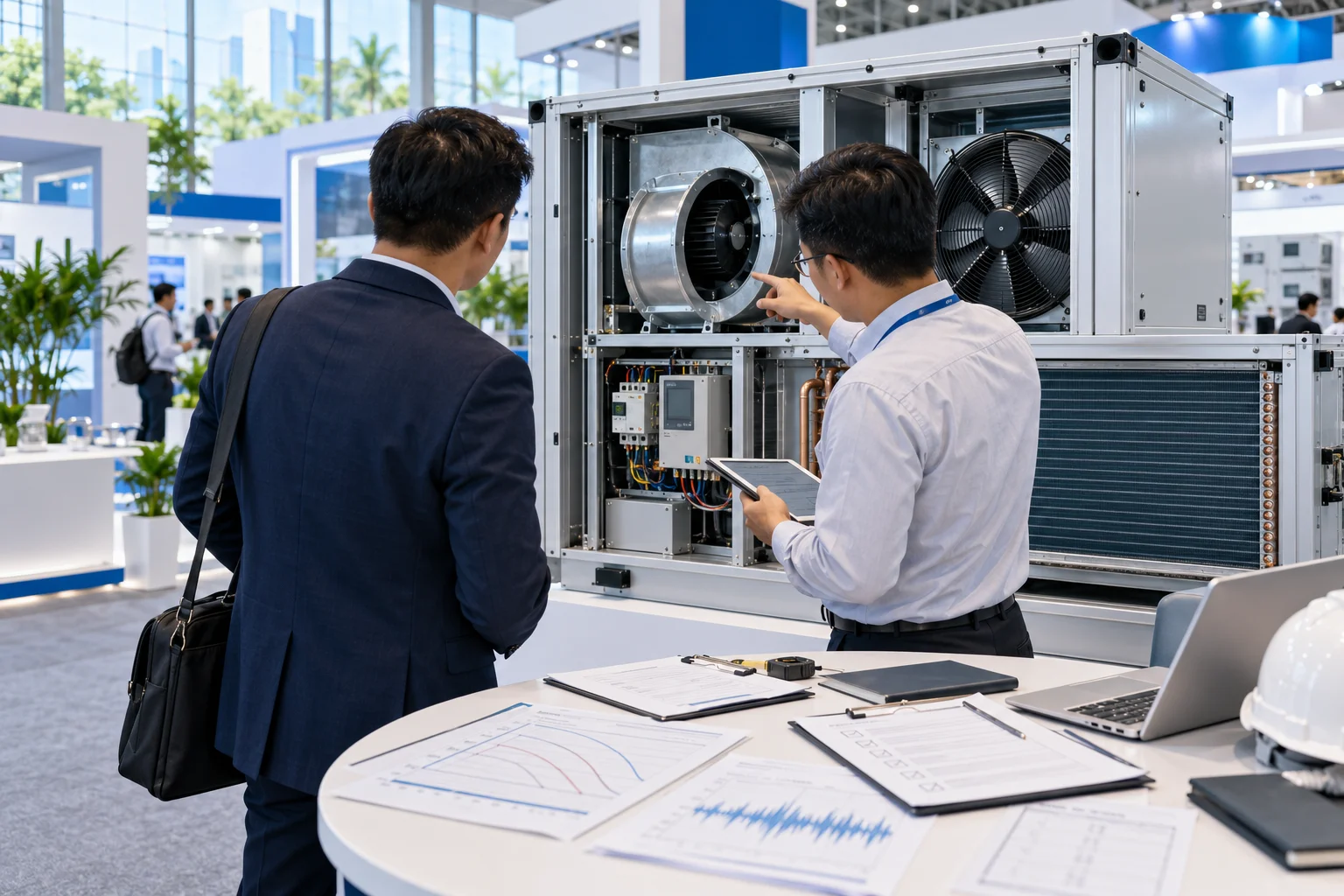
Fan and motor duty-point evidence review for HVACR Vietnam 2026 Information checked 2 November 2026
Event dates and buyer agenda
The official event page identifies HVACR Vietnam 2026 as an exhibition for HVAC, refrigeration and smart-building technologies at the Saigon Exhibition and Convention Center. The opening ceremony is scheduled for 08:30 to 11:00 on 4 November in Hall B2.
The 4 November buyer lounge lists sessions on HVAC solutions for factories and buildings at 12:00, power and cooling for digital infrastructure at 12:30 and B2B matching from 14:30. The 5 November agenda includes supplier and distributor connections, energy efficiency in production and operations, integrated factory and industrial-park solutions and additional matching sessions. The organiser notes that details may change, so confirm the current program before travel.
This guide does not state that Longwell is an exhibitor. It is a technical meeting checklist for buyers, OEMs, MEP contractors, facility teams and distributors attending the event.
Prepare one duty sheet before the exhibition
An exhibitor can answer a precise requirement much faster than a generic request for an efficient fan. Prepare one page for each application and include the following fields.
|
Field |
What to write |
Why it changes the selection |
|---|---|---|
|
Airflow and pressure |
Required airflow, static or total pressure and installed resistance |
A free-air flow number does not predict performance behind a coil, filter or duct |
|
Environment |
Inlet temperature, humidity, condensation, dust, corrosion and altitude |
Motor, electronics, bearings and coatings have application limits |
|
Power and control |
Voltage, frequency, phase, speed signal, feedback and communication |
The same impeller can use different motors and control interfaces |
|
Installation |
Available envelope, inlet and outlet clearance, mounting and service access |
Crowded installation can change airflow, sound and maintenance time |
|
Acceptance |
Required curve, sound data, protection, certification and sample test |
A quoted model is useful only when its evidence matches the project |
Five checks to perform at the booth
Confirm the exact model identity
Photograph or record the complete model number, motor, controller, firmware or parameter version, impeller, guard, housing and mounting. Ask whether the display unit is production hardware or a cutaway sample. A family brochure is not enough to approve a specific configuration.
Put the duty point on the curve
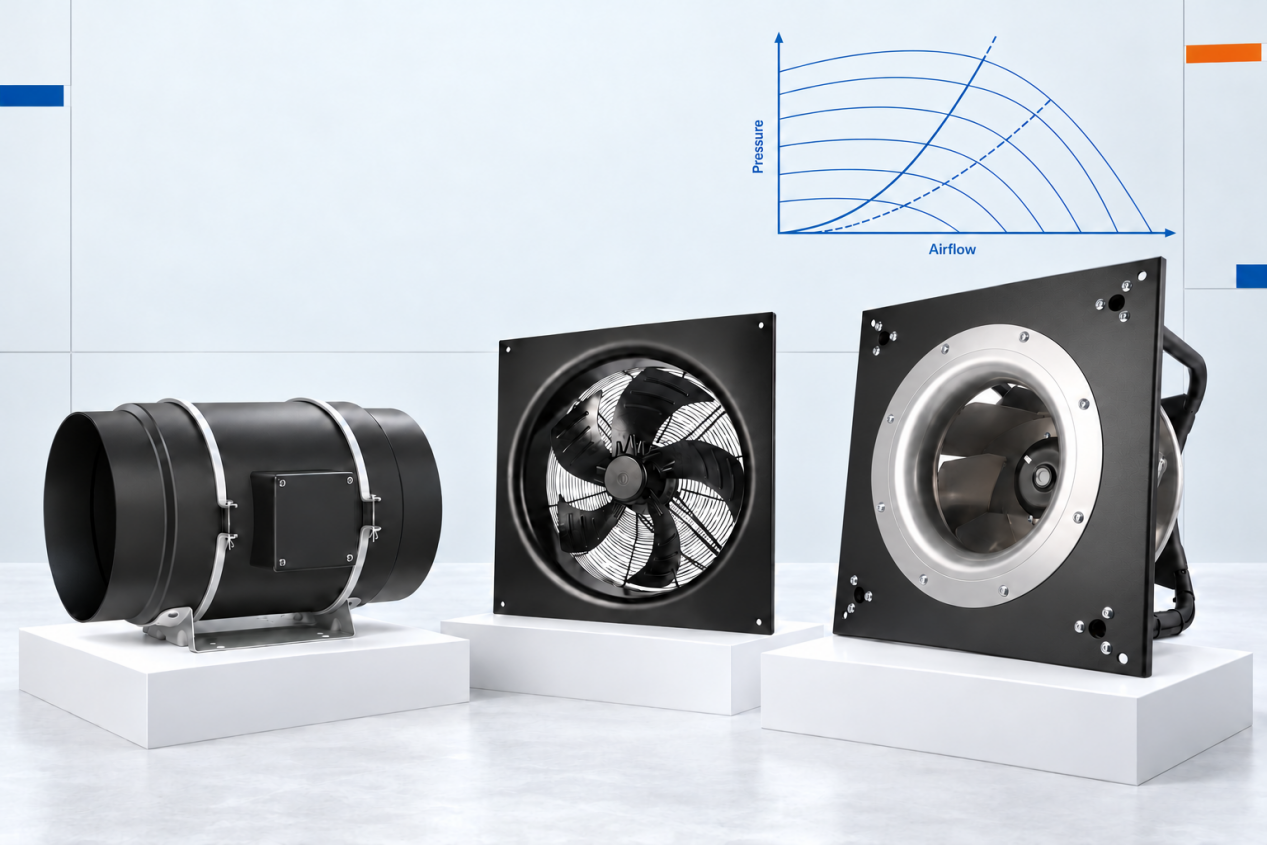
Ask the supplier to mark the required airflow and static or total pressure on the relevant curve. Confirm speed, air density, supply voltage, inlet and outlet arrangement and whether accessories are included. For a fan behind a filter or coil, use the assembled resistance rather than a free-air value.
Separate electrical input from motor labels
Request input power at the specified operating point, not only a motor nameplate rating. For EC fans, record the control signal, minimum and maximum command, feedback, alarm behavior and any communication protocol. For AC motor and variable-frequency-drive arrangements, record the motor, drive and parameter boundary used for the performance data.
Test environmental and service claims
If a supplier claims high-temperature, humid, condensing, dusty or corrosive operation, ask for the exact limit, duration, test method and model covered. Record ingress-protection and insulation claims only when the certificate or report identifies the same configuration. Ask how the fan, motor, bearings and electronics can be replaced and what evidence is available after a production change.
Define the acceptance test before requesting a sample
Write down the sample configuration and the measurements required after installation. At minimum, consider airflow, pressure, electrical input, speed, sound, control response and alarm behavior. If the sample enters an air-handling unit, condenser, evaporator or cabinet, test it with the actual system resistance and clearances.
Questions by application
|
Application |
Questions to ask |
Evidence to bring back |
|---|---|---|
|
Air-handling unit |
What is the operating point with the installed filter and coil; how is speed controlled at part load |
Fan curve, input-power points, controller map, sound data and installation drawing |
|
Condenser or heat pump |
What ambient range, recirculation margin and control behavior were used |
Temperature limit, airflow curve, motor protection, mounting and guard details |
|
Cold room evaporator |
How do low temperature, defrost moisture and fan delay affect the candidate |
Low-temperature limit, ingress evidence, materials, bearing information and restart behavior |
|
Data center or fan wall |
How is redundancy tested and how are individual modules monitored |
Duty per module, failure response, communication map, power and sound evidence |
|
Factory ventilation |
What dust, corrosion, continuous-duty and service conditions apply |
Materials, environmental rating, maintenance access and exact motor configuration |
Compare efficiency without losing the system boundary
An efficient motor does not guarantee an efficient installed fan system. Compare candidates at the same airflow, pressure, air density and accessories. Record electrical input for the complete candidate boundary and check whether a controller, variable-frequency drive, guard, filter or heat exchanger is included.
For variable-flow applications, request several operating points. A single peak efficiency value can hide poor part-load control or an oversized fan. For retrofit projects, keep the existing airflow, pressure, input power and sound baseline so the replacement can be commissioned against the same measurements.
Follow up within two working days
After each meeting, save the contact, model identity, promised documents and open questions in one record. Request electronic curves and reports, not photographs of booth boards. Mark every claim as received, pending or not available. Do not approve a model until the evidence, drawing and commercial quotation refer to the same configuration.
If a supplier proposes an alternative after the show, repeat the identity and duty-point review. A lower price or faster lead time does not preserve the original evidence automatically.
Common buyer questions
Which sessions are most relevant to fan and motor buyers
The official 4 November agenda includes HVAC solutions for factories and buildings and power and cooling for digital infrastructure. The 5 November agenda includes supplier and distributor connections, production energy efficiency and integrated factory solutions. Confirm live times with the organiser.
Is a fan curve enough for approval
No. The curve must identify the model, speed, air density, pressure definition, supply and test arrangement. The buyer also needs electrical, control, environmental, sound and installation evidence relevant to the project.
How should two EC fans be compared
Place both candidates at the same airflow and pressure, then compare complete electrical input, sound, control range, alarm and communication behavior, environmental limits and service access. Do not compare catalog maximums from different conditions.
What should be recorded when the display unit is a cutaway
Record which parts match production, the complete production model number and where the supporting curve, drawing and test report can be obtained. Treat the cutaway as an explanation tool, not as production evidence.
What information should be sent before requesting a quotation
Send airflow, static or total pressure, installed resistance, air temperature, humidity or contamination, voltage, frequency, control signal, mounting envelope, sound limit, certification target and expected annual quantity.
Send the duty sheet for a model review
Send the application, airflow, static or total pressure, temperature, humidity, voltage, frequency, control interface, installation drawing, sound target, certification target and required evidence to sales@longwellfans.com. Longwell will confirm which fan or motor families can be evaluated and which model-bound curves, drawings and reports are available. Final selection depends on the complete equipment and verified operating condition.
Official sources
- Source 1 HVACR Vietnam 2026 official event page
- Source 2 HVACR Vietnam 4 November B2B agenda
- Source 3 HVACR Vietnam 5 November B2B agenda
- Source 4 HVACR Vietnam opening ceremony — Information checked 2 November 2026