Key Takeaways
- ATEX certification is a legal requirement for axial fans installed in EU hazardous areas.
- The zone classification of the installation: gas Zones 0, 1, and 2 and dust Zones 20, 21, and 22.
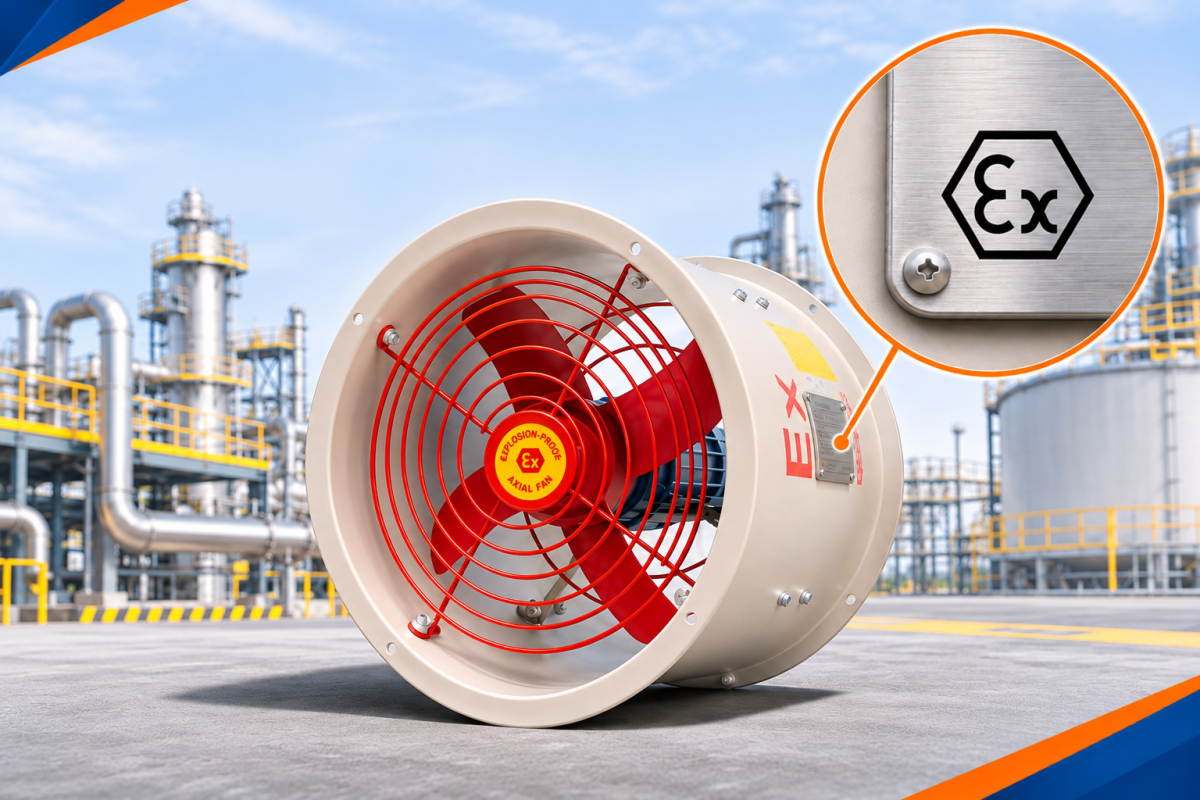
- The Ex marking on the nameplate encodes zone suitability, gas group, and temperature class; buyers should verify every field against the site classification before purchase.
- ATEX applies in the EU while IECEx is the international equivalent.
- Selecting the right fan follows five steps: confirm the ATEX zone, define airflow and system pressure, set the temperature limits and substance group, review materials, confirm motor options and installation method, and verify documentation.
In a chemical plant, a paint workshop, or a grain handling facility, invisible flammable gases, solvent vapour, and combustible dusts are present. A conventional axial fan can generate exactly the spark or surface temperature that triggers an explosion. For both workplace and worker safety, axial fans intended for use in EU hazardous areas—gas Zones 0, 1, or 2 and dust Zones 20, 21, or 22—must meet the applicable ATEX requirements for their classification. This guide sets out the zones, nameplate markings, and selection steps that buyers need in order to specify the right fan.
What is an ATEX Axial Fan?
ATEX certified stands for Atmosphere Explosibles, is a European Union directive that specified the minimum safety requirements for equipment used in explosive atmospheres. An ATEX axial fan is an axial fan with ATEX certified for installation in potentially explosive atmosphere.
Under Directive 2014/34/EU, any fan placed in an area where flammable substances may be present in the air must be proven incapable of becoming an ignition source under its declared operating conditions. In an axial fan this covers the motor, impeller, casing, fasteners, earthing path, and even the running clearances between rotating and stationary parts are all assessed.
Key Features of ATEX Axial Fans
- Limited surface temperature: ATEX fans are designed to run at lower surface temperatures, which reduces the risk of ignition from hot surfaces. Thermal protection is built in as well. If winding temperature or airflow conditions exceed the design limit, the protection trips and shuts the fan down.
- Durable Structure: Impeller and casing materials are chosen to take knocks and abrasive dust without sparking or holding a static charge.
- Sealed Housing: The motor sits fully enclosed, so any spark or hot spot stays inside the housing and never reaches the surrounding gas or dust. The seal also keeps moisture and process dirt off the winding.
- Corrosion Resistance: Fan components are specified in corrosion-resistant materials and coatings, where corrosive chemicals are present.
ATEX vs. IECEx: What’s the Difference?
ATEX is a European directive. It is mandatory for any fan sold into the EU, an sets the design and certification requirements for equipment. IECEx is an international certification system built on IEC standards. It is more like an international assessment but not a law. Many countries recognize IECEx marking. Both systems use the same Ex coding.
In practice, an ATEX-certified fan is required for installations inside the EU, while IECEx is the usual route for Australia, the Middle East, and other export markets. Some projects specify both.
Hazardous Area: ATEX Zones Classification
ATEX zoning divides a workplace into areas according to how often and how long an explosive atmosphere may be present. It is the starting point for every equipment decision, because the zone number fixes the minimum protection level of any fan installed in that area. The lower the number, the more frequently the explosive atmosphere occurs and the stricter the requirements placed on the equipment.
Gas Zones: 0, 1, and 2
For gases and vapour, the zone reflects the probability that an explosive gas atmosphere is present:
- Zone 0: an explosive atmosphere is present continuously, generally more than 1000 hours per year or more than 10% of operating time. Zone 0 represents the highest level of explosion risk in gas or vapor environments. It exists almost exclusively inside equipment, such as reaction vessels, evaporators, storage tanks, and in the vicinity of ventilation holes and other openings.
- Zone 1: Zone 1 represents a significant but intermittent explosion risk. An explosive atmosphere is likely to occur occasionally during normal operation, typically between 10 and 1000 hours per year. Typical locations are around filling openings, seals, glands, and flanged connections from which vapour can escape.
- Zone 2: an explosive atmosphere is not expected during normal operation and, if it does occur, persists only briefly, generally less than 10 hours per year. Zone 2 normally surrounds Zone 0 and Zone 1 areas.
Dust Zones: 20, 21, and 22
For combustible dusts, including flour, sugar, grain, wood dust, and metal powders, that may become suspended in air and form explosive dust clouds. The similar logic of gas zones applies to dust zones:
- Zone 20: an explosive dust cloud is present continuously or for long periods. It represents the highest level of explosion risk associated with combustible dusts.
- Zone 21: an explosive dust cloud is likely to occur occasionally during normal operation. For example at filling and discharge points, dust collection stations, and wherever process dust can escape and settle.
- Zone 22: represents a lower probability of dust explosion risk compared to Zones 20 and 21. Even if there is an explosion, it will only last for a very short period of time. Zone 22 typically covers the areas adjacent to dust-handling equipment where dust may leak out, accumulate, and occasionally be whirled up.
Ex Marking Examples Explained
|
Component |
Ex Marking Code |
Meaning |
|---|---|---|
|
Equipment category |
1 |
ATEX Category 1: very high protection (Zone 0/20) |
|
2 |
ATEX Category 2: high protection (Zone 1/21) |
|
|
3 |
ATEX Category 3: normal protection (Zone 2/22) |
|
|
Protection type |
Ex h |
Non-electrical explosion protection for the fan’s mechanical assembly. |
|
Ex db |
Electrical protection by flameproof enclosure, commonly used for motors. |
|
|
Ex eb |
Electrical protection by increased safety. |
|
|
Ex tb |
Electrical protection against dust ignition by enclosure. |
|
|
Gas group |
IIA |
propane as a representative gas |
|
IIB |
ethylene as a representative gas |
|
|
IIC |
including hydrogen and acetylene (most hazardous) |
|
|
Dust group |
IIIA |
Combustible flyings |
|
IIIB |
Non-conductive dust |
|
|
IIIC |
Conductive dust (most hazardous) |
|
|
Equipment Protection Level For Gas Atmosphere |
Ga |
Very high protection, for continuous / long periods (>1000 hrs/yr) |
|
Gb |
High protection for likely in normal operation (10-1000 hrs/yr) |
|
|
Gc |
Enhanced protection for unlikely / short duration (<10 hrs/yr) |
|
|
Equipment Protection Level For Dust Atmosphere |
Da |
Very high protection |
|
Db |
High protection |
|
|
Dc |
Normally not present, short duration |
Selecting an ATEX Axial Fan: Step-by-step Guide
Step 1: Confirm the ATEX Zone
Selection cannot start until the ATEX zone classification is known. Obtain the zone drawing or the explosion protection document and confirm the zone at the actual installation point. Record the atmosphere type, gas or dust, and the equipment category and EPL required. If no zone has been formally established, the engineer has to complete the classification first, or turn to an expert for definite classification.
Step 2: Define Airflow and System Pressure
Explosion-protected fans often run at lower impeller speeds and carry more restrictive casings. Allow a margin for filter loading, and confirm the selected model reaches the duty point inside its certified range. Size the fan on the duty point, but not on the catalogue maximum. Calculate the required airflow from the air change rate or the extraction demand of the process, then add the pressure losses of ductwork, filters, louvres, and weather protection.
Step 3: Set the Temperature Limits and Substance Group
Two temperatures decide the marking. The temperature class must keep the maximum surface temperature of the fan below the defined T-class. The gas group follows the substance, IIA for propane, IIB for ethylene, IIC for hydrogen. For dust, specify the dust group and the minimum ignition temperature of the layer.
Step 4: Review Fan Materials
Material selection carries the explosion protection in an axial fan. Impeller and casing materials must form a pair that cannot produce sparks on contact, typically aluminium running against brass or bronze, or antistatic polymers. Surface coatings must be conductive and thin enough to prevent charge build-up. In corrosive or wet atmospheres, stainless steel or epoxy protection keeps the running clearances that the certificate relies on.
Step 5: Confirm Motor Options and Installation Method
The motor must match the zone as closely as the fan itself. Choose the protection concept the site permits: Ex ec increased safety for Zone 2, Ex db flameproof or Ex eb for Zone 1. Confirm voltage, frequency, phase, and whether a variable speed drive is allowed. An external VSD need its own certification and thermal assessment. Then fix the installation method, whether wall ring, duct mounted, or roof unit, together with inlet and outlet guards and the access space needed for inspection.
Step 6: Verify the ATEX Axial Fan’s Documentation
Before the order is released, collect the documents that prove the marking: the EU Declaration of Conformity, the ATEX certificate with its schedule of limitations, the nameplate drawing, and the installation and maintenance instructions. Check that the certificate number on the plate matches the certificate supplied, that the ambient range and temperature class cover the site. An axial fan without these documents cannot be accepted into a hazardous area.
Specify the ATEX Axial Fan with LONGWELL
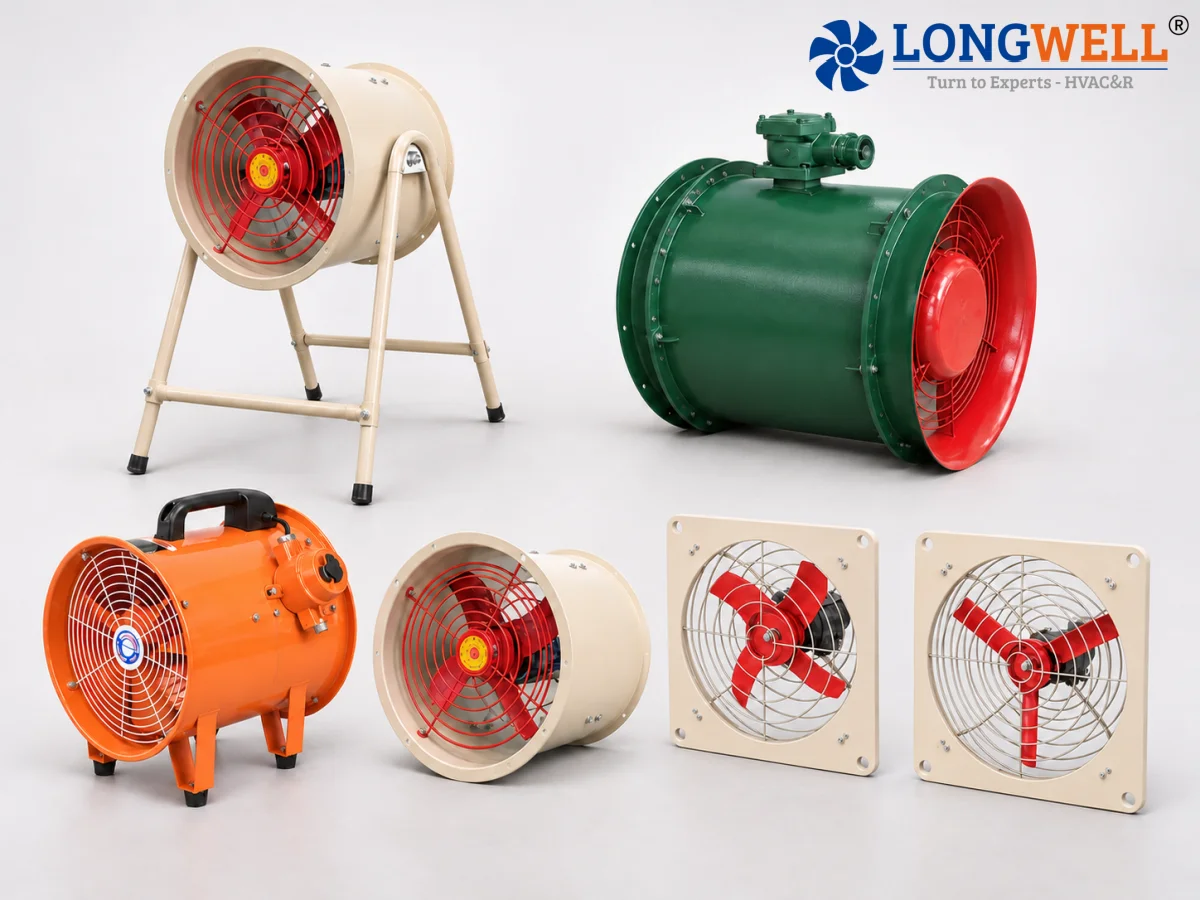
LONGWELL builds ATEX compliance into the fan itself: anti-static impellers, spark-free components, certified motors, and earthing. It is not only a label applied to a standard product.
A North American battery energy storage manufacturer needed emergency exhaust for workshops where flammable solvent vapour can be released. LONGWELL supplied the complete retrofit with the required ATEX certification.
Every ATEX unit from LONGWELLK ships with its ATEX certificate, test reports, and earthing continuity records. The ATEX zone classification map and maintenance schedules are available to provide. For applications a standard fan cannot match, a structured 90-day NPI cycle includes specification lock, design, prototype, and releases within 90 days, and delivers a certified custom solution.
FAQ
Is ATEX accepted in the USA?
No. ATEX is EU law, and the USA has no ATEX regulator. US installations typically use UL/CSA-listed equipment or IECEx-certified fans where accepted.
What is the ATEX standard for hazardous area classification?
Workplace classification falls under Directive 1999/92/EC, applied through EN 60079-10-1 for gases and EN 60079-10-2 for dusts. Areas are graded Zone 0/1/2 (gas) or 20/21/22 (dust) by how often and how long an explosive atmosphere is present.
Is ATEX the same as explosion proof?
Not exactly. Explosion proof is a North American UL/NEC concept. An explosion-proof fan uses flame-arresting enclosures. ATEX is the EU framework covering many protection types. ATEX compliance does not automatically mean UL explosion proof.
Is ATEX certification mandatory?
Yes, for equipment placed on the EU market for use in explosive atmospheres — it is a legal requirement under Directive 2014/34/EU, not voluntary. Outside the EU it is not legally binding, but many international projects specify ATEX or IECEx as a contractual requirement.
Choose the right axial fan
Longwell manufactures 1,048 axial fans in-house. Send airflow, static pressure and voltage — an engineer replies with a matching model, performance curve and price within one working day.