A fan that will not start may have a capacitor fault, but a multimeter reading is only one part of the diagnosis. The first decision is whether the equipment uses a serviceable motor run capacitor at all. The second is whether a qualified person can make the equipment safe under its own service procedure. This guide explains what a capacitance result can and cannot tell you; it is not a substitute for electrical training or the equipment manual.
First identify the motor and its capacitor
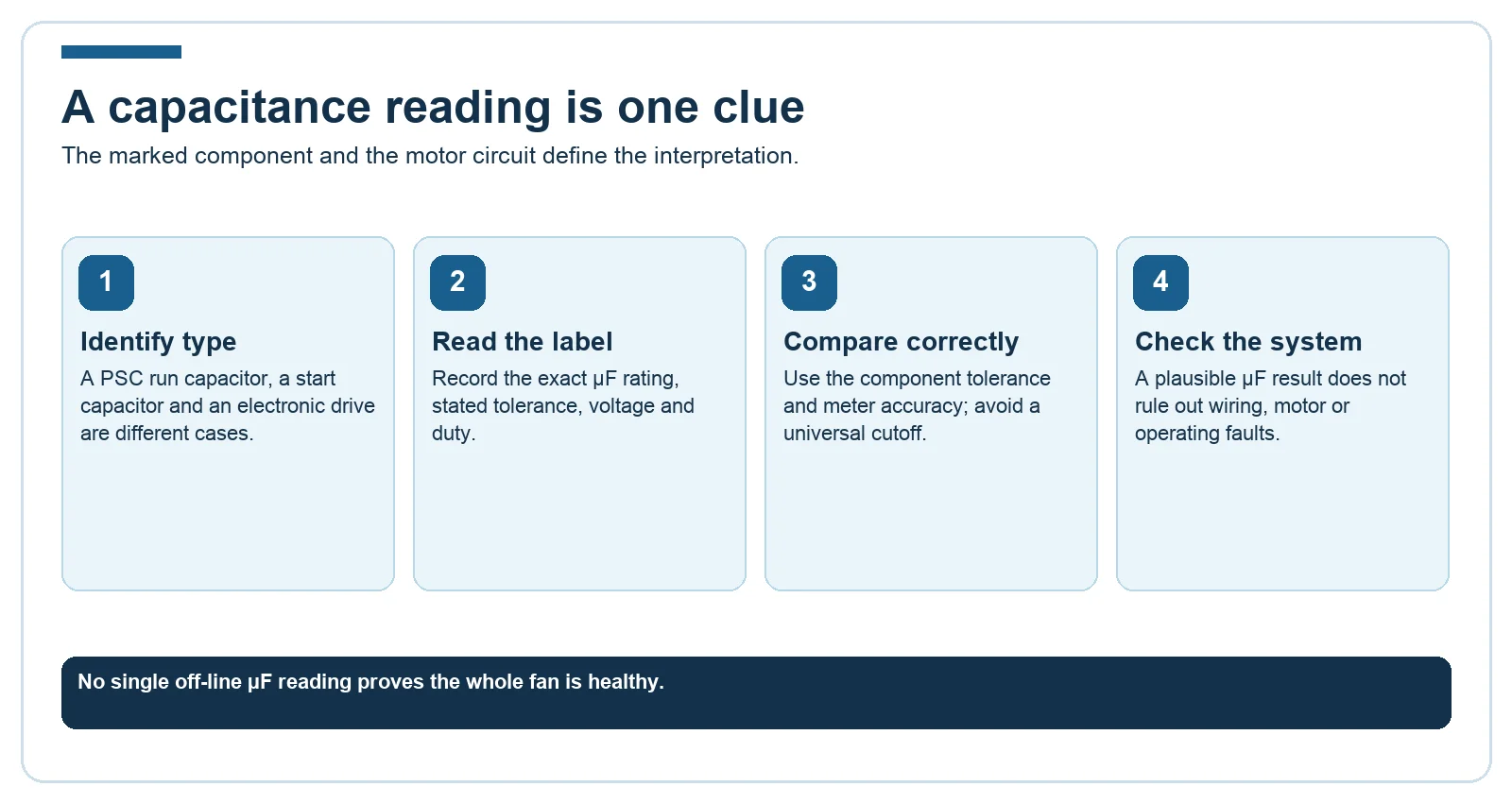
A permanent-split-capacitor (PSC) motor has a run capacitor in its operating circuit. A start capacitor has a different duty, and an EC or brushless DC fan uses electronic commutation rather than a field-replaceable PSC run capacitor. Do not assume that a cylindrical component beside a fan has the same function in every machine. The wiring diagram, motor marking and capacitor label settle the identity.
LONGWELL lists AC capacitor motors as a product family and single-phase motor families. Those pages show available motor categories; they do not establish the capacitor specification of an installed fan. An OEM should request the current drawing and bill of materials for the exact motor and revision before authorizing a replacement part.
Make the test a controlled service task
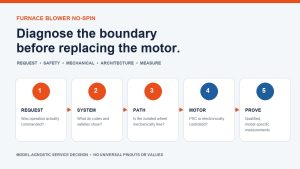
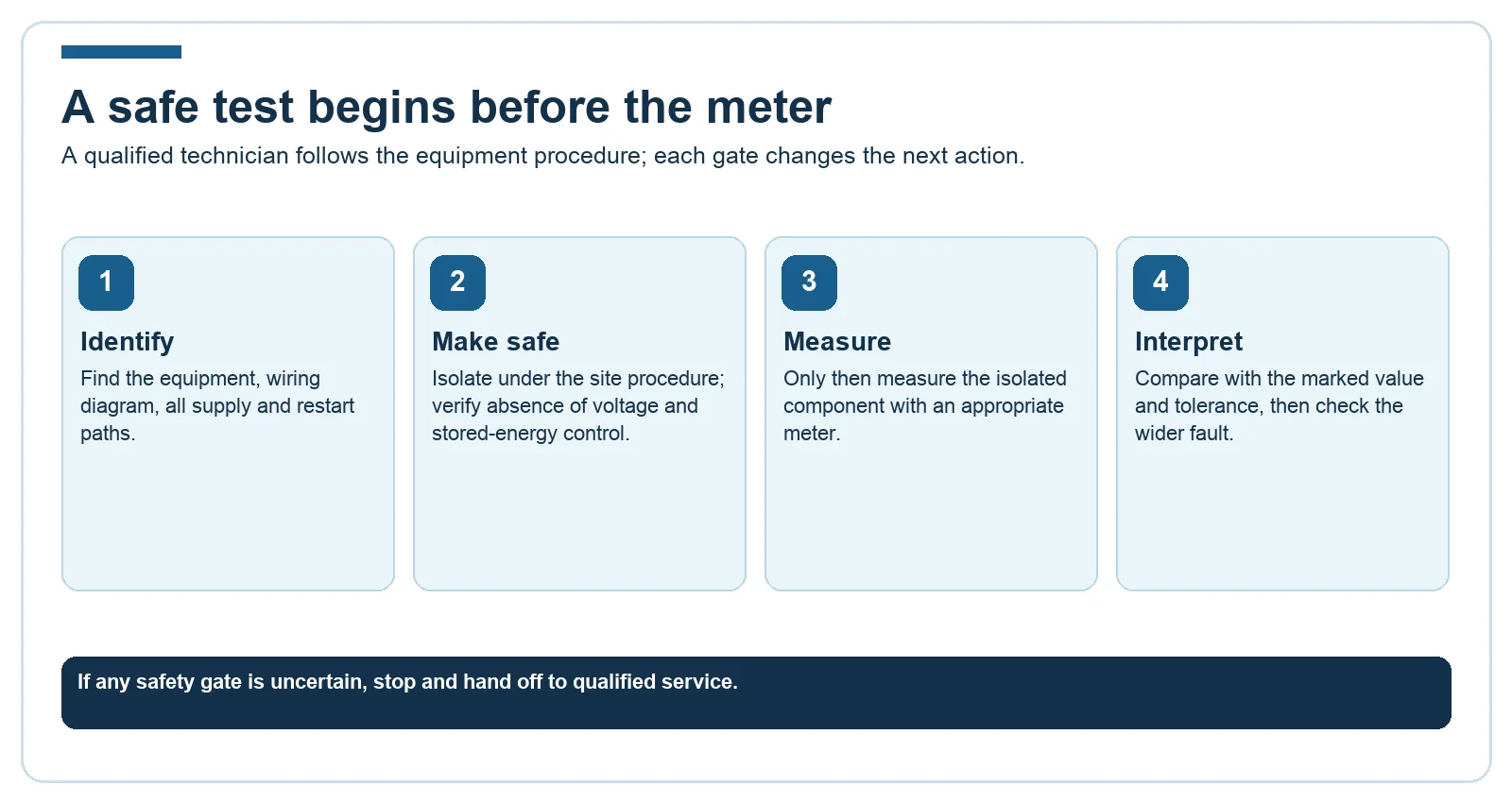
Line-voltage fan equipment can remain hazardous after a switch is opened. A qualified technician identifies every supply and automatic restart path, isolates and locks out as the site procedure requires, verifies absence of voltage with suitable test equipment, and controls stored energy before exposing the capacitor. The OSHA electrical work-practice rule describes these energy-control principles for covered US workplaces. The applicable local rules and equipment instructions still govern the job.
A meter indication of zero is not enough if the instrument or test setup is wrong. Fluke’s absence-of-voltage guidance explains checking the tester on a known source before and after the test. Follow the approved capacitor discharge method for that equipment and confirm its result with a voltage measurement. Do not short terminals with a screwdriver or use a generic resistor value as a universal instruction.
What the meter actually measures
After the safe-work gates, the technician isolates the component according to the service manual and uses the meter’s capacitance function within its rated range. An in-circuit reading may include parallel paths, so the meter and equipment instructions determine the required disconnection. Record the marked capacitance in microfarads, the stated tolerance, the meter reading, the meter’s accuracy and the ambient condition. For a dual capacitor, identify each marked section and its correct terminals from the device labeling and diagram.
The result is an off-line capacitance measurement. It does not by itself establish dielectric integrity, leakage under rated voltage, internal heating or performance under operating load. A value that appears plausible can coexist with another motor, control or wiring fault. Conversely, a single low reading should be checked against the component’s actual printed tolerance and the instrument’s uncertainty before declaring a part failed. Avoid a blanket “5%” or “6%” replacement rule: the component and equipment documentation define the acceptance decision.
Use symptoms to choose the next check, not to guess the part
Humming, failure to start, repeated protection trips or a damaged capacitor case warrant a safe shutdown and investigation. They do not uniquely diagnose a capacitor. A jammed impeller, bearing problem, incorrect supply, loose connection, control fault or damaged winding can produce overlapping symptoms. Never try to start a fan by manually spinning the wheel. A technician can compare the observed behaviour with the wiring diagram, motor nameplate and approved troubleshooting sequence once the equipment has been made safe.
Visible swelling, leakage, heat damage or corrosion strengthens the case for replacing a component and inspecting nearby wiring. Normal appearance proves little. The useful service record includes the exact equipment and motor identification, marked capacitor data, observed condition, isolation verification, measured value and uncertainty, and the reason for the final decision.
Specify a replacement from the exact design
Do not substitute a start capacitor for a run capacitor merely because the terminals fit. The technician should match the capacitor’s function, marked capacitance, permissible tolerance, AC voltage rating, temperature and duty requirements, physical mounting, terminals and any equipment-specific approvals to the motor manufacturer’s current instructions. A higher voltage rating may be acceptable only if the equipment maker and physical design permit it; it does not excuse an incorrect capacitance or duty class.
For an OEM fan program, retain the motor model, suffix and revision with the capacitor specification. The family-level LONGWELL catalog establishes that capacitor-run motor options exist, but it does not prove a particular service replacement. Ask for the exact assembly drawing and approved component list instead of converting a generic website description into a parts decision.
Decision to take away
Use the multimeter to answer a narrow question: what capacitance does this isolated component show under the meter’s conditions? Compare that value with the capacitor’s own marking and equipment documentation. If the safety procedure, identity or specification cannot be verified, stop and refer the machine to qualified service. If the reading is within the stated tolerance but the fan still misbehaves, continue the wider fault diagnosis rather than treating one number as a pass certificate.
For a new OEM fan or motor project, send the exact motor identification, operating voltage, application and current drawing to sales@longwellfans.com for an engineering review.
Choose the right ac motor
Longwell manufactures 22 ac motors in-house. Send airflow, static pressure and voltage — an engineer replies with a matching model, performance curve and price within one working day.