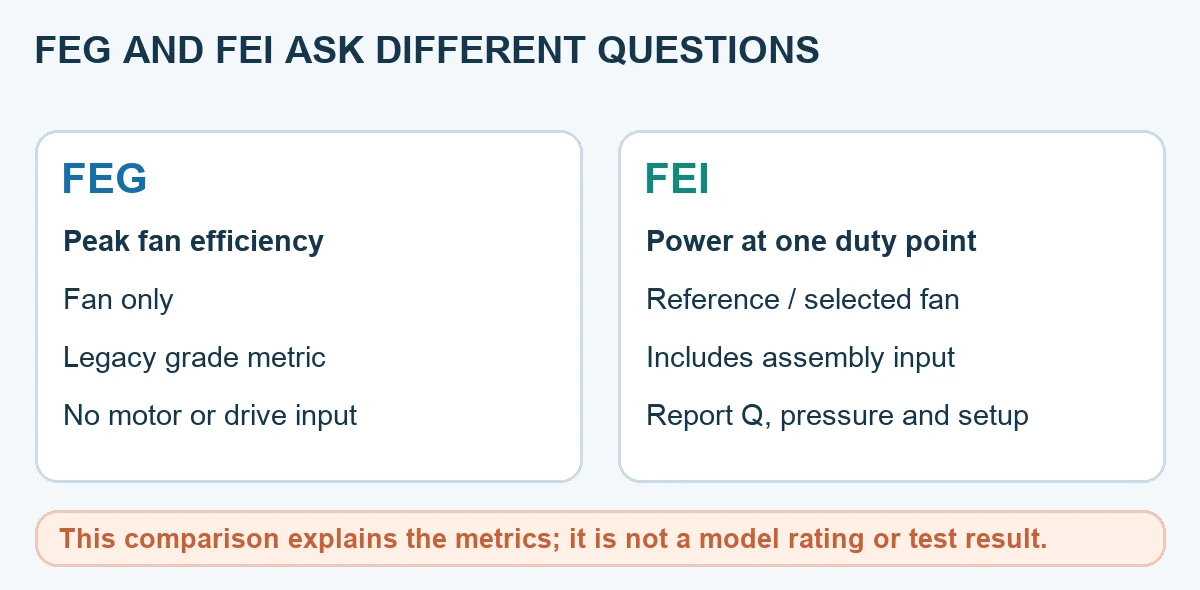
Fan Efficiency Grade (FEG) and Fan Energy Index (FEI) describe different parts of a fan selection. FEG is a legacy grade based on a fan’s peak efficiency. FEI compares electrical input with a defined reference fan at a stated airflow and pressure. The second number belongs to a particular operating point and assembly, so it cannot be read from a photograph or a generic product-family page.
For an OEM or building-system buyer, the useful question is: which exact fan, motor and control combination can meet the required duty with documented input power? Lock the airflow, pressure basis and installation conditions before comparing ratings. Then check the applicable code edition for the project location and equipment scope.
What FEG grades, and what it leaves out
FEG describes the fan’s peak total efficiency within the grading method of ANSI/AMCA Standard 205. It was used in earlier energy-code provisions. A peak figure helps characterize the fan design, but it does not show electrical input at the buyer’s operating point. Motor, transmission and drive losses are outside that bare-fan grade. Older specifications can still cite FEG; a newer model code does not automatically replace the edition adopted by every jurisdiction.
Some FEG-based provisions also constrained how far the selected point could sit from the peak. That condition matters when reviewing an older submittal. Ask for the actual selection point and the code language instead of relying on an FEG number alone. The reference to a grade is not a claim that a particular LONGWELL model holds that grade.
How FEI is calculated at a duty point
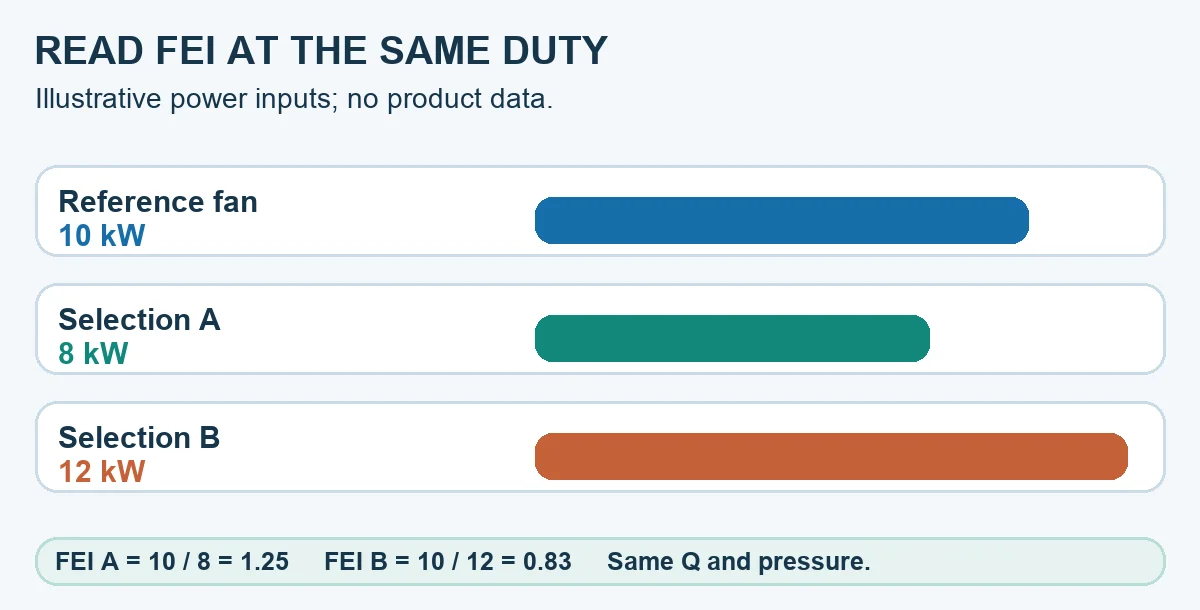
Under ANSI/AMCA Standard 208, FEI is reference-fan electrical input power divided by the evaluated fan’s electrical input power at the same airflow and pressure duty. The reference is defined by the method; it is not an arbitrary competing product. Actual fan electrical power includes the relevant fan assembly, motor and drive calculation boundary. An FEI above 1 means the selection requires less electrical input than that reference at the declared point. FEI is a ratio, not a percentage efficiency and not an annual energy-saving estimate.
For a purely illustrative comparison, suppose the reference requires 10 kW at one fixed airflow and pressure. A selection requiring 8 kW has FEI 1.25; another requiring 12 kW has FEI about 0.83. The first uses 20% less power than the 10 kW reference at that point. These are arithmetic examples, not tests, quotations or ratings of a LONGWELL fan. Real FEI values need the defined reference calculation and controlled data for the exact fan configuration.
Why one fan can show different FEI values
A fan’s operating point changes when airflow demand, system resistance, speed or control setting changes. Consequently, the electrical input and the reference power used in the FEI calculation can change. Report FEI with the airflow, static or total pressure basis, air condition, speed or control command, and assembly configuration. A single best-looking value without these inputs is not enough to compare two offers.
Oversizing can move a selection away from an efficient operating region, but it does not prove a particular FEI penalty without the corresponding curve and electrical-power data. Likewise, reducing duct resistance may reduce power demand, yet it also changes the duty; recalculate and verify rather than assuming that every pascal removed raises FEI by a predictable amount. Our fan-curve reading guide explains how to compare the actual operating point with a model’s published curve.
What the metric says about motor and fan choices
FEI accounts for the electrical path relevant to the rated assembly, which is why the motor and drive combination must be identified. An EC motor, a backward-curved wheel or variable-speed control can be useful design choices in suitable applications. None automatically guarantees a higher FEI or code compliance. Compare complete selections at the same duty and calculation boundary.
LONGWELL’s EC backward-curved centrifugal fan family is one route to inspect when the pressure, geometry and controls suit that architecture. The family page establishes available product types, not an FEI rating for an unnamed model. Request the exact model suffix, revision, air-performance curve, electrical input and motor/control configuration before making a project claim. For the distinction between fan efficiency and the index, see our FEI explanation.
Check the applicable rule before declaring compliance
FEI appears in newer U.S. model-code editions, while some adopted codes and older specifications still use FEG. Coverage, exemptions, test basis and minimum FEI can depend on the jurisdiction, code edition, fan type and application. Do not apply one generic threshold to a small embedded fan, a standalone ventilation fan and a variable-air-volume system alike. Confirm the current project requirement with the authority or design professional responsible for it.
AMCA’s FEI overview explains the metric and its use in model codes; its code-adoption review documents why both metrics may still appear in practice. A product-family page, marketing description or unlabeled curve cannot substitute for a current certified rating or a project-specific submittal.
Send a useful supplier inquiry
State the required airflow and whether pressure is static or total, plus air density or temperature, installation geometry, inlet and outlet effects, supply voltage, control strategy and operating schedule. Include the code edition and required metric if compliance is part of the purchase. Ask the supplier for the exact fan and motor/drive configuration, the test or calculation method, electrical input and FEI at each relevant duty point. For variable operation, request the points that represent the real operating range, rather than only one favorable point.
That package lets an engineer compare actual alternatives and identify missing evidence before a model is approved. It also separates a point-specific FEI comparison from annual energy use, which needs operating hours and the load profile. If an exact curve, rating or revision is unavailable, keep the selection provisional and define the verification required.
Review the fan duty with LONGWELL. Send the airflow, pressure and installation details to sales@longwellfans.com.