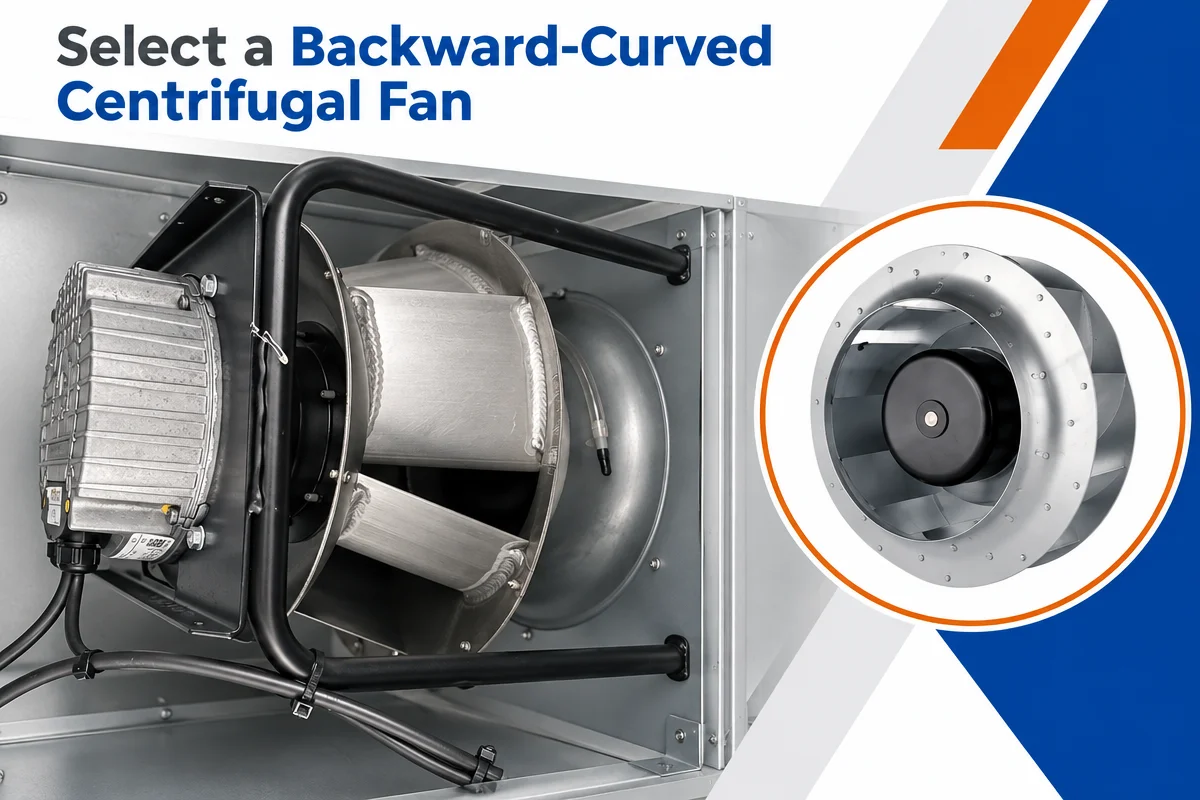
Fan efficiency and Fan Energy Index (FEI) are not two names for the same number. Fan efficiency is a percentage: useful air power divided by a clearly stated input power. FEI is a comparison: the electrical input of a defined reference fan divided by the electrical input of the fan being evaluated, both at the same airflow and pressure duty point.
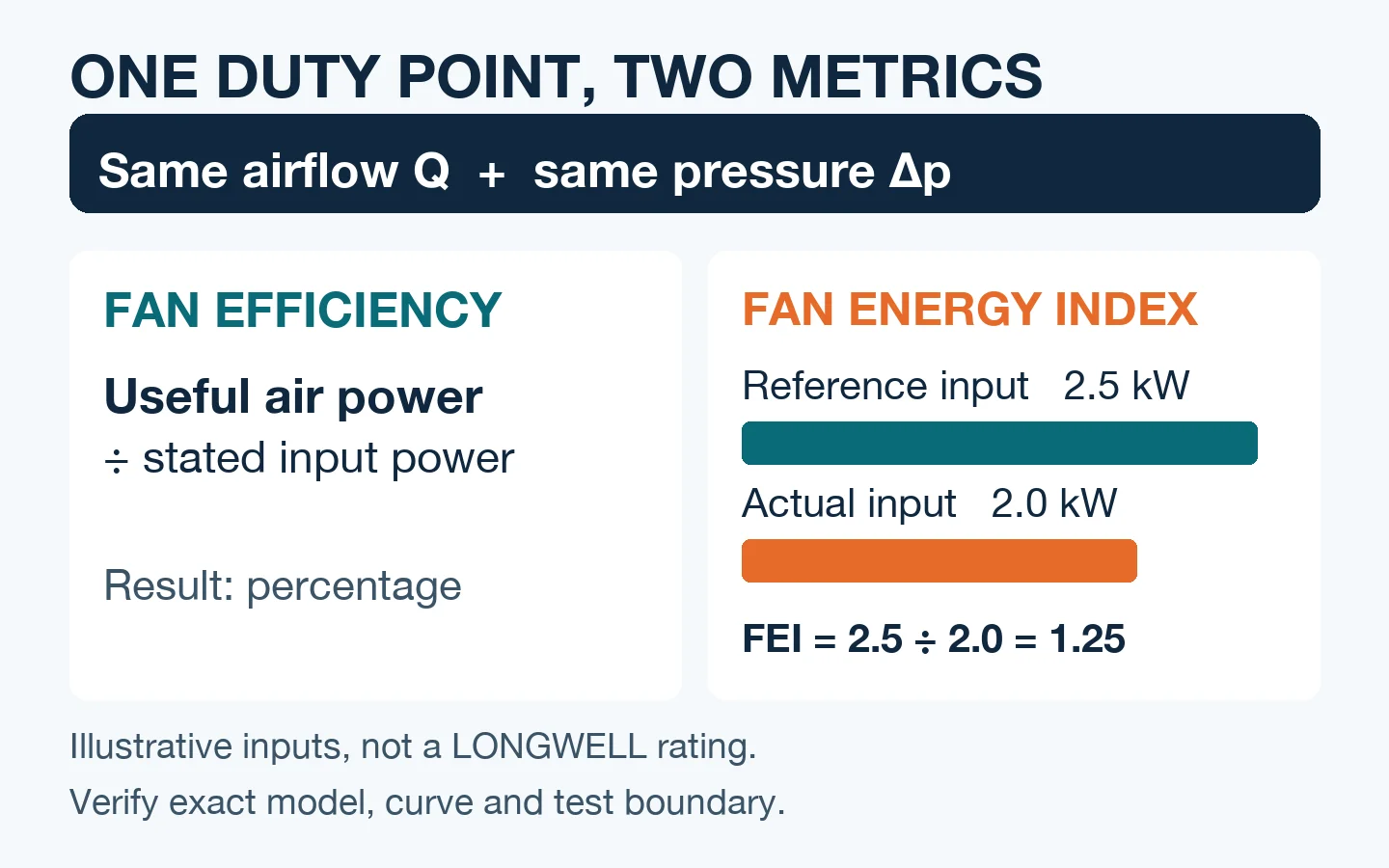
That distinction prevents the most common reading error. An FEI of 1.25 does not mean 125% efficiency. It says that, at the declared duty point and calculation boundary, the evaluated fan uses less electrical input than the reference. The percentage efficiency must still be calculated separately.
Start with one declared duty point
No fan energy comparison is complete without airflow and pressure together. Record the airflow, whether pressure is static or total, the air density or test air condition, rotational speed or control command, and the physical configuration. If one quotation uses static pressure and another uses total pressure, their values are not ready to compare.
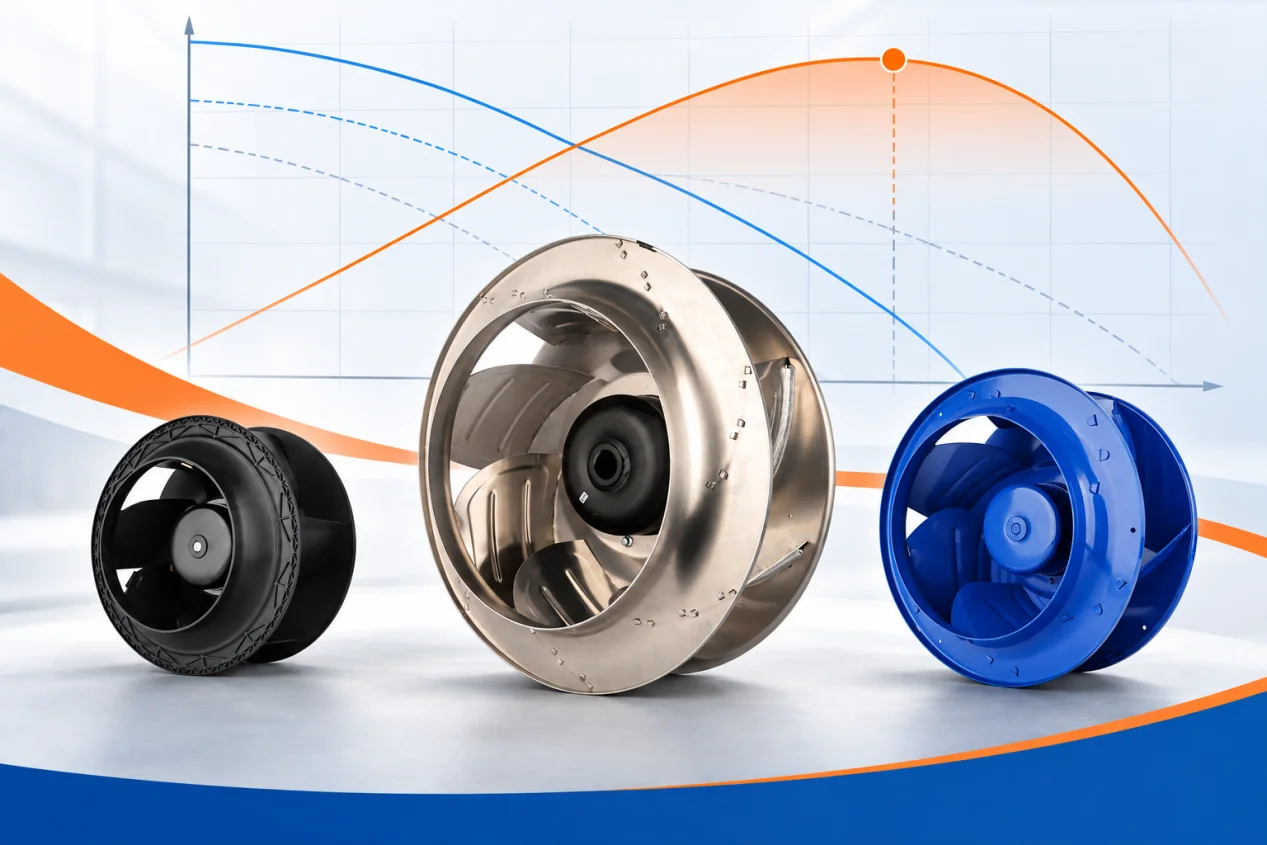
The operating point also needs to sit on a curve, not at a convenient catalogue maximum. A free-air airflow value, a shutoff pressure and a motor nameplate input come from different conditions. Our guide to reading centrifugal fan curves explains how the fan curve and system curve establish the point that matters.
What the efficiency percentage actually measures
Useful air power begins with airflow multiplied by fan pressure. With cubic metres per second and pascals, the result is watts. Efficiency compares that output with an input, but the input boundary must be named. Shaft-based fan efficiency excludes motor and controller losses; wire-to-air efficiency starts at electrical input and includes them.
Two percentages can therefore be mathematically correct and still describe different boundaries. Before accepting either one, ask for the pressure basis, input basis, test method and exact fan–motor–drive configuration. A photo of an EC motor or a drawing of an impeller cannot supply those missing facts.
How the FEI ratio works
FEI uses reference fan electrical input power divided by actual fan electrical input power at the same duty point. The reference is a standardized calculation baseline, not a competing catalogue model. A result above 1 means the evaluated fan requires less input than that reference at that point; a result below 1 means it requires more.
Take an illustrative reference input of 2.5 kW and an actual input of 2.0 kW. The FEI is 2.5 divided by 2.0, or 1.25. The actual input is 20% lower than the reference in this example because 1 minus 2.0 divided by 2.5 equals 0.20. These figures teach the ratio; they are not LONGWELL product data or a project rating.
FEI is not a certificate or an installed-energy promise
FEI brings the fan, motor, transmission and controller boundary into one comparable electrical-power metric when those components are part of the rated configuration. It does not by itself prove an AMCA-certified rating, regulatory compliance, installed airflow, annual energy use or payback. Certification requires the applicable programme and scope; compliance depends on the jurisdiction, product coverage and rule in force.
The photograph below shows a LONGWELL airflow test chamber. Its visible setup is useful facility context, but it does not establish the method used for a particular record, calibration status, test conditions, accreditation, an FEI value or a pass result.

Why one FEI value cannot stand in for the curve
Move the duty point and both the reference input and actual input change. Motor loading, controller behaviour and aerodynamic efficiency can also change with speed. That is why a single FEI value should travel with its airflow, pressure, speed and configuration, and why a variable-load project needs enough mapped points to represent its expected operating profile.
Installed ductwork adds another boundary. Poor inlet conditions, filters, coils, guards, transitions, leakage and control choices may shift the operating point or add system losses. The rated fan can be valid while the installed system performs differently. Diagnose that difference with field airflow, pressure and electrical measurements rather than changing the FEI calculation after the fact.
What to request in a supplier submittal
- Exact model, suffix and document revision.
- Airflow and static or total pressure at the required point.
- Air density, test air condition and the test or rating method.
- Fan electrical input power and FEI at that same point.
- Motor, transmission, controller, speed and control-state identity.
- Relevant curves or mapped points, with tolerances stated.
- The precise certification or compliance scope if either is claimed.
Do not accept a family brochure as the evidence for an exact suffix. The current LONGWELL centrifugal fan family catalogue is useful for architecture discovery, but model fit and FEI still require the controlled submittal above.
Common comparison mistakes
- Reading FEI as a percentage efficiency.
- Comparing fans at different airflow or pressure points.
- Mixing static-pressure and total-pressure results.
- Assuming an EC motor automatically guarantees a particular FEI.
- Treating one value as valid across every speed and operating point.
- Inferring performance, compatibility or compliance from a photo or CAD file.
A sound comparison keeps the duty, boundary and method aligned. If a supplier cannot identify all three, the apparent precision of the index is not enough to support a purchase.
Turn the result into an RFQ decision
Send suppliers one compact request: “Please return the exact fan, motor and controller suffix; the airflow and static or total pressure at our design point; electrical input power and FEI at that point; the supporting curve or mapped data; test method; air condition; tolerances; and any claimed certification scope.” Add minimum and maximum operating points when the system modulates.
Then compare like with like and investigate any gap before discussing price. The eight-step centrifugal fan selection checklist provides the next review sequence. FEI helps rank verified selections; it cannot repair an undefined duty point.