To replace a fireplace blower fan safely, first identify the exact appliance and confirm that the part is the room-air circulation blower. Then cool and isolate the appliance, preserve the documented removal path, match the full electrical, control, thermal and mechanical interface, restore every isolator and wire restraint, and prove the repair through the manufacturer-defined heat cycle. A blower that fits and spins is not yet a verified replacement.
Electric fireplaces, direct-vent gas fireplaces, wood appliances and pellet appliances have different access and hazard boundaries. Homeowners can collect labels, photographs and symptoms, but fuel, venting, sealed-firebox and energized electrical work belongs to qualified personnel following the exact appliance manual and local requirements. Never move a gas line simply to create working room or bypass an interlock.
Confirm which blower you are replacing
Separate the convection blower from combustion-air and exhaust equipment. The circulation blower moves room air around the outside of the firebox; it does not manage the flame or flue. Record the appliance manufacturer, model, serial number, fuel type, wiring diagram revision, blower location and the approved service-access sequence before ordering anything.
Photograph the old blower label, connector, ground, thermal switch or sensor, speed control, mounting points and wire route. Note which doors, grilles, glass panels, logs, media or trim the manual allows you to remove. Similar-looking fireplaces can use different service paths and assemblies, so an online photo or a matching wheel length cannot establish compatibility.
Prove the blower is the failed boundary
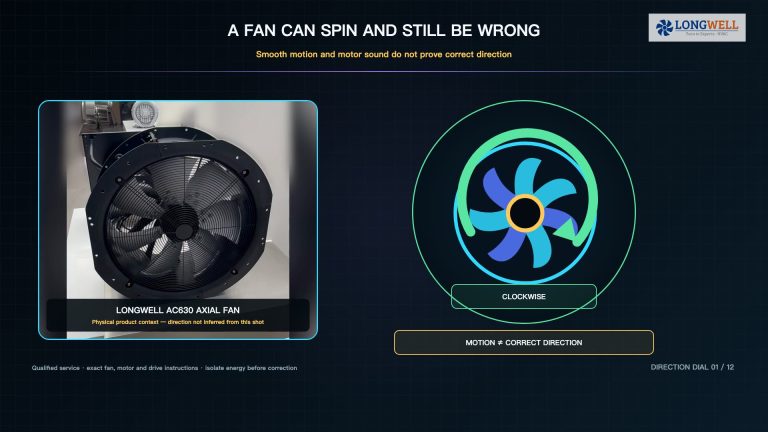
A delayed start can be normal when a thermally controlled blower waits for the firebox to warm. Before condemning the motor, qualified service should use the model-specific procedure to distinguish a missing supply, damaged connector, failed control or thermal device, displaced wire, loose bracket, debris, obstructed wheel and actual motor fault. Record the requested speed, start and stop timing, sound, vibration and airflow direction before resetting or dismantling the unit.
Stop for a gas odor, soot, damaged venting, overheated wiring, scorched insulation, broken glass, persistent breaker trip or an unexplained combustion symptom. Those findings cross the blower-only repair boundary. The next action must come from the appliance manufacturer, utility or qualified fireplace technician as appropriate.
Build a replacement passport before ordering
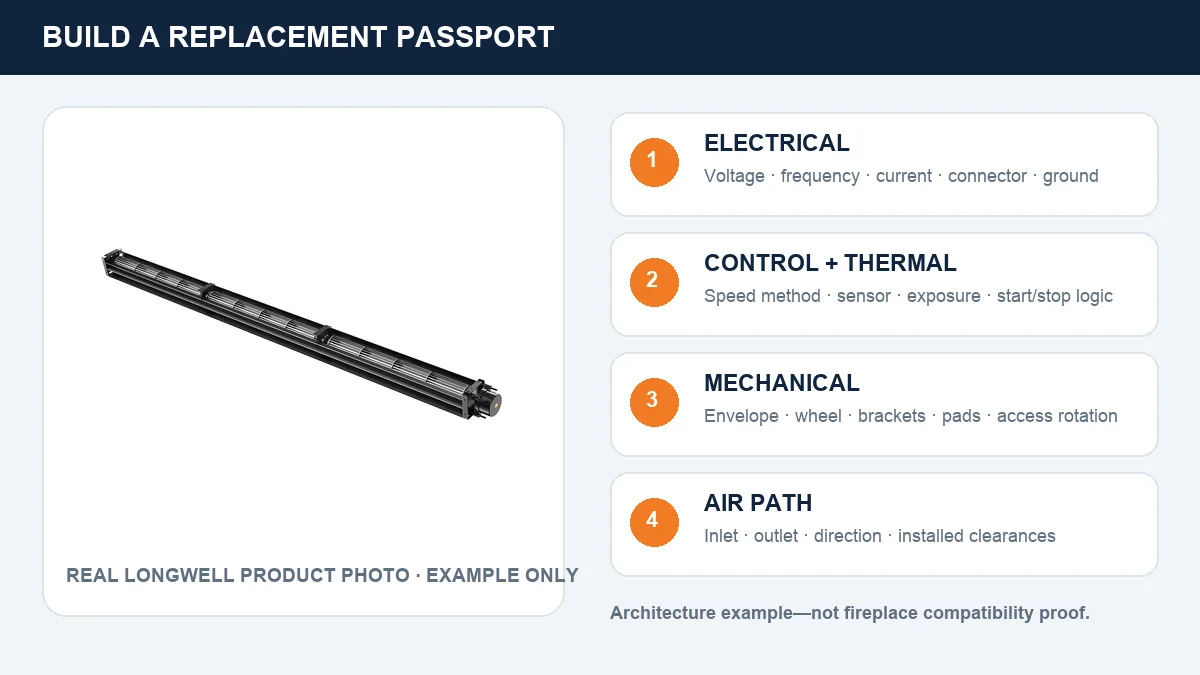
Record voltage, frequency, current or power, connector and grounding, control method, speed range, thermal rating and required airflow direction. Measure overall length, wheel diameter, motor and shaft projection, inlet and outlet geometry, bracket orientation, mounting-hole or stud positions, grommet or pad interfaces, and the clearance needed to rotate the assembly through the service opening.
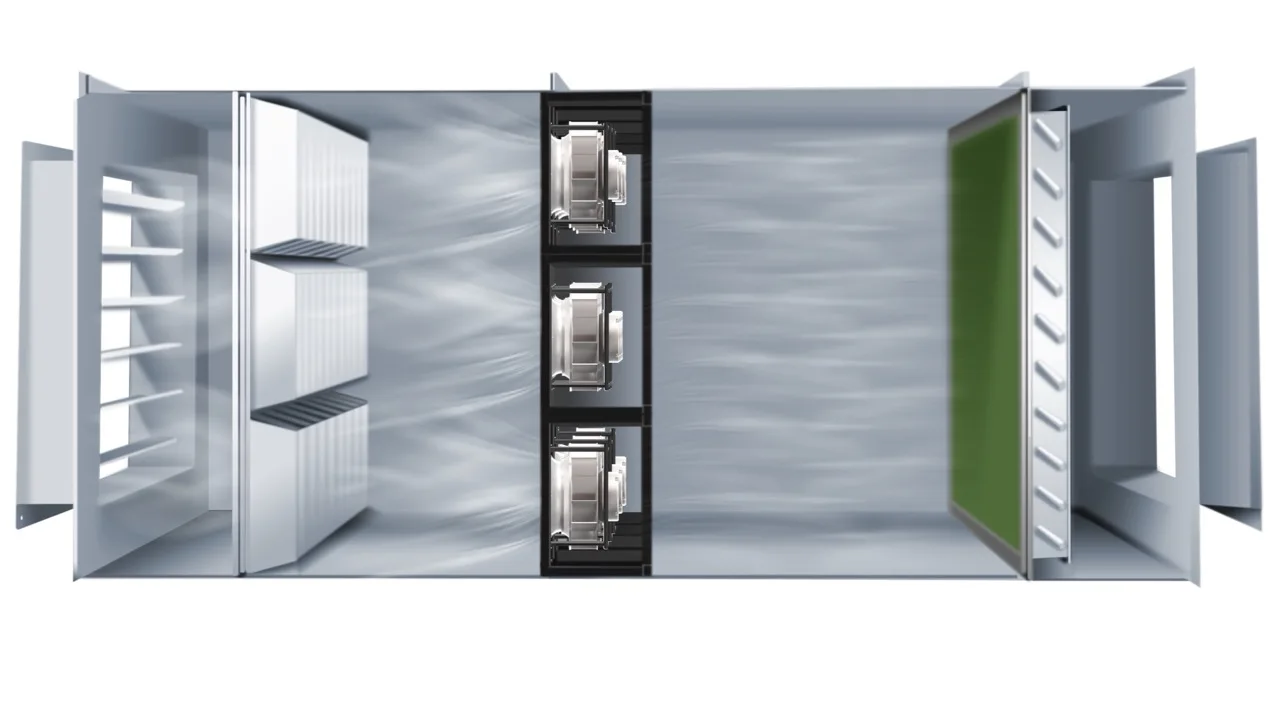
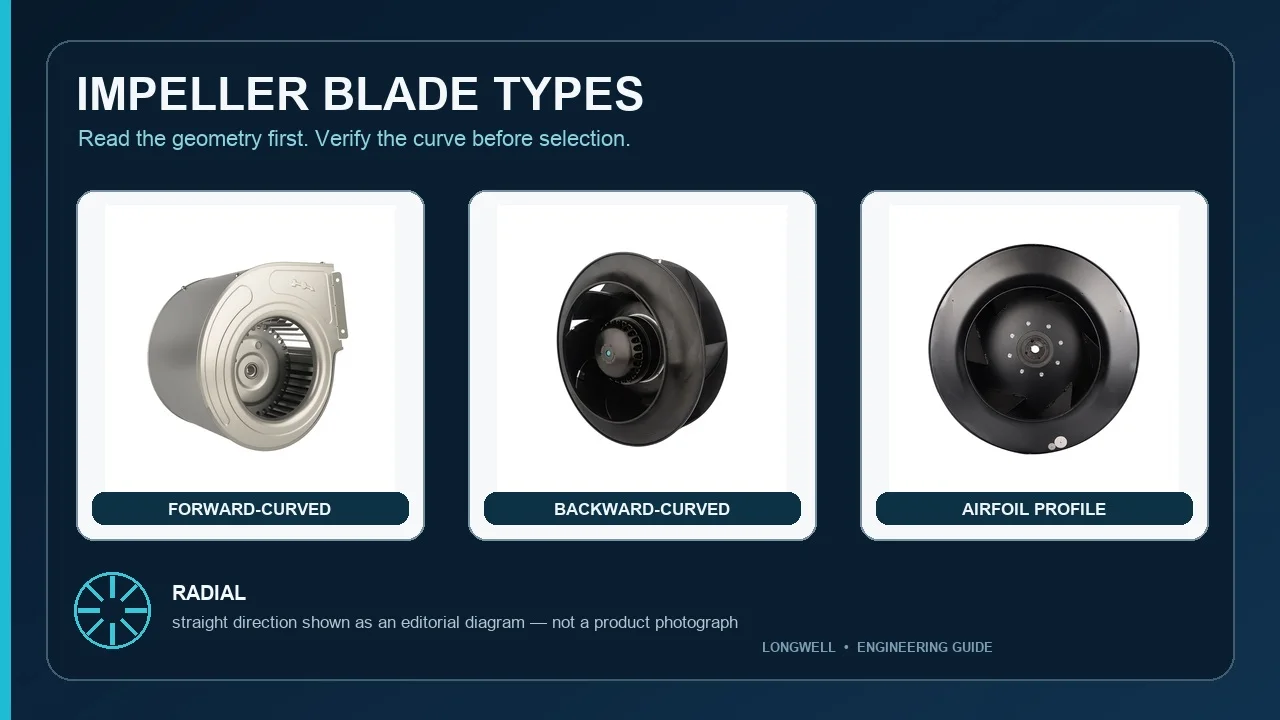
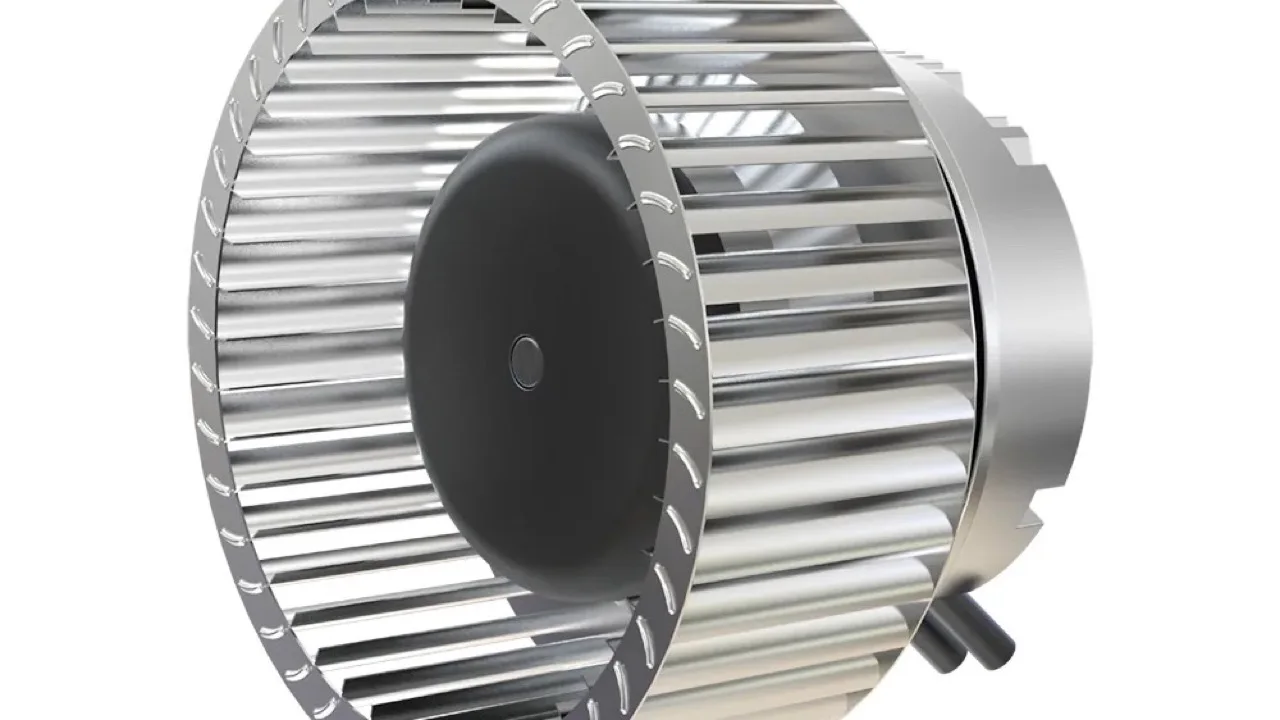
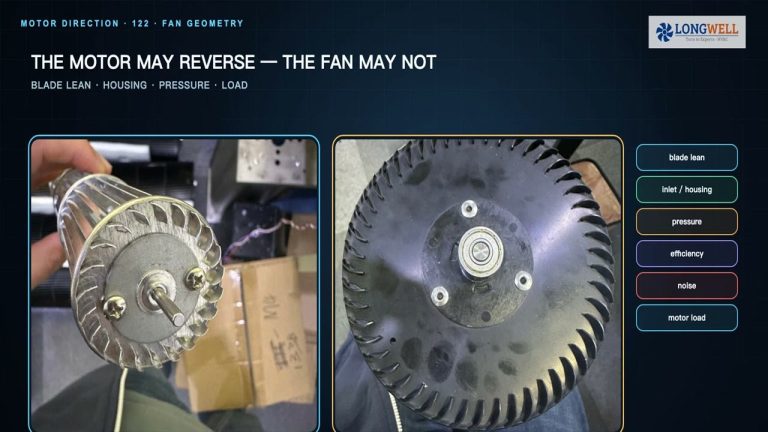
Identify whether the approved design is cross-flow, single centrifugal or twin-wheel. Longwell’s cross-flow fan selection guide can help explain the architecture and comparison fields, but it cannot approve a part for an unknown fireplace. Compare the old and proposed assemblies from the same mounting datum; appearance, nominal length or free-air operation alone is insufficient.
Create a safe state and preserve the removal path
Turn the appliance off and allow it to cool for the time and conditions stated in its manual. Identify every relevant energy source, isolate the electrical supply, apply lockout or tagout where required, control stored energy and verify de-energization with the prescribed method. A remote control, thermostat, wall switch or open interlock is control circuitry, not physical energy isolation.
Before disconnecting anything, label the connectors and photograph the wire route, ground, sensor position, fasteners, clips, spacers, rubber grommets and vibration pads. Support the assembly while the last restraint is removed. Follow the exact lift-slide-rotate path in the service instructions; do not force the wheel past a gas line, valve, glass edge or control assembly. Preserve the original parts and their orientation rather than treating them as packing material.
Match and reinstall the complete interface
Approve the candidate only when its current documentation matches the recorded supply, control, temperature exposure, airflow direction, full envelope, mount and access path. A Longwell fireplace cross-flow blower example shows one compact tangential construction; it is product-identity context, not proof that the model fits this appliance.
Reinstall every specified grommet, pad, spacer, clip, bracket, ground and strain relief. Keep the blower isolated from the firebox and surrounding sheet metal where the manual requires a vibration gap. Restore the thermal sensor at its controlled location and contain excess wire so it cannot reach the wheel, heater, sharp edge or hot surface. Do not invent a universal wire-colour map, sensor location, clearance or torque.
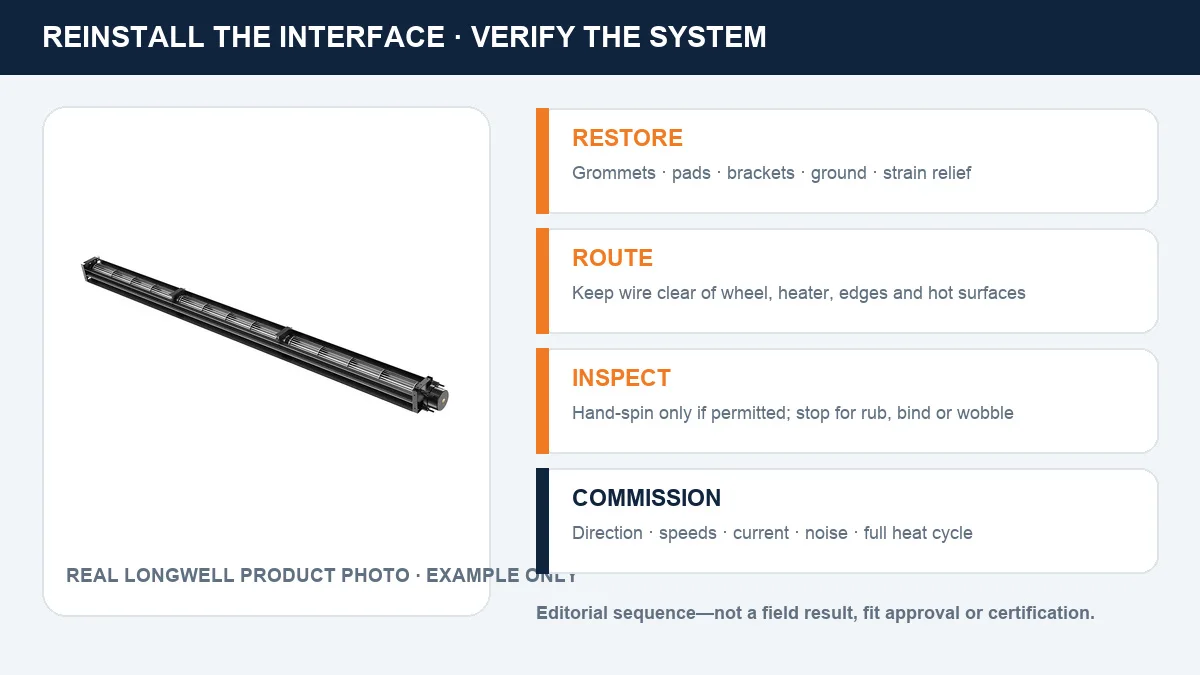
Inspect before power, then test under control
While the appliance remains isolated, clear tools and loose material, inspect both ends, and rotate the wheel by hand through several revolutions if the manufacturer permits it. Stop for rubbing, binding, wobble, unexplained axial movement or contact at the inlet, outlet or service opening. Restore the panels, guards, doors and safety devices required for testing.
If temporary energization is necessary, use the authorized sequence: clear people and tools, restore the test configuration, remove energy controls only as prescribed, energize for the defined test, then de-energize and reapply the controls before any adjustment. Never reach into a moving blower or simplify the test by defeating a switch, ground or guard.
Prove the repair through a complete heat cycle
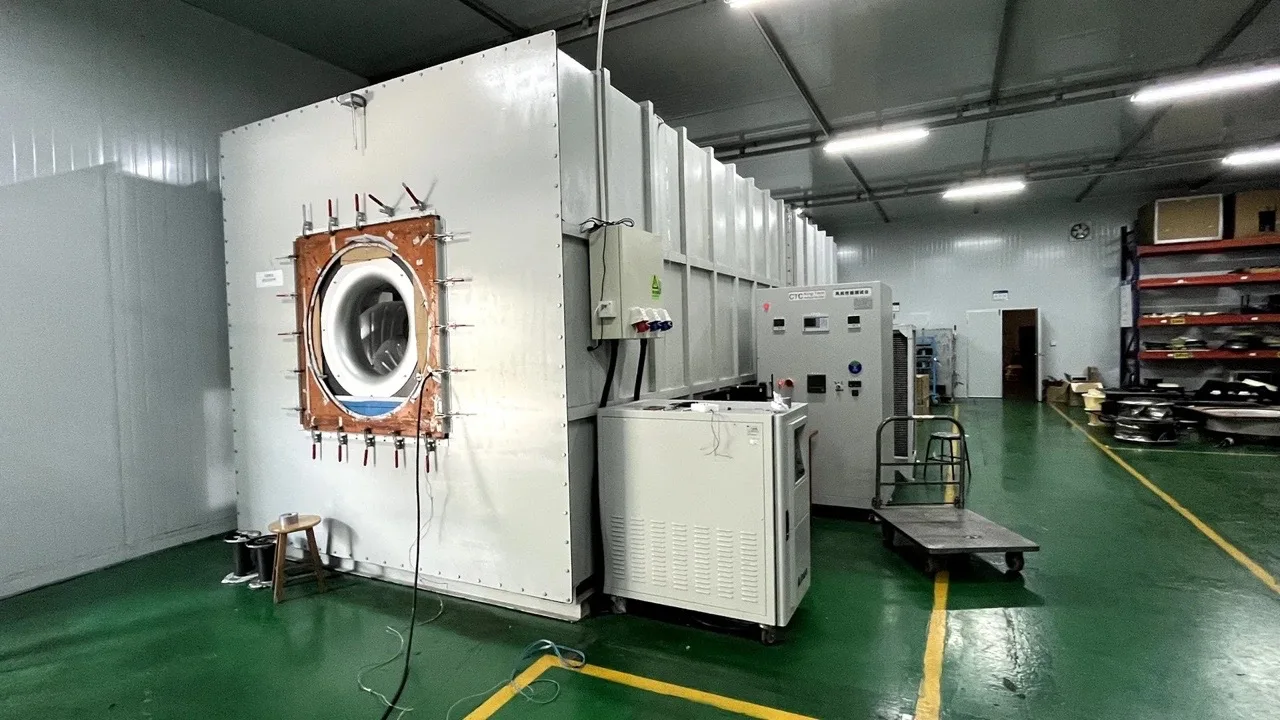
Verify airflow direction, requested speeds, supply voltage, running current, sound, vibration and temperature behavior in the installed configuration. For a thermally controlled system, record when the blower starts as the appliance warms and when it stops during cool-down; compare the behavior with the exact manual rather than a generic delay. Confirm that wiring remains restrained and that adjacent materials stay within their permitted boundaries.
Keep the appliance identity, old and new part numbers, photographs, document revisions, measurements, connector map, preserved isolators and commissioning readings. If airflow is not restored, current is outside the allowed range, the wheel rubs, or the original failure cause remains unresolved, stop and investigate. The repair is complete only when the installed evidence—not a bench spin—shows a correctly matched, quiet and controlled circulation blower.
Choose the right blower
Longwell manufactures 247 blowers in-house. Send airflow, static pressure and voltage — an engineer replies with a matching model, performance curve and price within one working day.