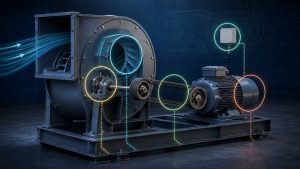
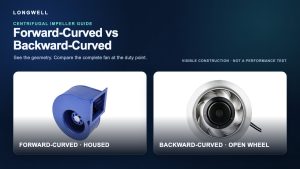
A fan motor label tells you how torque is produced, but it does not tell you whether the assembled fan will meet an airflow target. Shaded-pole, permanent split capacitor (PSC), and brushless DC (BLDC) designs use different starting and control hardware. The practical choice is to compare complete fan assemblies at the same installed duty, then check the electrical and mechanical interface.
What changes inside the motor
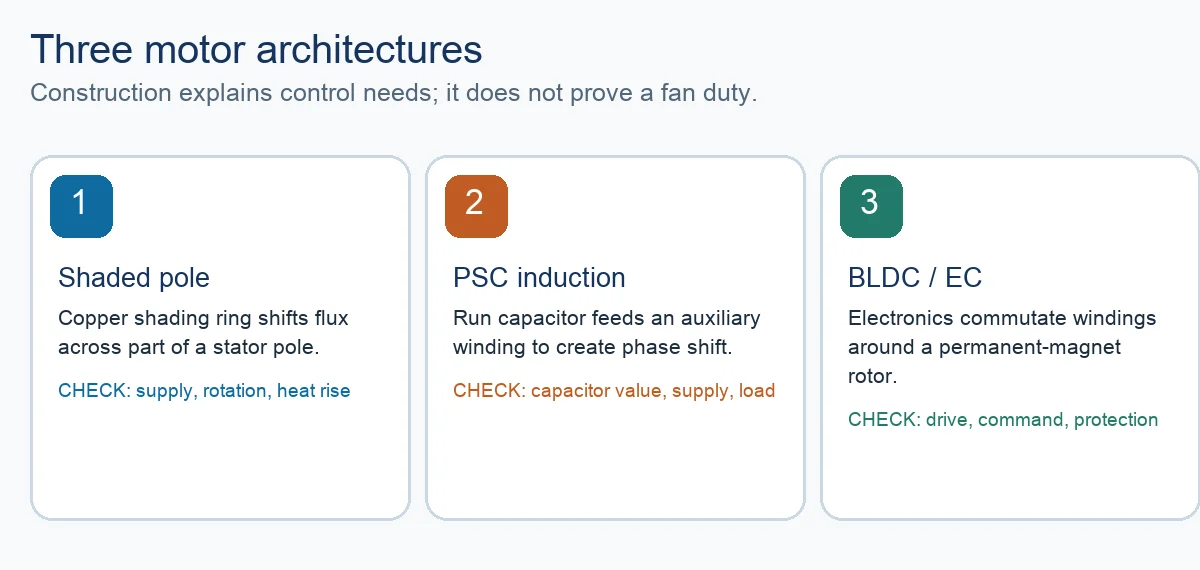
A shaded-pole motor is a single-phase induction motor with a copper shading ring around part of a stator pole. The ring delays magnetic flux in that portion, producing a weak starting field. Its simple construction suits some small fan duties, but its starting torque and losses must be checked for the actual load. LONGWELL’s shaded-pole motor family is a product-family reference, not a replacement approval for a particular fan.
A PSC motor adds an auxiliary winding and a run capacitor. The phase shift helps create a rotating field while the capacitor remains in the running circuit. Its supply frequency, capacitor value and winding configuration are part of the design; changing one without the motor manufacturer’s specification can change starting and operating behavior. The LONGWELL capacitor-motor family shows the architecture, while the exact data sheet is needed for selection.
A BLDC motor uses a permanent-magnet rotor and electronics that switch current among stator windings. An EC fan normally packages electronic commutation with its motor and input interface, but its command and feedback options vary by model. The controller, voltage and protection scheme are therefore as important as the motor body. See the LONGWELL BLDC family overview for the range; it does not establish an exact fit or measured advantage over another assembly.
Compare the same fan duty, not headline efficiency
Percentages quoted without a model, speed, load and test method are poor buying criteria. Motor shaft efficiency, electrical input to a complete fan, and airflow efficiency are different quantities. The existing article treated broad percentage ranges as universal facts and implied that every BLDC conversion pays back; those claims cannot be carried across motor sizes and installed systems. Ask for the exact candidate’s curve and input watts at the required airflow and static pressure, with the intended inlet, outlet and control setting.
For variable operation, compare a representative duty profile rather than a single full-speed point. Annual energy can be estimated by adding input watts multiplied by hours at each operating point, then dividing by 1,000 for kWh. This is a calculation method, not a product saving claim. It also leaves out purchase, installation, service and controller costs, which belong in a complete life-cycle comparison.
When each family can be a candidate
Shaded-pole designs may suit a small, fixed-speed duty when the tested assembly provides enough starting torque and acceptable heat rise. PSC designs are an option when the equipment already supports the specified AC supply and run capacitor. BLDC or EC designs are useful candidates when the equipment can provide the correct electrical input and the intended speed-control strategy. None of these statements makes one family the automatic winner for noise, lifetime, cost or energy use.
In particular, lower speed can reduce some fan noise, but a change of motor alone does not guarantee quieter operation. Blade shape, operating point, mounting and tonal behavior all matter. Likewise, a controller can offer adjustable speed only if the chosen model and system actually implement a compatible command. Confirm these features in the exact model documentation and in the assembled unit.
Use four release checks before changing a motor
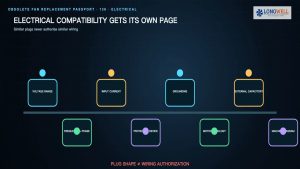
First, define the duty: required airflow, static pressure, air temperature and operating schedule. Second, map the interface: AC voltage and frequency or DC voltage, run capacitor where specified, connector pinout, speed command and feedback. Third, compare the tested fan-plus-motor curve at that duty rather than a bare-motor rating. Fourth, check the physical and safety details, including shaft or impeller coupling, rotation, mounting, thermal protection and clearance.
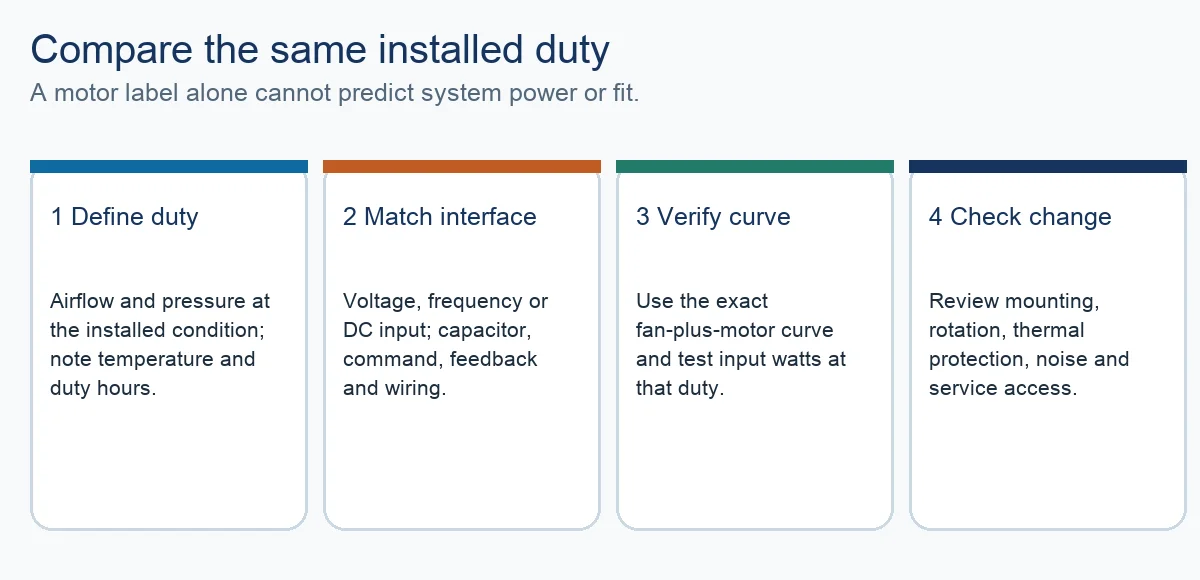
A motor swap can require a new controller or harness even when the nominal power looks similar. A PSC motor also needs the specified run capacitor; a BLDC unit needs its compatible electronics. Validate wiring and protective functions from the manufacturer’s current instructions before energizing equipment. If the existing fan is being replaced as a complete assembly, repeat the operating-point and clearance checks because the surrounding system still determines the delivered flow.
What to send for a useful shortlist
Send the existing motor and fan model, supply and frequency, capacitor marking if present, control wiring, mounting dimensions, required airflow and pressure, ambient temperature, and a photo of the installed air path. State whether the goal is a like-for-like replacement, a speed-control change, or a new OEM design. Those inputs let an engineer compare exact candidate data sheets and identify which details still need a bench or assembled-system test.
Choose the right ac motor
Longwell manufactures 22 ac motors in-house. Send airflow, static pressure and voltage — an engineer replies with a matching model, performance curve and price within one working day.