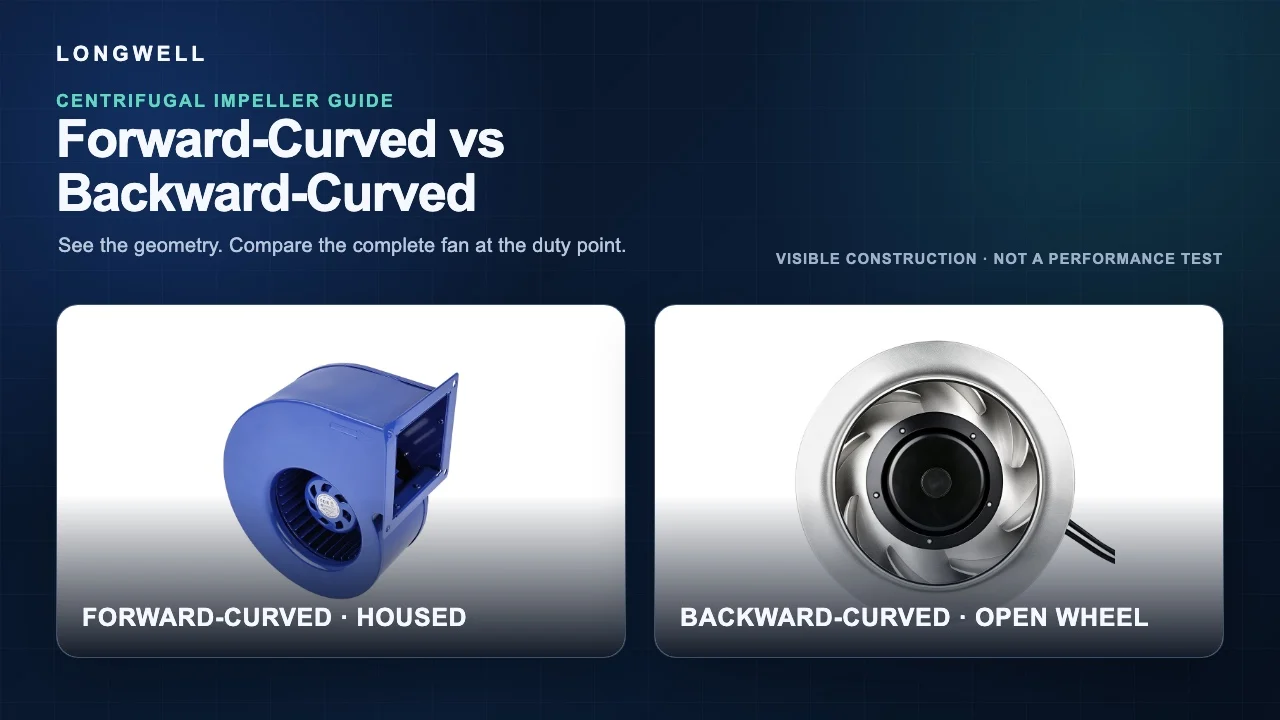
If you are choosing between a forward-curved and a backward-curved impeller from the blade photo alone, pause there. The photograph can identify visible construction. It cannot tell you which complete fan reaches your airflow and pressure point, how much input power it needs, or what it will sound like inside your equipment.
The video shows both geometries in motion. This article turns that visual difference into a practical comparison: what the wheel shape lets you say, what still needs a controlled curve, and what to put in an RFQ before anyone recommends a model.
First, lock the viewing and rotation reference
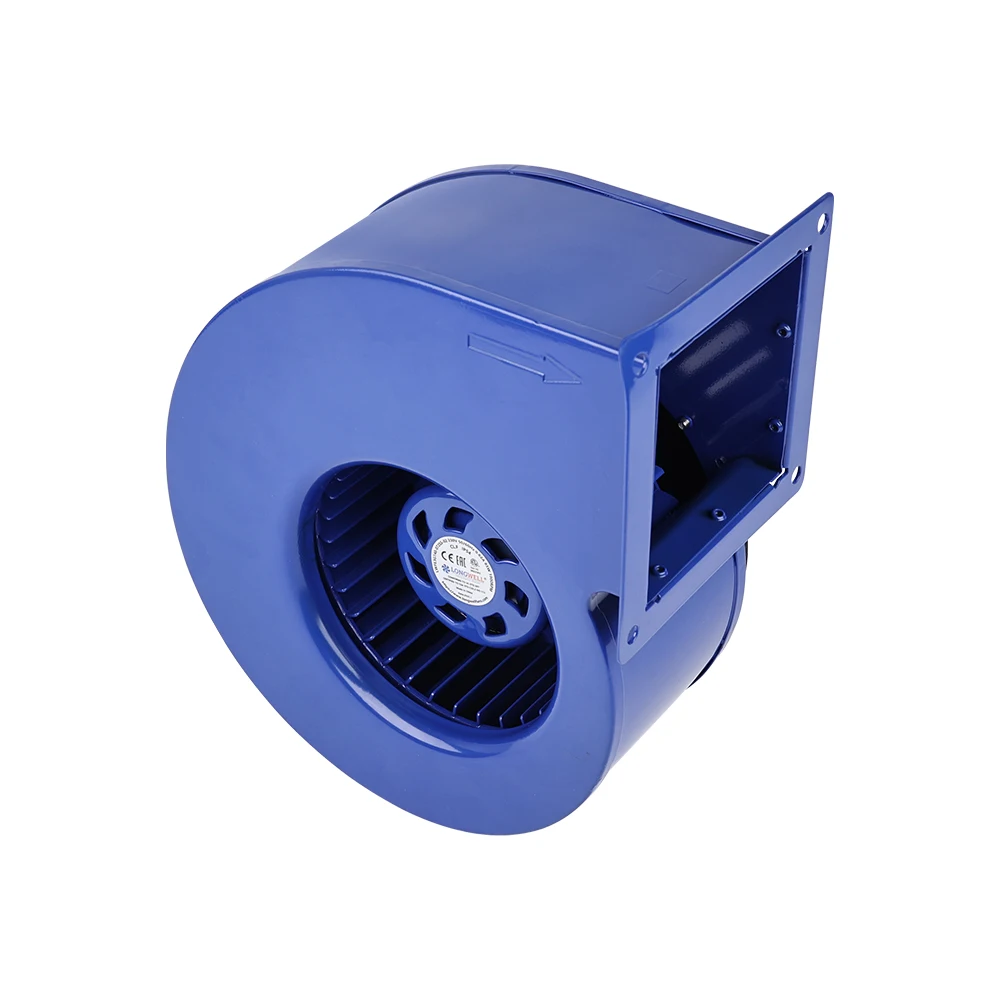
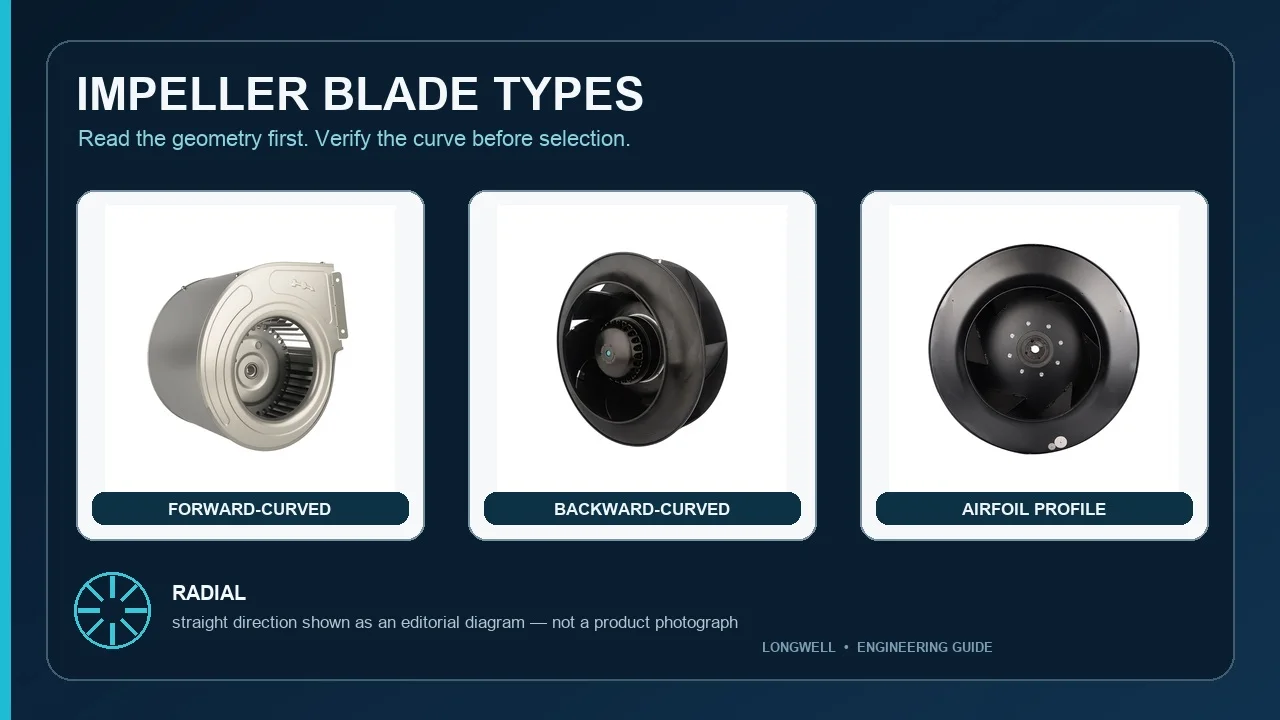
A forward-curved blade bends in the same general direction as wheel rotation at the outlet. The wheel often has many short, closely spaced blades. The blue unit above is a housed single-inlet blower, so the scroll and rectangular discharge are also visible. Those features describe this photographed assembly; they do not establish a generic pressure, airflow, sound, or efficiency value.
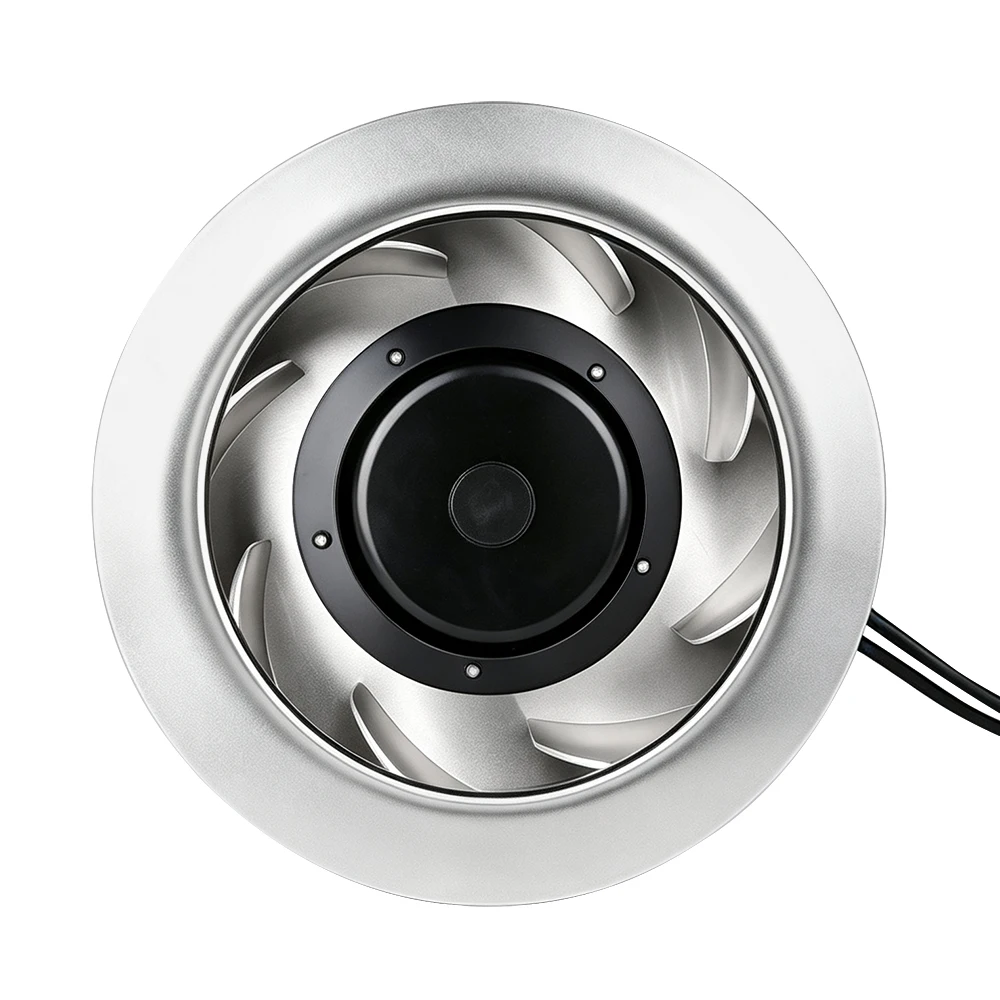
A backward-curved blade leans away from the direction of rotation at the outlet. The photographed open wheel has fewer, wider blades and an inlet ring rather than a scroll housing. Always confirm the rotation arrow and the side from which the wheel is viewed. A reversed photo or an ambiguous viewing direction can turn a useful comparison into a labeling error.
Blade direction changes the curve family, not the answer
The blade exit angle changes the velocity leaving the wheel and therefore influences pressure development and absorbed-power behavior. It is a meaningful aerodynamic distinction. It is not a universal ranking. Wheel width, diameter, blade profile, inlet clearance, speed, scroll or plenum geometry, motor, and control limits all contribute to the measured result.
Use the blade name to choose which data you need next. Do not use it to fill in missing data. Claims such as “backward is always quieter” or “forward always moves more air” collapse several variables into one label and can fail as soon as the diameter, speed, housing, or duty point changes.
A housed blower and an open wheel are not an equal-boundary test
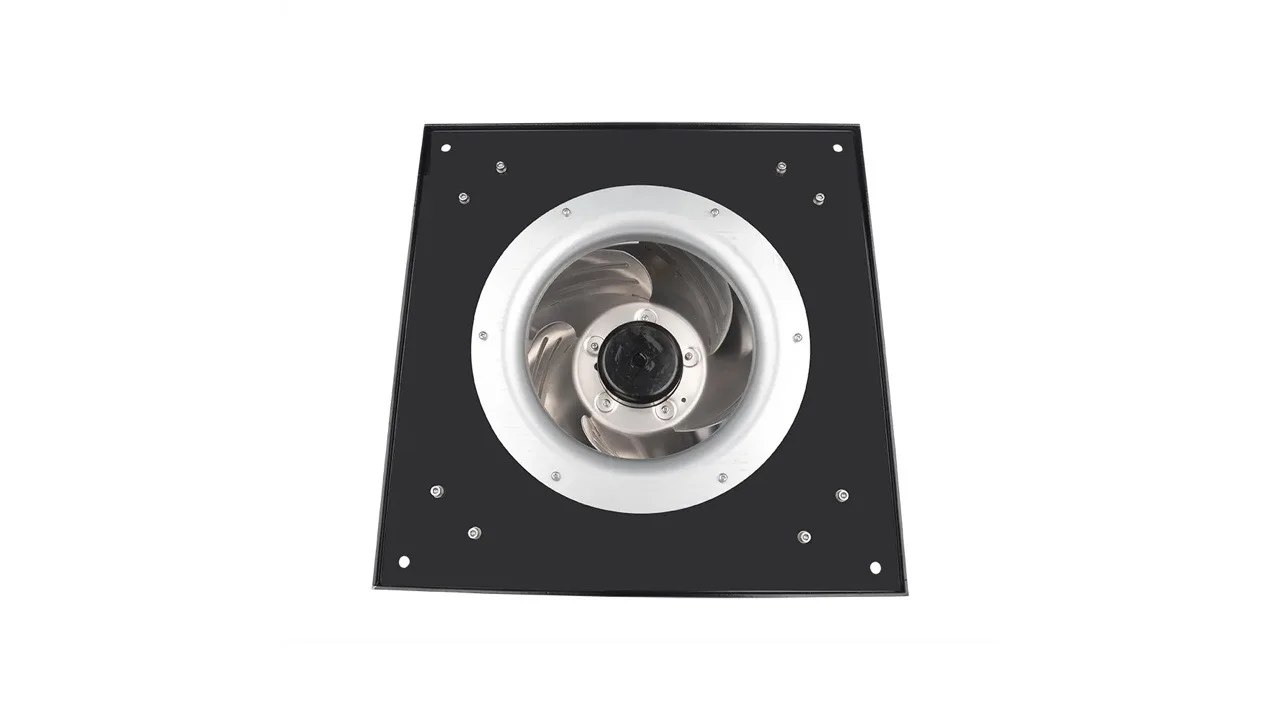
A scroll collects discharge around the wheel and directs it through a defined outlet. An open backward-curved wheel commonly works with an inlet ring and an equipment plenum; the surrounding cabinet then becomes part of the installed aerodynamic boundary. Comparing the two photographs by diameter alone would ignore that difference.
The forward-curved centrifugal fan family and the backward-curved centrifugal fan family are useful sourcing maps. They are not cross-reference approvals. Exact model suffix, current drawing, inlet condition, housing or plenum boundary, and controlled curve still have to match the project.
Compare both candidates at the same duty point
Start with required airflow and required pressure at the same operating condition. State whether the pressure is static or total and where it is measured. Add air temperature, density or altitude when those differ from the curve reference. Then place the fan curve against the system resistance curve. Their intersection is the expected operating point.
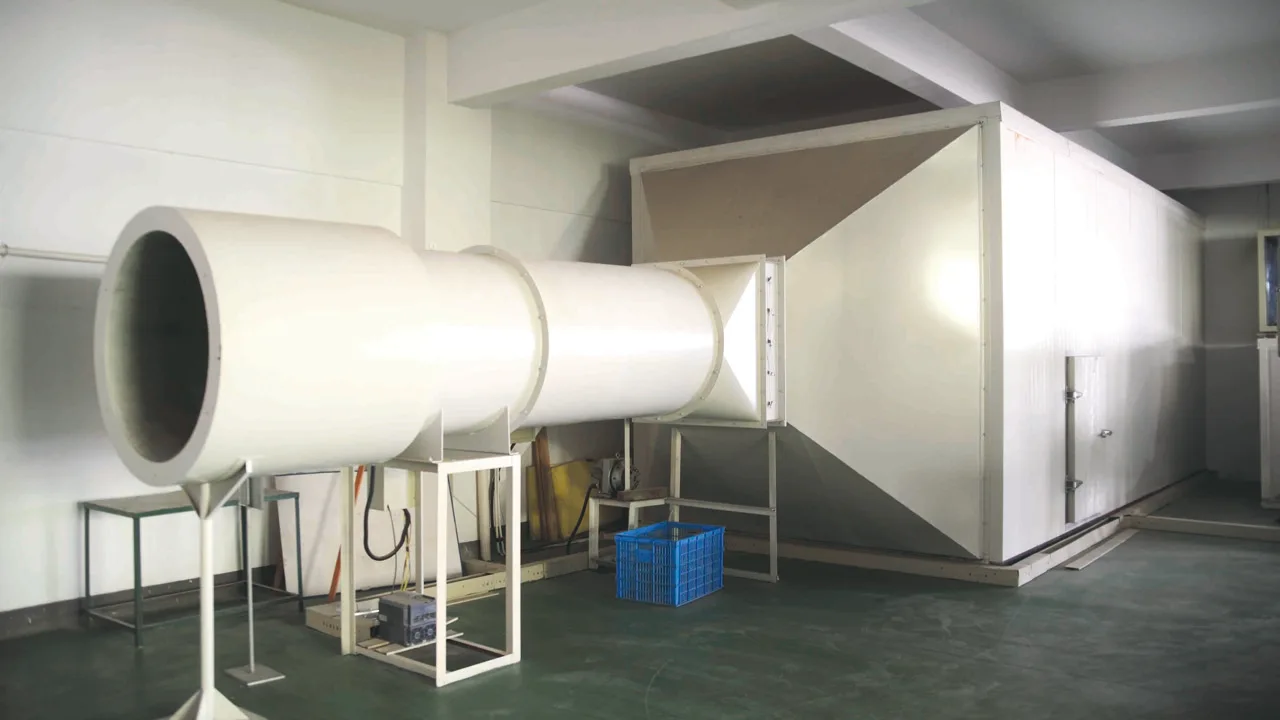
Catalogue maxima are usually endpoints measured under different conditions, not one usable duty. Do not combine a maximum airflow from one end of a curve with a maximum pressure from the other. For a real comparison, read airflow, pressure, absorbed power, efficiency, speed, and sound information at the same target point and under the declared test boundary.
The power curve sets the motor check
Forward-curved selections can require increasing power as the operating point moves toward higher airflow. Backward-inclined or backward-curved families can show a different power shape, often reaching a peak before the far end of the curve. These are family-level tendencies, not permission to skip the exact model data.
Check motor and controller loading across every credible state: clean and final filter resistance, damper positions, startup, minimum and maximum command, blocked or opened branches, and any density change. The question is not whether the nominal point fits. It is whether the complete fan-motor-control assembly remains inside its approved operating envelope.
Size, noise, and efficiency need a common boundary too
A compact scroll blower may solve a packaging problem that an open wheel cannot. An open wheel may integrate naturally into a plenum that already provides the required flow path. Neither statement predicts installed sound or system efficiency. Nearby obstructions, inlet distortion, cabinet panels, speed, control state, and measurement method can change the result.
For a broader project route, the application solutions directory can help identify the equipment context before model selection. Treat it as navigation, not proof that either photographed fan is suitable for a particular installation.
A useful shortlist has three branches
- Start with forward-curved candidates when the equipment requires a compact housed blower and the supplier can show the exact curve, power range, and acceptable operating region for the required duty.
- Start with backward-curved candidates when an open-wheel or plenum architecture fits the equipment and exact model data covers the resistance and control range.
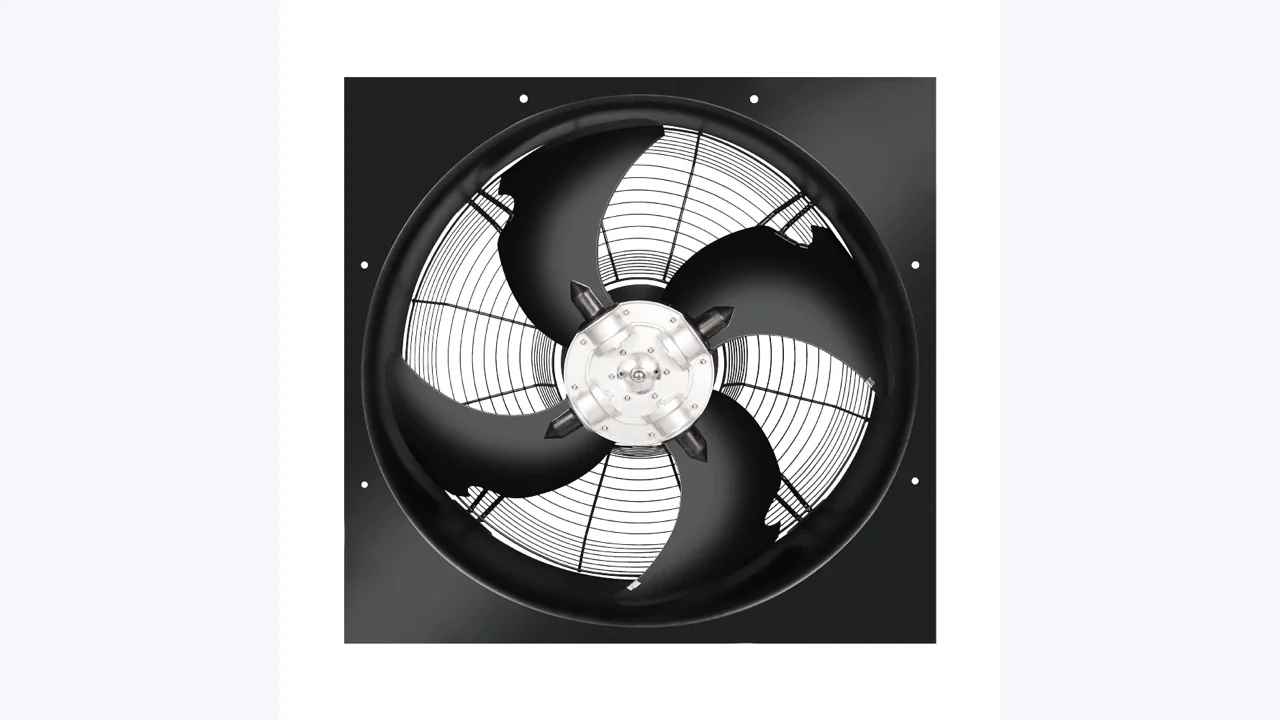
- Stop and widen the search when the airstream, temperature, contamination, pressure, envelope, or control requirement falls outside both reviewed families. Another centrifugal geometry or a different fan architecture may be more appropriate.
“Start with” is deliberate. The final choice belongs to the measured assembly and its installation boundary, not to a generic winner declared from the wheel shape.
Send an RFQ that makes the comparison answerable
- Duty: minimum, normal, and maximum airflow-pressure points, with units and static or total pressure definition.
- Air and system: temperature, density or altitude, filters at clean and final resistance, coils, ducts, dampers, and nearby inlet or outlet restrictions.
- Mechanical boundary: maximum envelope, inlet and outlet dimensions, housing or plenum arrangement, orientation, clearances, mounting, and service access.
- Electrical and control: supply, allowable input power or current, command signal, feedback, alarms, speed limits, and fault behavior.
- Acceptance: exact model and suffix, drawing and curve revision, test condition, sound basis, sample quantity, equipment-level test points, and the pass/fail record.
Ask the supplier to return both the assumptions and the evidence revision. That one step prevents a clear blade comparison from being mistaken for a replacement approval, and it gives engineering and purchasing the same decision boundary.
Choose the right backward curved centrifugal fan
Longwell manufactures 587 backward curved centrifugal fans in-house. Send airflow, static pressure and voltage — an engineer replies with a matching model, performance curve and price within one working day.