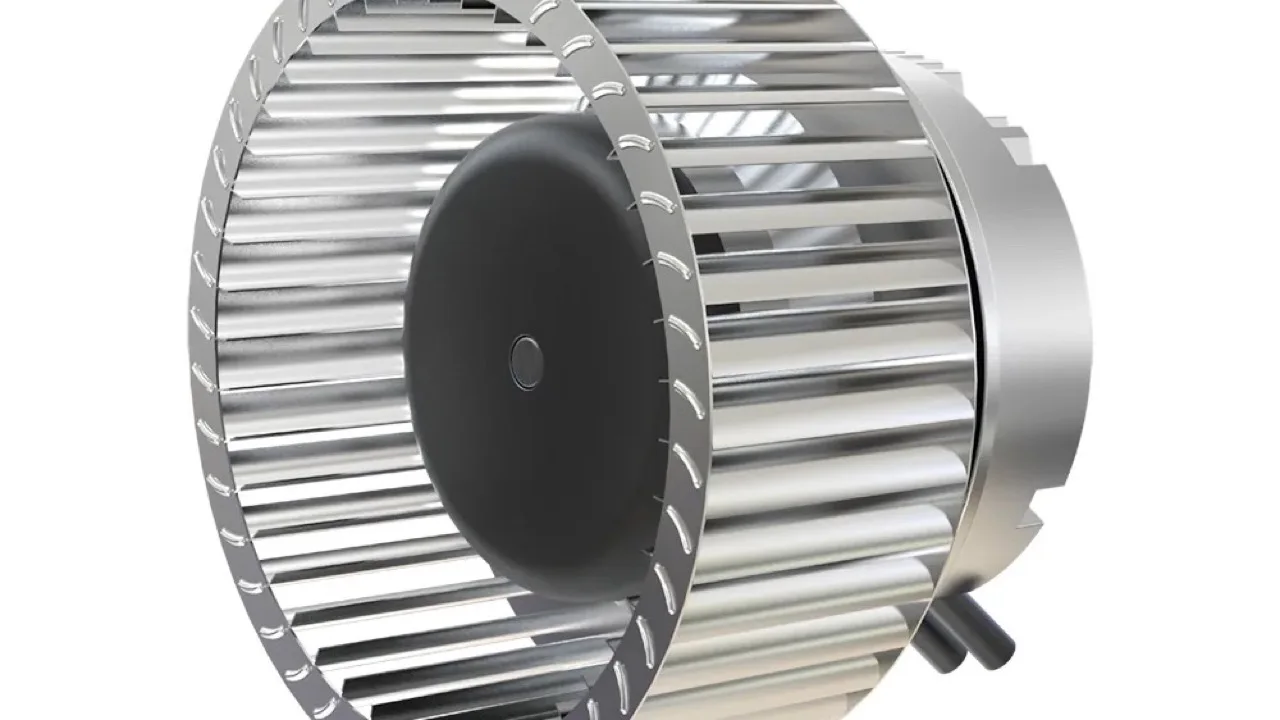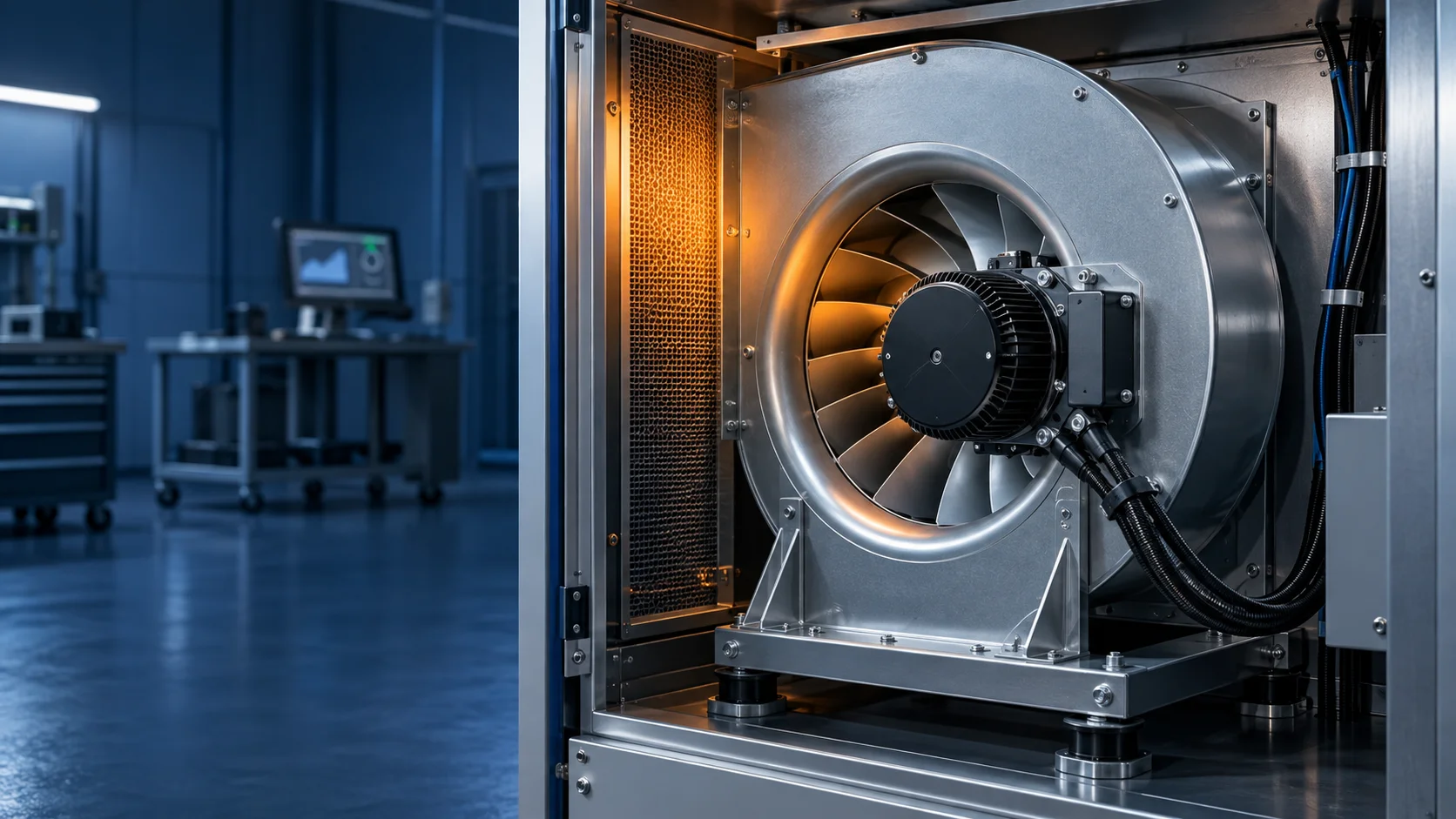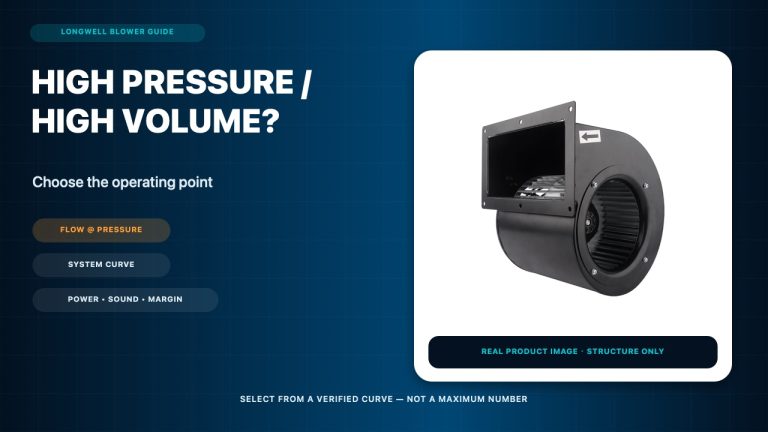
In HVAC work, a “squirrel-cage blower” usually means a centrifugal blower with a cylindrical wheel made from many narrow blades. Air enters at the wheel eye, turns through the rotating blade passages, moves outward into a scroll housing, and leaves at the discharge. It does not simply pass straight through the cylinder.
That short description answers the search query, but it is not enough for selection. The wheel, inlet and housing act as one air-moving assembly, while the connected duct, filter and coil decide where that assembly actually operates. The video and product stills below make the flow path visible; the buying checks explain what to verify before accepting a model.
First, identify which “squirrel cage” someone means
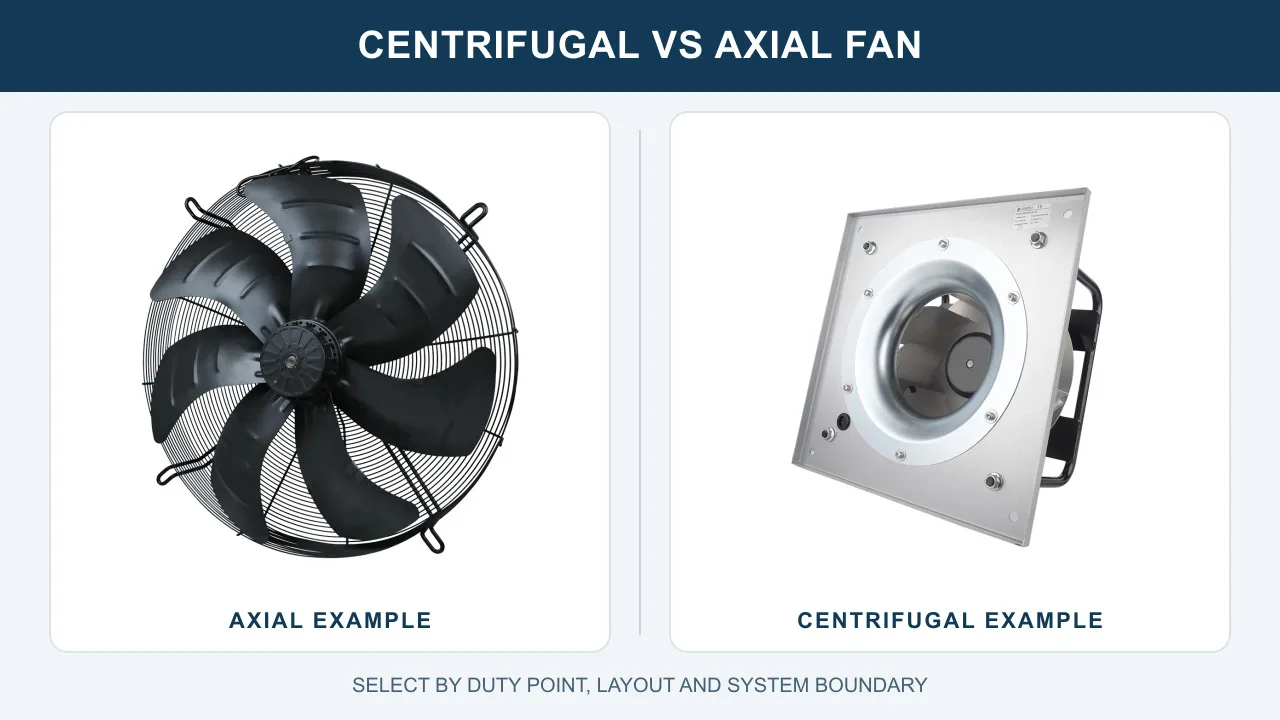
The nickname is used loosely. In this article it means the forward-curved or multi-wing centrifugal blower common in HVAC and equipment ventilation. A dense row of narrow blades forms the cage-like wheel. The phrase may also be used for a tangential cross-flow wheel, or for the rotor inside an induction motor. Those are different objects.
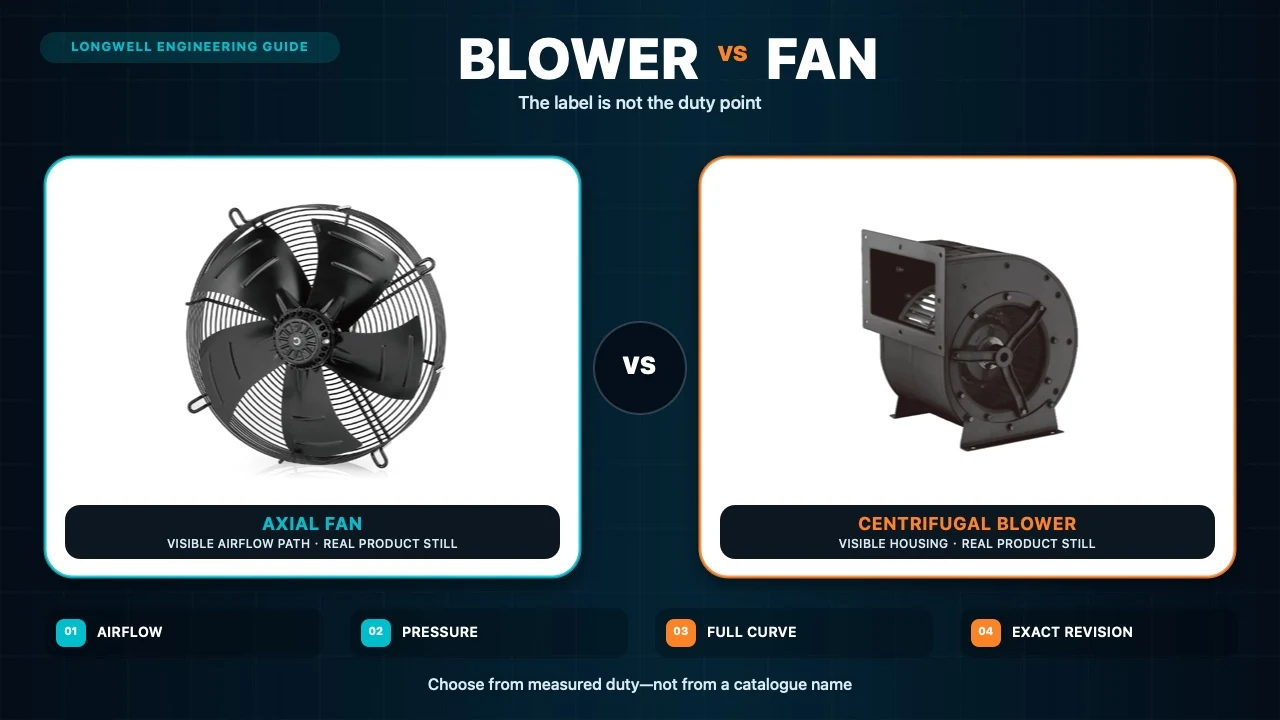
Look at the air path before trusting the label. A centrifugal blower draws air near the shaft and discharges it outward through a housing. A cross-flow fan moves air across a long wheel. A squirrel-cage motor describes the electrical rotor, not the fan wheel. LONGWELL’s current multi-wing centrifugal fan range is a useful visual reference, but the exact offered model and revision still need their own documents.
Trace the airflow from inlet to blade tips
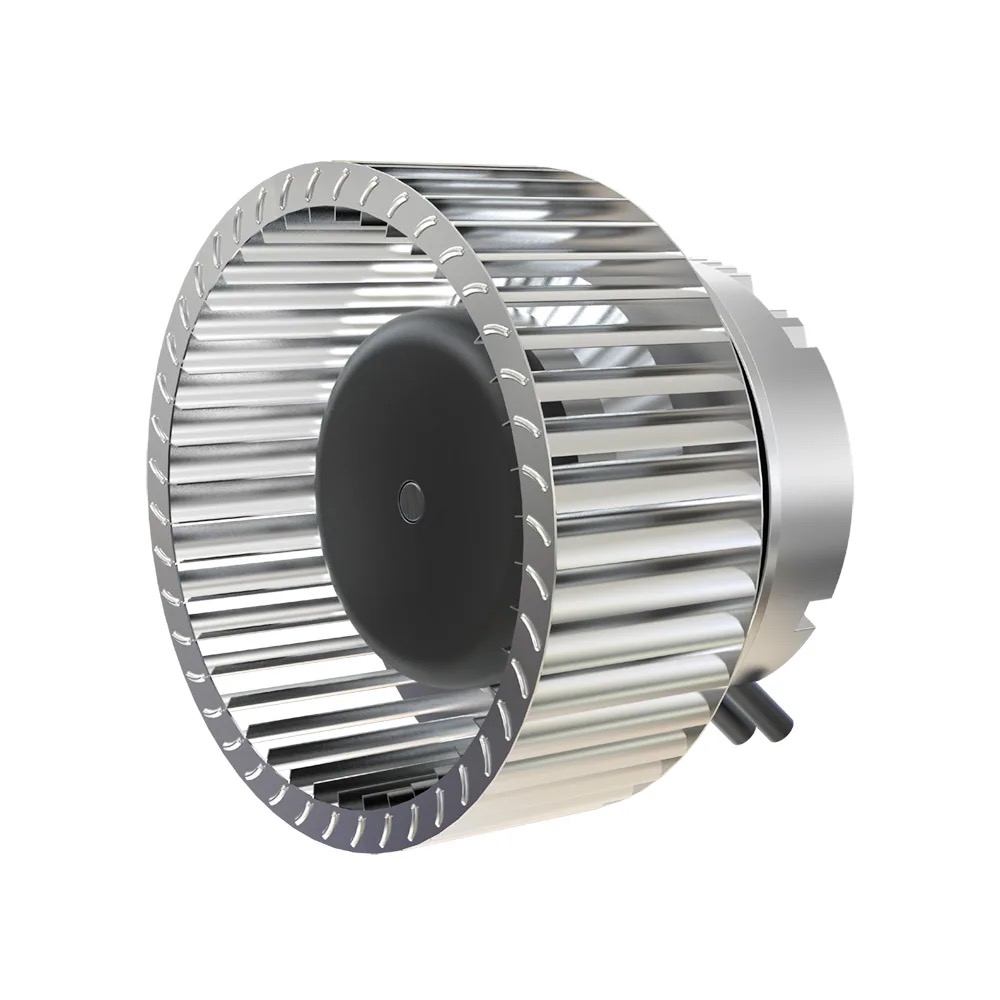
On a single-inlet blower, air approaches the round inlet roughly parallel to the shaft. The rotating blade passages add velocity and guide that air toward the wheel perimeter. At the outlet of the wheel, the flow has both outward and circumferential motion. That is why a centrifugal blower can accept air from the side and deliver it through a discharge oriented around the wheel.
An open wheel photograph is excellent for seeing blade count, blade direction and the two side rings. It cannot tell you the delivered airflow, pressure, absorbed power or sound. Those values belong to the tested wheel-and-housing configuration at a stated speed, air density and operating point.
The scroll housing does more than cover the wheel
The volute, or scroll, collects air leaving the full circumference of the impeller. Its passage generally grows toward the discharge because it must carry progressively more flow. As part of the fast-moving air slows in that expanding passage, part of its velocity energy becomes static pressure. The cutoff tongue separates the discharge region from the inlet side of the scroll.
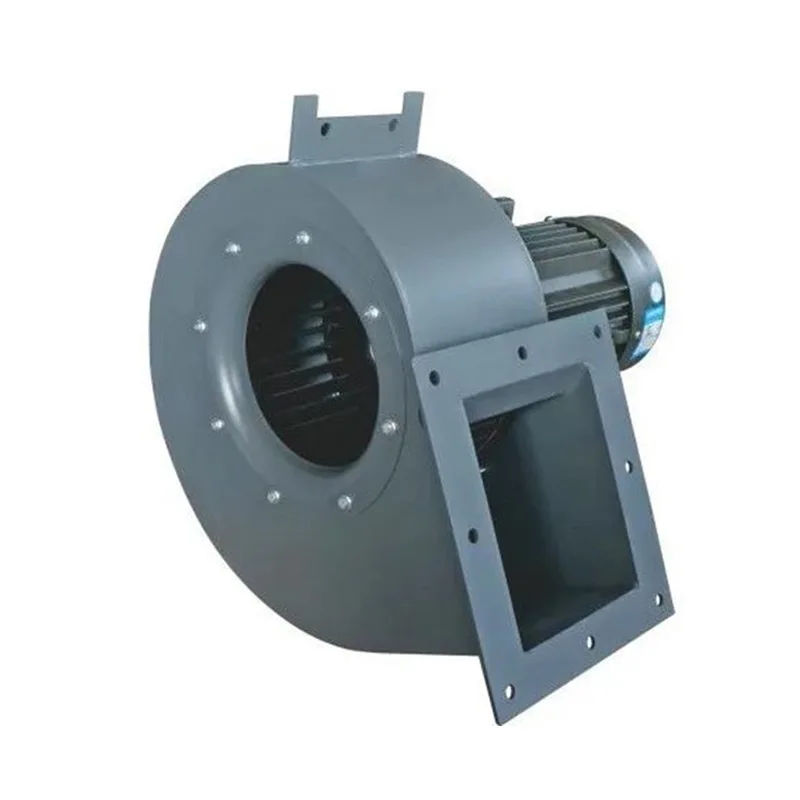
This is why a bare wheel and a housed blower are not interchangeable pieces of evidence. Wheel position, inlet geometry, scroll dimensions, tongue clearance and outlet boundary all affect the result. The centrifugal pressure-generation guide continues the mechanism explanation, while selection should still use the controlled curve for the complete offered assembly.
Forward-curved blades explain the compact wheel shape
At the outer diameter, a forward-curved blade bends toward the direction of rotation. Many narrow passages fit around the wheel, producing the familiar multi-wing appearance. This geometry is common in compact centrifugal blower packages, but the label alone does not establish a universal pressure, efficiency, sound or motor-power advantage.
Use the forward-curved centrifugal fan family to narrow the architecture. Then ask for the exact suffix, voltage, inlet arrangement, housing, speed range and released curve. A photograph can confirm visible construction; it cannot confirm that two similar-looking units are electrical or aerodynamic replacements.
Single inlet and double inlet are different purchase boundaries
A single-inlet assembly feeds the wheel from one side. A double-inlet assembly admits air from both sides of a wider wheel and usually places the motor or drive arrangement outside the two inlet paths. Both are centrifugal machines, but their envelopes, inlet clearances, mounting and tested curves are not interchangeable.
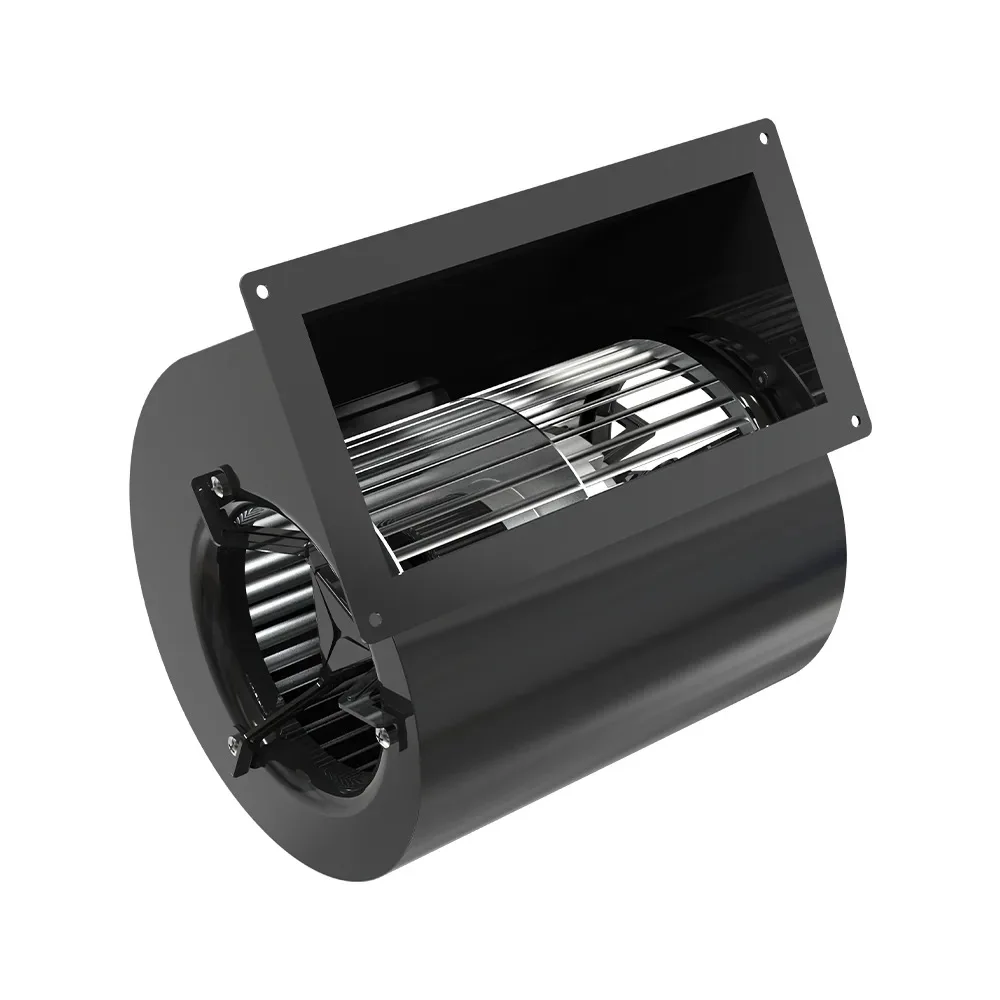
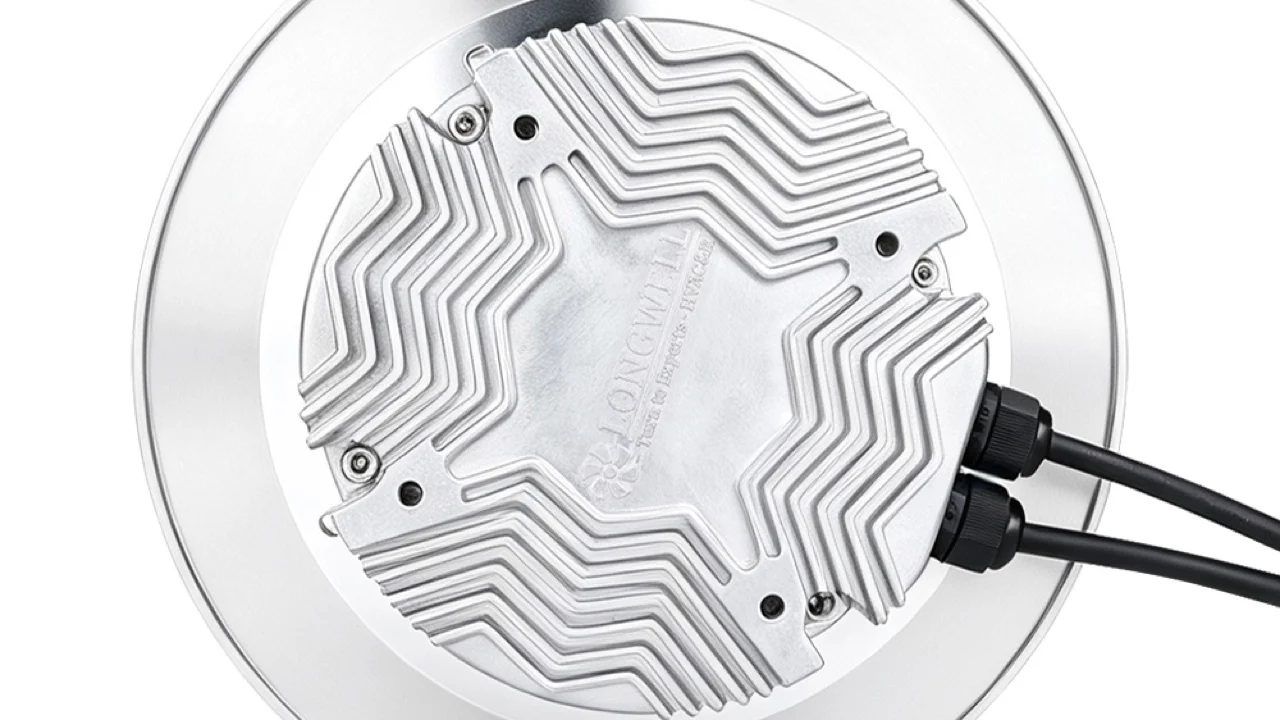
When the equipment drawing shows two inlet openings, do not approve a single-inlet substitute from diameter alone. Confirm which sides must remain clear, the discharge orientation, rotation viewed from the stated side, mounting points, cable exit and service space. Treat CAD as dimensional and visible-structure evidence only; it does not prove the duty point or installed result.
Why catalogue airflow is not the airflow in your equipment
Filters, coils, grilles, bends and ducts resist flow. The installed operating point is where the fan curve and the system-resistance curve meet. A free-air maximum sits at one end of the curve and does not predict delivery after the blower is installed behind a loaded filter or a restrictive heat exchanger.
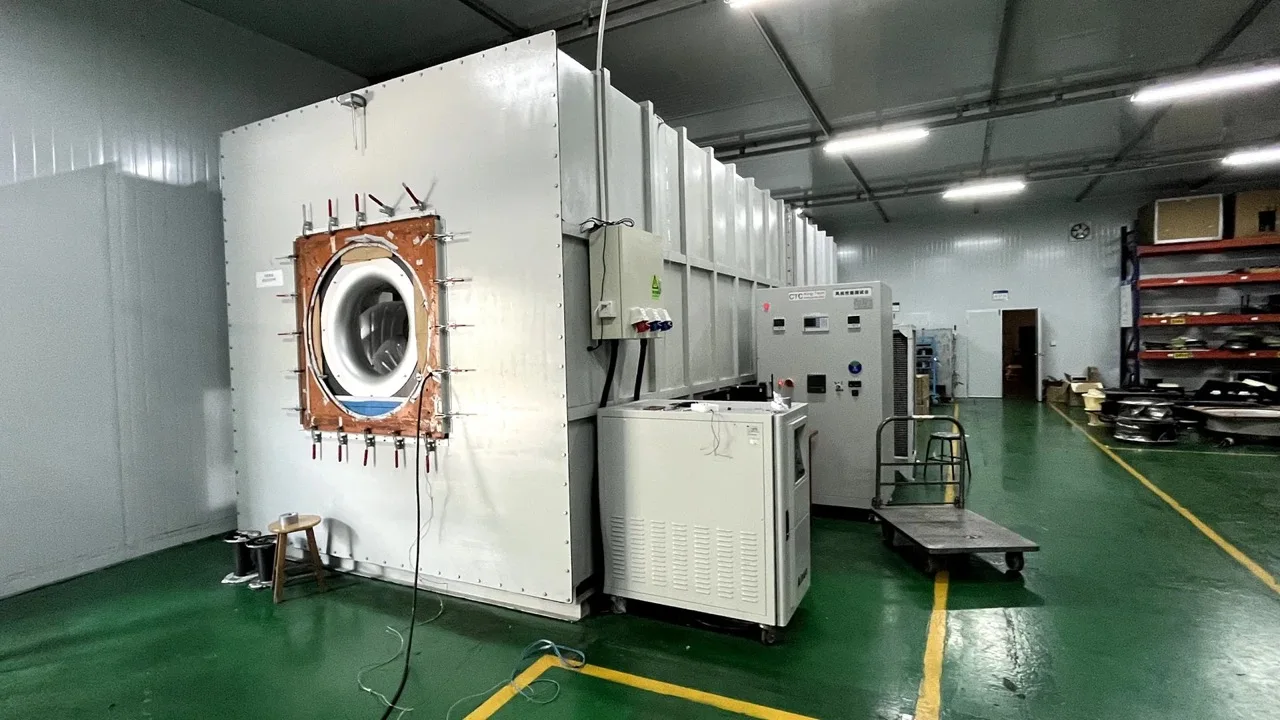
Read airflow and pressure together, then check absorbed power and the permitted operating region. The fan-curve reading guide shows the basic sequence. If the supplier’s curve belongs to another wheel diameter, housing, motor, speed or revision, keep it as a lead rather than using it as approval evidence.
Use symptoms to choose the next check, not to guess a cause
- Low airflow: inspect filter loading, inlet blockage, rotation, speed, duct resistance and wheel fouling before blaming the motor.
- New vibration: look for uneven buildup, loose mounting, wheel rub, damage and shaft or bearing issues; isolate energy before touching the assembly.
- Unexpected noise: check inlet distortion, nearby elbows, a partially blocked discharge, loose panels and operation away from the intended curve region.
- Motor or controller heating: verify supply, control command, current, airflow condition and the allowed power envelope for the exact assembly.
Cleaning can restore passage area when dirt is the cause, but it does not correct a damaged wheel, wrong rotation or poor system match. Preserve balance clips and follow the equipment maker’s isolation and cleaning instructions.
A practical RFQ checklist for a squirrel-cage blower
- required airflow and static or total pressure, with units and test condition;
- air temperature, density or altitude, plus moisture, particles or corrosive content;
- single- or double-inlet construction, housing requirement, rotation and discharge orientation;
- maximum envelope, mounting pattern, inlet clearance, outlet connection and service access;
- voltage, phase, frequency, control signal, duty cycle and permissible speed range;
- sound requirement and measurement boundary;
- exact model suffix, drawing revision, curve revision and acceptance method.
The reliable decision sequence is simple: identify the architecture, trace the flow path, define the system resistance, and approve the exact assembly from controlled evidence. The cage-like wheel explains the nickname. The tested operating point decides whether the blower belongs in your equipment.
Choose the right centrifugal blower fan
Longwell manufactures 244 centrifugal blower fans in-house. Send airflow, static pressure and voltage — an engineer replies with a matching model, performance curve and price within one working day.