Fan-efficiency rules are changing, but not through one worldwide deadline or one universal metric. The practical response is to build a repeatable review around the destination market, the exact fan configuration, the operating duty, the applicable test basis and the evidence that follows the product. That work belongs early in design and sourcing, before a catalog value is turned into a compliance statement.
This guide explains how an OEM, equipment builder or project engineer can prepare for a regulatory review without guessing at product coverage. It is an engineering workflow, not legal advice or a declaration that any specific fan is compliant. The accompanying video shows the same evidence-first approach.
Start with the market and transaction, not a headline date
A rule can apply differently according to where a product is manufactured, imported, placed on the market, sold, installed or used as a replacement. Begin the file with the destination jurisdiction, the responsible authority, the regulated party and the transaction being reviewed. If several markets are planned, create a separate row for each rather than merging them into a vague “global” requirement.
Then classify every source. A final regulation, a proposal, a test procedure, voluntary certification, procurement specification and industry guidance do not carry the same legal effect. Record the official title, identifier, version and the date it was checked. Search snippets and reseller summaries can point toward a source, but they should not become the controlling evidence.
Freeze the exact fan configuration before deciding scope
Marketing names are too broad for a coverage decision. Capture the fan type, size, wheel and housing arrangement, motor, drive or controller, supplied accessories and whether the fan is sold alone or integrated into other equipment. A change in the assembly can change the question being answered.
This is also the point to define who owns each configuration change. If purchasing substitutes a motor, engineering changes the wheel, or production combines the fan with a different control, the evidence package must be reviewed again. A family brochure should never silently stand in for the as-supplied unit.
Keep fan, motor, drive and system efficiency boundaries separate
Efficiency values are meaningful only when the measured boundary is clear. A fan-only result, motor efficiency, drive efficiency, combined electrical input and installed system performance describe different things. One favorable value cannot be used to prove another boundary.
Write the boundary beside each value in the technical file. Note what power input is included, what pressure definition is used, where airflow is measured, and whether accessories are part of the tested assembly. This prevents a purchasing table from comparing results that look similar but were derived from different physical systems.

A defensible review connects the market, exact configuration, test basis and supporting record. The workflow does not itself establish legal coverage or product compliance.
Attach every efficiency claim to an operating point
A peak value or free-air figure does not describe the required duty automatically. Record the design airflow, pressure, air density, speed or control state, and the expected operating modes. Then identify the test point and method behind each published representation.
If the operating duty is still being developed, the fan-curve reading guide helps organize airflow, pressure, speed and power at a common point. It is selection background only; the actual project still requires current data for the exact candidate.
Read definitions, exclusions and transition text together
Scope is rarely settled by a regulation title. Definitions may distinguish fan types, input ranges, integrated assemblies, special applications or replacement equipment. Exclusions can be narrow and conditional. Transition provisions may also separate design, manufacture, market placement and replacement dates.
Use a short decision note that cites the controlling passages and explains how the exact configuration maps to them. List unresolved questions instead of forcing a convenient answer. When the consequences are material, have the case reviewed by the appropriate qualified engineering or legal specialist for the market.
Build a technical evidence package before supplier approval
A useful package lets another reviewer reconstruct the decision. Include the model and configuration identifier, drawing revision, intended market, transaction type, duty point, metric definition, test method and version, declared values, report identity, labeling or marking basis, and any record-retention requirement. Keep the source document and the interpretation note together.
Ask the supplier to state limitations explicitly. Which variants are covered? Was the motor or controller included? Does the report match the production configuration? Who issued it, when was it checked, and what changed after testing? A clear limitation is more valuable than a broad “compliant” answer that cannot be traced.
Use certificates and declarations as indexed evidence, not shortcuts
A certificate, declaration or laboratory report can support a defined claim, but its title alone does not prove that it covers the selected model, configuration, market or current rule. Check the document number, issuer, validity, named product range, applicable method and any conditions. Preserve the version reviewed.
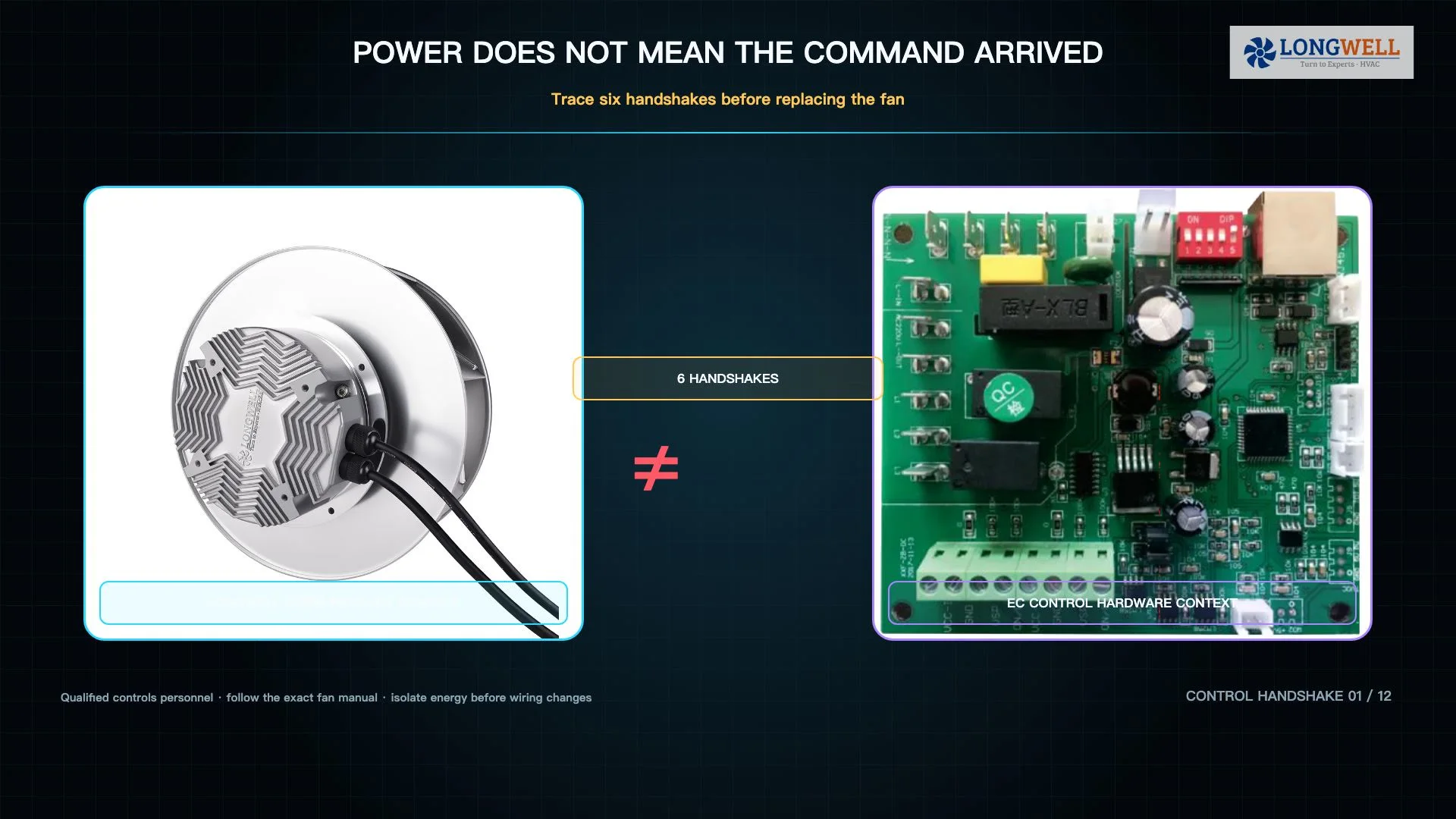
Longwell’s EC fan selection workflow provides a practical way to lock the application and interfaces before documentation is requested. After those boundaries are fixed, the EC backward-curved fan family can serve as a series-discovery route. Neither page is proof of regulatory coverage, certification, efficiency or suitability for a specific project.
Add regulatory review to normal project gates
Do not treat compliance as a one-time folder assembled at shipment. Review it when the market is selected, when the fan is shortlisted, when a configuration changes, before the purchase order, before production release and before final documentation. At each gate, record the reviewer, checked date, open items and release decision.
This cadence catches a common failure mode: the original test evidence may be sound, but the supplied configuration or controlling source has changed. A simple change log makes that drift visible and prevents an old conclusion from being copied into a new project.
Send suppliers a request that produces usable answers
Provide the destination market, equipment function, fan arrangement, airflow and pressure duty, operating modes, motor and control arrangement, environmental limits, proposed transaction date and the documents required by your release process. Ask for current exact-model data and the scope of every report or declaration.
Also state what you are not asking the supplier to assume. Do not ask for a universal compliance promise, a fixed energy-saving percentage or a conclusion based only on EC motor technology. The goal is a reviewable chain from authority and scope to configuration, test basis and evidence. That chain is what makes a changing-rule project manageable.