A kitchen exhaust system moves hot, greasy, humid air, and every part of it has to cope with that. The fan is only one component in a chain that includes the canopy, the filters, the duct and the make-up air.
Get any one wrong and the kitchen either fills with smoke or costs a fortune to heat.
Size kitchen exhaust from canopy face velocity, typically 0.25 to 0.4 m/s across the open face, then keep duct velocity between 7.5 and 10 m/s so grease stays airborne. Use an upblast roof fan with a grease drain, provide make-up air for at least 80 percent of the extract, and design for cleaning access along the whole duct run.
Start at the canopy, not the fan
Capture happens at the hood. If the canopy does not contain the plume, no amount of fan capacity will rescue it.
- Overhang the cooking line on all accessible sides, typically by 150 mm or more.
- Set hood height as low as practical, since capture falls off quickly with distance.
- Choose face velocity by appliance duty, from light to heavy cooking.
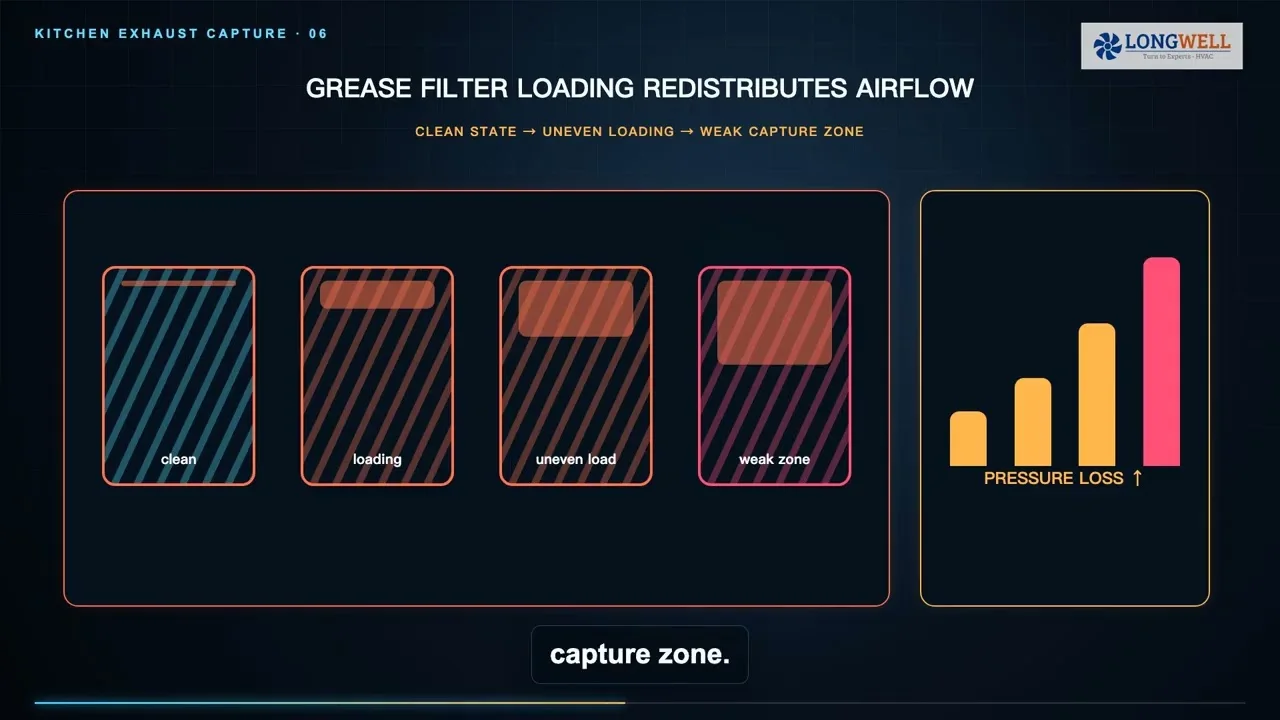
- Fit baffle filters rather than mesh, because baffles separate grease and clean easily.
- Avoid cross-draughts from doors and air conditioning, which destroy capture.
- Finally, check local codes, as they usually prescribe minimum rates.
A well-designed canopy often needs less airflow than a poor one, which saves both fan energy and make-up air heating.
Duct velocity keeps grease moving
Grease-laden air deposits whenever it slows down, and deposits in ductwork are a fire risk.
| Duct velocity | Result |
|---|---|
| Below 5 m/s | Heavy deposits, high fire risk |
| 5–7.5 m/s | Deposits likely on long runs |
| 7.5–10 m/s | Recommended working range |
| Above 12 m/s | Noisy and wasteful of fan energy |
That range constrains duct sizing, so kitchen exhaust ducts are deliberately smaller than ordinary ventilation ducts of the same airflow.
Choosing the fan
Roof-mounted upblast centrifugal fans dominate commercial kitchen exhaust, and for good reasons.
They discharge vertically away from the roof surface, they keep the motor out of the airstream, and they include a grease collection drain. Meanwhile inline centrifugal fans appear where a roof unit is impossible, although they need careful access for cleaning.
Keep the motor outside the airstream wherever possible. Grease attacks windings and bearings, and a motor in the stream needs cleaning as often as the duct does.
Make-up air is half the system
Extracting 6,000 m³/h from a sealed kitchen simply creates a vacuum, and the kitchen then pulls air from the dining room, the flue and every door gap.
- Provide make-up air for at least 80 percent of the extract rate.
- Temper it in cold climates, since untempered air makes the kitchen unworkable.
- Introduce it away from the canopy so it does not disturb capture.
- Interlock supply and extract so they start and stop together.
- Check that gas appliance flues still draw correctly under all fan modes.
- Finally, balance the building so the kitchen stays slightly negative to the dining area.
That last point keeps cooking odours out of the restaurant, which customers notice long before they notice the ventilation.
Cleaning and maintenance access
Grease systems are cleaned regularly by law in most markets, so the design has to make that possible.
Provide access panels at every change of direction and at intervals along straight runs. Meanwhile specify a fan with a hinged base so the wheel can be reached without removing the unit. Our food truck hood blower guide covers the compact end of the same problem.
For fire safety requirements covering ductwork, cleaning intervals and fan construction, NFPA 96 is the reference standard in North America.
Energy and control
Kitchen extraction is expensive because every cubic metre extracted has to be replaced and often heated.
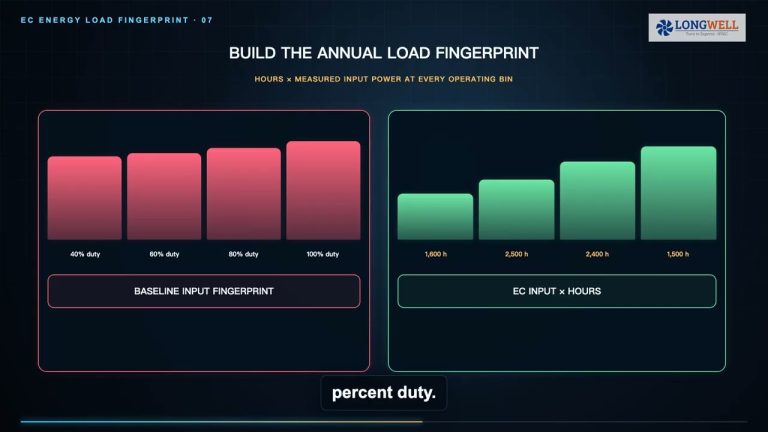
Demand-controlled kitchen ventilation uses temperature or optical sensors in the canopy to reduce airflow when appliances are idle. Because fan power follows the cube of speed, and because make-up air heating falls in proportion, savings of 30 to 50 percent are realistic in kitchens with variable trade.
Our exhaust blower range and roof exhaust fans cover the fan side, with EC options where variable control is wanted.
Kitchen exhaust FAQ
How much airflow does a commercial canopy need?
It depends on appliance duty and canopy type, although 0.25 to 0.4 m/s across the open face is a common starting point. Local codes usually prescribe minimum rates by appliance category.
Can I use a standard axial fan for kitchen exhaust?
No. Grease, temperature and duct resistance all rule it out, and most codes require fan construction suited to grease-laden air with a collection drain.
Why does my kitchen fill with smoke despite a big fan?
Almost always capture rather than capacity. Check hood overhang, height, cross-draughts and whether make-up air is being introduced too close to the canopy.
How often should the system be cleaned?
Typically every three to twelve months depending on cooking volume and local regulation. Heavy solid-fuel cooking can require quarterly cleaning or more.
Design kitchen exhaust from the canopy outward: capture first, transport velocity second, fan third, and make-up air alongside all of it.
Choose the right blower
Longwell manufactures 247 blowers in-house. Send airflow, static pressure and voltage — an engineer replies with a matching model, performance curve and price within one working day.