Industrial fans can look deceptively similar in a quotation: an inlet, an impeller, a housing and a motor. Yet two offers that share a nominal size may describe very different equipment and very different supplier responsibilities. The price gap often sits in the scope that a one-line comparison leaves out.
The practical answer is not that an expensive fan must be better. It is that industrial fan cost reflects the defined duty, construction, drive and controls, evidence, documentation and delivery boundary. Compare those layers first. Only then does the headline price become useful.
Start with the same airflow and pressure duty
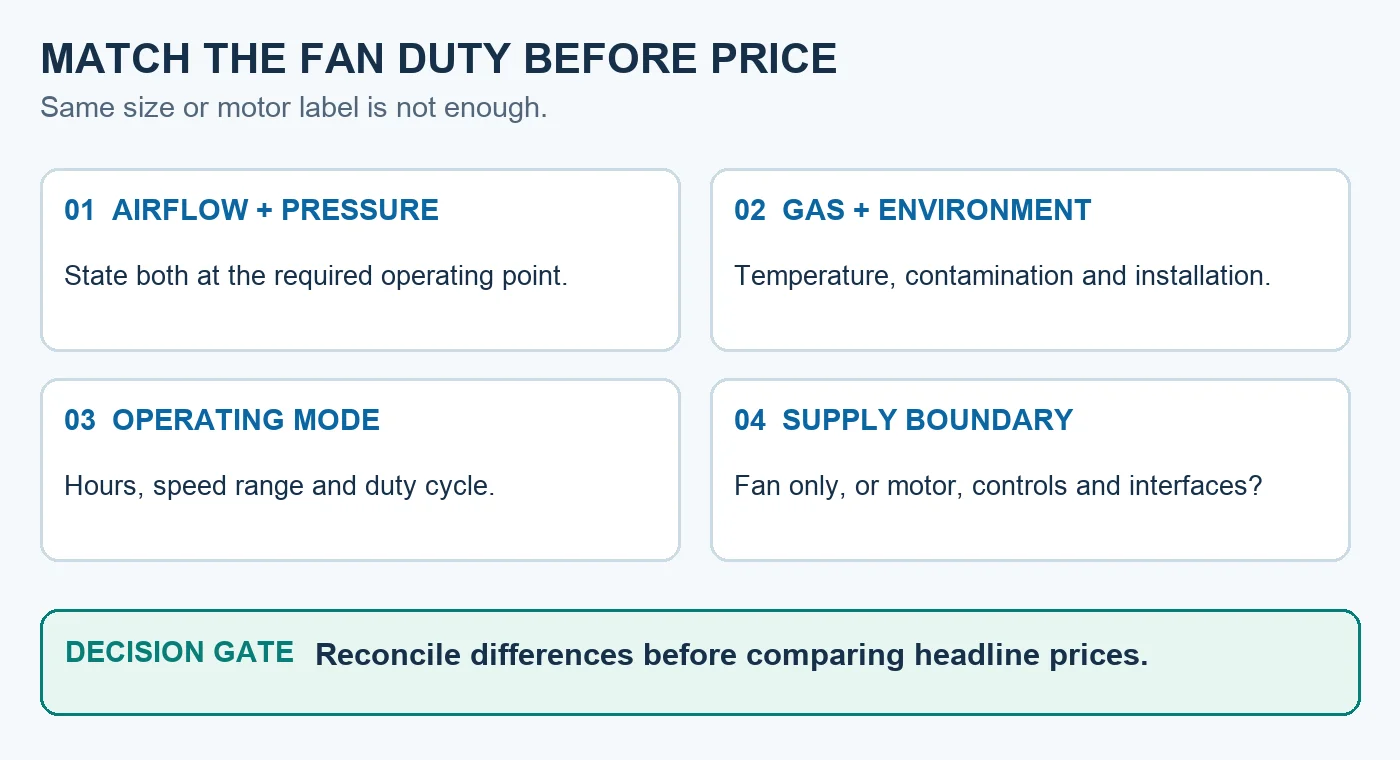
A quote is comparable only when every supplier is solving the same air-moving problem. State the required airflow and pressure together, then identify the gas condition, temperature, contamination, duty cycle and operating environment. Fan type and arrangement also belong in that definition. If one proposal is based on a different duty or supply boundary, its lower number is not yet a saving; it is a different offer.
Terminology can hide this difference. The distinction discussed in the fan vs blower guide is useful context, but a label alone does not establish the operating point or project fit. Procurement should work from the approved duty and application data, not from the product name.
Aerodynamic engineering is part of the purchased scope
Selection work may include the fan characteristic, system interaction, stable operating range, drive sizing, rotating loads, sound and vibration considerations, structural interfaces and drawing review. Some applications can use a catalog-configured arrangement. Others need engineered changes or a custom solution. Those paths do not carry the same work or the same deliverables.
Ask who owns each decision and what evidence will be delivered. A proposal that includes application review, defined interfaces and controlled approvals should not be compared as though it were only a loose fan assembly. Conversely, a higher price does not prove that this engineering has been done; the quotation and submittal must show it.
Construction follows the gas and the environment
Housing and impeller material, fabrication route, thickness, coating, sealing, clearances, shaft and bearing arrangement, guarding and access can all change what is being supplied. The right combination depends on the actual gas, contaminants, temperature, installation and maintenance plan. A broad material name or a polished finish is not proof of suitability.
This is also why diameter and motor power make a weak shortcut for price comparison. They say little about the full rotating assembly, housing geometry, corrosion or erosion considerations, inspection boundary or installation interface. Require each proposal to state these items in the same order so omissions become visible.
Motor, drive and controls can turn a fan into a system
A bare fan and an integrated package are not equivalent purchases. The electrical scope may include a motor, direct or belt drive, starting method, variable-speed or electronically commutated control, protection, sensors, communication, disconnects, panels or project-specific accessories. Environmental and electrical requirements must also be stated for the actual installation.
Separate included equipment from required equipment supplied by others. Then review the interface: electrical supply, control signal, feedback, alarms, limits and commissioning responsibility. This prevents an apparently inexpensive fan from acquiring essential components later, while also preventing unnecessary options from being treated as automatic value.
Testing and documentation are evidence, not decoration
Aerodynamic, sound, vibration, electrical, material, weld and coating checks are different activities. A type test, a production check and a witnessed project inspection are not interchangeable. The applicable method, test condition, acceptance criterion, report and unit coverage should be explicit. Never infer that every shipped unit received every possible test.
Documentation has a similar boundary. Drawings, calculations, manuals, certificates, inspection plans, point lists, spares lists and revision cycles require named responsibility. The industrial centrifugal fan sourcing guide provides a useful supplier-review framework, while the approved project specification and current evidence remain controlling.
Safety and compliance must stay inside the comparison
Guarding, access protection, isolation, electrical protection and application-specific construction can be mandatory. Requirements for hazardous areas, elevated temperature or process service depend on the project and jurisdiction. They are not cosmetic extras to remove simply to reach a lower figure.
Write the adopted requirements into the comparison and ask for exact supporting evidence. Do not treat a generic quality statement, logo or premium price as proof. Equally, do not assume a lower offer is deficient until its exclusions and deviations have been reconciled.
Delivery and service change the commercial boundary
Quantity, customization and schedule can change how engineering, setup and qualification work are distributed. Packaging, preservation, freight, insurance, duties, unloading, storage and installation may sit with different parties. A factory-gate offer and a delivered package cannot be compared responsibly without naming the delivery point and inclusions.
Commissioning support, training, spares, warranty terms, repairability and technical support may also matter. Count them only when they are explicitly included and relevant to the project. For one family-level starting point, the industrial fan category can help organize an initial search; it is not an exhaustive range and does not establish selection, compatibility, performance or commercial terms for a specific duty.
Use an included, excluded, deviation and evidence matrix
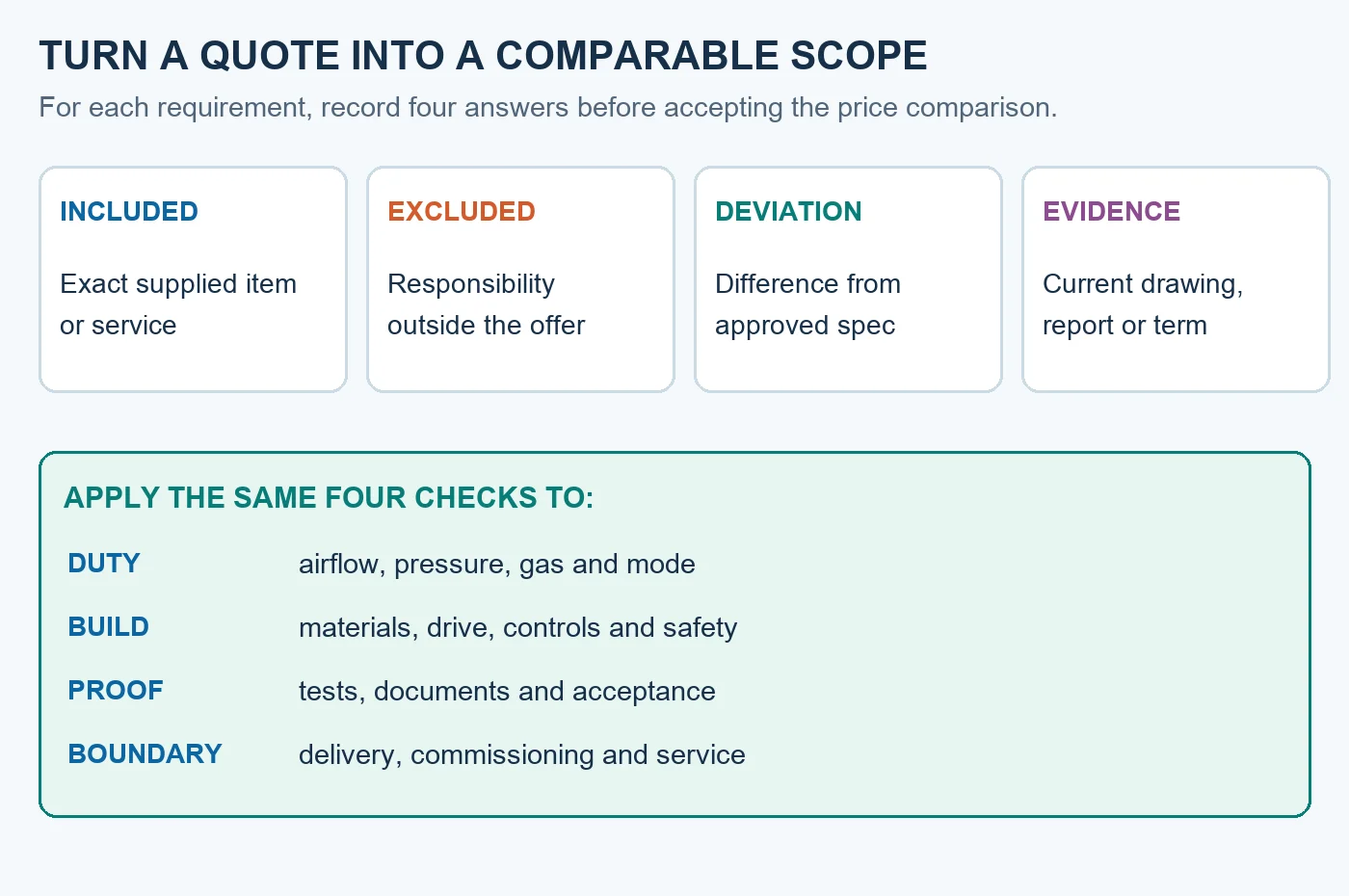
The most useful comparison tool is a four-column compliance matrix. For every duty, construction, drive, control, safety, test, document, delivery and service requirement, record what is included, what is excluded, any deviation and the evidence offered. Clarify blank cells rather than interpreting them in a supplier’s favor or against it.
Keep acquisition price separate from modeled lifecycle cost. Energy comparisons need the same useful airflow and pressure, total input boundary and a representative operating profile. Downtime, maintenance and payback need supported site assumptions. A low purchase price does not guarantee low ownership cost, and a high purchase price does not guarantee efficiency, reliability or longer life.
When is a higher industrial fan price justified?
A premium may be reasonable when it corresponds to necessary, documented scope: the right duty, suitable construction, required controls and protection, defined testing, complete interfaces and a delivery boundary the project actually needs. It is not justified merely because the equipment is described as heavy-duty, premium or custom.
Finish the technical reconciliation before negotiating the commercial total. That sequence turns “Why is this fan so expensive?” into a better decision: “Which necessary scope and evidence explain the difference, and which items can be removed without changing duty, safety or responsibility?”
Choose the right industrial fan
Longwell manufactures 38 industrial fans in-house. Send airflow, static pressure and voltage — an engineer replies with a matching model, performance curve and price within one working day.