Every fan selection ends with the same question: how much reserve should the fan have above the duty point? Too little, and the airflow collapses the first time the filters load up. Too much, and you have paid for a fan that runs at the wrong end of its curve, louder and less efficient than a smaller one would be. The practical answer used across the industry, and built into the LONGWELL Fan Selector, is a static-pressure margin of 10–25 %. This article explains what that margin is, why the band sits where it does, and how to read it on a real curve.
What the margin measures
Take your duty point: an airflow Q and a required static pressure P. Go to the fan curve, find your airflow on the horizontal axis, and read the static pressure the fan has available there. Call it Pavail. The margin is
margin = (Pavail − P) / P
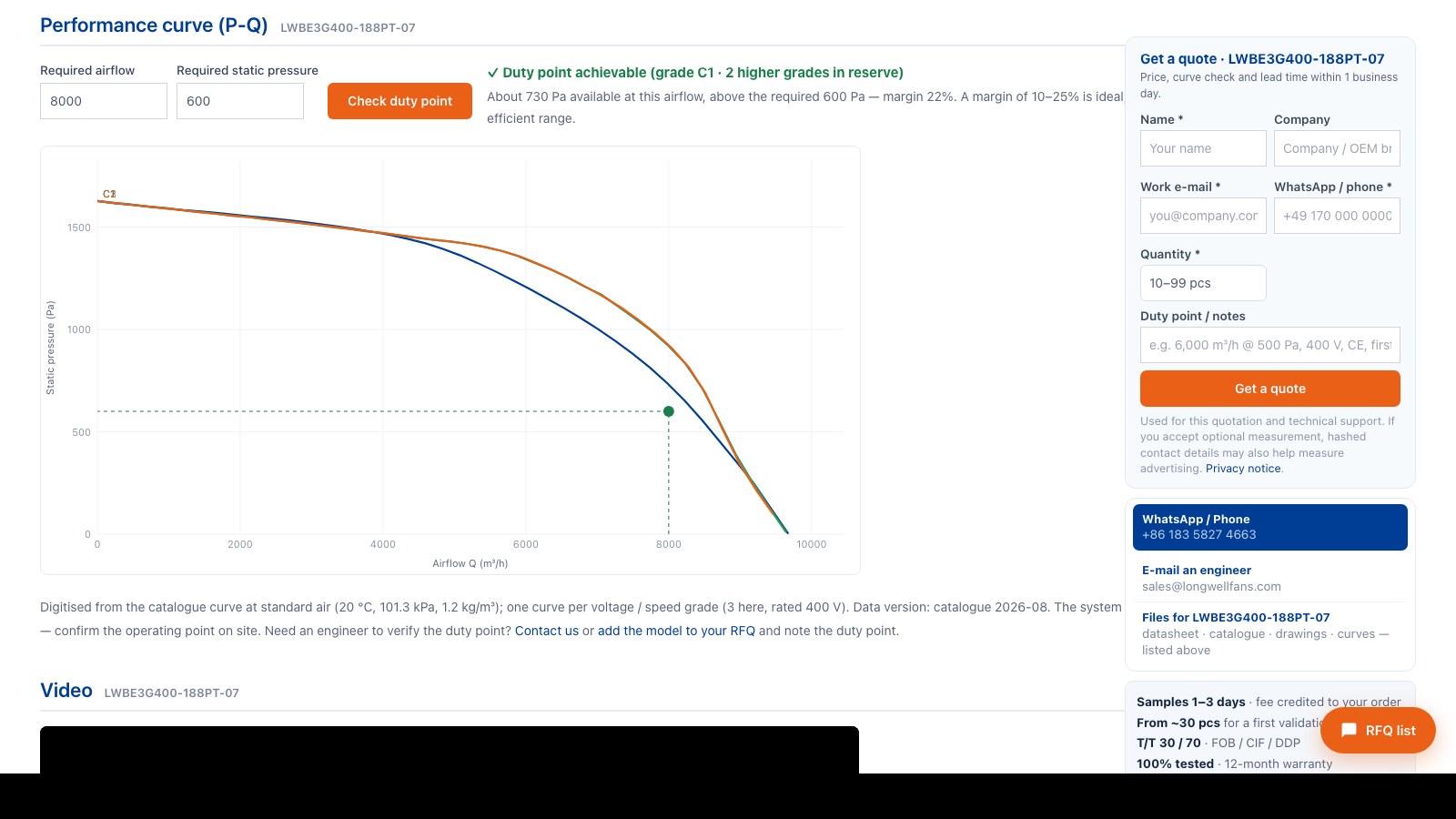
In the example above, LWBE3G400-188PT-07 has about 730 Pa available at 8,000 m³/h in its lowest speed grade, against a requirement of 600 Pa. The margin is (730 − 600) / 600 = 22 %. Note what the margin is not: it is not the distance to the nameplate maximum pressure, which is measured at zero airflow and has nothing to do with your operating point.
Why not zero margin?
A fan with no margin meets the duty point on the day of commissioning and never again. Three things push the required pressure up over the life of the installation:
- Filter loading. A filter’s pressure drop rises between changes, often to double its clean value. A margin sized for the dirty condition keeps the airflow inside its design range for the whole filter life.
- Installation losses. Real inlets and outlets are rarely the ideal straight duct of the test rig. A bend close to the inlet, a grille, or a cramped plenum adds pressure that no drawing shows.
- Air density. Warm exhaust air or a site above sea level lowers the pressure a fan produces. The curve is published at 1.2 kg/m³; the site is not.
The selector flags a margin below about 8 % as tight for these reasons. A tight selection is not wrong, but it needs a reason: a clean-room fan with no filter change, a fixed short duct, a controlled temperature.
Why not a large margin?
If reserve were free, engineers would choose 50 %. It is not free, for four reasons:
- Efficiency. A fan produces its best efficiency in a band around the middle of its curve. Running at a small fraction of its airflow range, near the shut-off end, moves it off that band; the input power at the point rises relative to the air power delivered.
- Noise. Backward-curved and axial fans are noisiest towards shut-off; an oversized fan throttled to the duty point is a louder fan.
- Stability. Some fan types have an unstable region at low airflow where the curve dips; a fan chosen far too large can operate in it.
- Cost and size. A bigger frame, a bigger motor and a bigger cut-out, paid for reserve that is never used.
The selector’s match score includes a penalty for exactly this case: candidates that would run at a small fraction of their airflow range drop down the list even if their margin looks generous.
The 10–25 % band, and what it looks like in a shortlist
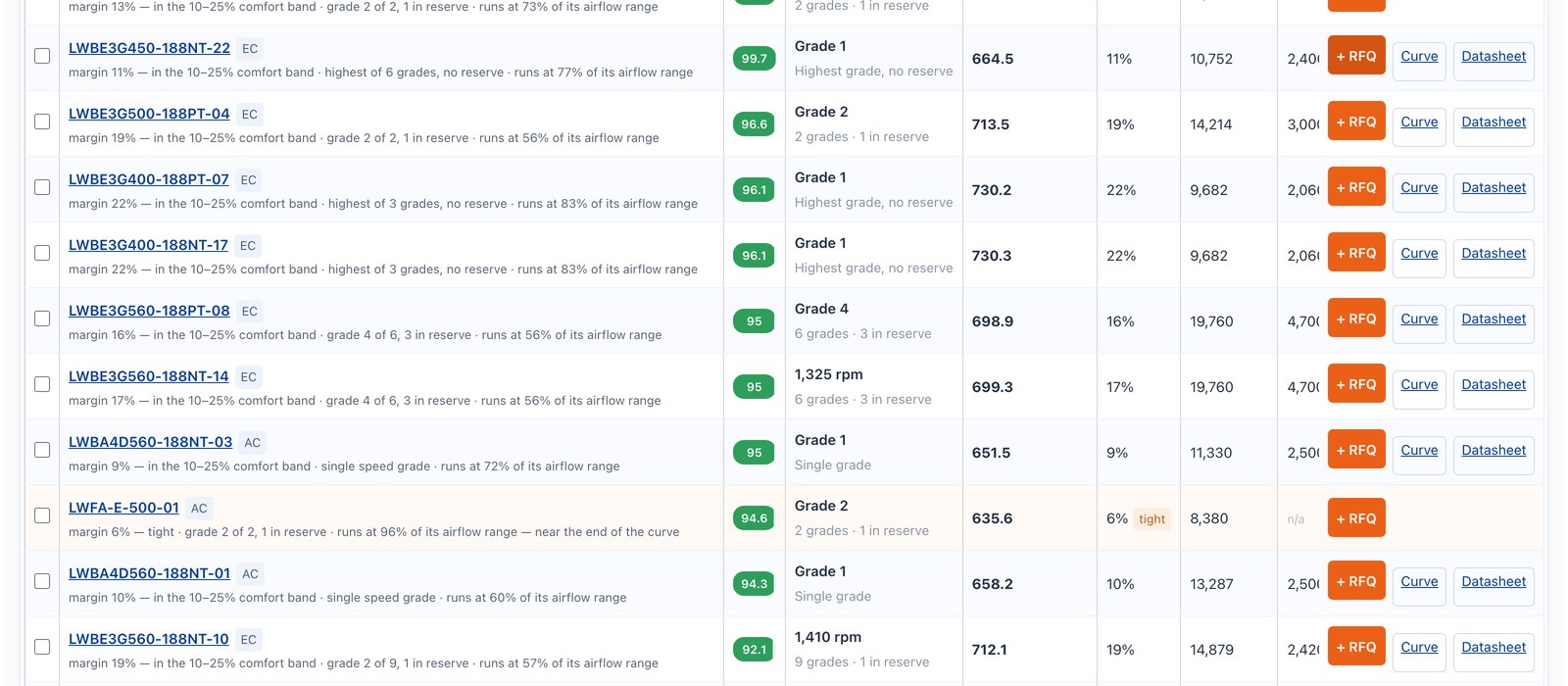
For 8,000 m³/h at 600 Pa the shortlist spreads from a 6 % margin, flagged tight and running at 96 % of its airflow range near the end of the curve, to 25 % at the top of the band. Rows in between differ in a second way: the speed grade. EC fans and multi-speed AC fans have several curves; the selector picks the lowest grade that clears the point and counts the higher grades as reserve. A model at 13 % margin in grade 2 of 2 has no further reserve; a model at 22 % in grade 1 of 3 can be sped up twice without changing the hardware. When the load is uncertain, the second is the safer choice at the same margin.
Reading the margin on the model page
Open any model with a curve and type the duty point into the curve check. The page marks the point on the P-Q curve and states the result in words: achievable or not, in which grade, with what margin, and how many grades remain in reserve. The same rule is used in the shortlist, so the number you see on the model page is the number you saw in the list.
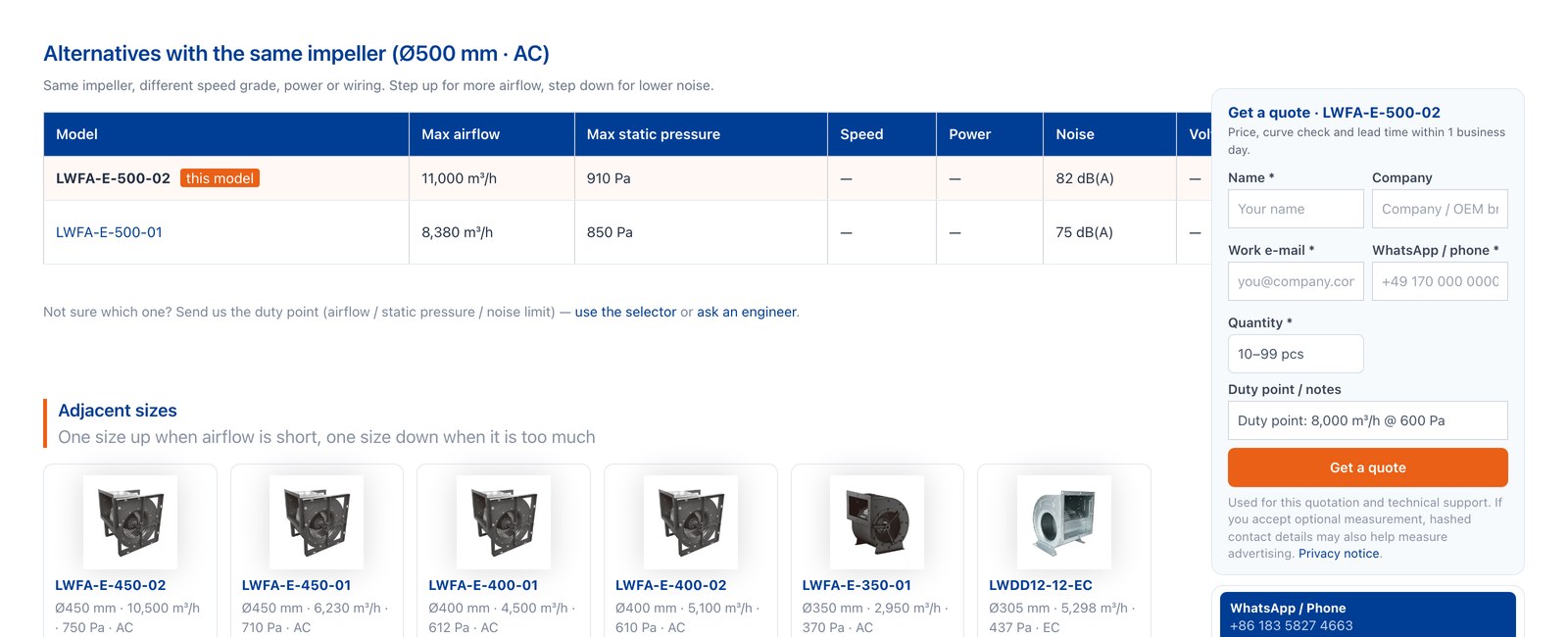
If the margin is outside the band, the alternatives are already on the page: the same impeller in another speed grade, one size up, one size down. Moving one size up on a tight selection typically lands inside the band; moving one size down on an oversized one does the same from the other side.
Margin rules of thumb
| Situation | Target margin | Note |
|---|---|---|
| Filtered supply or exhaust, filters changed on pressure drop | 15–25 % | size for the dirty filter, or leave a speed grade in reserve |
| Short fixed duct, no filter, controlled temperature | 10–15 % | a tight margin is acceptable with a documented reason |
| Site above 1,000 m or exhaust above 40 °C | correct the pressure first | use the air density calculator, then apply 10–25 % |
| Uncertain future load | 10–25 % plus a grade in reserve | prefer EC with speed control |
Ready to check a selection? Enter the duty point at select.longwellfans.com, or follow the full method in How to select a fan by duty point. For the fan-law side of the same question, the fan affinity laws calculator shows what a speed change does to airflow, pressure and power.