Watching a fan factory run explains a great deal about why two apparently identical fans behave differently.
Nearly every step along the way shifts performance. Worse, an error made early rarely gets corrected later.
A fan factory turns steel coil and copper wire into finished units through blanking, forming, welding, motor winding, rotor magnetising, balancing, assembly, electrical test and airflow checks. Of those, welding and balancing decide most of the noise, vibration and service life you eventually get.
Blanking and forming the wheel
Blades, backplates and shrouds all start as flat blanks. A press stamps them out of steel coil.
Tooling accuracy shows up straight away, since blade profile drives aerodynamic performance. Meanwhile a burr on an edge stirs up turbulence, so deburring earns its place on the line.
Forming presses then give each blade its curve. A press slightly out of tolerance turns out wheels that all fall a little short of the tested sample, and a good fan factory catches that drift early.
Welding and assembly of the impeller
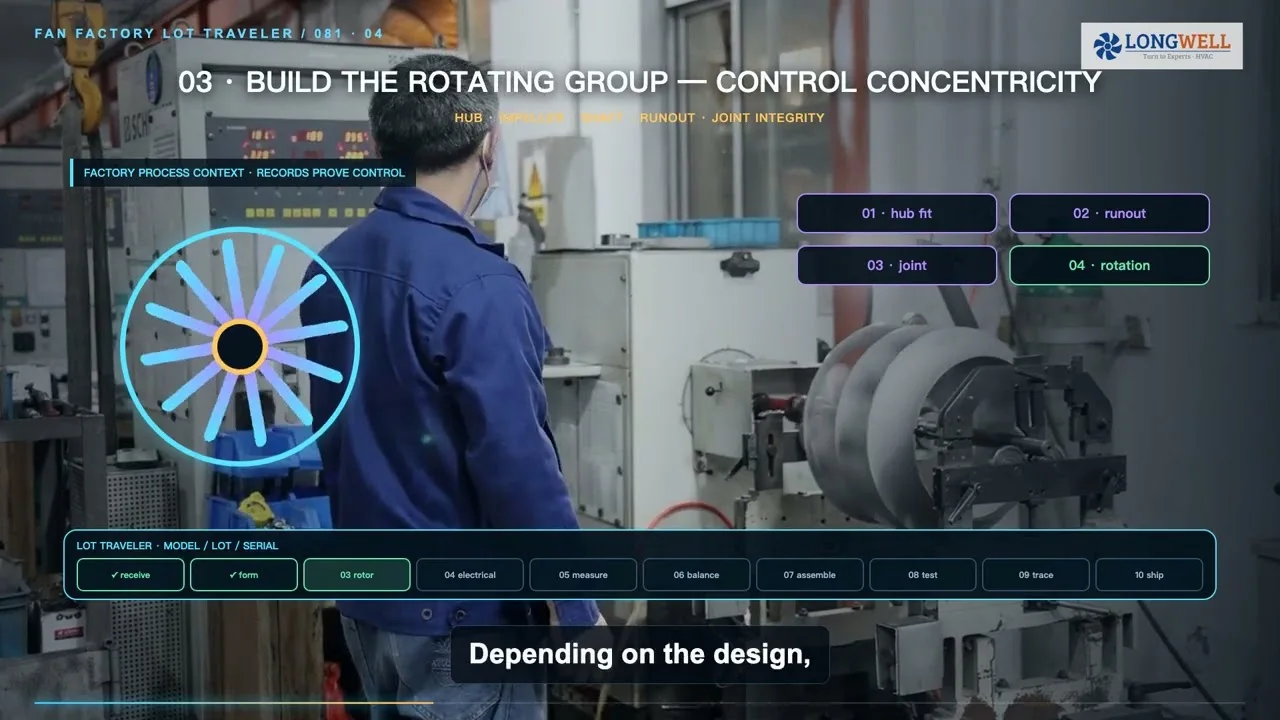
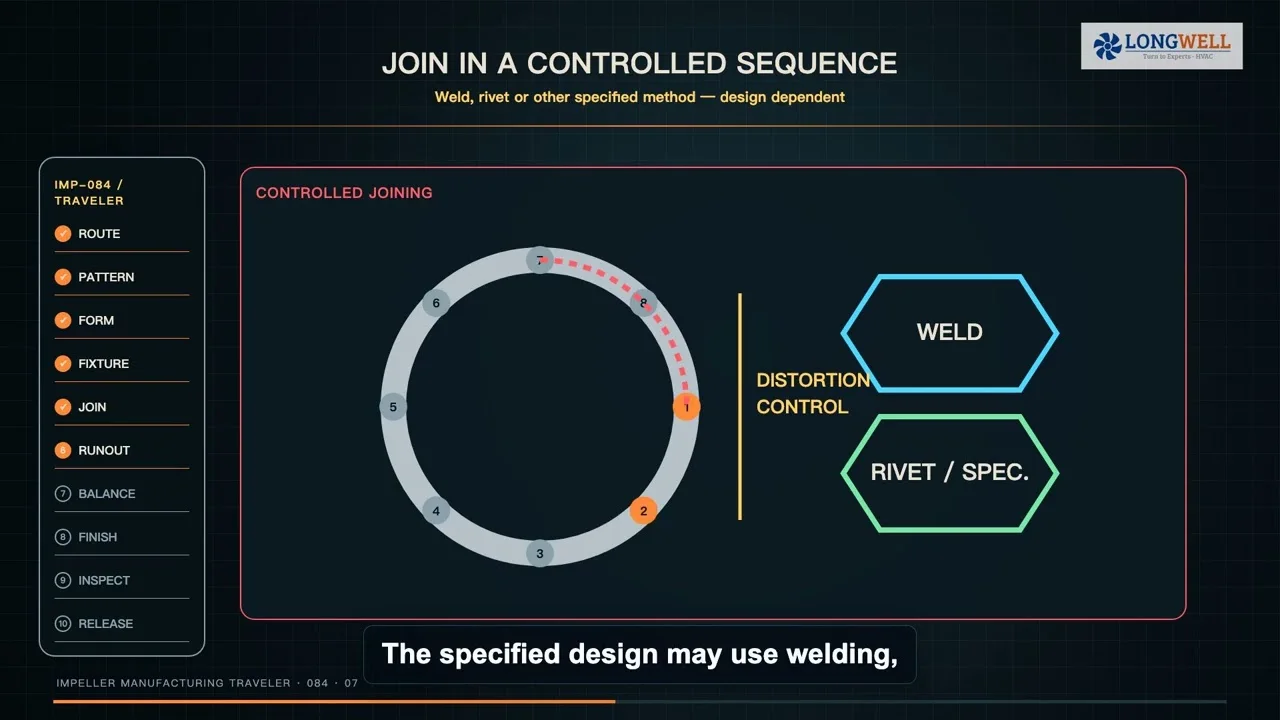
Blade-to-backplate joints carry the whole centrifugal load, so weld quality drives both performance and safety.
- Fixtures hold blade angle and spacing steady across a whole batch.
- Robot welding repeats what hand welding cannot.
- Heat pulls a backplate out of flat, so distortion control matters.
- Operators check weld penetration on structural joints rather than assume it.
- Spacing errors shift blade passing noise, even when performance looks fine.
- Finally, an inspector checks run-out before the wheel moves on.
Our backward-curved impeller manufacturing guide follows a single wheel through this stage in more detail.
Motor winding and magnetisation
The line winds, insulates, impregnates and tests every stator long before it meets a rotor.
For EC motors the rotor carries permanent magnets, and a fixture magnetises them after assembly. Meanwhile a separate line builds and tests the drive boards, then pairs each one with a motor and configures it for that fan.
Our motor winding and controller assembly guide covers this stage properly.
Balancing: the step that decides service life
Every wheel goes through a balancing machine, and the grade it reaches drives bearing life and noise.
| Balance grade | Typical use |
|---|---|
| G6.3 | General ventilation fans |
| G2.5 | Critical, high speed or vibration-sensitive equipment |
| G1.0 | Precision applications, rarely needed in HVAC |
Balancing hides nothing. A wheel with uneven welds needs more correction weight, so the balancing record quietly reports on everything upstream. See our impeller balancing and QC guide.
Assembly, electrical test and run-in
- A press fits the bearings with controlled force, never a hammer.
- Assembly mounts the wheel, then sets and checks inlet ring clearance.
- Insulation resistance and hipot tests then confirm electrical safety.
- A functional test checks rotation, speed and current draw.
- Run-in at duty settles the bearings and flushes out early failures.
- Finally, a technician measures vibration on the whole assembly, not just the wheel.
That last point matters. A perfectly balanced wheel can still vibrate once assembled if the hub fit or the bearing seat is out.
Airflow verification and packing
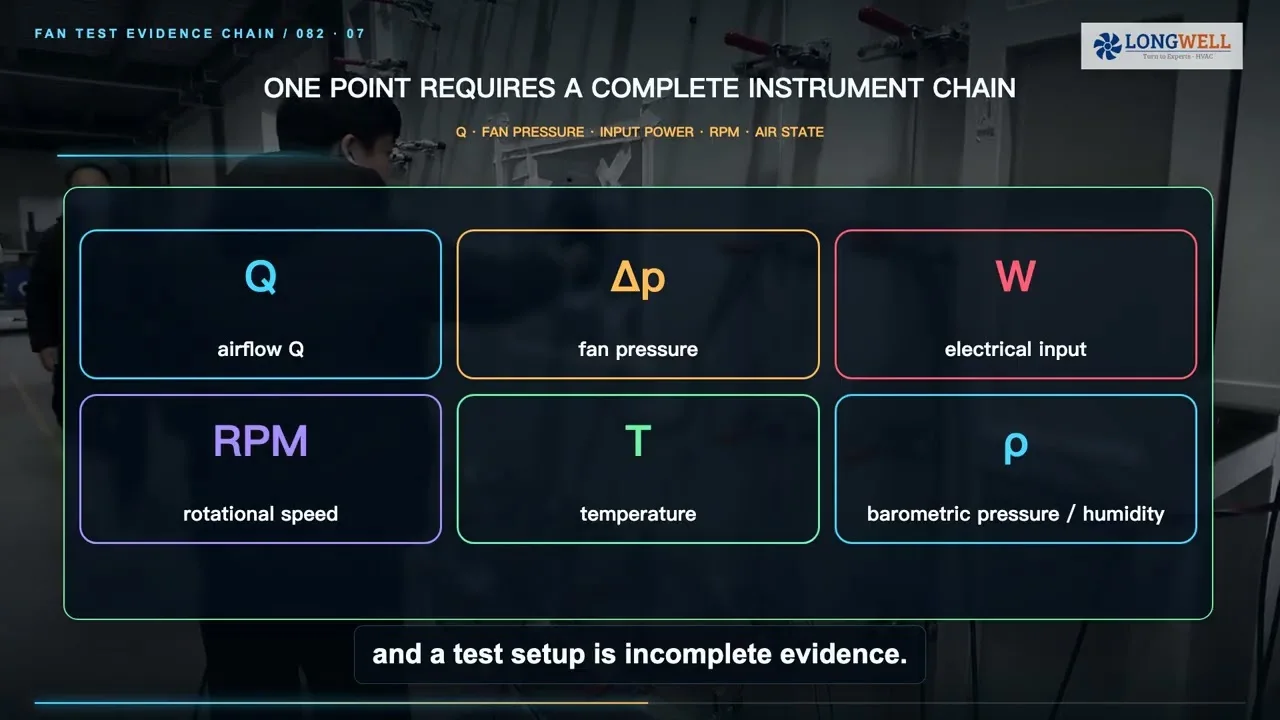
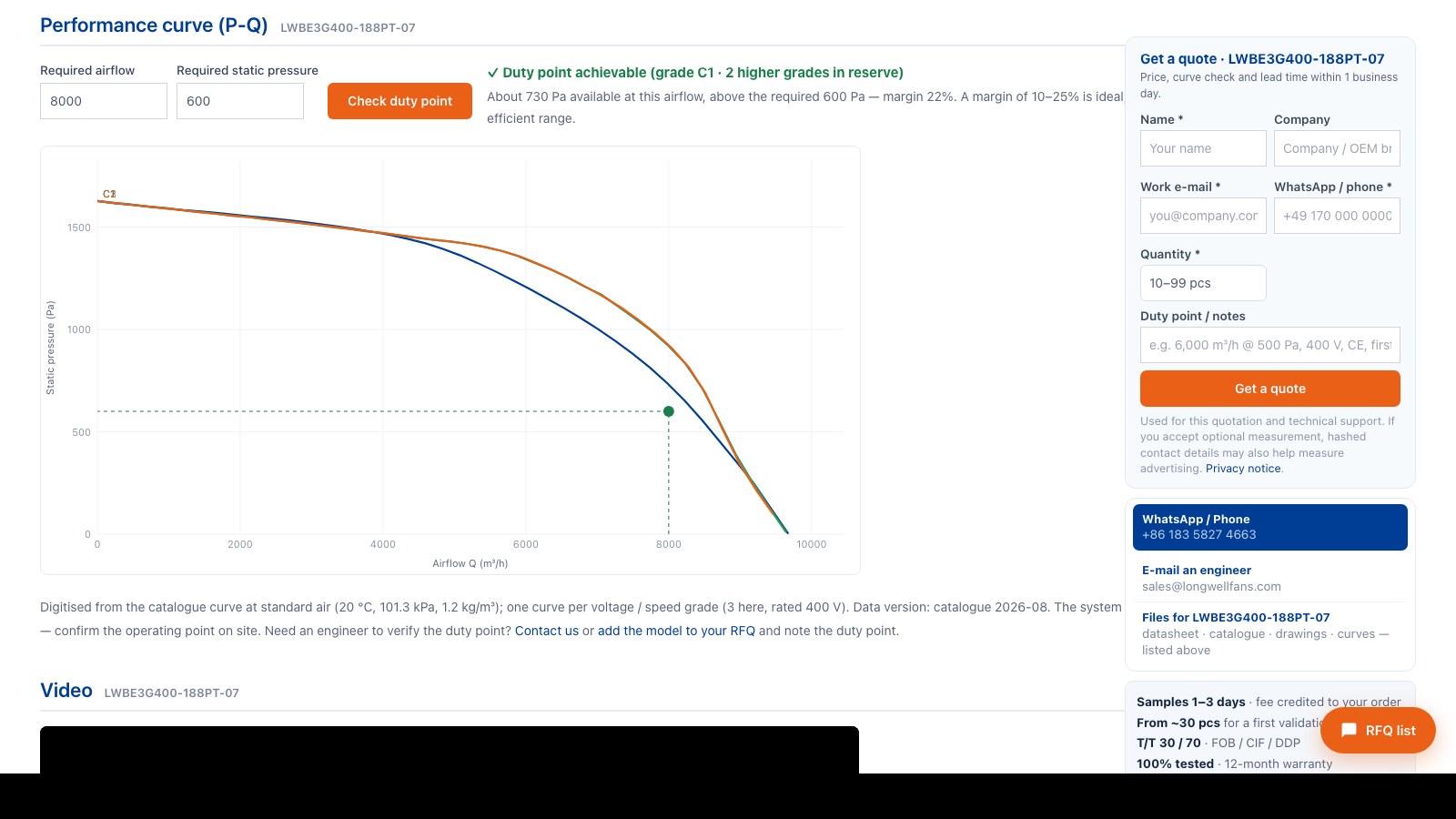
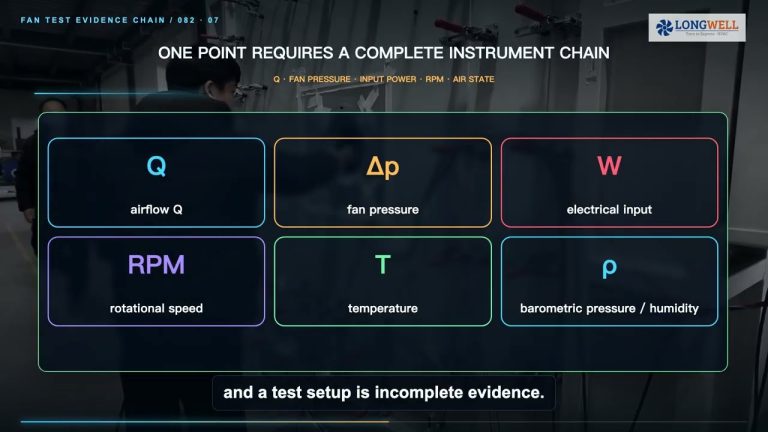
Sample units go on a test chamber to confirm the published curve, and production units get spot checks against it.
We test to AMCA 210/211 methods and provide the report on request. Meanwhile packing has to survive a container, so vibration and moisture protection are part of the design rather than an afterthought.
Our packaging and shipping guide covers that side, and AMCA sets out what the test methods actually control.
One habit separates a good plant from an average one. Every batch keeps its own record: press settings, weld parameters, balance weights, test results. So when a customer calls two years later about one noisy unit, the plant can look up that exact fan rather than guess.
That traceability costs almost nothing to maintain, yet it changes what a factory can promise. It also makes any audit far shorter, since the answers already exist on paper.
Fan manufacturing FAQ
How long does it take to make a fan?
The processes themselves take hours rather than days. Lead time is dominated by material availability, batch scheduling and any certification testing rather than by machining time.
What single stage affects quality most?
Balancing shows the result, although welding and forming create the condition that balancing has to correct. Consistency upstream is what makes downstream quality cheap.
Can a fan factory make one-off units?
Yes, using fabricated rather than moulded parts. Costs rise sharply per unit, which is why tooling only makes sense above a certain annual volume.
How do I judge a factory without visiting?
Ask for process documentation, calibration records, balancing data and test reports. Our remote factory audit guide sets out a structured approach.
A fan factory is a chain where every stage constrains the next. Consistency in forming and welding is what makes the balancing, the noise and the service life predictable.