Can an airfoil impeller be the most efficient choice? It can be a strong candidate at a particular operating point, but its blade name does not establish the efficiency of a complete fan. The defensible comparison is between rated fans delivering the same airflow and pressure under comparable test and installation conditions. This article shows what the airfoil profile can change, where that advantage can disappear, and what evidence to request before specifying a wheel.
What an airfoil section can change
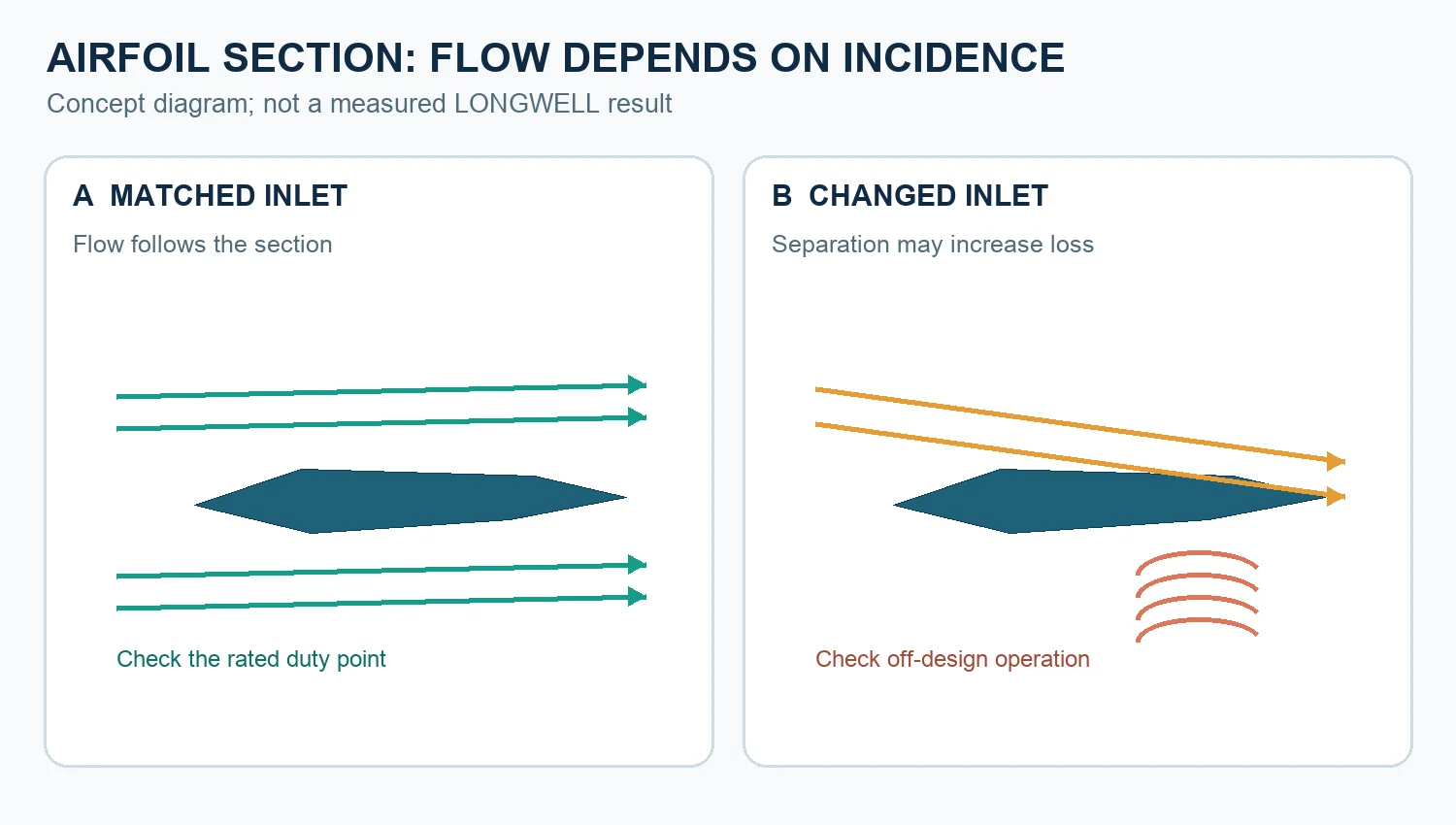
An airfoil blade has a shaped section rather than a simple flat plate. The intended inlet angle, camber, thickness, passage width, and outlet geometry all influence how air moves through the rotating wheel. When the flow approaches the blade as designed, the boundary layer may remain attached over more of the passage. Less separation can mean less aerodynamic loss. It is a mechanism, not a guarantee that every airfoil wheel beats every plate wheel.
At a different flow rate or rotational speed, the relative inlet direction changes. A blade that worked well near its intended point can then see greater incidence and separation. The same profile must be judged across the actual operating range, including reduced flow, filter loading, control changes, and any required standby condition. The sketch compares these conditions qualitatively; it contains no measured LONGWELL performance data.
Why a single peak percentage is a poor buying rule
Efficiency requires a defined boundary. Fan static efficiency, fan total efficiency, and electrical input efficiency answer different questions; a motor or drive can change the complete-system result. A catalog peak cannot be moved to an arbitrary airflow and pressure. Nor can a rating from one installation arrangement be treated as the delivered performance of a different inlet, plenum, outlet, guard, or duct. Ask the supplier to mark the proposed duty point on the exact current curve and state which power and efficiency definitions it uses.
The previous version of this article displayed broad efficiency ranges and a yearly energy-saving example without a controlled like-for-like comparison. Those figures are removed. A project-specific energy estimate needs the two actual fan selections, their input power at the same duty, the operating schedule, and the system-control assumptions. The apparent winner can change when the duty point moves.
What the LONGWELL RLM image does and does not prove
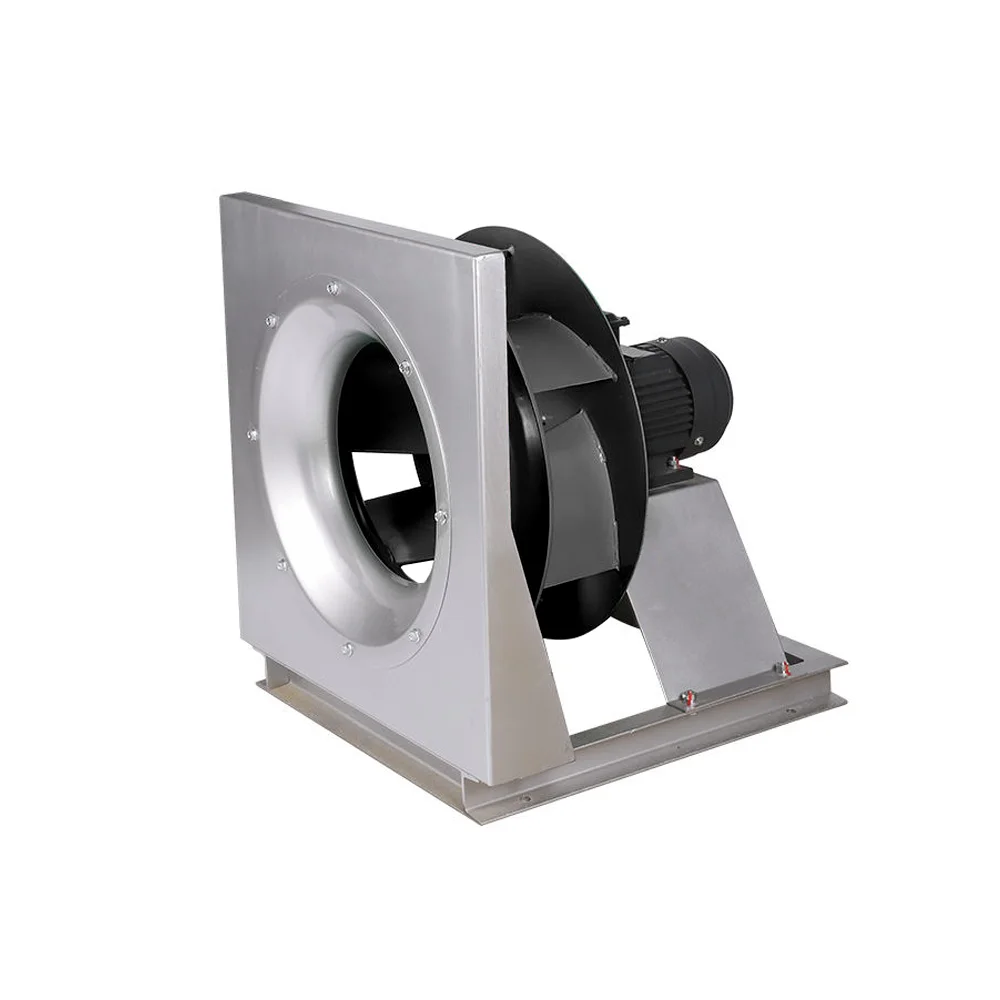
LONGWELL’s airfoil centrifugal fan family includes an RLM-series plenum construction. The RLM-250 catalog image below shows an inlet cone, wheel, support frame, and motor arrangement. It helps identify the assembly and its interfaces. The image cannot establish its blade-section revision, measured curve, certification scope, material specification, or suitability for a particular airstream. The RLM and RLMs family labels should be checked against the exact offered configuration.
Where air quality and maintenance alter the choice
Airborne dust, fibres, oil, moisture, and cleaning chemicals can affect the wheel and surrounding assembly. Deposits change surface condition and balance; erosion or corrosion depends on the material, concentration, particle size, velocity, temperature, and service time. Neither an airfoil nor a solid backward-curved blade can be approved from a label such as “dirty air” alone. Specify the actual contaminant and maintenance access, then obtain a material and cleaning review for the offered design.
Blade construction also varies. Some airfoil designs use hollow formed sections; other products have different geometries and materials. Do not assume every airfoil wheel is hollow, that deposits enter a sealed section, or that a damaged blade can never be repaired. A repair decision belongs to the manufacturer’s inspection and balance procedure. For a broader geometry overview, see LONGWELL’s impeller blade comparison, then verify the exact project model.
Compare complete fans at the same duty point
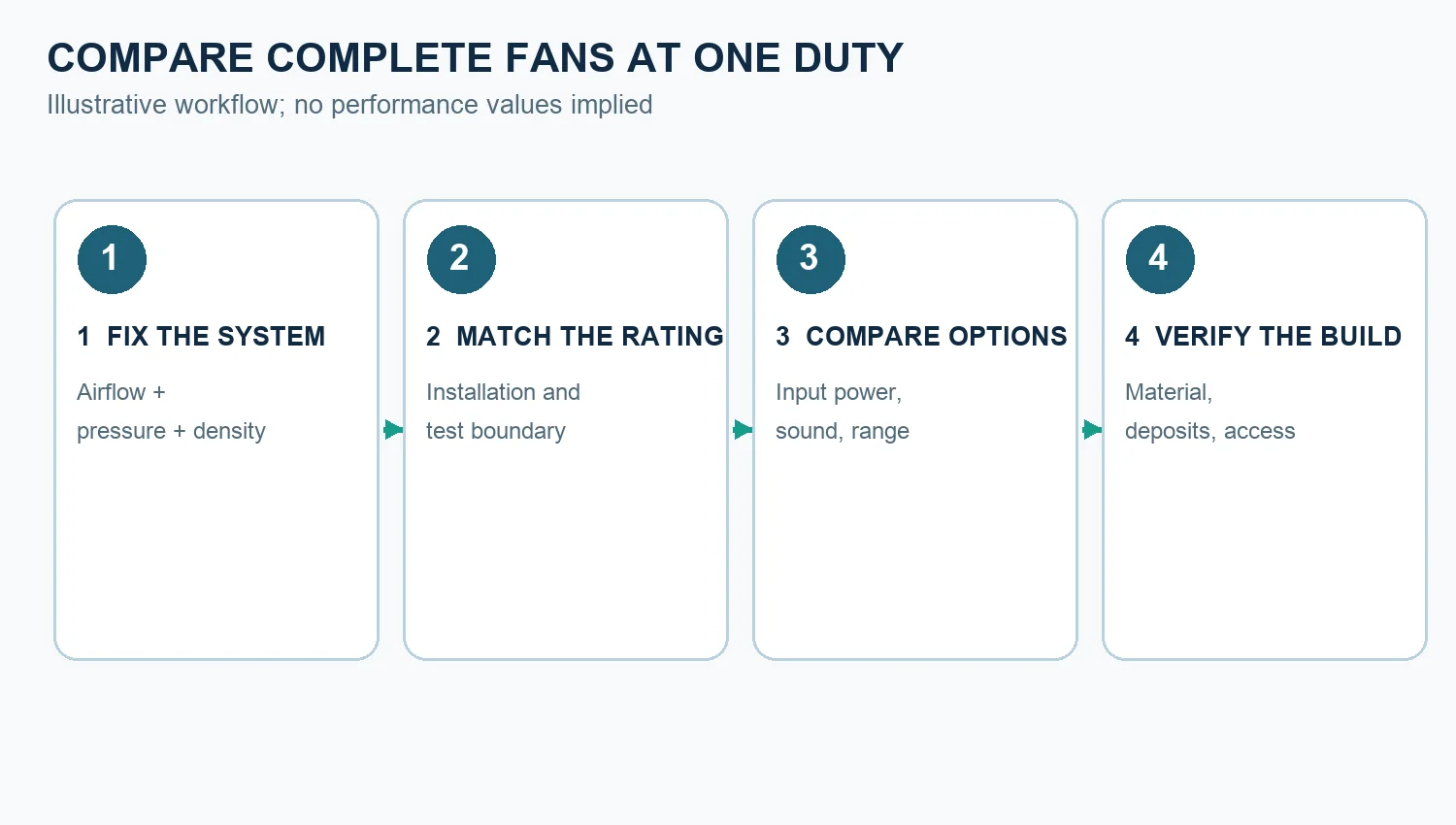
Start with required airflow, static or total pressure as appropriate, air density, temperature, and the expected operating range. Match the rating’s installation category and accessories to the real system. Compare input power, sound data with their stated boundary, control range, mechanical arrangement, service access, and the complete motor-and-drive package. An airfoil candidate may be attractive in clean, long-running service, but the decision still comes from the actual rated duty, not a presumed universal advantage.
Which documents should accompany an offer?
Request the exact model and suffix, current drawing revision, dimensional and electrical data, a curve at the specified density and installation boundary, the operating point, power definition, sound data, and any applicable controlled certification record. Confirm inlet and outlet clearances, motor and control limits, materials, and cleaning method. If the operating range crosses several points, ask for the curve over that range. A family page or product photograph is useful context, but it does not replace those documents.
Only after the same boundary is established should an efficiency or energy comparison be calculated. If one option lacks a comparable curve or sound test, mark that gap explicitly rather than filling it with a typical percentage. That is the practical meaning of “most efficient” for an OEM project: the best verified complete-fan choice for the specified duty and constraints.
Need a model-specific comparison? Email the duty point, air conditions, installation sketch, and operating schedule to sales@longwellfans.com.
Choose the right centrifugal fan
Longwell manufactures 1,136 centrifugal fans in-house. Send airflow, static pressure and voltage — an engineer replies with a matching model, performance curve and price within one working day.