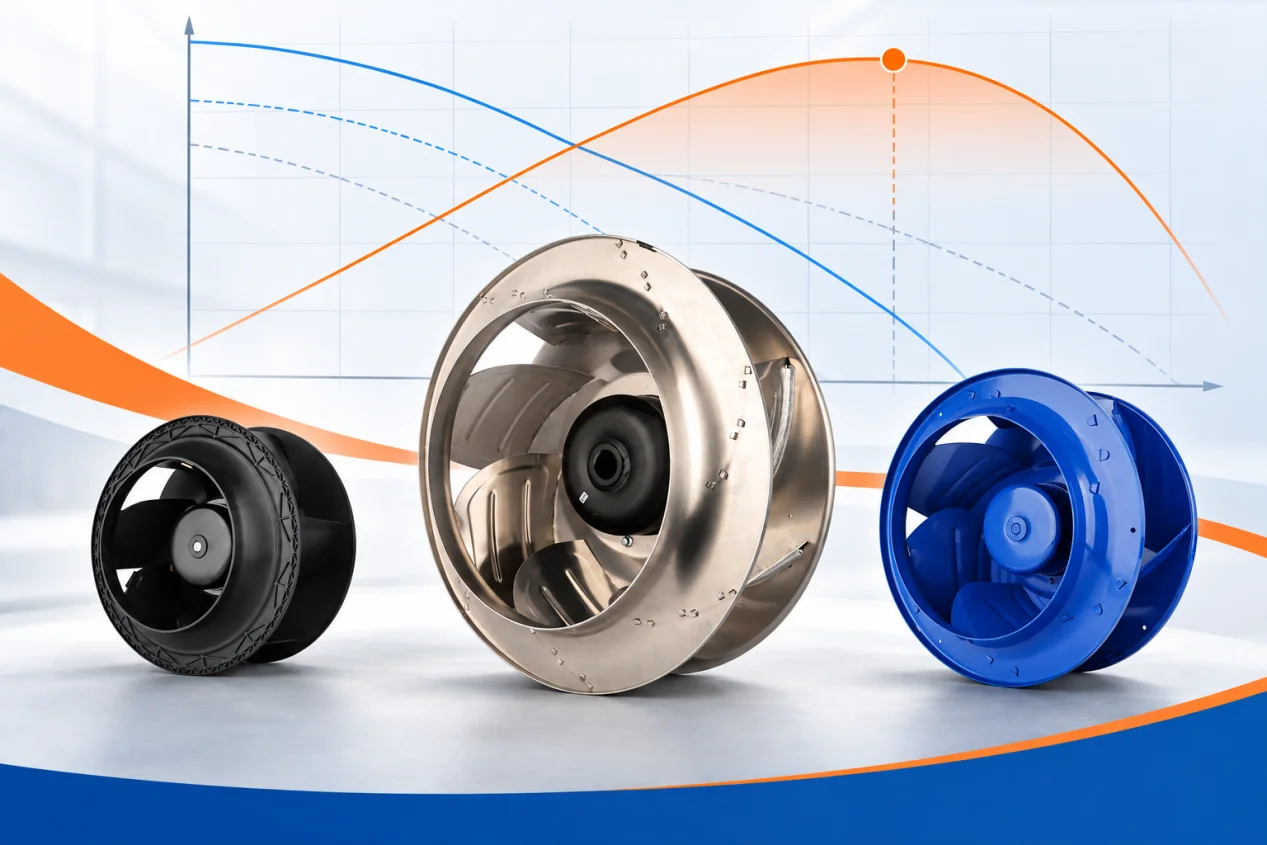
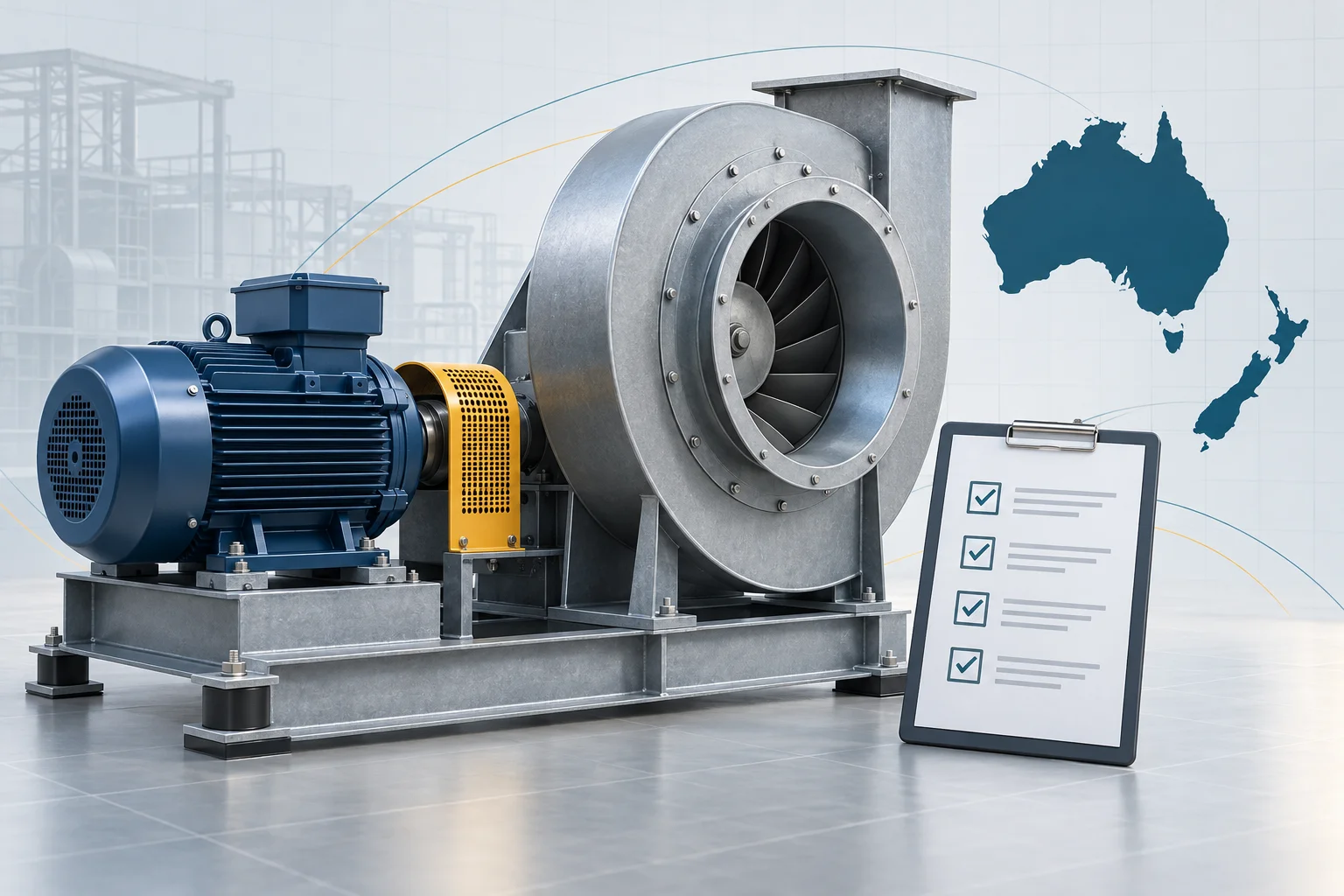
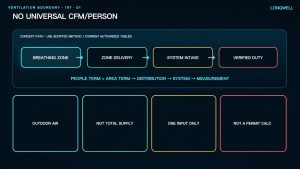
“Radial, forward-curved, backward-curved or airfoil?” sounds like a four-way product question. It is not quite that tidy. The first three names describe the blade direction at the impeller perimeter relative to rotation. Airfoil describes a shaped blade section and can overlap with a backward-inclined or backward-curved direction.
That distinction matters when an engineer or buyer compares quotations. A label can help you identify visible geometry, but it cannot replace the tested fan curve, absorbed-power data, sound data or the exact construction revision. This guide shows what each term tells you, what it does not tell you, and what to request before selection.
Start by separating blade direction from blade profile
AMCA terminology classifies a centrifugal impeller as forward-curved, radial or backward-curved/inclined according to the outward blade direction at the periphery. The U.S. Department of Energy fan sourcebook lists airfoil among common centrifugal blade shapes, but industry product names often combine it with a direction, such as a backward airfoil wheel.
So do not force every impeller into four mutually exclusive boxes. Record two attributes instead: direction at the outer diameter and blade section or construction. That simple change prevents a common RFQ error in which “airfoil” is treated as the opposite of “backward-curved.”
Forward-curved: many narrow blades inside compact packaging
A forward-curved blade bends toward the direction of rotation at its outer edge. The photographed LONGWELL blower makes the crowded, narrow passages visible through the inlet. It also shows why the wheel is usually discussed together with its scroll housing: the installed assembly, not the wheel name alone, defines the useful pressure-flow behavior.
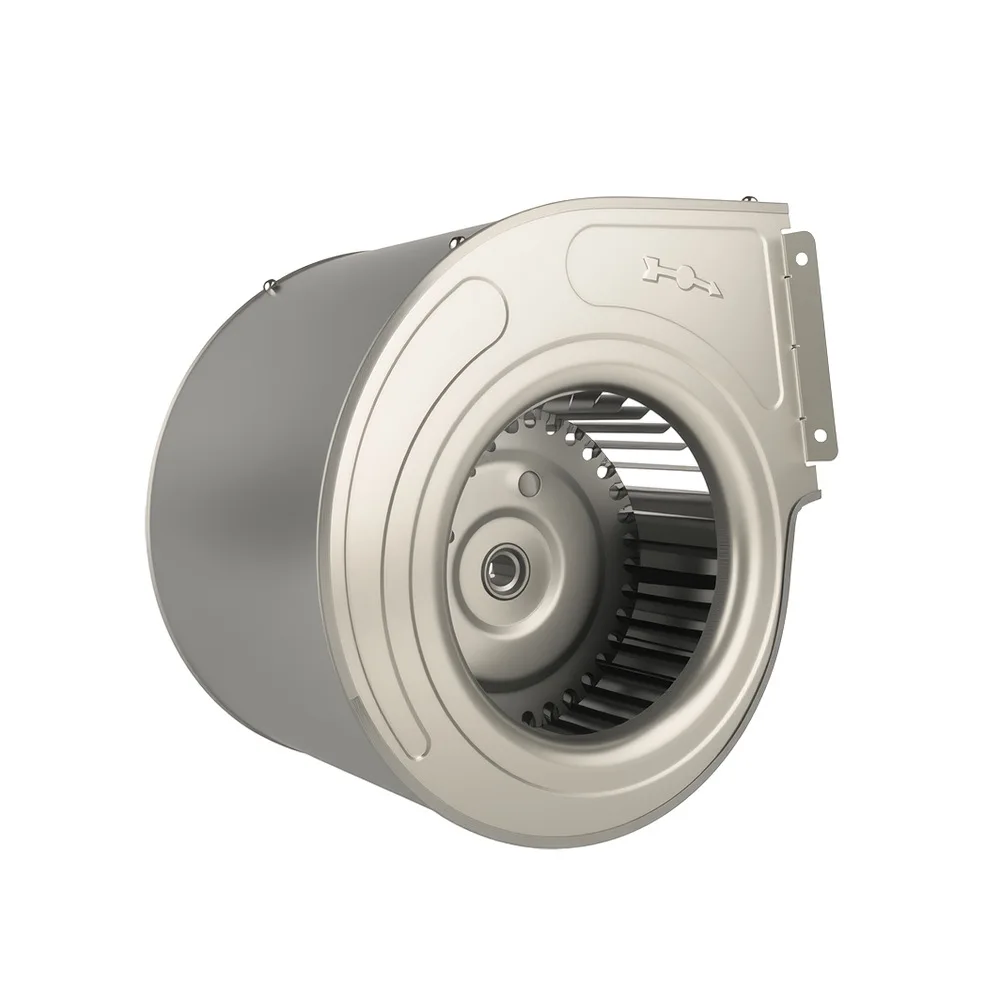
Use the label as a geometry and architecture clue. Do not infer a universal pressure, efficiency, speed or sound advantage from the photograph. Buyers exploring this architecture can review the EC forward fan family, then request the curve and electrical data for the exact returned model suffix.
Backward-curved: open passages with blades swept against rotation
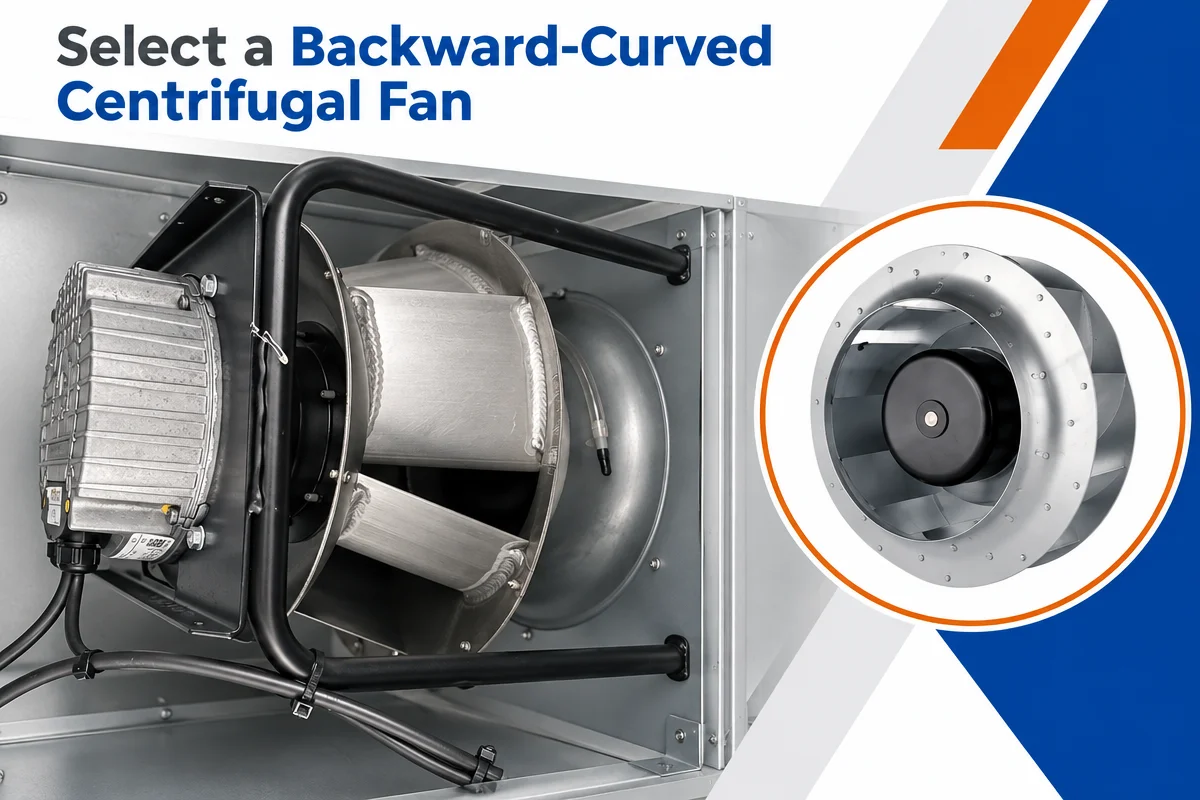
At the outer diameter, a backward-curved blade points against the direction of rotation. The LONGWELL image below shows an open-wheel construction and broad swept passages. It is useful for identifying the physical family; it is not a performance test or a revision-controlled dimensional drawing.
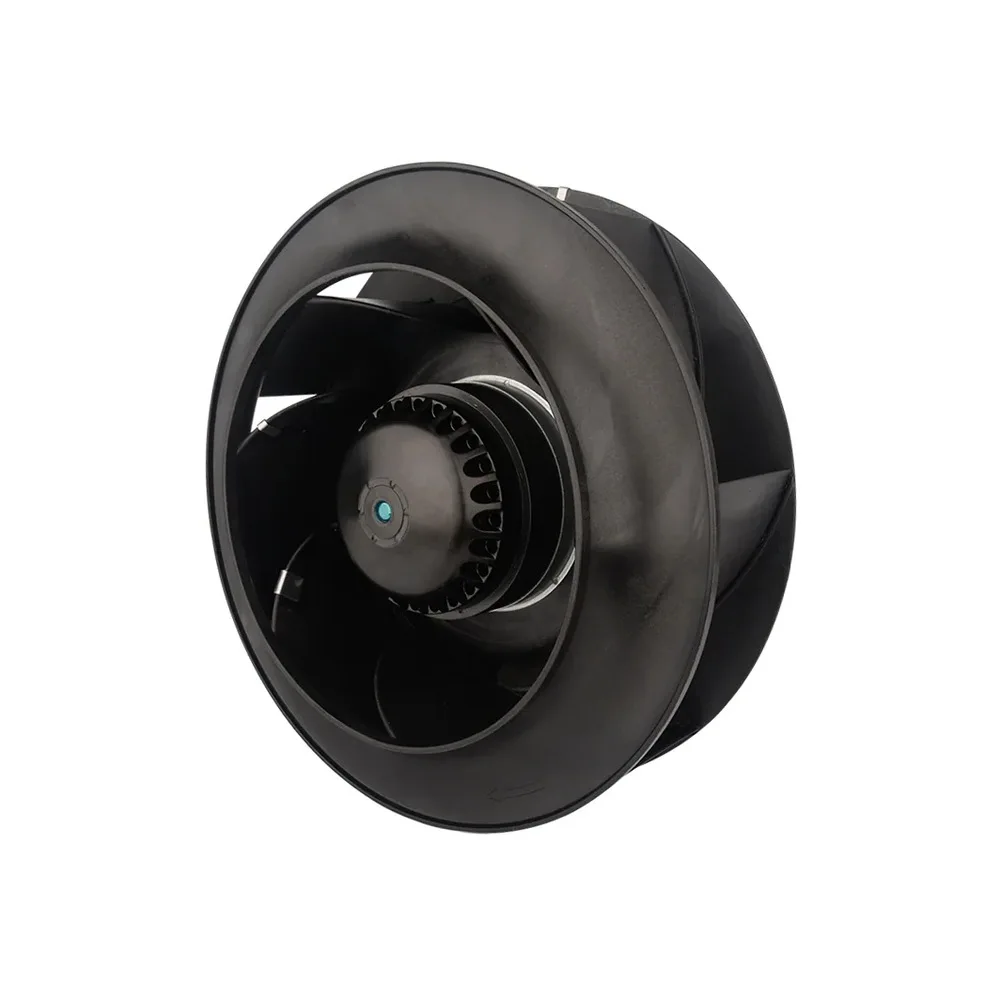
A project already committed to an AC backward-curved architecture can use the AC backward fan family as a browse route. Confirm inlet condition, wheel diameter, motor arrangement, supply, allowable speed, duty point and construction material before treating any two candidates as interchangeable.
Radial: a straight direction, not a photograph we can safely label here
A radial blade points roughly outward at the impeller perimeter. That description is geometric; it does not prove that a wheel is suitable for dust, high pressure, high temperature or any other service. Those decisions still depend on the fan design, material, speed, clearances, system resistance and controlled test data.
A current radial-blade LONGWELL wheel cannot be unambiguously identified from the available product photographs. The cover therefore uses a clearly marked editorial radial diagram. No photographed product has been relabeled to fill the gap.
Airfoil: identify the shaped section and its direction
An airfoil blade has a formed profile rather than a simple flat plate. In the photographed RLM wheel, the large formed blades and their backward-inclined direction are visible. The image establishes that physical structure only; it does not establish a curve, acoustic result, efficiency value or suitability for a particular air-handling unit.
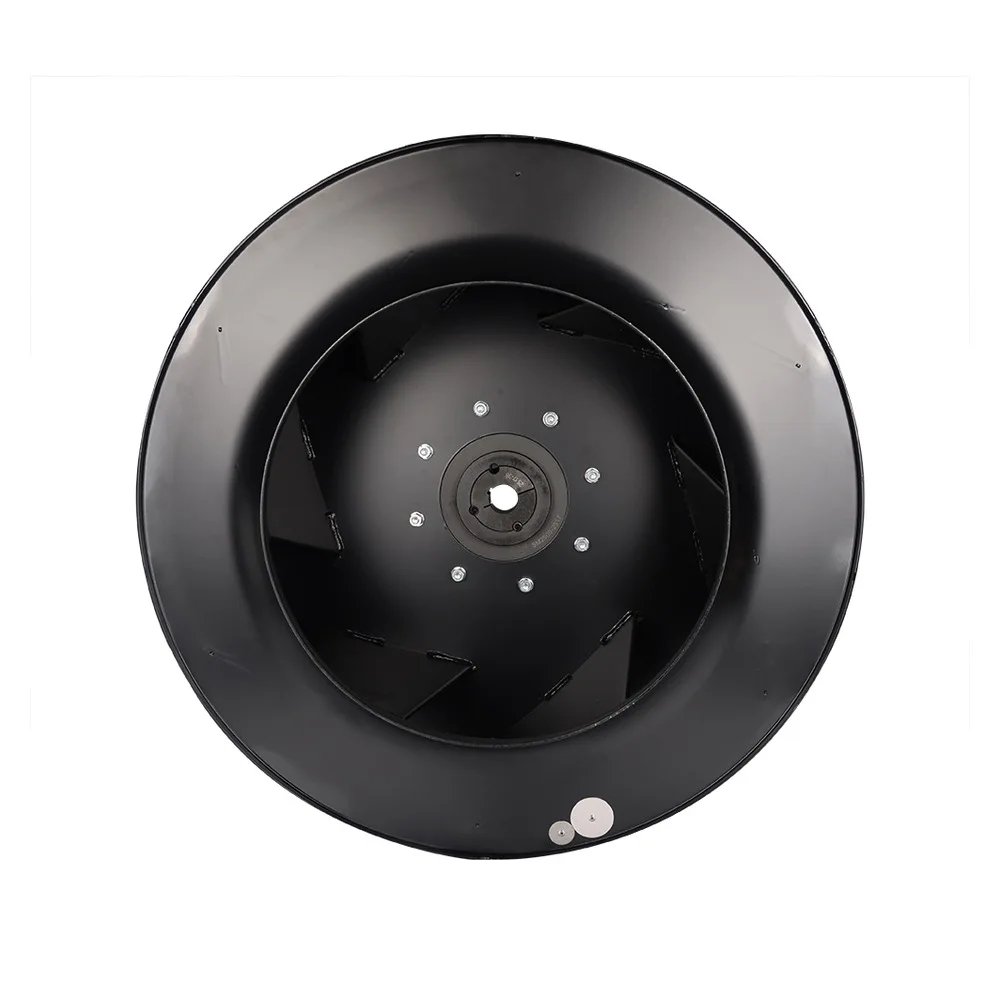
When a quotation says “airfoil,” ask whether the blade is backward-inclined or backward-curved, how the profile is built, and which tested series the curve belongs to. For broader discovery across current architectures, start with the LONGWELL centrifugal fan range, then narrow the request by duty point and construction.
Compare curves at the same duty, not adjectives in a catalogue
Begin with required airflow and static or total pressure. Add air density, temperature, altitude, inlet and outlet constraints, electrical supply, speed-control method, allowable sound and the airstream description. Then compare candidate curves at that same duty point. A tested operating point is more useful than a generic ranking such as “type A is always quieter” or “type B always uses less power.”
Plot the system resistance with the fan curve and check pressure, absorbed power, efficiency and stability around the expected operating region. The centrifugal fan curve guide explains that reading sequence. Installation effects can move real performance away from a catalogue curve, so inlet clearance, elbows, screens and discharge conditions belong in the review.
A short RFQ that produces comparable answers
Send every supplier the same decision inputs:
- required airflow and pressure, with static or total pressure stated clearly;
- air temperature, density or altitude, and any particles, moisture or corrosive content;
- installation envelope, inlet and discharge boundary, and whether a scroll housing is required;
- voltage, phase, frequency, control signal and permissible operating-speed range;
- sound limit, measurement location and acceptance method;
- exact model suffix, drawing revision, curve revision and test basis for the offered assembly.
Ask the supplier to mark the proposed duty point on the controlled curve and return absorbed power, motor margin and allowable operating region. If the evidence refers to another diameter, motor, housing or revision, keep it as a lead rather than treating it as proof.
The practical selection rule
Use blade terminology to understand the object in front of you. Use visible photographs to confirm structure. Use controlled drawings to confirm dimensions. Make the purchase decision from the exact fan curve, system intersection, power and sound evidence for the offered configuration.
That sequence avoids both extremes: choosing from a marketing adjective, or rejecting a valid architecture because two suppliers use overlapping names. Geometry starts the conversation; verified duty-point evidence finishes it.
Choose the right centrifugal fan
Longwell manufactures 1,130 centrifugal fans in-house. Send airflow, static pressure and voltage — an engineer replies with a matching model, performance curve and price within one working day.