Blade-tip clearance is the space between the outer edge of an open-tipped fan blade and its surrounding casing. It is easy to overlook because it is small, yet it joins two different pressure regions at the edge of the rotor. For an axial fan, the useful question is not whether the gap can be made as small as possible. It is whether the complete fan keeps its specified clearance throughout the operating envelope and delivers the required duty without contact.
Where the leakage path begins
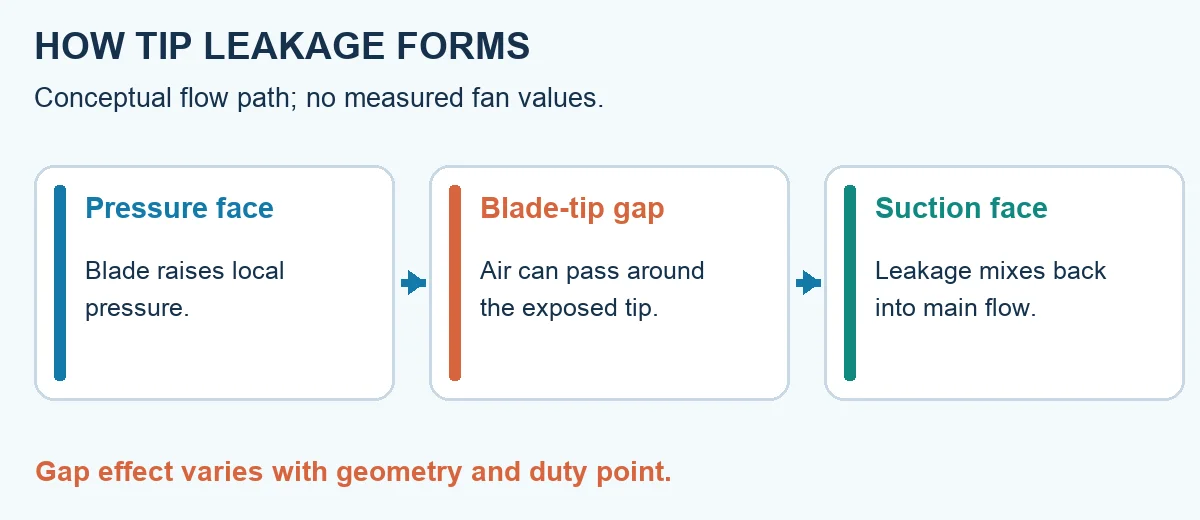
An axial blade creates a pressure difference between its faces. At an exposed tip, some air can cross the gap from the higher-pressure face toward the lower-pressure face instead of contributing to the intended through-flow. The resulting leakage flow can interact with the main stream near the casing. Its effect depends on blade shape, tip geometry, casing, speed, operating point and the size and distribution of the gap. A rotating blade with a visible gap does not, by itself, establish how much performance has changed.
Figure 1 separates the three parts of that path. The colors identify a mechanism, not measured pressure, velocity or a LONGWELL model. For a real selection, compare the exact fan curve and its test configuration with the installed inlet, discharge, guards and casing. Our fan-curve guide explains why a single free-air value cannot stand in for an operating point.
Why a smaller gap is not a stand-alone target
Reducing the tip gap can change leakage, but the direction and size of any full-fan benefit have to be established for the actual geometry and duty. The mechanical boundary matters at the same time. Manufacturing tolerances, casing roundness, shaft or bearing motion, rotor deflection and thermal expansion all affect the minimum running gap. High-temperature axial-fan guidance specifically calls for allowance for thermal growth. A stationary measurement at room temperature therefore cannot prove safe clearance at every running condition.
Do not transfer a clearance from a different diameter, blade family or casing revision. Even a nominally similar replacement wheel may have a different tip profile or mounting position. Use the manufacturer’s current drawing or service procedure for the exact assembly; stop a proposed modification when that evidence is unavailable. Contact marks, damaged blades or a distorted ring require a condition assessment before a performance claim or repair plan.
What a useful clearance inspection records
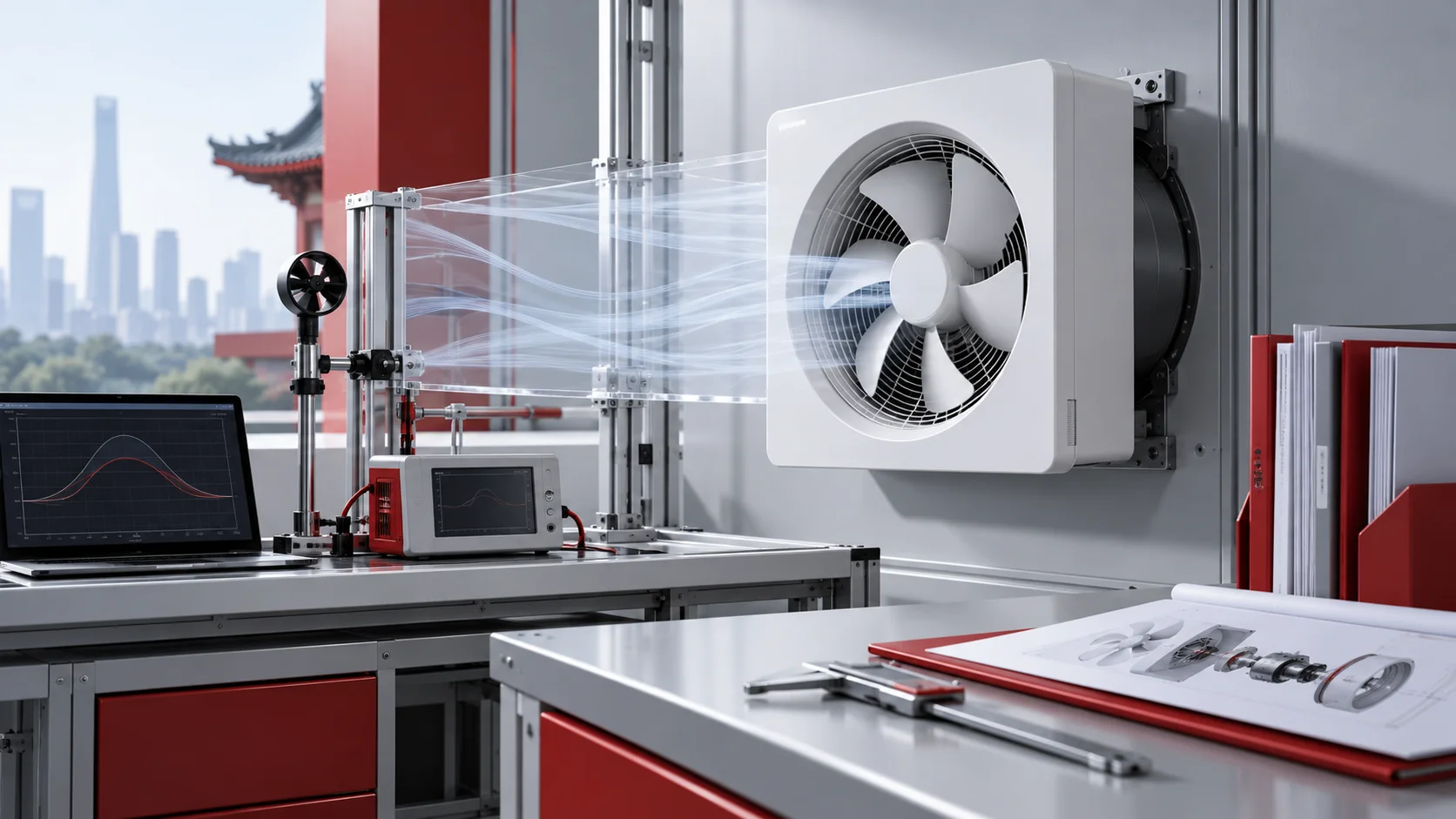
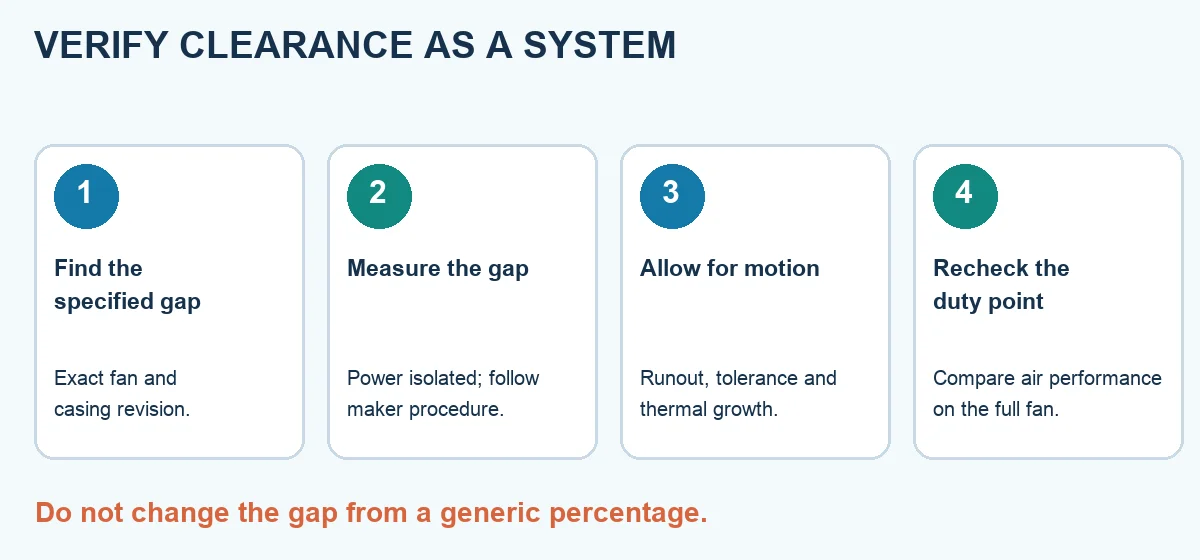
Figure 2 gives the sequence for an engineering review. First identify the exact fan, wheel, casing and revision. With the equipment isolated and according to its service procedure, inspect for rub marks and measure the static gap at several positions around the casing and across blade tips where accessible. Record the method, units, equipment condition and measurement positions so that a later comparison is meaningful. If the housing is not round, a single reading at the easiest point can conceal the limiting gap elsewhere.
Next evaluate what the static inspection cannot see directly: allowed runout, bearing condition, tolerances and thermal or load-induced movement. Use the maker’s limits rather than an assumed safe margin. Finally, if a clearance or component change is proposed, compare the complete fan’s airflow, pressure, power and acoustic requirements against its approved test or commissioning method. The drawing of a LONGWELL EC axial fan family can help identify candidate construction, but a family page does not give a universal blade-tip gap or prove a replacement fit.
Keep blade-tip and inlet gaps separate
An axial blade-tip gap and the inlet overlap of a centrifugal fan are different geometries. Both can create recirculation paths, yet one measurement method or tolerance cannot simply be copied to the other. If the project uses a centrifugal wheel, start with its inlet geometry and the inlet-cone guide instead of applying this axial tip diagram. If the fan is ducted or mixed-flow, confirm where the actual exposed tip and enclosing wall are located before deciding which clearance to inspect.
What to send for a selection or replacement review
Send the fan and equipment model, wheel and casing drawings with revisions, required airflow and pressure at the intended operating point, speed and supply details, ambient and process temperature range, installed inlet and outlet conditions, and any current inspection or test record. State whether the concern is a measured performance change, a contact mark, a replacement proposal or a design clearance question. Those are different decisions and may call for different evidence.
For comparison, LONGWELL AC axial fans and EC axial fans are product-family routes, not evidence that one model fits an unmeasured casing. A defensible recommendation names the exact fan, its curve and drawing revision, the allowable assembled clearance, and the verification procedure for the actual installation.