Direct-on-line (DOL) starting, a soft starter and a variable-frequency drive (VFD) can each start a suitable induction-motor fan. The choice depends on the electrical supply, the fan’s acceleration demand and what the process needs after startup. A large motor rating alone does not select the method.
Begin with a practical question: must the fan change speed during normal operation? Then test whether the proposed start can accelerate the actual motor and fan without unacceptable supply voltage dip, thermal loading or process interruption. The motor nameplate, fan inertia, driven-system duty and the chosen equipment manuals define the project boundaries.
What each starting method changes
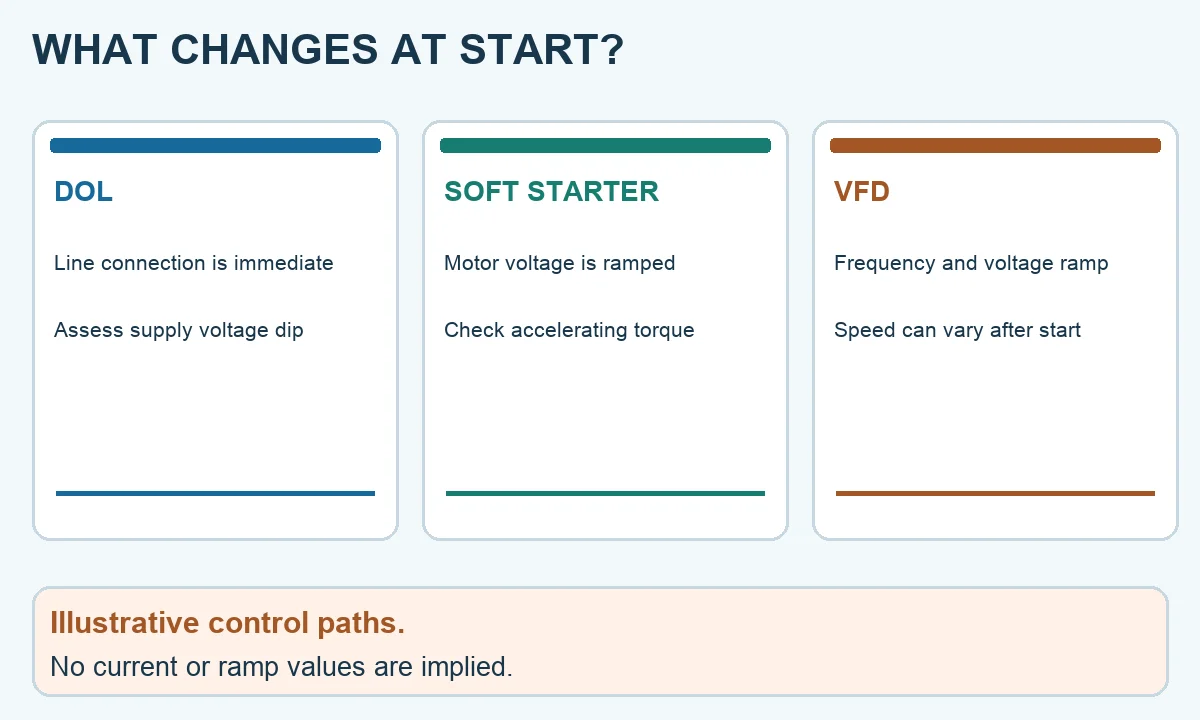
DOL connects the motor to the line through the appropriate switching and protection equipment. The electrical step is immediate. Starting current and voltage dip must be checked against the particular motor and site supply. A soft starter progressively changes the voltage applied during the start. That can reduce the initial current and mechanical disturbance, but reduced voltage also reduces available motor torque. It must still accelerate the fan to running speed within the motor and starter thermal limits.
A VFD changes frequency and voltage while the motor accelerates. Its distinctive value is that it can also control running speed when the fan and process permit it. A soft starter normally serves the start and stop event; whether it is bypassed at speed depends on the selected design. None of these descriptions specifies a universal current multiple or ramp time.
Why a large fan can be hard to accelerate
The wheel and connected drive train have inertia. Starting is complete only when the motor’s available accelerating torque exceeds the fan’s opposing torque across the speed range for long enough to reach the required running point. A current limit set too aggressively on a soft starter can prevent acceleration and increase heating. A long DOL start can hold a high current for longer than the supply or motor design tolerates. The answer comes from the matched motor torque-speed information, fan inertia, loading condition and starter documentation, not from a power-size shortcut.
ABB’s soft-starter handbook discusses fan inertia, voltage dip and acceleration settings, while noting that settings must be checked for the installed load. The US Department of Energy fan-system sourcebook explains why a gradual voltage start may help with starting-current effects and why VFDs add speed-control capability. Neither reference approves a setting for a particular LONGWELL assembly.
When DOL deserves consideration
DOL may be appropriate when the fan runs at one speed, the electrical study accepts its starting voltage dip and current, and the motor, switching gear and mechanical drive tolerate the start frequency and acceleration. A large fan is not automatically excluded. Conversely, a small motor is not automatically safe to start DOL on a weak supply. Check the actual feeder, transformer, protection coordination and other equipment that shares the circuit.
Its simpler control path does not remove the need for overload protection, isolation and a documented commissioning test. If starting is frequent or the fan is belt driven, the drive-train response also deserves attention. Claims such as “DOL is always most reliable” or a fixed kilowatt cutoff would need project evidence that this article does not have.
When a soft starter fits the operating duty
A soft starter is a candidate when the fan runs at essentially fixed speed after startup but its direct start produces an unacceptable electrical or mechanical event. Confirm that its current limit and voltage ramp leave enough torque to accelerate the real load. Review restart frequency, thermal capacity, any bypass arrangement and protective functions in the chosen starter manual. Reducing start current is not the same as reducing the fan’s energy use while it runs at unchanged speed.
Even a well-chosen soft starter cannot substitute for a VFD if the process genuinely needs adjustable airflow during service. Equally, a fixed-speed process does not justify a drive solely because a generic savings percentage appears in a brochure.
When a VFD earns the extra system review
A VFD is worth evaluating when the process varies its airflow demand and the fan, motor and system can safely operate across the intended speed range. Part-load energy can fall in suitable fan systems, but the result depends on the operating hours, duty points, control strategy and system resistance. It is not an automatic percentage saving. Our part-load fan guide explains the duty-point comparison; the final energy case should use measured or defensible operating data.
Drive selection must also address motor insulation and cooling, cable length, electromagnetic effects, bearing-current risk where applicable, harmonics, vibration and any minimum process airflow. These are system questions. A VFD can start gently yet still be a poor fit if the motor or fan has not been approved for the intended speed range.
A release review for the specific fan
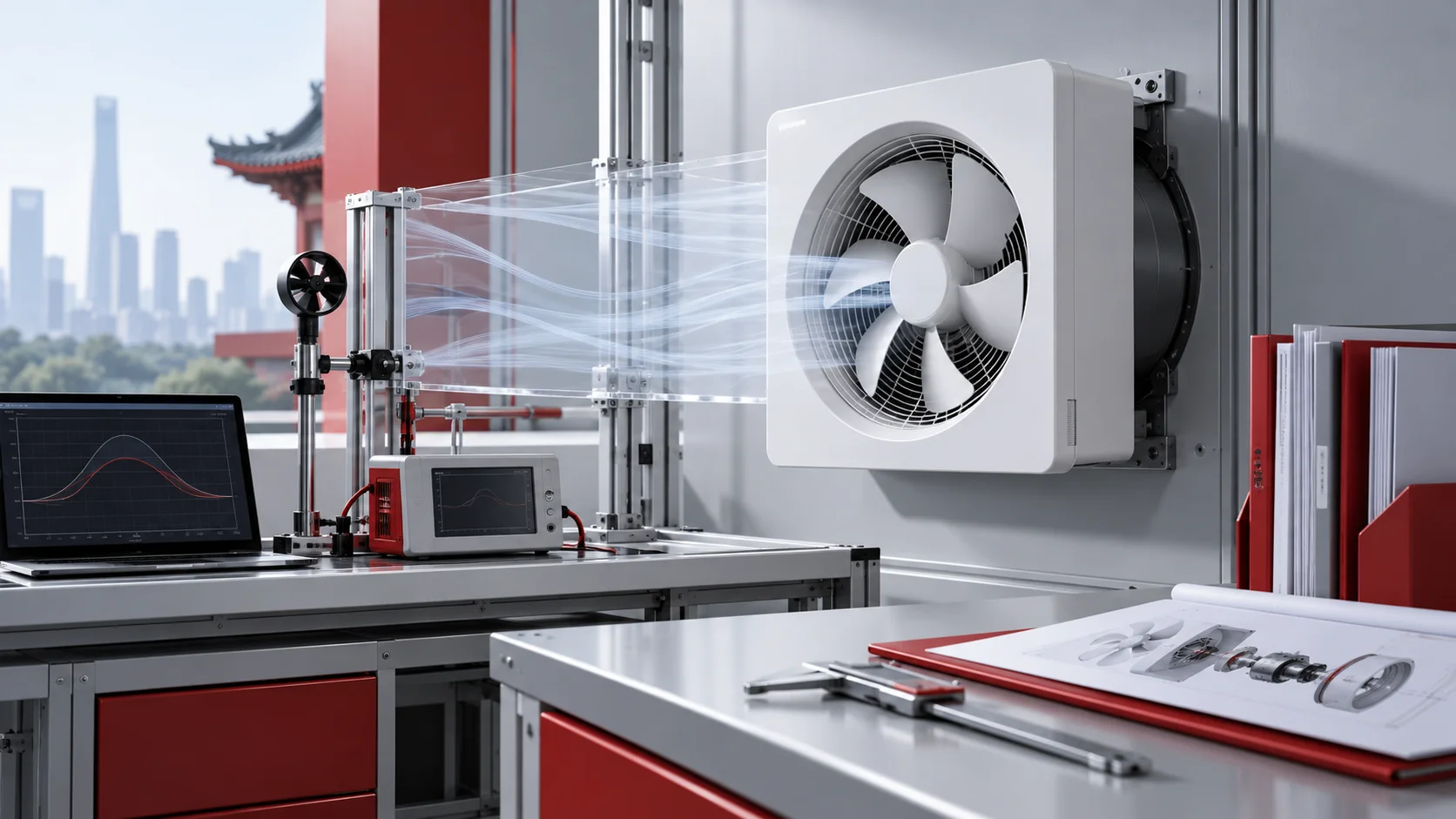
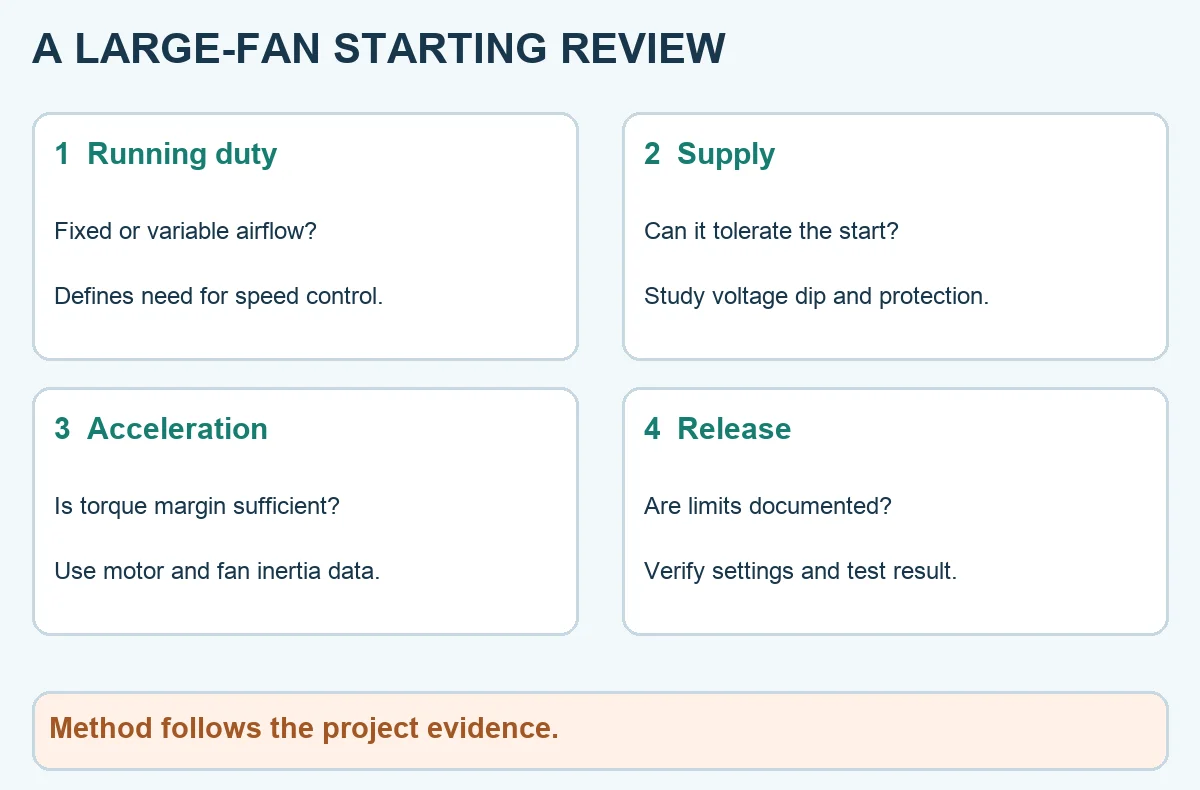
Collect the motor’s exact model and revision, the fan wheel and drive-train data, the supply study, required duty points and start frequency. Compare the motor’s torque-speed information with the fan’s accelerating load. Then confirm protections, starter or drive settings, bypass logic if used, and a commissioning record. The review diagram below keeps these questions in order; it is not a substitute for a qualified electrical design.
LONGWELL’s AC induction-motor family is a product-category starting point, not approval of DOL, a soft starter or a VFD for a particular fan. A LWYE3-132M-4-002 motor drawing, for example, identifies that motor’s geometry and rated electrical data but provides no starting-current curve or permission for a given starter. The specific fan, motor and control revisions must be reviewed together.